

In This Article
Split leather gloves for heavy duty labor are work gloves cut from the fibrous underlayer of a cowhide, the part left once the smooth outer grain is sliced away. That dense, suede-like layer shrugs off abrasion, splinters, and rough surfaces at a lower price than grain leather.

Here’s the plot twist: the “lesser” layer of the hide is often the smarter buy. Grain leather gets the glamour and the higher price tag. Split leather gets the pallet jacks, the rebar tie-wire, the splintery 2x6s, and the loading dock at 6 a.m. For crews who go through gloves the way other people go through coffee, that trade-off makes sense.
The case for wearing gloves at all has real numbers behind it. A NIOSH-indexed case-crossover study of 1,166 hand-injured workers linked glove use to roughly 60-70% lower risk of lacerations and punctures. It found no such benefit for crush injuries, fractures, or avulsions. Gloves are a precise tool for a precise job, not magic.
This guide compares seven real options across budget, mid-range, and premium tiers. It reads the spec sheets so you don’t have to, and it translates every feature into plain English. Along the way you’ll see how heavy duty leather gloves stack up against abrasion resistant work gloves made from synthetics, what rugged job site gloves really need, and what to buy for warehouse loading. Prices are ranges only, so check the current price before you buy.
Quick Comparison: Seven Split Leather Gloves at a Glance
| Product | Leather Type | Price Range | Best For |
|---|---|---|---|
| Custom LeatherCraft 2055 | Split cowhide | Under $15 | Stocking a whole crew cheaply |
| John Deere JD00004 | Split cowhide | Budget tier (check current price) | Tool-heavy general labor |
| Wells Lamont 1132 | Grain cowhide, split palm patch | Roughly $10-$25 | Adjustable-fit all-rounder |
| Wells Lamont HydraHyde 3241 | Split cowhide palm, spandex back | Around $15-$25 | Damp conditions, dexterity |
| Wells Lamont 1080 | Insulated split cowhide | Roughly $17-$30 | Cold docks, winter sites |
| Carhartt Grain-Leather Safety Cuff | Grain palm, suede patches | Low-to-high $20s | Knuckle protection, fast on/off |
| Ironclad Ranchworx RWG2 | Goatskin (premium reference) | Around the mid-$20s | Fencing, lumber, long wear |
Price ranges reflect retail listings seen during research and shift constantly. The table shows a clear pattern. Under $15 buys you the Custom LeatherCraft 2055, which is fine if you accept that it’s a consumable. The low-to-mid $20s is where features start piling up, like adjustable wrists, knuckle guards, and insulation. If your crew lives on a cold loading dock, the Wells Lamont 1080 earns its extra few dollars. If budget is the main constraint, the Custom LeatherCraft 2055 or John Deere JD00004 is where to start.
💬 Just one click — help others make better buying decisions too!😊
Top 7 Split Leather Gloves for Heavy Duty Labor: Expert Analysis
1. Custom LeatherCraft 2055 Split Cowhide Driver Gloves — cheapest way to glove a whole crew
The Custom LeatherCraft 2055 is the glove you buy when you’d rather replace than baby. It’s a classic driver-style pattern in split cowhide with a Gunn-cut palm, which puts the seam on the back of the fingers instead of across the gripping surface. Fewer seams under load means fewer blowouts exactly where you grip.
The spec sheet lists a keystone thumb and a shirred wrist with leather binding. In practice, that elastic gathering keeps debris out without a strap to fiddle with, and the keystone thumb reduces bunching when you wrap a hand around a handle. It’s unlined, so it breathes well in summer but won’t help on a frosty dock. Based on the construction, it suits light-to-moderate material handling, hauling lumber, and general cleanup rather than sustained demolition.
Review sentiment is mixed. One major retailer lists a middling average, and a leather-glove roundup calls it inexpensive with enough thickness to protect without wrecking dexterity. Treat it as a value pick rather than a forever pick.
Pros:
- ✅ Very low cost per pair
- ✅ Gunn cut keeps seams off the grip
- ✅ Shirred wrist blocks debris without fuss
Cons:
- ❌ Unlined, so no cold-weather help
- ❌ Mixed reviews on consistency
Price range: under $15. Verdict: excellent for bulk buying, ordinary for anything punishing.

2. John Deere JD00004 Leather Work Gloves — reinforced thumb saddle for tool-heavy days
The John Deere JD00004 puts its extra material where tool users actually wear gloves out: the thumb. A thumb saddle patch is the leather equivalent of reinforcing the knees on kids’ jeans. If you pinch wrenches, pry bars, and fence staples all day, that spot goes first.
It’s built from split cowhide, and a 2026 durability roundup describes it as a traditional heavy-duty option for construction sites, farms, workshops, and landscaping. The reasoning checks out. Split cowhide’s dense underside fibers resist abrasion and rough surfaces well, and the glove stays flexible enough for extended wear. What the spec sheet doesn’t tell you is cut or puncture performance, and no ANSI ratings surfaced in my research. For jobs with exposed sharps, add a rated glove or liner.
On review sentiment, I couldn’t verify a deep pool of independent buyer reviews, so I won’t characterize them. The glove’s reputation rests mostly on its design and brand, not published testing.
Pros:
- ✅ Reinforced thumb saddle where wear concentrates
- ✅ Split cowhide handles abrasive materials
- ✅ Suits construction, farm, and shop use
Cons:
- ❌ No published cut or puncture rating found
- ❌ Limited verifiable review data
Price range: budget tier, so check current price. Verdict: a sensible value choice for tool-heavy general labor.
3. Wells Lamont 1132 Leather Work Gloves — adjustable wrist, grain-leather comfort
The Wells Lamont 1132 is a useful curveball in a split-leather roundup, and I’m including it for that reason. Its body is grain cowhide, while the reinforced palm patch is split cowhide. That hybrid shows you what each layer does best: grain for comfort and suppleness, split where the abrasion hits.
Listings describe a Gunn cut, a keystone thumb, leather-bound edges, and a ball-and-tape wrist closure. That last detail matters more than it sounds. An adjustable closure lets you cinch the glove against slipping off when you’re pulling heavy loads, something slip-on elastic wrists can’t match. A medium weighs about 4.8 ounces, so it’s not a brick on your hand.
Reviewers consistently praise the value and the soft feel, with some calling it a long-time favorite. Common complaints include thumbs running long, sizing that runs snug, and leather wearing through the fingertips if it gets wet repeatedly. Break-in time seems to be part of the deal.
Pros:
- ✅ Ball-and-tape closure for a secure fit
- ✅ Leather-bound edges extend seam life
- ✅ Soft grain leather improves comfort
Cons:
- ❌ Fingertips reportedly wear faster when wet
- ❌ Fit can run snug, so size carefully
Price range: roughly $10-$25 depending on pack size and seller. Verdict: strong value if you keep it dry and size up when in doubt.
4. Wells Lamont HydraHyde 3241 Leather Palm Hybrid Gloves — water-resistant split palm, stretchy back
The Wells Lamont HydraHyde 3241 solves a problem that plain split leather has: it hates getting soaked. The palm is 100% split cowhide treated with HydraHyde, a tanning process the maker says makes it water-resistant and breathable. The back of the hand is spandex, which stretches instead of fighting your knuckles.
That hybrid layout is the point. The palm is where abrasion lives, so it gets the heavy leather. The back is where flexibility lives, so it gets the stretch. The elastic slip-on wrist makes it quick to pull on between tasks, and cowhide-reinforced fingertips protect the first spots to fray. Based on the spec comparison, this is the better choice for work needing frequent grip changes, like stacking, sorting, or handling small hardware.
Review sentiment for HydraHyde slip-ons is generally warm. One contractor-focused roundup lists a HydraHyde slip-on at a 4.6-star average on its retail listing. Check that you’re looking at the same style number before assuming parity.
Pros:
- ✅ Water-resistant, breathable split palm
- ✅ Stretch back improves flexibility
- ✅ Reinforced fingertips resist early fraying
Cons:
- ❌ Spandex back offers less protection
- ❌ Elastic wrist gives no adjustability
Price range: around $15-$25. Verdict: a smart middle path when dexterity and moisture both matter.
5. Wells Lamont 1080 Insulated Split Cowhide Gloves — warmth for cold docks
The Wells Lamont 1080 answers the question every winter warehouse crew eventually asks: why are my fingers numb? Retail listings for Wells Lamont’s insulated split cowhide work gloves describe a split cowhide palm with reinforced palm, fingertips, and knuckles. They also list a safety cuff, a fleece lining, and 100-gram Thermofill insulation. Confirm the exact model on the listing, since similar insulated styles share many details.
The insulation deserves a practical note. Insulated gloves trade dexterity for warmth, so you’ll feel less when picking up small items. For loading trucks and moving freight in cold air, that’s a fair trade. The safety cuff slides on quickly, which matters when you pull gloves on and off repeatedly. The shirred wrist back keeps drafts and debris out.
A major retailer shows dozens of reviews for the 1080L size, but I couldn’t confirm the average rating or recurring themes. If reviews matter to you, read the current listing before ordering.
Pros:
- ✅ Thermofill insulation and fleece lining
- ✅ Reinforced palm, fingertips, and knuckles
- ✅ Safety cuff speeds on and off
Cons:
- ❌ Reduced dexterity for fine work
- ❌ Too warm for mild or summer days
Price range: roughly $17-$30. Verdict: worth it for cold-weather crews, wasted money in a warm shop.

6. Carhartt Grain-Leather Safety Cuff Work Glove — knuckle guards, easy-off cuff
The Carhartt Grain-Leather Safety Cuff Work Glove is the most “built” glove on this list. It combines cotton duck fabric with a cowhide grain palm, suede cowhide patches over the palm, and cowhide knuckle protectors. Like the Wells Lamont 1132, it mixes grain and split, but here the split suede patches target the abrasion zones.
The knuckle guards are the standout. Knuckles take more punishment on a job site than people expect, from scraping on block walls to catching on pallet corners. The safety cuff speeds removal, and the cotton duck shell adds durability while keeping the glove lighter than all-leather designs. Based on the construction, it suits framing, masonry assistance, and material handling.
Carhartt’s insulated sibling shows a 4.5-star average on the brand’s site, with buyers citing warmth and durability. For this uninsulated model, I found only limited review data, so sentiment is hard to generalize.
Pros:
- ✅ Cowhide knuckle protectors
- ✅ Suede palm patches cover wear zones
- ✅ Safety cuff for fast removal
Cons:
- ❌ Costs more than basic driver gloves
- ❌ Limited review data for this version
Price range: low-to-high $20s depending on seller. Verdict: a solid upgrade if knuckle scrapes are your daily reality.
7. Ironclad Ranchworx RWG2 Leather Work Gloves — goatskin step-up for premium budgets
I’m including the Ironclad Ranchworx RWG2 as a premium reference point, not a split-leather pick. It’s goatskin, which reviewers and manufacturers often rank as the most heavy-duty of the common glove leathers. Seeing it next to split cowhide shows what extra money buys.
A contractor roundup names it the best leather glove in its lineup for fencing, splitting wood, ranch chores, and heavy lumber. Listings also mention rolled fingertips, Kevlar reinforcements, a cuff puller, and a sweat wipe, though features vary by listing. Goatskin tends to stay supple and flexible, so you give up less dexterity than with thick split cowhide. The roundup rates it 4.6 stars on its retail listing.
The catch is cost. If you’re gloving a crew, the price difference multiplies fast, and split cowhide remains the practical bulk choice.
Pros:
- ✅ Goatskin stays supple and strong
- ✅ Extra reinforcements reported on listings
- ✅ Roundup rates it highly for rough work
Cons:
- ❌ Costs more than split cowhide options
- ❌ Not a split leather glove
Price range: around the mid-$20s. Verdict: worth it for a single worker who wears gloves daily, overkill for a bulk crew order.
Top 7 Compared: Specs That Change the Buying Decision
| Product | Palm Material | Wrist / Cuff | Standout Reinforcement | Best For |
|---|---|---|---|---|
| Custom LeatherCraft 2055 | Split cowhide | Shirred, leather-bound | Gunn-cut palm | Bulk crew orders |
| John Deere JD00004 | Split cowhide | Not specified | Thumb saddle | Tool-heavy labor |
| Wells Lamont 1132 | Grain cowhide | Ball-and-tape closure | Split palm patch | Adjustable fit |
| Wells Lamont HydraHyde 3241 | Split cowhide | Elastic slip-on | Reinforced fingertips | Damp, dexterous work |
| Wells Lamont 1080 | Split cowhide | Safety cuff | Palm, fingertip, knuckle | Cold docks |
| Carhartt Grain-Leather Safety Cuff | Grain cowhide | Safety cuff | Knuckle protectors | Knuckle-scrape jobs |
| Ironclad Ranchworx RWG2 | Goatskin | Varies by listing | Kevlar (per listings) | Premium durability |
Looking at the comparison above, the Wells Lamont 1132 and Carhartt Grain-Leather Safety Cuff blend grain comfort with split durability, while the Custom LeatherCraft 2055 is pure split. The Wells Lamont HydraHyde 3241 suits anyone who struggles with stiff leather, and the Wells Lamont 1080 is purpose-built for cold. The right glove depends mostly on your hazard and your climate, not on brand loyalty.
✨ Don’t Miss These Exclusive Deals!
🔍 Take your search for split leather gloves for heavy duty labor to the next level with these carefully selected options. Click on any highlighted item to check current pricing and availability. These gloves will help you build a safer, more comfortable work
routine your hands will thank you for!
How to Choose Split Leather Gloves for Heavy Duty Labor
Choosing well comes down to a short list of decisions. MSC Direct’s leather-glove guide breaks the process into similar steps.
- Identify your main hazard. Abrasion and splinters point toward split cowhide. Cuts and punctures from sharp metal call for rated gloves or liners.
- Check which split you’re getting. Side split comes from the rib area and is the best of the splits. Shoulder split is less durable, and belly split is the cheapest and least consistent.
- Match the closure to the task. Adjustable wrists stay put under load. Elastic slip-ons are faster. Safety cuffs make removal easy.
- Pick the thumb style. A keystone thumb reduces bunching, while reinforced saddles outlast plain thumbs for tool users.
- Decide on lining. Unlined for warm shops, insulated for cold docks.
- Size honestly. Snug gloves wear out at the seams, and loose gloves snag and slip.
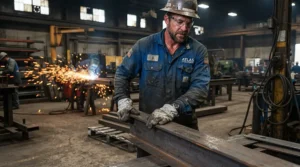
Split Leather vs Full Grain: What the Difference Really Means
Split and grain leather come from different layers of the same hide. The grain layer is the outer surface with tight, interwoven fibers. Split leather comes from the looser underlayer after the grain is separated. One glove maker’s guide notes that grain leather lasts longer, and MSC advises choosing grain gloves when longevity is the top priority.
So why would heavy-duty crews choose split? Because abrasion resistance, heat tolerance, and price all lean in split’s favor for rough work, even if the leather isn’t as strong fiber for fiber. A thick split palm is also less likely to feel precious. You won’t flinch when it drags across concrete.
| Option | Strength | Weakness | Best For |
|---|---|---|---|
| Split cowhide | Abrasion, low cost | Less supple, shorter life | Rough, high-volume labor |
| Grain cowhide | Comfort, longevity | Higher price | Daily wear, mixed tasks |
| Goatskin | Flexible and tough | Premium cost | Long-wear, skilled work |
| Synthetic palms | Light, washable | Less rugged on rough surfaces | Light-duty assembly |
In plain terms, split cowhide wins on price-per-abrasion. Grain wins on comfort and often on lifespan, and goatskin wins when you want both and can pay. Hybrids like the Wells Lamont 1132 and Carhartt Grain-Leather Safety Cuff try to split the difference.
Features That Actually Matter (And Those That Don’t)
A glove’s marketing copy shouts about “premium” and “pro-grade.” Ignore that and look at the features that change how long it lasts.
Abrasion resistant work gloves: what the ratings mean
The ANSI/ISEA 105-2024 standard rates gloves for abrasion, cut, and puncture resistance. The 2024 edition introduced a pentagon pictogram that displays all three ratings together. A glove rated abrasion Level 3 survives at least 1,000 test cycles, while puncture Level 2 resists 20 to 59 newtons of force. Cut ratings run A1 to A9.
Here’s the nuance. Higher isn’t always better. Ansell notes that using a top-rated cut glove in warehousing adds bulk and slows work. Mid-range abrasion levels fit pallet handling and construction well. Many budget leather gloves publish no ratings at all, so treat unrated claims like “abrasion resistant” as marketing until backed by a test level.
Features worth paying for
- Reinforced palm patches and fingertips, where leather fails first
- Leather-bound edges and double stitching
- A closure that suits your task
Features you can skip
- Touchscreen patches on gloves meant for rough work
- Fancy colors, which show dirt and add nothing to protection
Rugged Job Site Gloves: Matching the Glove to the Trade
Rugged job site gloves take different abuse depending on your trade.
Framing and carpentry punish the thumb and fingertips. The John Deere JD00004 with its thumb saddle and the Carhartt Grain-Leather Safety Cuff with knuckle guards make sense here.
Masonry and landscaping mean constant abrasion and moisture. The Wells Lamont HydraHyde 3241 handles damp material better than plain split leather.
Fencing and lumber reward sturdy palms and secure closures, which is where the Wells Lamont 1132 and the Ironclad Ranchworx RWG2 fit.
Warehouse loading: what changes
Warehouse loading is about repetition. You’re gripping cardboard edges, strapping, pallet wrap, and metal racking hundreds of times a shift. Lightweight comfort matters more than armor, and a cheap glove like the Custom LeatherCraft 2055 can make sense, since pallets chew gloves up. Cold docks change the answer, and the Wells Lamont 1080 becomes the logical pick.
What to Expect: Real-World Performance
Specs describe a glove. They don’t describe your Tuesday. Based on construction details and reviewer themes, a few patterns hold across these gloves.
New split leather feels stiff, sometimes boardlike. It loosens within days of regular use, and reviewers of the Wells Lamont 1132 specifically describe a break-in period. Gloves with spandex backs like the Wells Lamont HydraHyde 3241 skip most of that stiffness.
Leather also changes when it gets wet. Reviewers note that fingertips can wear faster after repeated soaking, and that dried leather can harden. Water-resistant treatments help, but they aren’t waterproofing.
Finally, expect the palm to go before anything else. Palms thin out gradually, and the moment you can see light through the leather, the glove has stopped protecting you.
Heavy Duty Leather Gloves: Long-Term Cost & Maintenance
Price per pair is the wrong metric. Price per week of use is the right one.
Here’s illustrative math, not a measured result. Suppose a roughly $10 pair lasts three weeks of daily abuse, while a roughly $25 pair lasts three months. The cheap pair costs more per week of use, though both figures depend heavily on your job. The reverse can also be true on light-duty work.
| Product | Price Range | Value Verdict |
|---|---|---|
| Custom LeatherCraft 2055 | Under $15 | Best for disposable-tier use |
| John Deere JD00004 | Budget tier | Reasonable general value |
| Wells Lamont 1132 | Roughly $10-$25 | Strong value if kept dry |
| Wells Lamont HydraHyde 3241 | Around $15-$25 | Good for damp work |
| Wells Lamont 1080 | Roughly $17-$30 | Worth it only in the cold |
| Carhartt Grain-Leather Safety Cuff | Low-to-high $20s | Good for knuckle protection |
| Ironclad Ranchworx RWG2 | Mid-$20s | Premium durability pick |
The table reveals that pricing across these gloves sits in a tight band, so features should drive the decision. Crews that buy in bulk should lean toward the Custom LeatherCraft 2055, while solo workers who wear gloves daily often come out ahead with sturdier options. Remember that replacement frequency, not sticker price, determines your real cost.

Common Mistakes When Buying Heavy Duty Leather Gloves
The most common mistake is buying on brand alone. A recognizable name doesn’t guarantee the right leather, closure, or fit for your job.
Another is ignoring the wrong-glove-for-the-hazard problem. Split cowhide resists abrasion well, but that doesn’t make it cut-proof. If sharp metal is part of your day, look for a rated cut or puncture glove.
People also buy too big. Loose gloves snag and slip, and extra material bunches under grip. A glove that’s snug in the palm and fingers wears better.
Lastly, many buyers forget that gloves can be a hazard near moving machinery. A NIOSH mining analysis found that when gloves were identified in injury reports, they contributed to a fifth of the injuries. Gloves protect hands, but they can also catch.
Safety, Regulations, and Compliance for Hand Protection
If you manage a crew, there’s a compliance angle. Under OSHA’s hand protection standard, employers must select and require appropriate hand protection when hands face hazards such as severe cuts, severe abrasions, punctures, thermal burns, or temperature extremes. Selection must be based on an evaluation of the task, the conditions, the duration of use, and the hazards identified.
In plain English, “we bought leather gloves” isn’t a hazard assessment. Document what the task involves and match the glove to it. Keep in mind that ANSI/ISEA 105 doesn’t cover welding, so welding gloves need their own rating. Standard split leather work gloves aren’t a substitute.
Practical Guide: Breaking In and Caring for Split Leather Gloves
A little care stretches glove life noticeably, and it costs almost nothing.
Week one:
- Wear them for lighter tasks first so the leather conforms gradually.
- Skip heavy soaking while the leather is still stiff.
Maintenance routine:
- Air-dry wet gloves away from heaters, since fast heat tends to harden leather.
- Brush off dirt and grit, which acts like sandpaper inside the weave.
- Check the care label before washing. Some HydraHyde gloves are listed as machine washable, but many leather gloves are not.
- Rotate two pairs if you wear gloves daily, so each dries fully.
Common first-30-day mistakes:
- Wearing a damp pair repeatedly
- Ignoring a loose seam until it unravels
- Using gloves near rotating tools
- Leaving gloves on a dashboard or radiator
Some reviewers report conditioning leather gloves with oil to restore softness. Results vary by leather type, so test on a small area first. When the palm thins to the point you can see light through it, retire the pair.
Real-World Scenarios: Warehouse Loading, Framing, and Fencing
Specs make more sense with faces attached. These are illustrative buyer profiles, not testimonials.
The dock associate. Eight-hour shifts, cardboard, strapping, and a cold dock door in January. Reasoning: pick the Wells Lamont 1080 for the winter months and a Custom LeatherCraft 2055 for the warm season. Budget: around $15-$30 per pair. Frequency: daily.
The framing carpenter. Constant lumber handling, tool use, and edge scrapes. Reasoning: the John Deere JD00004 thumb saddle protects against tool wear, and the Carhartt Grain-Leather Safety Cuff guards knuckles. Budget: low-to-mid $20s. Frequency: five days a week.
The fence builder. Posts, wire, and mud. Reasoning: the Wells Lamont 1132 gives an adjustable fit, while the Ironclad Ranchworx RWG2 offers premium goatskin for long wear. Budget: $10 to mid-$20s. Frequency: heavy seasonal use.
Across all three, the common thread is matching the glove to the dominant hazard rather than buying one pair for everything.

FAQ
❓ How long do split leather gloves for heavy duty labor last?
❓ Can split leather work gloves get wet?
❓ Do heavy duty leather gloves protect against cuts?
❓ What size rugged job site gloves should I order?
❓ Are abrasion resistant work gloves necessary for warehouse loading?
Conclusion
Split leather gloves for heavy duty labor aren’t glamorous, and that’s precisely why they work. The underlayer of a cowhide gives you abrasion resistance and rough-surface toughness at prices that make bulk buying possible. The trade-off is less supple feel and, generally, a shorter life than grain leather or goatskin.
If you want the shortest answer: the Custom LeatherCraft 2055 is the budget workhorse, the John Deere JD00004 is the tool-user’s choice, and the Wells Lamont HydraHyde 3241 handles damp, dexterity-heavy work. The Wells Lamont 1132 offers adjustable fit, the Wells Lamont 1080 keeps cold docks bearable, and the Carhartt Grain-Leather Safety Cuff guards your knuckles. The Ironclad Ranchworx RWG2 shows what a premium step up looks like.
Match the glove to your hazard, size it honestly, care for it, and replace it when the palm thins. Do those four things and your hands will outlast every pair you buy.
✨ Ready to upgrade your hand protection?
🔍 Click on any highlighted product above to check current pricing and availability. The right pair of heavy duty leather gloves is a small investment that keeps you working, safely, all season long!
Recommended for You
- Elkskin Gloves For Ranch And Farm Work: 7 Tough Picks For 2026
- Deerskin Work Gloves For Cold Weather: 7 Proven Picks (2026)
- Goatskin Vs Pigskin Work Gloves For Dexterity: 7 Best Picks 2026
Disclaimer: This article contains affiliate links. As an Amazon Associate, I earn from qualifying purchases. If you purchase products through these links, we may earn a small commission at no additional cost to you.
✨ Found this helpful? Share it with your friends! 💬🤗
