
In This Article
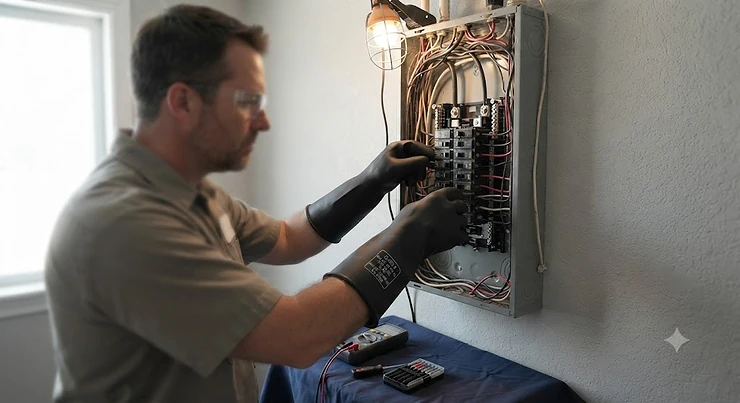
There’s a specific kind of quiet that settles over a job site right before someone opens a live panel. That’s the moment class 0 rubber insulating gloves earn their keep. Rated for work up to 1,000 volts AC, these gloves sit right in the sweet spot for most utility, industrial, and commercial electrical tasks — high enough voltage to matter, common enough that nearly every qualified electrician owns a pair. They’re not glamorous. Nobody posts a glove unboxing video. But the rubber compound, the wall thickness, and the dielectric testing behind each pair are the only things standing between a technician’s hand and a fault current that doesn’t care how experienced you are.
This guide breaks down seven real, currently available class 0 rubber insulating gloves, compares them head-to-head, and — just as importantly — explains the regulatory backbone behind them: OSHA’s 1910.137 standard on electrical protective equipment, the ASTM D120 classification system, and NFPA 70E’s role in shaping how employers build a glove program in the first place. Whether you’re outfitting a five-person maintenance crew or replacing a single worn-out pair, you’ll walk away knowing exactly what “Class 0” means, what to check before you buy, and which of these seven options fits your actual job — not just the marketing copy on the listing page.
Quick Comparison Table
| Glove | Max Working Voltage | Style | Best For |
|---|---|---|---|
| Salisbury by Honeywell E011B | 1,000V AC | 11″ straight cuff, black | All-around everyday use |
| Salisbury by Honeywell E011R | 1,000V AC | 11″ straight cuff, red | High-visibility crews |
| Salisbury by Honeywell E014B | 1,000V AC | 14″ extended cuff, black | Deep panel/reach work |
| Salisbury GK011B9 Kit | 1,000V AC | 11″ kit with protector + bag | First-time buyers wanting a complete set |
| Enespro Class 0 Insulated Gloves Kit | 1,000V AC / 1,500V DC | 11″ kit, multi-color | Utility and power crews |
| Enespro Class 0 Premium Kit | 1,000V AC / 1,500V DC | 11″ premium kit | Linemen wanting a heavier-duty bundle |
| Salisbury E011BL (EPDM) | 1,000V AC | 11″ synthetic rubber, blue | Ozone/chemical-exposed environments |
Look at that table long enough and a pattern jumps out: every single one caps out around 1,000 volts AC, because that’s the literal definition of Class 0 under ASTM D120 — the number in the name isn’t a marketing flourish, it’s a regulatory ceiling. What actually separates these seven is everything around the rubber: cuff length, whether leather protectors and a storage bag ship in the box, and the base polymer (natural rubber versus EPDM synthetic). Buyers doing quick panel work in dry conditions can lean on the shorter, more dexterous 11-inch gloves, while anyone reaching deep into cluttered gear or working outdoors in ozone-heavy air should weight their decision toward the 14-inch or EPDM options below.
Ready to compare specs side by side? Scroll down for the full breakdown of all 7 gloves — including pricing ranges and honest pros and cons for each.
Top 7 Class 0 Rubber Insulating Gloves: Expert Analysis
1. Salisbury by Honeywell E011B — the industry-standard workhorse
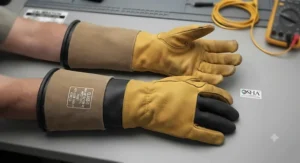
If you asked ten electricians to picture a “rubber insulating glove,” most would picture something close to the Salisbury by Honeywell E011B. It’s an 11-inch, black, Type I natural rubber glove built specifically to the Class 0 spec. Rated to 1,000 volts AC when paired with leather protectors, the glove is manufactured and tested to ASTM D120, and the reinforced rolled cuff is there for a reason — it’s the part most prone to nicks during repeated don/doff cycles, so Salisbury thickened it rather than leaving it as an afterthought. In practice, that rolled edge means the glove holds its shape better after months of daily use instead of curling or cracking at the wrist first.
This is the glove most crews reach for by default, and the “why” comes down to balance: it’s flexible enough for tool handling and connector work, yet durable enough to survive a full utility shift. Based on the spec sheet and aggregated buyer feedback, it suits journeyman electricians, maintenance techs, and anyone who needs one dependable pair rather than a specialty variant. Reviewers consistently mention that sizing runs true if you measure palm circumference carefully first, and that the black finish hides surface grime better than lighter colors — a small thing, but useful for daily inspection since dirt is easier to wipe off than it is to see under.
Pros:
- ✅ True-to-spec ASTM D120 Class 0 certification
- ✅ Reinforced cuff resists wear at the most common failure point
- ✅ Widely stocked, so replacement sizing is rarely an issue
Cons:
- ❌ Sold as glove only — leather protectors purchased separately
- ❌ Natural rubber degrades faster under UV/ozone than EPDM alternatives
Pricing on the Salisbury by Honeywell E011B typically runs in the $85-$100 range per pair; check current price at the time of purchase since dielectric-rated PPE pricing shifts with raw rubber costs. For a single dependable, no-frills Class 0 glove, it’s hard to argue with the value here.

2. Salisbury by Honeywell E011R — same rating, built for visual identification
The Salisbury by Honeywell E011R is functionally identical to its black sibling — same 11-inch length, same Class 0 rating to 1,000 volts AC, same ASTM D120 compliance — with one deliberate difference: it’s red. That sounds cosmetic until you’ve worked on a crew running a color-coded testing calendar, where the glove’s shade tells a supervisor at a glance which six-month test window it’s currently in.
What most buyers overlook about color-coded gloves is that the color isn’t just organizational — it’s a safety control. OSHA already requires periodic testing every six months, and a mixed-color inventory makes it dramatically easier to spot a glove that’s aged out of its window before someone grabs it for a live-front job. Reviewers who manage larger glove inventories specifically call out the red/black alternating system as the reason they stock both colors rather than picking one and moving on. For a solo electrician, the color choice is mostly preference; for a facility running dozens of pairs across multiple techs, it’s closer to a genuine operational safeguard.
Pros:
- ✅ Identical Class 0 protection to the black version
- ✅ Supports a two-color testing-interval rotation system
- ✅ High visibility inside dark panels or bags
Cons:
- ❌ No functional advantage over black for solo users
- ❌ Red dye can show wear patterns more visibly than black
Expect a similar $85-$100 range for the Salisbury by Honeywell E011R, with pricing tracking almost exactly with the black variant since the underlying glove is the same.
3. Salisbury by Honeywell E014B — extended-cuff reach for deep panel work
Cuff length quietly matters more than most buyers assume, and the Salisbury by Honeywell E014B solves a specific problem the 11-inch gloves don’t: reaching past exposed conductors without exposing forearm skin. At 14 inches, the extra three inches of coverage change the calculus for anyone working inside deep switchgear cabinets, motor control centers, or overhead line work where the hand isn’t the only body part near energized parts.
Based on the spec comparison against the shorter models, the trade-off is straightforward — more material means slightly less wrist flexibility, but the added coverage is exactly what NFPA 70E-conscious safety programs look for when the arc flash boundary and shock protection boundary both come into play near the forearm. Reviewers doing utility-adjacent maintenance work note that the extended cuff eliminates the need to double up with rubber sleeves for moderate-depth tasks, which saves both money and don/doff time on shorter jobs.
Pros:
- ✅ Extra forearm coverage versus standard 11″ gloves
- ✅ Reduces need for separate rubber sleeves on medium-depth work
- ✅ Same 1,000V AC Class 0 rating as the shorter models
Cons:
- ❌ Slightly bulkier for fine dexterity tasks
- ❌ Higher cost per pair than the 11-inch baseline
The Salisbury by Honeywell E014B typically lands in the $95-$110 range, a modest premium over the standard length that buys real additional coverage rather than just a bigger price tag.
4. Salisbury GK011B9 Insulated Glove Kit — the complete starter bundle
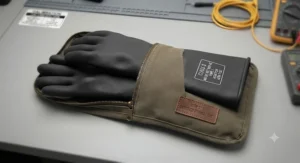
New hires and first-time buyers rarely know they need three things, not one: the rubber glove itself, a leather protector to guard against punctures and abrasion, and a storage bag to keep the rubber from creasing. The Salisbury GK011B9 Insulated Glove Kit bundles all three into a single Class 0 package, which quietly solves the most common rookie mistake — buying the glove alone and improvising the rest.
What the spec sheet won’t tell you, but safety trainers consistently point out, is that a leather protector isn’t optional gear layered on for comfort; OSHA’s own standard treats the rubber-plus-leather pairing as the default configuration for Class 0 work, with bare-glove use reserved for narrow, high-dexterity exceptions. Buying the kit removes the guesswork entirely. Reviewers who outfit apprentices specifically favor this bundle because it standardizes what “properly equipped” looks like across an entire training class, rather than leaving glove selection to individual judgment.
Pros:
- ✅ Glove, leather protector, and storage bag included
- ✅ Removes guesswork for apprentices and new hires
- ✅ Storage bag prevents fold-creases that shorten glove life
Cons:
- ❌ Bundle pricing means less flexibility to mix brands
- ❌ Protector sizing must still match the rubber glove size
Expect the Salisbury GK011B9 Insulated Glove Kit to run in the $115-$140 range for the complete set — noticeably more than a bare glove, but genuinely cheaper than buying all three components separately at retail.
5. Enespro Class 0 Insulated Electrical Gloves Kit — dual-rated for AC and DC work
The Enespro Class 0 Insulated Electrical Gloves Kit carries a rating that’s worth reading twice: 1,000 volts AC and 1,500 volts DC, tested and date-stamped per pair, with the full kit — glove, leather protector, storage bag — included from the start. That AC/DC dual rating matters more than it might seem, since EV maintenance, battery storage systems, and DC-heavy utility work have all grown fast enough that a glove rated only for AC leaves a real gap in some crews’ PPE lineup.
Here’s what to weigh: the kit ships in sizes 8 through 12 and multiple colors, and it’s certified to NFPA 70E-2015 and CSA Z462-15 for arc flash applications on both sides of the U.S.-Canada border. Reviewers working around EV charging infrastructure and solar installations specifically flag the DC rating as the deciding factor over comparably priced AC-only gloves, since it lets one glove cover two very different job types instead of stocking separate PPE for each.
Pros:
- ✅ Dual AC/DC voltage rating covers more job types
- ✅ Complete kit with protector and storage bag included
- ✅ NFPA 70E-2015 and CSA Z462-15 certified for cross-border crews
Cons:
- ❌ Premium over AC-only kits at a similar cuff length
- ❌ Color/size combinations can sell out during peak demand
The Enespro Class 0 Insulated Electrical Gloves Kit generally sits in the $130-$160 range, which reflects the added DC coverage rather than padding for its own sake.
6. Enespro Class 0 Premium Electrical Gloves Kit — the heavier-duty bundle for daily field crews
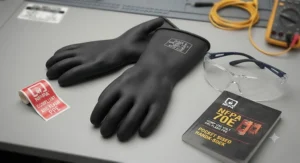
Where the standard Enespro kit covers most needs, the Enespro Class 0 Premium Electrical Gloves Kit is built for the crews putting the gear through daily abuse — linemen, utility contractors, and construction electricians logging real hours in the field every week. It carries the same 1,000V AC / 1,500V DC dual rating and the same NFPA 70E, CSA Z462-15, and ANSI/ASTM D120 compliance, but the premium tier is positioned around build quality intended to hold up to sustained daily wear rather than occasional use.
Based on the spec comparison, the difference between this and the standard kit isn’t a different voltage class — it’s durability margin. For a crew that only pulls gloves out occasionally, that margin is money left on the table; for a full-time lineman replacing gear on a predictable cycle anyway, the premium kit’s added durability can stretch the replacement interval and offset the higher upfront cost over a year or two of service.
Pros:
- ✅ Same dual AC/DC rating with added build-quality margin
- ✅ Full certification stack: NFPA 70E, CSA Z462-15, ASTM D120
- ✅ Designed around daily, sustained field use
Cons:
- ❌ Overkill for occasional or light-duty users
- ❌ Highest price point among the Enespro lineup
Pricing for the Enespro Class 0 Premium Electrical Gloves Kit typically runs $150-$180 at the time of research, positioning it as the premium anchor of this entire list.
7. Salisbury by Honeywell E011BL (EPDM) — synthetic rubber for ozone and chemical exposure
Natural rubber has one well-known weakness: ozone. Over months of outdoor exposure — think rooftop equipment, substations, or anywhere ground-level ozone concentration runs high — natural rubber gloves can develop surface cracking (often called “ozone checking”) well before the rubber’s dielectric properties actually fail. The Salisbury by Honeywell E011BL sidesteps that entirely by using EPDM, a synthetic rubber compound engineered specifically for ozone and chemical resistance, while still meeting the same Class 0, 1,000-volt AC rating as the natural rubber gloves on this list.
The trade-off shows up in flexibility — EPDM tends to run slightly stiffer than premium natural rubber blends, so fine dexterity work can feel marginally less nimble in the first few uses. Reviewers working in refineries, outdoor substations, and other ozone- or solvent-exposed environments consistently note that the trade-off is worth it, since a glove that lasts through its full test cycle without surface degradation beats one that looks pristine on delivery but starts checking within a season.
Pros:
- ✅ Resistant to ozone cracking that shortens natural rubber life
- ✅ Better chemical resistance for solvent-exposed job sites
- ✅ Same 1,000V AC Class 0 rating as natural rubber options
Cons:
- ❌ Slightly stiffer feel than premium natural rubber
- ❌ Typically priced above standard natural rubber equivalents
The Salisbury by Honeywell E011BL usually falls in the $100-$120 range, a reasonable premium for anyone whose job site actively shortens the lifespan of standard rubber gloves.
Practical Usage Guide: Getting the Most from Your Class 0 Gloves
Buying the right glove is half the job; the other half is not ruining it in the first thirty days. Before first use, every pair of class 0 rubber insulating gloves needs an air test — inflate the glove by rolling the cuff to trap air, then listen and feel along the surface for leaks. It takes under a minute and catches pinhole damage that’s invisible to the eye. Store gloves flat or gently rolled in their bag, away from direct sunlight, sharp tools, and anything petroleum-based; a glove left balled up in a toolbox next to a utility knife is a preventable failure waiting to happen.
The most common first-month mistake isn’t damage — it’s skipping the daily visual inspection because “the gloves are new.” New rubber can still have a manufacturing flaw slip through, and OSHA’s inspection requirement applies before every single use, not just after the gloves show visible age. Wash gloves in warm water with mild soap when they pick up grime, dust them lightly with talc if the interior starts feeling tacky, and never fold them along a hard crease for storage — creases become the weak points where rubber eventually splits. Rotate between two pairs if your job allows it, since resting rubber between uses measurably extends its working life compared to constant single-pair rotation.
Real-World Scenarios: Matching the Glove to the Job
Picture three different people buying Class 0 gloves this month, and you’ll see why “best glove” is really “best glove for you.” First, a solo residential-adjacent electrician doing panel swaps and service upgrades in dry, indoor conditions — for this buyer, the Salisbury by Honeywell E011B covers the job completely, and there’s little reason to pay for DC rating or extended cuff length they’ll never use. Second, an apprentice on their first utility crew assignment, still building muscle memory around PPE discipline — the Salisbury GK011B9 Insulated Glove Kit removes the risk of mismatched components and gives a training program one consistent standard to teach against.
Third, a field technician splitting time between traditional AC panel work and a growing slate of EV charging station installs — that mixed workload is exactly where the Enespro Class 0 Insulated Electrical Gloves Kit‘s dual AC/DC rating earns its higher price tag, since it means one glove replaces what would otherwise require two separate PPE purchases. None of these three buyers are wrong about what they need; they’re just solving different problems, which is precisely why this list includes seven gloves instead of one “best” pick.
Problem → Solution: Fixing the Most Common Class 0 Glove Headaches
Problem: Gloves keep failing air tests within a few months. This usually traces back to storage, not manufacturing — direct sunlight and folded creases are the two most common culprits. Solution: store flat in the provided bag, out of UV exposure, and consider an EPDM option like the Salisbury by Honeywell E011BL if the job site itself is the problem (ozone-heavy outdoor environments).
Problem: Sizing feels off after ordering online. Rubber gloves fit differently than work gloves; palm circumference, not general hand size, is the correct measurement. Solution: measure carefully before ordering, and size up if you land between two sizes — a slightly loose Class 0 glove is safer and more comfortable than a tight one that strains at the seams.
Problem: A crew can’t tell which gloves are due for retesting. Solution: adopt a two-color rotation using both the Salisbury by Honeywell E011B and Salisbury by Honeywell E011R, alternating which color represents the current six-month test window — a low-cost visual system that removes the guesswork from compliance tracking.
Problem: One glove type doesn’t cover both AC panel work and DC-heavy tasks. Solution: standardize on a dual-rated option like the Enespro Class 0 Insulated Electrical Gloves Kit rather than maintaining two separate glove inventories for what is, in practice, a single crew doing mixed work.

How to Choose Class 0 Rubber Insulating Gloves
Selecting the right pair comes down to five practical questions, each grounded in how the glove will actually be used rather than how it’s marketed:
- What’s the actual working voltage on your jobs? Class 0 covers up to 1,000 volts AC — confirm your typical exposure actually falls at or under that ceiling before assuming Class 0 is sufficient.
- Natural rubber or EPDM? Indoor, climate-controlled work favors natural rubber’s flexibility; outdoor or ozone/chemical-exposed work favors EPDM’s durability.
- Do you need AC-only or AC/DC dual rating? Anyone touching EV, solar, or battery storage systems should lean toward dual-rated gloves rather than assuming AC coverage is enough.
- Cuff length: 11 inches or 14 inches? Shallow panel work rarely needs the extra reach; deep switchgear or overhead work often does.
- Glove only, or a complete kit? First-time buyers and training programs benefit from kits with a leather protector and bag included; experienced techs replacing a single worn component may only need the rubber glove itself.
Answer those five honestly, and the seven options above sort themselves into a shortlist of one or two rather than a confusing wall of near-identical products.
Features That Actually Matter (And Those That Don’t)
Marketing copy on electrical PPE tends to lean hard on adjectives — “heavy-duty,” “professional-grade,” “industrial strength” — that carry no regulatory weight whatsoever. What actually matters is narrower and less exciting: the ASTM D120 class rating, the proof-test voltage stamped on the glove, the manufacture/test date stamp, and the base rubber compound. Everything else is comfort and convenience layered on top of that core.
Color, for instance, has zero bearing on protection — it’s purely organizational, as covered above. “Extra thick” rubber sounds protective but can actually reduce dexterity without improving the voltage rating, since the class rating (not the wall thickness alone) is what’s certified. The genuinely useful features worth paying attention to are cuff length matched to your actual reach needs, a rolled or reinforced edge that resists the wear pattern gloves see first, and — for anyone in outdoor or industrial-adjacent settings — ozone resistance, which no amount of “premium” branding substitutes for if the base compound is standard natural rubber.
ASTM D120 Rated Gloves and the Voltage Class Ladder
What ASTM D120 Rated Gloves Actually Certify
ASTM D120 rated gloves are manufactured and proof-tested against a single governing specification covering six distinct voltage classes, and understanding that ladder clears up most of the confusion buyers run into when comparing listings. The standard lays out acceptance testing for rubber insulating gloves used to protect workers from electrical shock, and it organizes that protection into six classes — 00, 0, 1, 2, 3, and 4 — each defined by its own electrical characteristics. It also splits gloves into two ozone-resistance types — Type I for non-ozone-resistant natural rubber, and Type II for ozone-resistant compounds like EPDM. That Type I/Type II split is exactly why the natural rubber and EPDM gloves reviewed above carry the same Class 0 rating but behave so differently outdoors. You can review the full official scope directly through ASTM’s own standard listing if you want the source document rather than a secondhand summary.
1000 Volt Rubber Gloves: Where Class 0 Sits on the Ladder
Every one of the seven gloves in this guide is a 1000 volt rubber glove because that’s the literal ceiling of the Class 0 designation. Class 00 sits below it, rated to 500 volts AC for lower-voltage work; Class 1 sits above it at 7,500 volts, followed by Classes 2 through 4 climbing into transmission-level voltages most electricians never touch. What most buyers overlook is that the class number isn’t just the maximum use voltage — it also determines the proof-test voltage applied during manufacturing, which runs several multiples higher than the rated use voltage to build in a genuine safety margin rather than a bare pass/fail line.
Class 0 vs Class 00 vs Class 1: Choosing the Right Rung
| Class | Max Use Voltage (AC) | Typical Application |
|---|---|---|
| Class 00 | 500V | Light residential/commercial low-voltage work |
| Class 0 | 1,000V | Standard commercial and industrial electrical work |
| Class 1 | 7,500V | Higher-voltage industrial and utility distribution work |
The jump between classes isn’t cosmetic — a Class 00 glove used on a 1,000-volt circuit isn’t a minor rule violation, it’s a genuine protection gap, while a Class 1 glove on the same 1,000-volt job is safe but usually stiffer and less dexterous than necessary. Class 0 is the practical middle ground for most general electrical work precisely because it matches the voltage most commercial and light-industrial technicians actually encounter without over-engineering the glove for voltages they’ll never see.
Voltage Rated Glove Testing and Dielectric Testing Explained
How Voltage Rated Glove Testing Works at the Factory
Voltage rated glove testing starts long before a glove reaches a job site. Manufacturers proof-test every pair — not a sample batch, every pair — at a voltage well above the rated working voltage, then date-stamp the result directly on the glove. For a Class 0 glove, that proof test runs into the low five figures, far beyond the 1,000-volt working rating, which is intentional: the margin between proof-test voltage and use voltage is what accounts for material variance, aging, and real-world conditions that a lab can’t fully replicate.
Dielectric Testing in the Field: The Air Test and the Six-Month Cycle
Dielectric testing doesn’t stop once a glove ships. Once rubber insulating gloves go into service for the first time, federal rules under 29 CFR 1910.137 require a full retest every six months, plus additional retesting whenever the insulating value looks suspect, after any repair, or after use without protector gloves. On the shop floor, the daily version of this is the air test — inflating the glove and checking for pinhole leaks — while the six-month version is a full dielectric test performed by a certified lab or in-house testing service. Skipping either one doesn’t just risk a compliance citation; it risks trusting a glove that’s already silently failed.
NFPA 70E and OSHA Electrical Glove Requirements
NFPA 70E’s Role in Your Glove Program
NFPA 70E is the National Fire Protection Association’s standard covering electrical safety requirements for employees, and while it doesn’t replace OSHA’s binding regulations, it functions as the de facto playbook most employers use to build a compliant electrical safety program around. That program is where glove class selection actually gets decided in practice — a facility performs a hazard assessment, determines the working voltage and arc flash exposure at each task, and only then specifies which glove class (00 through 4) is appropriate for which job. You can read more background on how the standard is structured via NFPA 70E’s overview.
OSHA Electrical Glove Requirements in Plain English
The actual binding OSHA electrical glove requirements live in 29 CFR 1910.137, and they cover three things every buyer should understand before a glove ever gets used on the job: mandatory periodic testing (the six-month cycle above), daily visual inspection before each use, and the pairing of rubber gloves with leather protectors except under narrow, clearly defined exceptions for high-dexterity work. Employers are also required to certify that testing occurred and retain that documentation — meaning a compliant glove program isn’t just about owning the right class of glove, it’s about proving, on paper, that it was tested on schedule.
Common Mistakes When Buying Class 0 Rubber Insulating Gloves
The single most common mistake is buying by price alone and landing on a glove one class too low for the actual working voltage — a $60 pair rated Class 00 looks like a bargain right up until it’s used on a 1,000-volt circuit it was never built to handle. A close second is skipping the leather protector entirely to save money, when OSHA’s default expectation is that rubber and leather work as a pair, not as optional add-ons.
Buyers also frequently underestimate storage requirements, assuming any drawer or bag will do, when direct sunlight and folded creases are proven glove killers. And a surprising number of crews buy gloves once and never build a retest calendar around them, effectively gambling that six-month-old rubber still performs like day-one rubber — a bet ASTM D120’s own testing philosophy explicitly says not to make.
Long-Term Cost & Maintenance: The Real Total Cost of Ownership
A $90 pair of class 0 rubber insulating gloves doesn’t cost $90 over its service life — it costs that plus periodic retesting, plus the leather protector and storage bag if bought separately, plus eventual replacement when a test fails or physical damage shows up. Budgeting realistically means treating the retest cycle as a recurring line item, not a surprise, since gloves issued for service must be tested every six months for the full working life of the pair under OSHA’s official testing-interval guidance.
Where the premium options on this list actually pay for themselves is in that maintenance math: a glove built for daily abuse that survives two or three extra retest cycles before failing outright can cost less per year of service than a cheaper glove replaced twice as often. EPDM options like the Salisbury by Honeywell E011BL follow the same logic in ozone-heavy environments — the higher upfront cost buys fewer early replacements, which is where the real savings show up on an annual PPE budget rather than a single receipt.
Frequently Asked Questions
❓ What voltage do class 0 rubber insulating gloves protect against?
❓ How often must rubber insulating gloves be tested?
❓ Do class 0 gloves need leather protectors?
❓ What's the difference between Class 0 and Class 00 gloves?
❓ Can class 0 gloves be used outdoors?
Conclusion
Class 0 rubber insulating gloves aren’t a product you buy once and forget — they’re a piece of equipment tied to an ongoing testing cycle, a storage routine, and a regulatory framework that exists because the alternative is genuinely dangerous. Among the seven gloves covered here, the Salisbury by Honeywell E011B remains the sensible default for straightforward indoor work, the Enespro Class 0 Insulated Electrical Gloves Kit earns its keep for anyone straddling AC and DC job types, and the Salisbury by Honeywell E011BL solves a real problem for crews working in ozone-heavy outdoor conditions.
Whichever pair fits your work, the underlying discipline stays the same: verify the ASTM D120 class matches your actual voltage exposure, pair the glove with a leather protector, test on schedule, and store it like the safety equipment it is rather than another item tossed in a toolbox. Get that right, and the glove will do exactly what it’s rated to do — quietly, reliably, and without anyone in the room needing to think twice about it.
✨ Ready to gear up? Compare current pricing on today’s top-rated Class 0 gloves and get your crew properly equipped before the next job. 🧤⚡
Recommended for You
- Blacksmith Forge Gloves: 7 Best Picks for Hot Metal Work (2026)
- Hot Glass Handling Gloves: 7 Picks That Won’t Fail You (2026)
- 7 Best Industrial Oven Gloves for Commercial Kitchens (2026)
Disclaimer: This article contains affiliate links. As an Amazon Associate, I earn from qualifying purchases. If you purchase products through these links, we may earn a small commission at no additional cost to you.
✨ Found this helpful? Share it with your crew! 💬🧤
