
In This Article
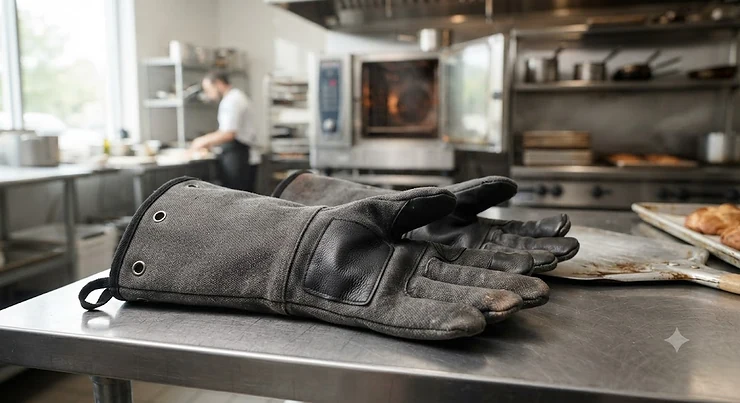
Ask any line cook how they got their first real kitchen burn, and you’ll probably hear some version of the same story: a dish towel, a hot sheet pan, and a decision made in half a second that didn’t go their way. That’s the entire reason industrial oven gloves exist — not as a “nice to have” accessory, but as the one piece of gear standing between a chef’s hands and a 500°F rack of hotel pans. An industrial oven glove is a reinforced, high-heat-rated hand covering — usually built from Nomex, Kevlar, aramid, silicone, or heavy terry cloth — engineered to protect kitchen workers from burns, steam, and sharp edges during commercial cooking and baking. Unlike the fraying mitt in your grandmother’s kitchen drawer, these are rated, certified, and built to survive a commercial laundry cycle five nights a week.
This guide breaks down seven real, currently available industrial oven gloves — spanning budget terry cloth options to Nomex-and-Kevlar mitts that laugh at 500°F racks. We’ll also dig into how commercial oven mitts differ from bakery oven gloves, what actually matters when you’re buying pizza oven gloves commercial operators trust, and where food service heat protection standards like NSF and OSHA fit into your purchase decision. Whether you’re outfitting a single-location bakery or restocking gloves across a multi-unit restaurant group, you’ll walk away knowing exactly which glove matches your kitchen’s heat, budget, and daily grind.
Quick Comparison: Industrial Oven Gloves at a Glance
Before diving into full reviews, here’s the fast version for anyone who just needs a starting point.
| Product | Heat Rating | Material | Best For |
|---|---|---|---|
| San Jamar KT0218 Cool Touch Flame | Up to 535°F (30 sec) | Nomex® / Kevlar® | High-heat commercial ovens |
| San Jamar CTP17 Cool Touch Puppet | Up to 500°F (15 sec) | Cotton / Kevlar WebGuard | Bakeries, NSF-conscious kitchens |
| San Jamar 817TMSB Terry Cloth | Up to 500°F (30 sec) | Heavy-duty terry cloth | Budget bakery operations |
| Ekogrips Plus Oven Gloves | Manufacturer-stated high heat, waterproof | Silicone / cotton lining | Pizza ovens, wet-hands handling |
| RAPICCA 932°F Neoprene Gloves | Up to 932°F (contact-dependent) | Food-grade neoprene | Budget-conscious commercial baking |
| Grill Armor 932°F EN407 Gloves | Up to 932°F, EN407 certified | M-Aramid / P-Aramid | Restaurant equipment handling, cut risk |
| Gorilla Grip Silicone Mitts | Up to 550°F | Silicone / cotton lining | Small ops, entry-level food service |
Looking across this table, the split is really about trade-offs between heat ceiling, dexterity, and price. San Jamar KT0218 Cool Touch Flame and Grill Armor sit at the top of the heat spectrum thanks to aramid construction, while San Jamar 817TMSB and Gorilla Grip Silicone Mitts trade some of that ceiling for a friendlier price tag. If your kitchen regularly pulls deck-oven racks or handles open-flame pizza ovens, the higher-rated gloves aren’t optional — they’re the difference between a quick grab and a trip to urgent care.
💬 Already narrowing down your pick? Compare the full breakdown below before you check current pricing.
Top 7 Industrial Oven Gloves: Expert Analysis
1. San Jamar KT0218 Cool Touch Flame — highest heat ceiling in this lineup
The standout here is simple: this mitt is rated to handle 535°F for a full 30 seconds, which covers nearly every deck oven, combi oven, and proofer rack you’ll encounter in a commercial kitchen. Built from Nomex® and Kevlar® — the same aramid fiber family used in firefighter turnout gear, according to industry references on aramid textiles — the mitt resists melting and charring rather than merely slowing heat transfer. A Kevlar WebGuard between the thumb and forefinger targets the exact spot where cheaper mitts wear through first, since that’s where fingers grip and twist against hot pan edges. Based on the spec comparison with the rest of this list, this is the mitt built for kitchens that run their ovens hot and often — pizza deck ovens, high-volume bakeries, and any operation pulling racks multiple times an hour. Reviewers on foodservice supply sites consistently note that the lining resists pilling even after repeated commercial laundering, and several mention the mitts retain their heat-blocking ability long after cheaper alternatives have started failing. The angled cuff design also gets called out for making it easier to grip and twist hot sheet pans without losing wrist mobility.
Pros:
- ✅ 535°F rating covers nearly any commercial oven task
- ✅ Kevlar WebGuard reinforces the highest-wear grip zone
- ✅ Holds up through repeated commercial laundering
Cons:
- ❌ Premium pricing compared to terry cloth alternatives
- ❌ Bulkier fit reduces fine dexterity for small items
Expect this one to sit at the upper end of the price range for commercial oven mitts — call it a mid-to-upper investment per glove rather than a per-pair bargain buy. For kitchens running high-heat ovens daily, the value case is straightforward: fewer replacements and fewer close calls easily offset the higher unit cost.

2. San Jamar CTP17 Cool Touch Puppet Style — NSF-certified two-hand coverage
The standout advantage of the puppet-style design is that it wraps protection around both sides of the hand in one continuous piece, which matters when you’re sliding a hand under a hot sheet pan rather than gripping a single handle. Rated to 500°F for 15 seconds and NSF certified, this mitt is built from cotton with the same Kevlar WebGuard reinforcement found on its Cool Touch siblings, giving it steam resistance alongside dry-heat protection. What most buyers overlook about puppet-style mitts is that the ambidextrous shape actually reduces training time for new hires — there’s no “wrong hand” mistake to correct on a busy line. The NSF certification specifically matters for operations that undergo health inspections, since it signals the mitt meets recognized sanitation and material-safety benchmarks rather than just a heat-resistance marketing claim. Aggregated commentary from foodservice supply retailers frames this model as a workhorse choice for diners, hotels, and bakeries that need dependable, everyday protection rather than the highest possible heat ceiling.
Pros:
- ✅ NSF certification simplifies health inspection compliance
- ✅ Ambidextrous puppet design reduces new-hire training time
- ✅ Kevlar WebGuard adds durability at the highest-wear point
Cons:
- ❌ Lower heat ceiling than the Cool Touch Flame model
- ❌ Cotton shell needs more frequent replacement in heavy use
Priced in the mid-range for commercial oven mitts, this is a strong default choice for operations that want NSF assurance without paying for a 535°F rating they may never need.
3. San Jamar 817TMSB Terry Cloth with Steam Barrier — budget-friendly bakery workhorse
This one’s standout feature is straightforward value: a heavy-duty, institutional-grade terry cloth mitt rated to 500°F for 30 seconds, with a built-in steam barrier, at a price point well below the aramid options on this list. Terry cloth won’t match Nomex for pure heat-blocking speed, but here’s what the spec sheet doesn’t say outright — for bakery environments where the primary hazard is dry oven heat rather than open flame, terry cloth with a steam barrier covers the actual risk profile most bakeries face. At roughly 0.75 pounds, it’s also noticeably lighter than aramid or silicone alternatives, which matters over an eight-hour shift pulling proof racks every twenty minutes. Commentary from commercial kitchen suppliers frames this as a staple for institutional kitchens and bakery operations specifically because it’s fully machine washable and holds up to industrial laundering without degrading the fabric’s heat resistance.
Pros:
- ✅ Budget-friendly entry point for commercial-grade protection
- ✅ Steam barrier addresses a real bakery-specific hazard
- ✅ Lightweight terry cloth reduces fatigue over long shifts
Cons:
- ❌ 30-second dry-heat rating trails aramid competitors
- ❌ Less abrasion resistance than Kevlar-reinforced models
This sits at the lower end of the commercial oven mitt price range, making it a sensible pick for bakeries stocking multiple pairs across several stations without blowing the smallwares budget.
4. Ekogrips Plus Oven Gloves with Fingers — best dexterity for pizza and wet-hands tasks
The standout feature is the five-finger silicone design paired with a long cuff, which solves a problem the mitt-style options above don’t: fine motor control while still covering the forearm. Because the shell is waterproof silicone rather than absorbent cotton or terry cloth, these gloves stay protective even when splashed with sauce, grease, or steam — a genuinely common scenario around pizza ovens and deep fryers. Here’s what most buyers overlook: waterproofing isn’t just about comfort. A soaked cotton mitt loses much of its insulating value almost instantly, while silicone keeps its heat-blocking properties wet or dry. The cotton lining underneath adds breathability that all-silicone gloves often lack, addressing the “sweaty hands after ten minutes” complaint common with fully rubberized designs. Because manufacturer-verified third-party review data specifically for this listing wasn’t available at the time of research, we’ll be upfront rather than invent sentiment — what’s verifiable is the build spec (silicone shell, cotton lining, long cuff, five-finger dexterity) rather than a large body of aggregated review quotes.
Pros:
- ✅ Five-finger design allows precise handling of small items
- ✅ Waterproof silicone maintains protection when wet
- ✅ Long cuff shields the forearm during deep pizza-oven reaches
Cons:
- ❌ Independently verified review volume is limited at this time
- ❌ Silicone shell runs warmer on hands than breathable terry cloth
Priced in the middle of this lineup, this is a solid pick for pizza-forward kitchens and any station where fingers, not just palms, need protecting.
5. RAPICCA 932°F Heat Resistant Neoprene Gloves — best budget pick for high-heat spikes
The standout here is a manufacturer-stated 932°F heat tolerance from FDA-compliant, BPA-free neoprene rubber, at a price point closer to the budget end of this list. The double-layer cotton liner underneath is what makes the glove wearable rather than just protective — insulation without a comfortable interior just means workers avoid wearing it, which defeats the purpose entirely. Independent testing from AmazingRibs.com’s gear review team rated a related Rapicca glove as safe up to roughly 450°F in practical use, a useful reminder that manufacturer heat-tolerance numbers and independently tested sustained-contact temperatures aren’t always the same figure — read both when comparing gloves. What most buyers overlook is the neoprene shell’s oil and grease resistance, which matters enormously around fryers and rotisserie stations where sauce and fat exposure degrade cotton and terry fabrics fast. The textured palm grip specifically targets wet, greasy handling — pulled pork, fried items, hot sheet pans splashed with oil — rather than dry oven racks alone.
Pros:
- ✅ High manufacturer heat rating at a budget-friendly price
- ✅ Neoprene shell resists oil, grease, and moisture
- ✅ Double-layer cotton lining keeps hands comfortable
Cons:
- ❌ Independent testing shows lower real-world sustained-heat comfort than the marketed figure
- ❌ Loose, one-size-fits-most cut reduces fine dexterity
At the budget end of the price spectrum, this is a reasonable value pick for operations that need broad, wet-and-dry protection without a large per-unit spend — just calibrate expectations against the independently tested figure rather than the headline number alone.
6. Grill Armor 932°F EN407 Certified Gloves — best for cut-plus-heat combination risk
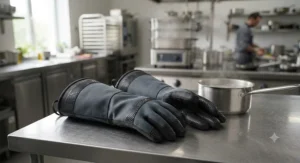
The standout feature is EN407 certification — a recognized European standard for heat-resistant protective gloves — combined with M-Aramid and P-Aramid construction rated to 932°F. What that certification means in practice: the glove has been independently tested against a defined heat-and-flame protocol, not just marketed with a temperature number pulled from a lab data sheet. This matters specifically for restaurant equipment handling tasks that combine heat exposure with sharp edges — pulling hot hotel pans with damaged corners, handling equipment fresh out of a dish machine, or working near slicer blades that have residual heat from a sanitizing cycle. The same aramid fiber family used here — chemically related to Kevlar and Nomex — is prized in industrial safety gear specifically because it resists melting rather than just slowing heat transfer, according to materials science references on aramid fibers. The 100% cotton lining keeps the interior wearable, while the textured silicone grip addresses the control problem that pure aramid gloves sometimes struggle with on smooth pan handles.
Pros:
- ✅ EN407 certification confirms independently tested heat protection
- ✅ Aramid fiber construction resists melting, not just heat transfer
- ✅ Silicone grip improves control on smooth handles
Cons:
- ❌ Priced above basic silicone or terry cloth alternatives
- ❌ Bulkier profile than five-finger silicone gloves
This lands in the mid-to-upper price range, justified for kitchens where cut risk and heat risk overlap — think dish pit adjacent to the oven line, or equipment handling stations.
7. Gorilla Grip Silicone Oven Mitts — best entry-level pick for smaller operations
The standout feature is accessibility: a BPA-free silicone mitt rated to 550°F with a thick cotton lining, sold at the most budget-friendly price point in this roundup. For a food truck, small café, or home-based bakery scaling into light commercial work, this is often the first “real” oven glove purchase before stepping up to NSF-certified or aramid-rated gear. The 550°F rating comfortably covers standard home and light-commercial oven temperatures, and the waterproof exterior means splashes from a stand mixer or a dripping sheet pan won’t compromise the glove mid-shift. Here’s what the spec sheet won’t tell you: at this price point, the trade-off is usually replacement frequency rather than immediate failure — expect to cycle these more often than the commercial-grade options above if daily oven use is heavy. As one of Amazon’s best-selling oven mitts in this broader category, it benefits from a large volume of general consumer feedback, though we’d caution that broad best-seller status reflects popularity more than commercial-duty durability specifically.
Pros:
- ✅ Most accessible price point in this comparison
- ✅ 550°F rating covers standard oven and light-commercial use
- ✅ Waterproof silicone shell resists splashes and spills
Cons:
- ❌ Not built for the heaviest commercial-duty cycle
- ❌ Cotton lining lifespan shorter under daily high-volume use
At the lowest price point here, this is the right call for light-duty or scaling operations — just budget for more frequent replacement than the NSF or aramid options above.
✨ Don’t Miss These Exclusive Deals! 🔍 Take your kitchen safety setup to the next level with these carefully selected gloves. Click on any highlighted item to check current pricing and availability. The right pair protects your team and your bottom line for years to come!
Getting the Most from Your New Industrial Oven Gloves
Buying the right glove is half the job — using and maintaining it correctly is the other half, and it’s the part most kitchens skip. Start by matching glove length to your actual reach: if you’re pulling racks from a deep deck oven, a 17-inch mitt like the San Jamar KT0218 Cool Touch Flame protects the forearm in a way a short mitt simply can’t. In the first 30 days, inspect the grip zone between thumb and forefinger weekly — this is where mitts fail first, since it’s the spot under the most repeated flex and friction. A common early mistake is tossing aramid or Kevlar-reinforced gloves into a standard dryer on high heat; check the care label, since some models specify air-drying or lower dryer settings to preserve the fiber’s protective properties over time. Rotate at least two pairs per station so one can be laundered while the other stays in service — a single mitt cycling through back-to-back shifts wears out roughly twice as fast. Finally, train new hires to feel for hot spots through the glove during onboarding, not after their first minor burn; a glove that’s degraded still looks fine on the outside.
Who Actually Needs What: Real Kitchen Scenarios
Picture a 22-year-old line cook at a downtown pizzeria, pulling 900°F deck-oven pies every ninety seconds during a Friday rush. For that person, a budget terry cloth mitt is a liability — the Grill Armor 932°F EN407 Certified Gloves or the San Jamar KT0218 Cool Touch Flame are the realistic minimum, since the heat exposure is frequent, intense, and combined with fast handling under time pressure. Now picture a small bakery owner running one deck oven and two proofers, baking in batches rather than constant rotation — the San Jamar 817TMSB Terry Cloth or San Jamar CTP17 Cool Touch Puppet cover that lower-frequency, lower-intensity heat exposure comfortably, at a fraction of the cost. Finally, picture a food truck operator handling a compact convection oven and the occasional fryer basket, working solo with limited storage space — the Gorilla Grip Silicone Oven Mitts or Ekogrips Plus Oven Gloves fit that lower-volume, budget-conscious, space-constrained reality without over-buying protection the operation doesn’t need daily.
How to Choose Industrial Oven Gloves
- Match the heat rating to your actual oven temperature, not the highest number available. A 500°F rating is plenty for most bakery ovens; save the 900°F+ aramid gloves for deck ovens and open-flame stations.
- Check for NSF certification if you’ll face health inspections. It’s a fast way to signal compliance without relying on marketing claims alone.
- Decide between mitt and five-finger glove based on the task. Mitts protect better against raw heat; five-finger gloves like Ekogrips Plus Oven Gloves win when you need to grip small items precisely.
- Weigh cuff length against your reach requirements. Deep ovens and proofer racks call for 17-inch coverage; countertop tasks rarely need more than 13 inches.
- Consider material based on your kitchen’s real hazard — dry heat, steam, or grease. Terry cloth suits dry oven heat; silicone and neoprene shrug off grease and moisture better.
- Buy in pairs, per station, with rotation in mind. A single glove doing double shifts wears out roughly twice as fast as a rotated pair.
- Check the return and warranty policy before bulk ordering. Commercial kitchens buying multiple units benefit from knowing replacement terms upfront.
Commercial Oven Mitts vs Bakery Oven Gloves vs Industrial Oven Gloves: What’s the Real Difference
These three terms get used almost interchangeably in product listings, but the distinctions matter when you’re actually ordering for a kitchen. Commercial oven mitts typically describe hand-only or hand-plus-partial-forearm coverage designed for general commercial kitchen use — think the San Jamar CTP17 Cool Touch Puppet or San Jamar 817TMSB Terry Cloth, built for repeated daily use and commercial laundering rather than occasional home baking. Bakery oven gloves lean specifically toward dry-heat, proofer-and-deck-oven environments where steam resistance and long cuffs matter more than cut resistance or grease protection — the terry cloth and puppet-style options above fit that profile well. Industrial oven gloves, meanwhile, is the broader umbrella term covering the highest-heat, most durable options built for continuous, high-volume use — the San Jamar KT0218 Cool Touch Flame and Grill Armor 932°F EN407 Certified Gloves both earn that label through their aramid construction and extended heat ratings. On paper, this means a small bakery can often get away with mid-tier bakery oven gloves, while a high-volume pizzeria or catering operation genuinely needs industrial-grade protection to match its equipment’s heat output.
Common Mistakes When Buying Industrial Oven Gloves
The most frequent mistake is buying based on the highest advertised temperature number without checking whether that number reflects sustained contact or a brief flash exposure — as the independent testing on the RAPICCA 932°F Heat Resistant Neoprene Gloves shows, manufacturer figures and tested real-world comfort can diverge. A second common error is under-buying cuff length, leaving forearms exposed when reaching into deep ovens or racks — a 13-inch mitt simply wasn’t designed for that reach. Kitchens also frequently skip checking for NSF certification, then discover during a health inspection that their smallwares don’t meet local code requirements. Another overlooked issue: buying a single pair per station instead of a rotation, which accelerates wear and leaves staff without protection mid-shift during laundering. Finally, many buyers assume all “heat resistant” claims are independently verified, when in practice many are self-reported by manufacturers rather than tested against a standard like EN407 — checking for that certification, as with the Grill Armor 932°F EN407 Certified Gloves, removes the guesswork.
Pizza Oven Gloves Commercial Operators Actually Trust
Pizza ovens present a specific challenge that generic oven mitts weren’t built for: extreme, sustained radiant heat combined with the need for fast, repeated hand movements as pies cycle through every 90 seconds to two minutes during a rush. This is why pizza oven gloves commercial pizzerias favor tend to skew toward either high-heat aramid mitts or five-finger silicone gloves rather than lightweight terry cloth. The Grill Armor 932°F EN407 Certified Gloves and San Jamar KT0218 Cool Touch Flame both handle the radiant heat load of a deck or wood-fired oven without the melting risk that lower-rated synthetic gloves face near open flame. For operators who need to manipulate a peel, rotate a pie, or pull a hot pan in one motion, the Ekogrips Plus Oven Gloves offer the finger dexterity that bulkier mitts sacrifice — a real trade-off worth weighing against raw heat ceiling. What most pizza-focused buyers overlook is glove length: wood-fired and deck ovens often require deeper reaches than a home oven, making the 17-inch options genuinely more protective than an 8-inch consumer mitt, regardless of material.
Food Service Heat Protection: Long-Term Cost & Maintenance
Food service heat protection isn’t a one-time purchase decision — it’s a recurring line item, and total cost of ownership looks different than the sticker price suggests. A budget pair like the Gorilla Grip Silicone Oven Mitts costs less upfront but typically needs replacing more often under heavy commercial-duty cycles, while the San Jamar KT0218 Cool Touch Flame costs more per pair but holds up through repeated industrial laundering without losing its protective properties, based on aggregated commentary from foodservice suppliers. Running the math over a year: if a budget mitt needs replacing three times while a premium mitt needs replacing once, the actual cost gap narrows considerably — sometimes to near parity, depending on usage intensity. Maintenance matters just as much as purchase price: gloves laundered correctly (following care labels for temperature and drying method) retain heat-resistant properties longer than those thrown into a standard high-heat dryer cycle. Kitchens that budget for glove replacement as a recurring smallwares expense, rather than a reactive “buy when it fails” purchase, tend to avoid the gap where a degraded glove is still in rotation simply because no one flagged it.
Commercial Baking Safety and Restaurant Equipment Handling: Regulations & Compliance
Commercial baking safety isn’t just good practice — it’s a regulatory requirement. Under OSHA’s Hand Protection Standard, employers must select and require appropriate hand protection whenever workers face hazards like thermal burns and severe cuts, which directly covers oven mitts and heat-resistant gloves in commercial kitchens. Beyond OSHA, many health departments look for NSF certification as a practical signal that smallwares — including oven mitts and related handling equipment — meet established material safety and cleanability standards. For restaurant equipment handling specifically, the overlap between heat exposure and cut risk is worth flagging: hot pans with damaged edges, freshly sanitized slicer components, and dish-pit equipment all create combined hazards that a single-purpose mitt may not fully address, which is exactly the gap EN407-certified gloves like the Grill Armor 932°F EN407 Certified Gloves are built to close. Training matters here too — OSHA guidance specifically notes that workers need information in a language and format they understand about workplace hazards and the standards that apply, meaning a glove policy is only as good as the onboarding that goes with it.
Restaurant Equipment Handling: Features That Actually Matter (And Those That Don’t)
When you strip away the marketing language, a handful of features genuinely affect safety and performance, while others are mostly comfort or aesthetic add-ons. What matters: verified heat rating tied to a testing standard (EN407 or NSF, not just a number on the packaging), reinforcement at the thumb-forefinger grip zone where wear concentrates fastest, and cuff length matched to actual oven or equipment reach. What matters less than it seems: color options, decorative patterns, and marginal weight differences between similar-rated gloves — none of these affect burn protection. A frequently overlooked feature that does matter: whether the glove is machine washable and how it holds up to commercial laundering cycles, since a mitt that degrades after a dozen washes creates a false sense of security. Grip texture also deserves more attention than it typically gets — a glove with excellent heat resistance but poor grip on wet or greasy handles, like some smooth-palm silicone options, can actually increase drop-related burns rather than prevent them.
Frequently Asked Questions
❓ What temperature can industrial oven gloves withstand?
❓ Are silicone oven gloves better than fabric mitts for commercial kitchens?
❓ Do commercial oven mitts need to be NSF certified?
❓ How often should restaurants replace oven gloves?
❓ Can oven gloves protect against both heat and cuts?
Conclusion
Choosing the right industrial oven gloves really comes down to matching your kitchen’s actual heat exposure, hazard mix, and budget rather than chasing the highest number on a spec sheet. If you’re running a deck oven or pizza station at full tilt, the San Jamar KT0218 Cool Touch Flame or Grill Armor 932°F EN407 Certified Gloves earn their higher price tag through genuine, tested heat and durability performance. If your kitchen’s hazard profile is steadier and lower-intensity — a bakery running scheduled bake cycles rather than constant rotation — the San Jamar CTP17 Cool Touch Puppet or San Jamar 817TMSB Terry Cloth deliver solid, NSF-conscious protection without overspending. And if you’re scaling a smaller operation, the Gorilla Grip Silicone Oven Mitts or Ekogrips Plus Oven Gloves cover real, everyday needs at an accessible price point. Whatever you choose, remember that the glove is only as good as the maintenance and rotation schedule behind it — a degraded mitt in someone’s hands is still a burn waiting to happen. Check current pricing and availability before you order, since commercial smallwares pricing shifts often, and stock up in pairs so your team is never one busy shift away from grabbing a bare towel.
✨ Don’t Miss These Exclusive Deals!
🔍 Take your kitchen’s safety setup to the next level with these carefully selected gloves. Click on any highlighted item to check current pricing and availability. The right pair protects your team — and your bottom line — for years to come!
Recommended for You
- 7 Best Silicone Heat Resistant Gloves for Commercial Kitchens (2026)
- Nomex Heat Resistant Gloves: 7 Best Picks Ranked for 2026
- 7 Best Kevlar Heat Resistant Gloves (2026): Tested Picks & Guide
Disclaimer: This article contains affiliate links. As an Amazon Associate, I earn from qualifying purchases. If you purchase products through these links, we may earn a small commission at no additional cost to you.
✨ Found this helpful? Share it with your friends! 💬🤗
