
In This Article
Your hands do the actual work on a jobsite — the multimeter, the wire strippers, the fish tape, the panel screws — and yet electricians routinely buy the cheapest gloves in the bin and wonder why their palms are shredded by month three. Electrician work gloves under $50 exist in a strange middle ground: too expensive to treat as disposable, too affordable to expect miracle-grade armor. What is an electrician work glove, really? In practical terms, it’s hand protection built for de-energized electrical tasks — abrasion resistance, cut resistance, grip, and dexterity for stripping wire, pulling cable, and setting devices — distinct from voltage-rated rubber insulating gloves used on live circuits. This guide breaks down seven real, currently available options that stay under that $50 ceiling, matched to the specific tasks electricians actually do all day. Whether you’re chasing better cut resistance rating numbers, gloves built for wire pulling without losing dexterity, or a pair that still lets your phone unlock without stripping off a glove, there’s a logical pick below. We researched actual product specs, aggregated review sentiment, and independent testing coverage — not marketing copy — because OSHA’s hand protection standard puts the burden of matching gloves to the actual hazard squarely on the person doing the choosing.
Budget matters here, but so does not lying to yourself about what “durable” means at this price point. A $28 leather glove that lasts fourteen months of daily wire work is a better deal than a $12 pair replaced every six weeks. That’s the lens for everything below: real specs, honest trade-offs, and where each glove actually earns its price tag.
Quick Comparison Table
| Glove | Best For | Cut Rating | Touchscreen | Price Range |
|---|---|---|---|---|
| Klein Tools 60188 | Daily all-around use | Not rated | No | $25-30 |
| Mechanix Wear Original | Touchscreen + dexterity | Not rated | Yes | $20-25 |
| Klein Journeyman Cut 5 | Wire pulling, rough-in | CE Level 5 | No | $30-38 |
| Ironclad General Utility | Grip on oily surfaces | Not rated | No | Under $20 |
| Wells Lamont FX3 | Budget cut resistance | ANSI A4 | No | $15-22 |
| Youngstown Ground Utility | Maximum durability | ANSI A4 | No | $45-50 |
| MaxiFlex Ultimate 34-874 | Precision terminations | Not rated | Partial | $10-14 |
Looking at the spread above, there’s no single “best” glove here — there’s a best glove for what you’re doing at 9 a.m. versus what you’re doing at 2 p.m. The Klein Journeyman Cut 5 and Wells Lamont FX3 are your two real answers if cut resistance rating is the deciding factor, while the MaxiFlex Ultimate 34-874 sacrifices almost all cut protection in exchange for fingertip feel that the bulkier options simply can’t match. If you only buy one pair, the Klein Tools 60188 sits in the sensible middle, which is exactly why it shows up so often in independent electrician gear roundups.
💬 Found a pair that fits your work? Tap the link above to check today’s price before it changes.
Top 7 Electrician Work Gloves Under $50: Expert Analysis
1. Klein Tools 60188 Leather Work Gloves — best all-around value for daily wire work
The professional-grade goatskin leather on the Klein Tools 60188 is the standout feature here — it’s noticeably softer and more supple straight out of the package than the stiff cowhide found on cheaper big-box gloves. Key specs translate directly into jobsite behavior: the PVC knuckle and finger guards absorb impact from conduit benders and panel edges, the mesh back keeps hands from turning into a sweaty mess during summer attic work, and the hook-and-loop cuff closure stops debris from working its way in while you’re fishing wire overhead. Based on the spec comparison against other leather-palm options in this price bracket, the goatskin construction is what separates this glove from generic cowhide competitors — goatskin retains flexibility even after repeated wet-dry cycles, which matters enormously for anyone stripping romex all day. This is the glove for electricians who want one dependable pair rather than a rotation, and reviewers consistently note that the EVA foam palm padding reduces hand fatigue during long termination sessions without adding the bulk that kills fingertip feel. A common theme in aggregated feedback is that these gloves are simple, unglamorous, and reliable — several long-tenured utility workers report using this exact model for years running.
Pros:
- ✅ Genuine goatskin leather stays flexible after repeated use
- ✅ PVC guards protect knuckles without limiting hand closure
- ✅ Hook-and-loop cuff keeps debris and dust out
Cons:
- ❌ No cut-resistance rating for sharp metal edges
- ❌ Not touchscreen compatible
Priced around $25-30, the value verdict is straightforward: this is the safest “default” purchase on this list if you only want to own one glove.
2. Mechanix Wear Original — most reliable touchscreen work gloves for electricians
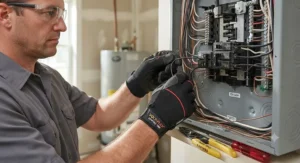
The 0.8mm synthetic leather palm on the Mechanix Wear Original is thin enough to genuinely register on a capacitive screen, which is the standout feature that separates real touchscreen work gloves for electricians from ones that merely claim compatibility. The Freedom-Flex cuff eliminates the bunching you get with elastic-only designs, and the welded Lock Ring thumb panel is a small but meaningful durability upgrade — it’s usually the first seam to blow out on cheap gloves. What most buyers overlook about this model is that the ANSI Level 3 abrasion resistance on the snag-reducing mesh back matters as much as the palm material, since electricians drag the backs of their hands across rough drywall cutouts and conduit straps constantly. Reviewers consistently report that touchscreen responsiveness holds up well even after months of grime, and that the anatomical fit reduces the “claw hand” fatigue that stiffer synthetic gloves cause after a full shift of pulling cable. This is the pick for anyone who’s tired of stripping off gloves fifteen times a day just to check a text or snap a panel photo for the inspector.
Pros:
- ✅ Genuine touchscreen response through the palm material
- ✅ Freedom-Flex cuff prevents bunching at the wrist
- ✅ Vented palm padding cuts vibration and hand fatigue
Cons:
- ❌ No formal cut-resistance certification
- ❌ Synthetic palm wears faster than full leather on rough conduit
At $20-25, the value here is clear for anyone whose day involves a phone as much as a screwdriver.
3. Klein Tools Journeyman Cut 5 (40225) — top pick for wire pulling and rough-in
CE Cut Level 5 protection is the standout feature of the Klein Tools Journeyman Cut 5, and that rating means something specific: it’s built to resist the nicked, frayed copper strands and sharp EMT edges that shred lesser gloves during rough-in. The high-tech knit shell (a cut-resistant fiber blend rather than leather) delivers dexterity closer to a mechanic’s glove than a traditional leather work glove, which is exactly why independent trade-gear reviewers single this model out specifically for wire pulling and conduit rough-in work. On paper this means you get real fiber-level cut protection without the stiffness that makes leather gloves clumsy for threading wire through tight junction boxes. Aggregated user feedback highlights the snug, second-skin fit as the biggest selling point — electricians report being able to feel wire nuts seat properly without needing to remove the glove, something that’s genuinely rare at this cut-resistance level. What the spec sheet won’t tell you, but reviewers note, is that the knit construction runs warm in enclosed spaces like crawlspaces, so it shines best for rough-in and pulling rather than all-day summer attic work.
Pros:
- ✅ CE Cut Level 5 protects against frayed wire and sharp EMT
- ✅ Snug knit fit preserves fingertip sensitivity
- ✅ Purpose-built for wire pulling and rough-in tasks
Cons:
- ❌ Runs warmer than leather gloves in enclosed spaces
- ❌ Knit shell shows wear faster than leather under heavy abrasion
Landing around $30-38, this is the highest-value cut-resistant pick if wire pulling is your main daily task.
4. Ironclad General Utility Glove (GUG) — best grip on oily and slick surfaces
The textured synthetic leather palm on the Ironclad General Utility Glove is the standout feature, and it’s a deliberate departure from the fabric-based palms Mechanix uses — the payoff is noticeably better traction on smooth conduit fittings, greasy panel screws, and slick PVC boxes. The foam knuckle padding (rather than a rigid TPR guard) is a meaningful practical detail: it absorbs light impact from cramped panel work without adding the bulk that makes precise screw-driving awkward. Based on the spec comparison with the Mechanix Original, the GUG trades some of that model’s snag-resistant mesh for raw grip performance, which is the right trade if your primary complaint about other gloves is dropping tools on slippery surfaces. Reviewers consistently frame this as the answer for anyone working around oily conduit lube, damp basements, or older panels coated in decades of grime, and the elastic cuff design makes it fast to pull on and off between tasks — a small thing that adds up across a ten-hour shift.
Pros:
- ✅ Textured palm holds traction on oily or wet surfaces
- ✅ Foam knuckle padding without added bulk
- ✅ Fast on/off elastic cuff for frequent task switching
Cons:
- ❌ No cut-resistance rating
- ❌ Less structured protection than leather-guard gloves
At under $20, this is the cheapest genuinely useful pick on the list for anyone working in grimy or wet panel conditions.
5. Wells Lamont FX3 Cut-Resistant A4 Coated Gloves — best budget cut resistance rating
An ANSI A4 cut-resistance rating on a sub-$25 glove is the standout feature of the Wells Lamont FX3, and it’s a genuinely strong number for the price — A4 sits comfortably above what most leather work gloves offer and covers the sharp-edge hazards common around stamped metal boxes and freshly cut conduit. The PU-coated palm is water- and oil-resistant, which in practice means the coating doesn’t get slick or brittle after repeated exposure to conduit lubricant or damp crawlspace conditions. Here’s what to weigh: this glove prioritizes cut protection and coating durability over the buttery flexibility of leather, so fingertip feel is good but not class-leading. A common complaint in user reviews is that the coated fingertips reduce touchscreen usability entirely, so pair this with a dedicated touchscreen glove if you need both features in the same shift. Reviewers consistently praise the flexibility relative to the cut rating — Wells Lamont has clearly engineered this to avoid the stiff, glove-in-a-cast feeling that plagues some budget A4-rated competitors.
Pros:
- ✅ ANSI A4 cut resistance well above typical leather gloves
- ✅ Water- and oil-resistant PU coating
- ✅ Genuine flexibility despite the cut rating
Cons:
- ❌ Coated fingertips block touchscreen use
- ❌ Less breathable than uncoated leather in warm conditions
Priced at $15-22, this is the single best cut-resistance-per-dollar pick on this list.
6. Youngstown Ground Utility Gloves — most durable work gloves for electricians
A 60% goatskin / 40% Kevlar blend is the standout feature of the Youngstown Ground Utility Gloves, delivering ANSI A4 cut resistance, Level 5 puncture resistance, and a 37 cal/cm² arc rating in a single glove — a combination that’s genuinely rare below the $50 mark. The 3D pre-curved construction pre-shapes the fingers and palm around a natural grip position, so you retain dexterity despite the heavyweight material, and the double-layered thumb, pointer, and middle finger patches specifically reinforce the three points that wear out first on every other glove on this list. Based on the spec comparison, this is the clear pick if durable work gloves for electricians is your actual priority over raw dexterity — buyers report these gloves lasting eight-plus years with occasional fraying but continued function, which is an exceptional return on investment even at the top of this budget range. The Kevlar liner’s flame resistance also satisfies NFPA 70E-adjacent considerations for arc-flash-aware environments, though you should always verify the specific arc rating against your task’s calculated incident energy rather than assuming coverage. What most buyers overlook: these run slightly small, so sizing up is worth doing if you’ll ever wear these over a thin liner glove in cold conditions.
Pros:
- ✅ Kevlar/goatskin blend rated for 8-plus years of use
- ✅ ANSI A4 cut and Level 5 puncture resistance combined
- ✅ 37 cal/cm² arc rating for flash-aware environments
Cons:
- ❌ Sits at the top edge of the under-$50 budget
- ❌ Runs small; sizing up is usually necessary
At $45-50, this is a premium buy within the budget ceiling, best justified by genuinely heavy daily use rather than occasional jobs.
7. MaxiFlex Ultimate 34-874 — best jobsite dexterity for precision terminations
A 15-gauge nylon/lycra knit shell is the standout feature of the MaxiFlex Ultimate 34-874, producing a fit so thin it feels closer to a surgical glove than a work glove — which is exactly the point for anyone terminating fine-gauge control wiring or seating tiny wire nuts in a crowded panel. The nitrile micro-foam palm coating grips small hardware without the tackiness that some foam coatings develop over time, and the breathable knit back keeps hands cool during long stretches of bench or panel work. On paper this means you’re sacrificing almost all cut and impact protection in exchange for jobsite dexterity that heavier gloves simply cannot deliver — this is not the glove for rough-in or conduit handling, and it shouldn’t be treated as one. Reviewers consistently position this style as the go-to for detail work: setting devices, dressing wire in a panel, or handling delicate low-voltage connections where fingertip sensitivity decides whether the job goes fast or slow. Some variants of this line include partial touchscreen compatibility on the index finger and thumb, though this isn’t consistent across every SKU, so verify before assuming.
Pros:
- ✅ Thinnest, most precise fit on this list
- ✅ Breathable knit shell resists overheating
- ✅ Nitrile micro-foam palm grips small hardware securely
Cons:
- ❌ Minimal cut or impact protection
- ❌ Not durable enough for rough conduit or demo work
At under $12-14, this is the cheapest pick here and the smartest add-on pair rather than a standalone daily glove.
Practical Usage Guide: Getting the Most Out of Any Pair
Break-in matters more than people admit. Leather gloves like the Klein Tools 60188 or Youngstown Ground Utility benefit from flexing the fingers repeatedly during the first few wears rather than letting them stiffen into whatever shape they arrived in — a few minutes of deliberate fist-and-release motions the first day saves a week of awkward fit. For coated gloves like the Wells Lamont FX3, avoid direct heat sources during storage; PU coatings degrade and crack faster when baked on a dashboard or near a space heater. A common mistake in the first 30 days is machine-washing leather-palm gloves on a normal cycle — this strips natural oils and causes premature cracking, so hand-wash with mild soap and air-dry away from direct sunlight instead. Rotate gloves rather than running one pair into the ground: keeping a cut-resistant pair like the Klein Journeyman Cut 5 dedicated to rough-in and a dexterity pair like the MaxiFlex Ultimate 34-874 dedicated to terminations extends both lifespans considerably, since neither glove is being asked to do a job it wasn’t built for. Inspect gloves at the start of every shift for thin spots at the fingertips and palm center — that’s where failure starts, and catching it early prevents an unprotected cut mid-task.
Real-World Scenarios: Which Glove Fits Your Jobsite
If you’re a residential service electrician running four to six calls a day — mostly panel swaps, outlet replacements, and troubleshooting — the Mechanix Wear Original or Klein Tools 60188 covers nearly everything, and the touchscreen capability on the Mechanix pairs well with constantly checking work orders on a phone between stops. If you’re a commercial rough-in electrician pulling hundreds of feet of cable through conduit runs daily, the Klein Journeyman Cut 5 earns its keep fast — the cut resistance against nicked strands and sharp EMT edges pays for itself the first time it prevents a slice that would’ve cost you a trip to first aid. If you’re a panel-and-controls specialist spending most of your day terminating low-voltage wiring, thermostats, or control boards, the MaxiFlex Ultimate 34-874 is worth keeping in a back pocket specifically for that fine work, even if you wear something heavier for the rest of the job. And if you’re an apprentice or budget-conscious solo operator buying your first “real” pair of work gloves, start with the Ironclad General Utility Glove — it’s the lowest financial commitment on this list that still performs like an actual work glove rather than a hardware-store throwaway.
How to Choose Electrician Work Gloves Under $50
- Identify your primary hazard first. Sharp conduit edges and frayed wire call for a cut-resistance rating; oily panels call for grip; cold crawlspaces call for insulation.
- Match cut resistance to the actual task. ANSI A2-A3 covers light handling; A4 and above, like the Wells Lamont FX3 or Youngstown Ground Utility, covers rough-in and demo work.
- Decide if touchscreen use is a daily need. If you’re constantly checking a phone on the jobsite, prioritize a genuine touchscreen palm like the Mechanix Wear Original rather than assuming any glove works.
- Weigh dexterity against protection honestly. Heavier gloves protect more but slow down fine termination work — most electricians need at least two different pairs, not one do-everything glove.
- Check fit before durability. A glove that’s slightly loose will wear out at the fingertips faster than one that’s snug, regardless of material quality.
- Budget for a rotation, not a single purchase. Two $20-25 gloves matched to different tasks consistently outperform one $50 glove asked to do both jobs.
- Read aggregated review sentiment, not star ratings alone. A 4.3-star average hides a lot; look for recurring specific complaints about stitching, palm wear, or coating cracking.
Cut Resistance Rating Explained: What ANSI A-Levels Mean for Electricians
The cut resistance rating on a glove label isn’t marketing fluff — it’s a standardized number from ANSI/ISEA’s hand protection classification system, which ranks gloves from A1 (lowest) to A9 (highest) based on the grams of force needed to cut through the material during lab testing. For electricians, this matters most during rough-in and demo, where nicked copper strands, sharp stamped-metal box edges, and cut conduit create real laceration risk that a plain leather glove doesn’t fully address. A1-A2 gloves suit light material handling; A4, like the Wells Lamont FX3 and Youngstown Ground Utility, covers most rough-in and panel demo scenarios; anything above A6 is generally overkill for electrical work and usually sacrifices too much dexterity to be practical. What most buyers overlook is that a high cut rating says nothing about puncture or impact resistance — those are separate ratings entirely, so a glove can be excellent against blade-style cuts and still fail against a puncturing screw tip. Reviewers consistently note that cut-resistant knit gloves like the Klein Journeyman Cut 5 trade some fingertip precision for that protection, which is a fair trade during wire pulling but a poor one during fine termination work.
Wire Pulling vs Precision Terminations: Matching Gloves to the Task
Wire pulling and precision terminations sit at opposite ends of the glove-selection spectrum, and treating them as the same job is where a lot of electricians waste money on gloves that underperform at both. Wire pulling — threading cable through conduit runs, fishing through joists, hauling feeder through a raceway — punishes gloves with abrasion, snags, and the constant risk of a nicked strand slicing through material. This is exactly the environment the Klein Journeyman Cut 5 was built for: its CE Cut Level 5 rating and snug knit fit resist those specific hazards while still letting you feel the cable moving through your grip. Precision terminations — landing wire on a breaker, dressing conductors in a crowded panel, seating a wire nut just right — punish gloves with bulk and stiffness far more than they punish gloves with low cut resistance, since the actual injury risk during termination work is lower than during pulling. The MaxiFlex Ultimate 34-874‘s 15-gauge knit shell exists specifically for this scenario, sacrificing cut protection for the kind of fingertip feedback that heavier gloves can’t replicate. Based on the spec comparison, most experienced electricians end up owning both types rather than compromising with a single “in-between” glove that does neither task particularly well.
| Task | Priority | Best Match | Trade-Off |
|---|---|---|---|
| Wire pulling / rough-in | Cut resistance, snag protection | Klein Journeyman Cut 5 | Runs warm in enclosed spaces |
| Precision terminations | Fingertip dexterity | MaxiFlex Ultimate 34-874 | Minimal cut/impact protection |
| Mixed daily tasks | Balance of both | Klein Tools 60188 | No formal cut rating |
The table above underscores a simple rule: buy for the task that happens most often in your specific role, then keep a second pair on hand for the exception. Electricians who split time evenly between pulling and terminating are usually better served owning both the Klein Journeyman Cut 5 and the MaxiFlex Ultimate 34-874 than trying to find one glove that averages both jobs.
✨ Ready to build your glove rotation? Check current pricing on the picks above before your next supply run.
Budget Electrician Gloves: Common Mistakes to Avoid
The most common mistake with budget electrician gloves is buying based on price alone and ignoring what the glove is actually rated for — a $12 pair with no cut resistance is a poor substitute for the $18-22 Wells Lamont FX3 if you’re regularly handling cut conduit or stripped Romex. A second mistake is assuming “touchscreen compatible” printed on packaging means genuine responsiveness; a common complaint in user reviews of unnamed budget gloves is laggy or unreliable screen response, which is why verified performers like the Mechanix Wear Original are worth the extra few dollars. Buyers also frequently skip checking fit against actual hand measurements, defaulting to “large” out of habit — a glove that’s even slightly oversized loses grip precision and wears out at the fingertips faster, undermining any durability claims the manufacturer makes. Another overlooked issue: budget gloves with coated palms, like the FX3, aren’t interchangeable with uncoated leather gloves for every task — wearing a coated glove during summer attic work traps heat and moisture in ways uncoated leather doesn’t. Finally, treating gloves as a one-time purchase rather than a wearable tool with a lifespan leads to delayed replacement — reviewers across multiple budget lines note that visible fraying at the fingertips is the signal to replace, not the point where the glove finally rips through.
Touchscreen Work Gloves for Electricians: Do They Actually Work?
Touchscreen work gloves for electricians work by embedding conductive threads or thin conductive palm material into the fingertips, allowing the capacitive sensors in modern smartphones to register a touch through the glove material. The Mechanix Wear Original‘s 0.8mm synthetic leather palm is thin enough to transmit that signal reliably, and reviewers consistently report that responsiveness holds up even after months of dirt and grime accumulation — a meaningful detail since a glove that only works clean isn’t much use on an actual jobsite. It’s worth noting that touchscreen response depends on the screen too: gloves work best on modern capacitive displays and won’t register at all on older resistive screens, which is largely a non-issue for anyone using a phone from the last decade. Coated gloves like the Wells Lamont FX3 typically sacrifice this feature entirely, since the PU coating that provides cut resistance and grip also blocks the capacitive signal — a real trade-off worth knowing before you buy. What the spec sheet won’t tell you, but field reports confirm, is that touchscreen responsiveness also degrades slightly in very cold or very wet conditions, mirroring how bare fingers behave on the same screens.
Durable Work Gloves for Electricians: What Actually Extends Lifespan
Durable work gloves for electricians live or die at three specific failure points: the fingertip pads, the palm center, and the seam where the thumb meets the palm — which is exactly why the Youngstown Ground Utility Gloves‘ double-layered thumb, pointer, and middle finger patches translate into a genuinely longer service life rather than just marketing language. The aramid fiber material known as Kevlar reinforcing that glove’s liner resists abrasion far better than leather alone, which is a big part of why buyers report these gloves surviving eight-plus years of regular use. Material choice matters, but so does care: leather gloves lose durability fastest when repeatedly soaked and dried without conditioning, while coated gloves like the FX3 degrade faster when stored in direct sunlight or heat. Based on the spec comparison across this list, the general pattern holds that reinforced double-layer stitching at stress points outlasts single-layer construction by a wide margin, regardless of brand, and it’s a detail worth checking on any glove before purchase rather than assuming price alone signals durability.
Jobsite Dexterity: Features That Matter (And Those That Don’t)
Jobsite dexterity comes down to a handful of factors that actually matter — glove thickness at the fingertips, seam placement between fingers, and how the palm material flexes under load — and a much longer list of marketing features that don’t move the needle much. The 15-gauge knit construction on the MaxiFlex Ultimate 34-874 matters because thinner material genuinely transmits more tactile feedback; a printed “ergonomic” label on a thick leather glove, by contrast, does very little if the leather itself is stiff out of the box. Pre-curved 3D construction, like the design used on the Youngstown Ground Utility Gloves, is a feature that actually matters — it reduces the resistance you feel when closing your hand around a tool, even in a heavier glove. Features that matter less than advertised: elaborate cuff closures beyond a simple hook-and-loop strap, decorative stitching patterns, and “enhanced grip” palm textures that aren’t backed by an actual coating material like nitrile or PU. Reviewers consistently rank fingertip thickness and palm flexibility above nearly every other spec when asked what actually affects their ability to work quickly, which is a useful filter the next time a product listing leads with a feature that sounds impressive but doesn’t touch either of those two things.
Long-Term Cost & Maintenance
Total cost of ownership rarely favors the cheapest glove on the shelf once you account for replacement frequency. A $12 unrated glove replaced every six to eight weeks of daily use costs more over a year than a $28 Klein Tools 60188 replaced twice, and dramatically more than a $48 Youngstown Ground Utility pair that reportedly lasts years rather than months. Maintenance costs are low across this entire list — none of these require special cleaning products — but neglecting basic care shortens lifespan regardless of upfront price. Leather gloves benefit from an occasional light leather conditioner application, which keeps the material from cracking after repeated wet-dry cycles common in crawlspace and outdoor work. Coated gloves need no conditioning but should be inspected for coating cracks, since a compromised coating on something like the Wells Lamont FX3 loses both its cut resistance and its water resistance simultaneously. The practical takeaway: budget for a rotation of two gloves matched to different tasks rather than a single “do it all” pair, since task-matched gloves wear more evenly and last meaningfully longer than a single pair asked to handle everything.
Safety, Regulations & Compliance Guide
OSHA’s general hand protection standard, 29 CFR 1910.138, requires employers to select gloves based on an evaluation of the actual task, conditions, and hazards present — it doesn’t specify exact cut levels, which is why the ANSI/ISEA 105 classification system exists as the practical reference point most safety programs lean on. None of the seven gloves on this list are voltage-rated insulating gloves, and none should ever be used as a substitute for proper Class 00 rubber insulating gloves on or near energized circuits — these are strictly for de-energized work, handling tools, and general jobsite protection. If your work brings you within an arc-flash boundary as defined by NFPA 70E, verify that any glove’s arc rating (like the Youngstown Ground Utility‘s 37 cal/cm² figure) actually covers the incident energy calculated for that specific task rather than assuming any arc-rated glove is automatically sufficient. Gloves showing visible fraying, thinning at stress points, or coating cracks should be retired immediately regardless of how “broken in” and comfortable they’ve become — comfort is not a safety metric. When in doubt about whether a task requires cut-resistant, insulated, or standard gloves, the safest default is matching the highest hazard present, not the most common one.
Frequently Asked Questions
❓ What cut resistance rating do electrician work gloves need?
❓ Are touchscreen work gloves for electricians actually reliable?
❓ What's the most durable work glove for electricians under $50?
❓ Do I need different gloves for wire pulling versus terminations?
❓ Can budget electrician gloves replace voltage-rated rubber gloves?
Conclusion
There isn’t one perfect pair of electrician work gloves under $50 — there’s a right glove for the task in front of you, and that’s the mindset that actually saves money and hands over time. For an all-around daily driver, the Klein Tools 60188 remains a dependable default. For anyone constantly checking a phone between calls, the Mechanix Wear Original earns its keep. For rough-in and wire pulling specifically, the Klein Journeyman Cut 5‘s cut resistance rating is worth the extra cost, while the Wells Lamont FX3 delivers similar protection at an even lower price point. The Ironclad General Utility Glove is the smartest entry-level buy for anyone building their first real glove rotation, the Youngstown Ground Utility Gloves justify their spot at the top of this budget for anyone prioritizing raw longevity and arc awareness, and the MaxiFlex Ultimate 34-874 deserves a permanent spot in your bag for the fine termination work that heavier gloves fumble. Match the glove to the hazard, replace it before it fails rather than after, and treat the $20-40 spent here as cheap insurance against the far more expensive alternative of an actual hand injury.
✨ Don’t Miss These Exclusive Deals!
🔍 Take your hand protection to the next level with these carefully selected picks above. Click on any highlighted glove to check current pricing and availability before your next supply run — the right pair pays for itself the first time it saves your hands.
Recommended for You
- Class 0 Rubber Insulating Gloves: 7 Top ASTM Picks (2026)
- Blacksmith Forge Gloves: 7 Best Picks for Hot Metal Work (2026)
- Hot Glass Handling Gloves: 7 Picks That Won’t Fail You (2026)
Disclaimer: This article contains affiliate links. As an Amazon Associate, I earn from qualifying purchases. If you purchase products through these links, we may earn a small commission at no additional cost to you.
✨ Found this helpful? Share it with your friends! 💬🤗
