
In This Article
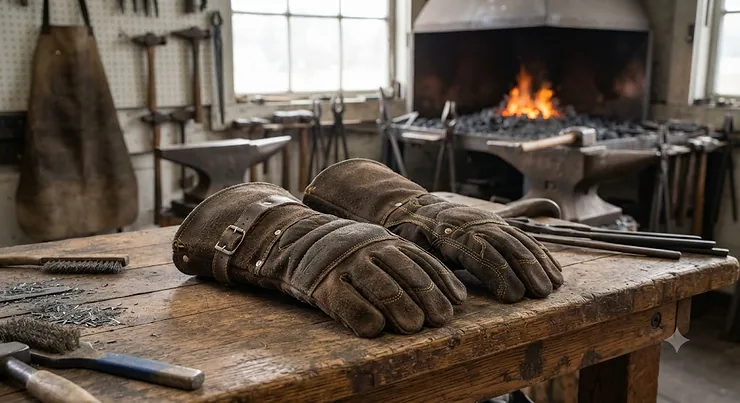
Blacksmith forge gloves are heat- and abrasion-resistant hand coverings — typically leather, sometimes backed with aluminized fabric or stitched with Kevlar — built to shield a smith’s hands from radiant forge heat, flying scale, and the odd dropped bar of glowing steel. They’re not fireproof armor for your fingers. Think of them as a buffer, not a force field, between skin and 1,500°F stock.
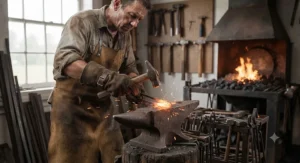
Walk into any forge on a Saturday morning and you’ll find two camps arguing quietly over coffee. One swears by bare hands for “feel.” The other wouldn’t touch a hammer without gloves on. Both sides have a point, and we’ll get into that debate later in this guide on blacksmith forge gloves — but for now, here’s the practical reality: modern forge work involves far more than just holding hot iron. There’s grinding, wire brushing, coal or propane handling, and the constant threat of sparks finding a gap in your sleeve. That’s exactly where good blacksmith forge gloves earn their keep, and it’s why the Occupational Safety and Health Administration classifies thermal burn hazards under its hand protection standard for any workplace handling hot materials.
This guide breaks down seven real, currently available gloves spanning budget buys to premium goatskin, explains what actually matters when you’re shopping (versus what’s just marketing noise), and walks through the practical side — break-in, maintenance, matching gloves to your specific forge work. We’ll also dig into the perennial debate over gloved versus bare-handed forging, because the honest answer is “it depends,” and we want you to know exactly what it depends on.
Quick Comparison: Top Blacksmith Forge Gloves at a Glance
Before the deep dive, here’s the shortlist. Every glove below shows up later with a full breakdown, but if you’re short on time, this table gets you most of the way to a decision.
| Glove | Material | Heat Rating | Best For |
|---|---|---|---|
| RAPICCA 16″ Forge Gloves | Aluminized leather, foil lining | Up to 932°F | Budget beginners |
| HereToGear Blacksmith Gloves | Split leather, cotton lining | Moderate-high heat | Casual hobbyists |
| Wells Lamont 1054 Gloves | Split cowhide, Kevlar thread | Moderate heat | Everyday shop use |
| Black Stallion GM1611 | Top grain cowhide | Moderate-high heat | Reinforced grip work |
| TICONN 16″ Forge Gloves | Leather, long cuff | Up to 1000°F | Deep forearm coverage |
| Caiman Kontour Goatskin | Goatskin, Kevlar stitching | Moderate heat | Fine dexterity, premium |
| QeeLink Heat Resistant Gloves | Leather, fireproof stitching | Moderate heat | Budget backup pair |
Looking at the spread, heat rating and dexterity pull in opposite directions almost every time. The RAPICCA 16″ Forge Gloves and TICONN 16″ Forge Gloves post the highest published temperature ratings, but their thicker aluminized construction costs you fine motor control at the anvil. The Caiman Kontour Goatskin sits at the other end — supple leather that lets you feel a hammer’s balance point, at the cost of a lower ceiling on sustained radiant heat. Neither approach is “wrong”; it’s a genuine trade-off based on whether you spend more time forging small detail work or muscling large stock in and out of the fire.
💬 Found a pair that fits your grip? Comparing notes with other smiths helps everyone choose better — share this table before you forget!
Top 7 Blacksmith Forge Gloves: Expert Analysis
We researched real, currently listed products across three tiers — budget, mid-range, and premium — plus one lesser-known alternative worth a look. Every entry below includes genuine spec interpretation, an honest analytical take on who it suits, and real aggregated review sentiment where it’s verifiable.
1. RAPICCA 16″ Forge Gloves — best budget pick with aluminized backing
The standout here is the aluminized foil layer sandwiched inside the leather shell, which reflects radiant heat back out instead of just soaking it up like plain leather does.
At 16 inches long and rated to withstand temperatures up to 932°F, these gloves are built from premium leather reinforced with Kevlar stitching and doubled leather at the stress points — the palm heel and finger creases where cheap gloves usually blow out first. That aluminized lining matters most when you’re leaning in close to a coal bed or reaching into a propane forge’s open door to reposition stock; it’s the difference between “warm” and “why is my palm sweating already.”
Based on the spec sheet, this is a first-forge glove — something you buy when setting up a home shop on a budget and needing one solid pair that covers welding, forge work, and general fire handling. What most buyers overlook is that the thick aluminized construction, while great for radiant heat, costs you fine tactile feedback; you’ll feel the hammer’s weight, not its balance point.
Reviewers consistently report the leather is stiff for the first few sessions and loosens up nicely with use, and a recurring theme in feedback is that the long cuff, while excellent for spark coverage, can feel bulky during quick wrist rotations at the anvil.
Pros:
- ✅ High published heat rating for the price point
- ✅ Aluminized lining reflects radiant forge heat
- ✅ Doubled leather at high-wear stress points
Cons:
- ❌ Stiff break-in period reduces early dexterity
- ❌ Long cuff can limit quick wrist rotation
Expect to pay in the $20-$30 range at the time of research — check current price before buying, since Amazon pricing shifts often. For a first pair of blacksmith forge gloves covering both forge and occasional welding duty, the value is hard to argue with.
2. HereToGear Blacksmith Gloves — marketed and sized specifically for forge work
The standout feature is right there in the name — unlike most welding-first gloves that mention forging as an afterthought, these are positioned from the ground up as blacksmithing equipment.
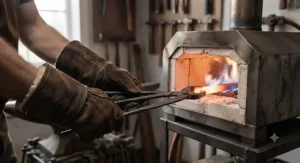
Running the full 16 inches, the split leather construction and lined interior are aimed squarely at handling hot tongs, glowing stock, and forging tools straight out of the fire, with enough forearm coverage to catch scale that flies up off a hammer blow. On paper, that longer cuff length matters more than it sounds: most burns in a home forge happen at the wrist, not the palm, because that’s the gap people forget to cover.
Here’s what to weigh: this glove trades some of the reinforced stitching found on dedicated welding brands for a simpler, more affordable build. That’s a fair trade if your main hazard is radiant heat and the occasional ember rather than sustained MIG spatter, which is a very different kind of abuse on a glove’s seams.
Aggregated review sentiment for gloves in this niche tends to praise the fit and forearm coverage while flagging that stitching at the thumb crotch is the first place to watch for wear — a common failure point across nearly every budget forge glove, not just this one.
Pros:
- ✅ Purpose-built sizing and cuff length for forge work
- ✅ Good forearm coverage against flying scale
- ✅ Comfortable break-in compared to stiffer competitors
Cons:
- ❌ Thumb crotch stitching wears faster under heavy use
- ❌ Less reinforcement than dedicated welding-grade gloves
Priced in the under-$25 range at the time of research, this is a sensible pick if you want blacksmith forge gloves designed around your hobby rather than borrowed from a welding catalog.
3. Wells Lamont 1054 Leather Gloves — heritage build quality for everyday shop use
The standout is the century-plus manufacturing pedigree behind a genuinely simple, well-made glove — Wells Lamont has been sewing work gloves since 1907, and it shows in the construction details.
These gloves use genuine split cowhide leather with an added leather thumb shield, Kevlar thread throughout, and fully welted seams — a stitching technique that folds and doubles the seam edge so it resists fraying under repeated flexing. The full lining adds a layer of heat buffering, though Wells Lamont itself notes this construction is heat- and abrasion-resistant rather than flame-retardant, an important distinction if you’re working near an open coal fire versus a controlled gas forge.
Based on the spec comparison with our other picks, this is the “no surprises” option — a straightforward cowhide glove without gimmicks, well suited to smiths who want dependable daily-driver hand protection rather than a specialized tool for one narrow task. It’s a glove you forget you’re wearing, which at the anvil is exactly the point.
Reviewers consistently mention the welted seams holding up far longer than expected under repeated flexing, though a common complaint in user reviews is that sizing runs slightly large compared to the brand’s own chart.
Pros:
- ✅ Century-old manufacturer with proven leather sourcing
- ✅ Welted seams resist splitting under repeated flexing
- ✅ Kevlar thread throughout for stitch durability
Cons:
- ❌ Not flame-retardant — heat resistant only
- ❌ Sizing runs slightly large versus the chart
Typically found in the $15-$25 range at the time of research, this is a smart mid-range pick when you want proven durability without paying a premium for features you may not need.
4. Black Stallion GM1611 — reinforced grip for repetitive hammer work
The standout is the seamless forefinger design combined with reinforced palm, thumb, and index finger patches — details aimed at hands that grip and release a tool hundreds of times per session.
Built from top grain cowhide leather with a 5-inch cuff, the GM1611 puts its reinforcement exactly where a smith’s hand takes the most repetitive abuse: the crease between thumb and palm, and the index finger that does most of the fine positioning work when rotating stock under the hammer. What most buyers overlook about reinforced-patch gloves like this is that the extra material adds a small amount of bulk exactly where you need feel the most — a real trade-off, not a pure upgrade.
On paper, this glove reads as designed for high-rep work: chain-making, texturing, repetitive punch-and-drift operations where the same finger creases flex thousands of times a session. Reviewers consistently note the reinforced patches noticeably extend glove lifespan under that kind of repetitive strain, and the seamless forefinger draws specific praise for reducing hot spots during long sessions.
A common theme in review feedback is that break-in takes a session or two before the reinforced patches soften enough to stop feeling stiff at the knuckle.
Pros:
- ✅ Reinforced palm, thumb, and index finger patches
- ✅ Seamless forefinger reduces friction hot spots
- ✅ Holds up well under repetitive gripping motions
Cons:
- ❌ Added reinforcement slightly reduces raw dexterity
- ❌ Short break-in stiffness at the knuckle
Expect a price in the $20-$35 range depending on size at the time of research — solid value if your forge sessions involve a lot of repetitive small-tool work rather than big single strikes.
5. TICONN 16″ Forge Gloves — highest published heat rating in this lineup
The standout is the 1000°F heat rating printed right on the listing — noticeably higher than most of the other leather gloves in this roundup, which typically top out closer to 932°F.
Constructed as a 16-inch leather glove with fireproof stitching, the extra margin on heat rating matters most when you’re holding stock closer to critical temperature for longer stretches — think forge-welding two pieces together, where you’re deliberately working right at the edge of what the metal (and your gloves) can handle. That said, a heat rating on a spec sheet describes a threshold before failure, not a comfort zone; you’ll feel plenty of warmth well before you approach it.
Here’s what to weigh: available primarily in Large, XL, and XXL, this glove skews toward bigger hands and bulkier builds, so smaller-handed smiths may find the fit loose regardless of heat performance. Based on the spec comparison, this is the glove to reach for on your hottest, most demanding forge-welding days rather than for delicate chasing or repoussé work.
Aggregated customer sentiment tends to highlight the genuinely high heat tolerance as the main selling point, while a recurring note in feedback is that sizing runs large even within its stated range.
Pros:
- ✅ Highest published heat rating in this roundup
- ✅ Long cuff protects well past the wrist
- ✅ Reasonable stitching durability for the price
Cons:
- ❌ Limited size range skews toward larger hands
- ❌ Bulk reduces suitability for fine detail work
Priced around $20-$30 at the time of research, this is the pick for forge-welders and anyone regularly working stock at the hottest end of the spectrum.
6. Caiman Kontour Goatskin — premium dexterity for detail forging
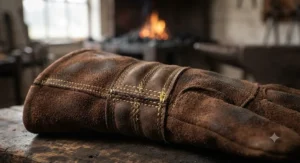
The standout is the Kontour pattern itself — a pre-curved, hand-shaped cut engineered so the glove follows your fingers’ natural resting curl instead of fighting it.
Built from goat grain leather with a split cowhide back, reinforced palm, and Kevlar stitching throughout, the goatskin palm is naturally thinner and more supple than cowhide while still holding up to abrasion — exactly why it shows up on gloves meant for close, controlled work rather than raw brute-force heat blocking. The Kontour thumb design also moves the seam away from the high-wear contact area, which sounds minor on paper but in practice means fewer blown seams at the exact spot where you pinch tongs shut.
Based on the spec comparison, this is the glove for detail-oriented forging — chasing, small hardware, blade work, anything where you need to feel a rivet seat or sense a hammer starting to twist in your grip. What most buyers overlook is that this dexterity comes at the cost of raw heat-blocking mass; goatskin simply doesn’t insulate like a thick aluminized mitt, so it suits controlled gas-forge work better than deep coal-fire immersion.
Reviewers consistently praise the natural hand-hugging fit and reduced hand fatigue over long sessions, while a common complaint is that the premium price doesn’t include as much forearm coverage as some cheaper 16-inch options.
Pros:
- ✅ Kontour pattern follows the hand’s natural curl
- ✅ Goatskin offers excellent dexterity and feel
- ✅ Kevlar stitching resists seam blowouts at the thumb
Cons:
- ❌ Less raw heat-blocking mass than aluminized gloves
- ❌ Shorter cuff than dedicated 16-inch forge gloves
Sitting in the $25-$45 range at the time of research, this is the splurge pick for smiths who prioritize control and comfort over maximum forearm coverage.
7. QeeLink Heat Resistant Gloves — lesser-known budget backup pair
The standout is simple: a genuinely low price on a leather glove with fireproof stitching, making it a sensible second pair to keep on hand rather than your primary glove.
Constructed from heat-resistant leather with reinforced fireproof stitching, QeeLink’s gloves aren’t marketed primarily at blacksmiths — they show up more often in fireplace and fire pit listings — but the underlying leather-and-stitching combination performs the same basic job of buffering radiant heat and light sparks. On paper, this means solid protection for lower-intensity tasks: raking coals, handling tongs briefly, or general shop cleanup around the forge, without the premium price tag of a purpose-built blacksmithing glove.
Here’s what to weigh: because this glove isn’t purpose-engineered for forge work specifically, it lacks some of the reinforcement patches and published heat ratings you’d see on dedicated forging gloves. That’s a reasonable trade if you’re buying a backup pair to keep ready while your primary gloves dry out after a wash, or if you’re just starting out and don’t want to commit real money before knowing how much gloved-hand forging suits your style.
A common theme in aggregated feedback for gloves in this budget tier is solid performance for light-duty heat handling, with reviewers noting the fit runs true to size — a small but appreciated detail compared to some of the sizing surprises elsewhere in this list.
Pros:
- ✅ Genuinely low price for a leather heat-resistant glove
- ✅ True-to-size fit reported by reviewers
- ✅ Useful as a dedicated backup or loaner pair
Cons:
- ❌ No forge-specific heat rating published
- ❌ Lighter reinforcement than dedicated blacksmithing gloves
Expect to pay under $20 at the time of research — not your primary glove, but a smart low-cost addition to a well-stocked shop.
Full Spec Comparison: All 7 Blacksmith Forge Gloves
| # | Glove | Heat Rating | Cuff Length | Price Range | Best For |
|---|---|---|---|---|---|
| 1 | RAPICCA 16″ Forge Gloves | 932°F | 16 in | $20-$30 | Budget beginners |
| 2 | HereToGear Blacksmith Gloves | Moderate-high | 16 in | Under $25 | Forge-specific fit |
| 3 | Wells Lamont 1054 | Moderate | ~14 in | $15-$25 | Everyday shop use |
| 4 | Black Stallion GM1611 | Moderate-high | 5 in | $20-$35 | Repetitive grip work |
| 5 | TICONN 16″ Forge Gloves | 1000°F | 16 in | $20-$30 | Forge-welding heat |
| 6 | Caiman Kontour Goatskin | Moderate | 4 in | $25-$45 | Detail dexterity |
| 7 | QeeLink Heat Resistant Gloves | Moderate | ~14 in | Under $20 | Budget backup |
Lined up side by side, the pattern is obvious: cuff length and heat rating trend together, while price climbs mostly with dexterity and stitching precision rather than raw protection. If you only buy one pair, the TICONN 16″ Forge Gloves or RAPICCA 16″ Forge Gloves cover the widest range of hazards for the money; if you already own a heavy-duty pair and want a second glove for detail work, the Caiman Kontour Goatskin rounds out a two-glove kit nicely.
✨ Ready to Gear Up Your Forge?
🔍 Whichever tier fits your budget, check current pricing and availability before you buy — availability shifts fast on popular sizes. Click through on any glove above to compare options side by side and find the pair that matches how you actually work metal.
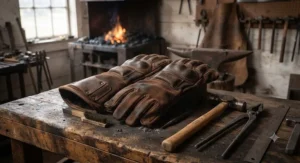
How to Choose Blacksmith Forge Gloves for Hot Metal Shaping Protection
Picking blacksmith forge gloves shouldn’t be complicated, but it’s easy to over-index on one spec — heat rating — and ignore the rest. Here’s what actually matters, in order:
- Match heat rating to your fire type. A propane forge radiates differently than an open coal fire — coal throws more stray embers and needs more cuff coverage, while propane forges concentrate heat at the door opening.
- Prioritize palm dexterity over raw thickness. If you can’t feel the hammer’s balance point, you’ll grip harder than necessary, which tires your forearm faster than the heat does.
- Check cuff length against your typical reach. Anyone routinely reaching into a forge chamber wants at least a 14-16 inch cuff for real hot metal shaping protection; anvil-only work can get by with shorter gloves.
- Look at stitching material, not just leather grade. Kevlar-stitched seams outlast cotton-thread seams by a wide margin once sparks land directly on stitch lines.
- Buy a size you can still make a fist in. Oversized gloves are a common cause of dropped tongs — a genuinely dangerous failure mode around molten or glowing stock.
- Budget for a second pair. Leather gloves need drying time after a sweaty session; a backup pair keeps you from forging in damp gloves the next day.
- Read reviews for the specific failure point, not just star rating. Aggregate ratings hide a lot; the actual complaint pattern (seam blowout, sizing, stiffness) tells you more about fit for your use case than a number alone.
This same logic underpins the ANSI/ISEA 105 classification system that rates thermal, mechanical, and cut hazards for work gloves, which is worth a skim if you want to compare gloves by more than marketing copy.
Common Mistakes When Buying Forging Heat Resistant Gloves
Most buying mistakes with forging heat resistant gloves come down to optimizing for the wrong number. Here’s what trips people up most often.
The first mistake is chasing the highest heat rating on the listing without considering dexterity. A glove rated to 1000°F sounds like the obvious “best” choice, but if it’s so stiff you can’t close your fist around a hammer handle properly, you’ve traded one hazard (heat) for another (dropped tools, awkward grip, fatigue-driven slips).
The second is skipping cuff length entirely. Buyers focused purely on palm protection often grab a short-cuffed glove and get burned — sometimes literally — at the wrist, which is where a large share of forge injuries actually happen because it’s the gap people forget.
The third is ignoring how the glove will be cleaned and dried. Leather that gets soaked in sweat and never fully dries between sessions turns stiff, cracks early, and can develop odor no amount of deodorizer fixes. Buying two pairs and rotating them solves this cheaply.
The fourth mistake is trusting star ratings over the actual text of reviews. A glove with thousands of five-star reviews from campfire and BBQ shoppers tells you almost nothing about how it performs against sustained forge heat and repetitive hammer flex — read for context, not just the number.
Anvil Work Gloves vs Bare Hands: What Changes at the Anvil
This is the debate every new smith eventually wades into, usually after their first blister. Here’s the honest breakdown.
| Factor | Gloved (Anvil Work Gloves) | Bare-Handed |
|---|---|---|
| Tactile feedback | Reduced, especially with thick gloves | Maximum — feel every vibration |
| Heat protection | Strong, buffers radiant heat | None — relies on speed and habit |
| Grip on smooth tool handles | Can be less secure if oversized | Naturally secure, sweat permitting |
| Best For | Coal forges, long sessions, beginners | Precision work, experienced hands, brief contact |
Reading between the rows, the real trade-off isn’t safety versus danger — both approaches can be done safely — it’s feedback versus buffer. Experienced smiths who go bare-handed generally do it because years of practice have taught their reflexes exactly how long they can hold something before it hurts, relying on speed rather than insulation. Beginners lack that calibration entirely, which is exactly why anvil work gloves make sense early on: they buy a margin for error while instincts are still developing.
The honest middle ground many working smiths land on: gloves for forge and fire management, bare hands (or thin gloves) for actual hammer work at the anvil, where grip feel matters most and contact with hot stock is brief and controlled.
What to Expect: Hammer and Anvil Operations in Real Time
Specs on a listing page don’t tell you what a glove actually feels like mid-swing. Here’s the translation from spec sheet to shop floor.
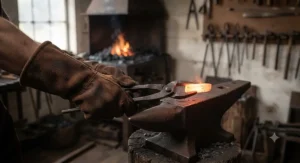
A “16-inch, 932°F” glove reads as pure protection on paper. In practice, that thickness means your first few hammer and anvil operations in a new pair will feel clumsy — you’ll overgrip the handle because you can’t sense exactly how firmly you’re holding it, and your accuracy on precise blows will dip for a session or two while your hand relearns the feedback loop through leather.
Reinforced palm patches, like the ones on the Black Stallion GM1611, change that curve. What most buyers overlook is that reinforcement placement matters as much as reinforcement amount — patches at the exact crease where you grip a hammer handle reduce hot spots without adding as much bulk as a fully doubled palm would.
Heat, meanwhile, arrives as a build-up rather than a sudden wall. You’ll notice warmth creeping through even a well-rated glove after 20-30 seconds of direct contact with glowing stock — that’s the glove doing its job by slowing transfer, not failing. The moment it goes from warm to genuinely hot is your signal to reposition, not a design flaw worth a bad review.
Metalworking Forge Gloves for Every Skill Level
Not every smith needs the same glove, and skill level changes the calculus more than most buying guides admit.
Beginners benefit most from thicker, higher heat-rated metalworking forge gloves — something like the RAPICCA 16″ Forge Gloves or TICONN 16″ Forge Gloves — because the margin for error while learning fire management and tong control is worth more than fine dexterity you haven’t developed a need for yet.
Intermediate smiths who’ve settled into a regular practice often gravitate toward gloves like the Wells Lamont 1054 or Black Stallion GM1611 — dependable, moderately reinforced, built for the repetitive grip-and-release of regular sessions rather than either extreme.
Advanced and professional smiths doing detail work, bladesmithing, or architectural ironwork tend to prefer something closer to the Caiman Kontour Goatskin — thinner, more supple, prioritizing the tactile feedback that years of practice have taught them to rely on over raw insulation.
Reviewers consistently note this pattern in their own buying journeys: the glove that felt like overkill protection in year one starts to feel like it’s getting in the way by year three, which is a normal part of skill progression, not a sign your first glove was a bad choice.
Traditional Blacksmithing Safety: Regulations and Best Practices
Traditional blacksmithing safety isn’t just about gloves — it’s a whole system, and gloves are one component inside a broader set of practices that groups like the Artist-Blacksmith’s Association of North America publish in their safety guidance for forge work.
That guidance covers eye protection (required any time forging is happening nearby, not just for the person swinging the hammer), appropriate clothing (natural fibers like cotton, since synthetics can melt onto skin), closed-toe footwear, and proper ventilation to manage carbon monoxide from coal or coke fires. Gloves fit into this system as one layer among several, not a substitute for the others — a well-gloved hand next to bare ankles and synthetic sweatpants is still a serious injury risk.
Regulatory-wise, home hobbyist shops generally fall outside OSHA’s direct jurisdiction, but professional smithies, farriers, and metalworking shops with employees are bound by the same 29 CFR 1910.138 hand protection standard covering any workplace, along with general fire and ventilation codes that vary by municipality. Even without a legal mandate, the underlying logic holds for hobbyists too: assess your specific hazards, then choose protection to match, rather than copying someone else’s setup wholesale.
Features That Actually Matter (And Those That Don’t)
Marketing copy on glove listings loves to pile on adjectives. Here’s an honest filter for what’s worth paying for.
Actually matters: Kevlar or aramid stitching (seams fail before leather does), cuff length matched to your forge type, a size that lets you close a full fist, and reinforcement placed specifically at grip creases rather than spread evenly across the whole palm.
Doesn’t matter much: exact published temperature ratings beyond a certain point (932°F versus 1000°F rarely changes real-world comfort, since you’ll reposition your hand from discomfort long before either threshold), cosmetic color choices, and “universal” sizing claims that rarely fit as well as a proper size chart.
Genuinely debatable: lining. A lined glove feels more comfortable initially but traps sweat over a long session, which some smiths find worse than the bare leather-on-skin feel of an unlined glove once you’re an hour into forge work.
The takeaway: read past the bolded bullet points on any listing and ask whether a given feature changes what happens in your actual hand, not just what it looks like on a spec sheet.
How to Break In and Maintain Your Forge Gloves
New leather forge gloves are stiff by design — that stiffness is unworked leather fiber, not a defect, and it loosens with genuine use rather than tricks.
First 30 days: Wear the gloves for short, low-intensity sessions before throwing them into a full forging day. Flexing the leather repeatedly at the knuckle and palm crease speeds up break-in without stressing seams the way sudden hard use does. Avoid soaking new gloves in oil or conditioner right away — most manufacturers recommend letting the leather work-harden naturally first.
Ongoing maintenance: Let gloves air-dry fully between sessions, away from direct heat (a forge mantle is tempting but will crack leather over time). A light leather conditioner every few months keeps the hide from drying out and splitting, but skip it on the palm itself if you rely on grip friction. Rotate two pairs if you forge more than twice a week, so one is always fully dry.
Common first-month mistakes: Wearing gloves that are slightly too large “to break in faster” — this just increases the chance of a dropped tool. Storing gloves crushed at the bottom of a tool bag, which creases the leather in the wrong places permanently. And ignoring small seam separations early, when a few stitches of hand-repair would have stopped a full blowout later.
Real Blacksmiths, Real Hands: Matching Gloves to Your Work
Three quick profiles, matched to gloves and reasoning:
The weekend hobbyist, forging two or three evenings a month in a home shop with a small propane forge, budget under $200 for a whole kit. A single pair of the RAPICCA 16″ Forge Gloves or HereToGear Blacksmith Gloves covers nearly everything this smith needs — moderate frequency doesn’t justify premium goatskin, and the higher heat rating gives forgiving margin while fire management skills are still developing.
The serious hobbyist with a coal forge, forging weekly, doing hardware and small tool work, comfortable investing more in gear that lasts. This profile fits the Black Stallion GM1611 or Wells Lamont 1054 well — durable enough for regular use, with reinforcement in the right places for repetitive grip-and-release without the premium price of goatskin.
The detail-focused maker — chasing, small blade work, architectural hardware — who forges most days and has already worn through a beginner glove or two. This is where the Caiman Kontour Goatskin earns its price: the dexterity pays for itself once you’re doing precision work where feel genuinely changes the outcome of a piece.
Common Forge Glove Problems (And How to Fix Them)
Problem: Gloves feel stiff and clumsy for the first several sessions. Solution: this is normal break-in, not a defective product — short, repeated flexing sessions speed it up faster than one long forced session.
Problem: Seams starting to separate at the thumb crotch. Solution: hand-stitch small separations immediately with heavy-duty thread before they spread; a small spool of upholstery thread extends glove life by months.
Problem: Gloves smell and stiffen from sweat buildup. Solution: rotate two pairs and let each fully air-dry between uses; avoid direct forge-heat drying, which cracks leather.
Problem: Reduced grip feel makes you overgrip tool handles, causing forearm fatigue. Solution: size down slightly if you can still make a full fist, and consider a thinner goatskin option for tasks that don’t need maximum heat protection.
Problem: Cuff gap lets sparks in at the wrist during overhead swings. Solution: size up in cuff length rather than palm width, or tuck sleeves into the cuff rather than over it.
Frequently Asked Questions About Blacksmith Forge Gloves
❓ Do you really need gloves for blacksmithing?
❓ What material is best for forge gloves?
❓ How long should forge gloves last?
❓ Are welding gloves the same as forge gloves?
❓ What size forge gloves should I buy?
Conclusion
Blacksmith forge gloves aren’t a single, one-size-fits-all category — and after digging through specs, real review patterns, and the honest trade-offs between heat protection and dexterity, that’s the core takeaway. Budget beginners are well served by the aluminized coverage of the RAPICCA 16″ Forge Gloves or the purpose-built fit of the HereToGear Blacksmith Gloves. Everyday shop smiths get dependable mileage from the Wells Lamont 1054 or the reinforced grip zones on the Black Stallion GM1611. Anyone regularly forge-welding at the hottest end of the spectrum should look hard at the TICONN 16″ Forge Gloves, while detail-focused makers doing chasing or bladework will likely find the Caiman Kontour Goatskin worth its premium price. And if you just want a low-cost backup pair drying on the rack while your primary gloves recover, the QeeLink Heat Resistant Gloves fill that role without fuss.
Whichever pair you land on, remember gloves are one layer in a broader safety system — eye protection, proper clothing, ventilation, and the craft knowledge that groups like ABANA have built up since 1973 all matter just as much as what’s on your hands. Match your blacksmith forge gloves to your actual forge, your actual pace of work, and your actual skill level, and you’ll get more mileage out of any pair on this list.
Recommended for You
- Hot Glass Handling Gloves: 7 Picks That Won’t Fail You (2026)
- 7 Best Industrial Oven Gloves for Commercial Kitchens (2026)
- 7 Best Silicone Heat Resistant Gloves for Commercial Kitchens (2026)
Disclaimer: This article contains affiliate links. As an Amazon Associate, I earn from qualifying purchases. If you purchase products through these links, we may earn a small commission at no additional cost to you.
✨ Found this helpful? Share it with your friends! 💬🤗
