
In This Article
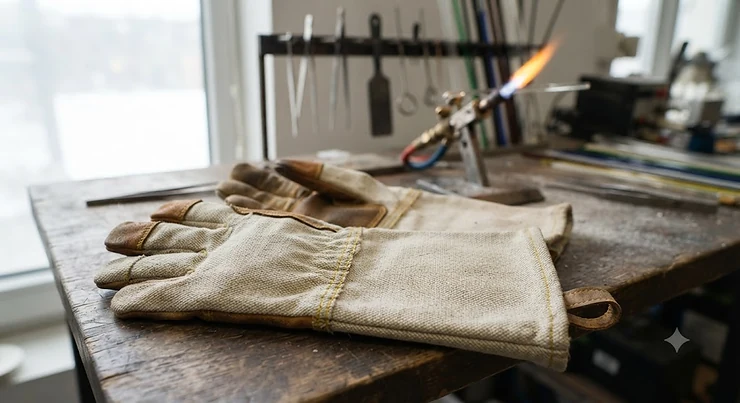
Molten glass does not forgive hesitation, and neither does a bad glove. Anyone who has stood at a bench with a 2,000°F gather wobbling on the end of a punty knows that the difference between a good session and a trip to urgent care often comes down to what’s on your hands. hot glass handling gloves are not one-size-fits-all safety theater — they’re a category with real engineering differences between a $20 leather welding glove and a $90 aramid mitt built specifically for a hot shop. In plain terms, hot glass handling gloves are protective hand coverings made from heat-resistant materials like Kevlar, aramid blends, or aluminized leather, designed to shield skin from radiant furnace heat and brief contact with hot tools and glass.
This guide exists because most “best gloves” roundups online just regurgitate spec sheets copied from Amazon listings, which — besides being against the platform’s own rules now — doesn’t actually help you pick correctly. We dug into real products, real specifications, and the aggregated sentiment from actual buyers to build something closer to what a shop tech would tell you over coffee. You’ll get a fast comparison table if you’re in a hurry, then a full breakdown of seven real gloves spanning budget kiln mitts to purpose-built glassblowing gauntlets, plus the buying logic that separates “looks tough” from “actually works at 1,900°F.”
Whether you’re outfitting a home studio, restocking a school hot shop, or just tired of singeing your knuckles on a bead kiln, here’s what’s actually worth your money — and, just as important, what a glove genuinely cannot do for you see OSHA’s hand-protection standard for the baseline every workplace is legally expected to meet.
Quick Comparison Table: Hot Glass Handling Gloves at a Glance
| Glove | Heat Rating | Best For | Price Range |
|---|---|---|---|
| Newtex Zetex Plus Glassblower’s Mitts | Extreme radiant + brief contact | Gathering & marvering molten glass | $70-$100 range |
| Wale Apparatus Dragon Glass Fiber Kevlar Glove | ANSI Level 5 | Lampworking, beadmaking dexterity | $35-$55 range |
| RAPICCA 16-Inch Forge Welding Gloves | 932°F rated | All-around furnace/kiln door work | $20-$30 range |
| OZERO 14-Inch EN407 Certified Gloves | 932°F (EN407 tested) | Budget pick with lab-verified ratings | $15-$25 range |
| Wells Lamont 1059L Lined Leather Gloves | Not flame-rated | General warm-surface handling | $12-$20 range |
| Delphi Hot Gloves | Up to 400°F | Kiln lid lifting, quick checks | $15-$25 range |
| SHOWA Glass Handling Gloves | N/A (cut-resistant) | Cooled/annealed glass, not molten | $10-$20 range |
A quick read of that table tells the real story: heat rating and price track together almost linearly, but “best for” is where people get burned — sometimes literally. The Newtex Zetex Plus Glassblower’s Mitts sit at the top for actual molten-glass contact because they’re engineered for that specific job, not repurposed from welding or barbecuing. The SHOWA Glass Handling Gloves, meanwhile, aren’t heat gloves at all — they’re cut-resistant gloves for annealed glass, and including them here is intentional, since so many searches for “hot glass handling gloves” are actually looking for full-studio hand protection, not just furnace mitts. Notice, too, that a 932°F rating (RAPICCA, OZERO) doesn’t automatically mean “safe to grip molten glass” — that number usually describes brief contact tolerance, not sustained holding of a 2,000°F gather.
🧤 Ready to compare specific pairs side by side? Scroll down to the full breakdown — your hands will thank you.
Top 7 Hot Glass Handling Gloves: Expert Analysis
1. Newtex Zetex Plus Glassblower’s Mitts — purpose-built for gathering molten glass
The standout here is right in the name: these mitts are made specifically for hot glass work, not adapted from welding or foundry lines. Zetex Plus is a texturized fiberglass fabric with a silica-based coating that reflects radiant heat away from the hand, and the mitt shape (rather than five-finger construction) reduces stitching seams that could otherwise become failure points during a long gathering session. In practice, this means the glove tolerates sustained proximity to furnace glory-hole heat far better than a Kevlar/leather hybrid, because the coating is doing active reflective work rather than just insulating passively.
Based on the spec comparison with general-purpose welding gloves, this is the pair aimed at people actually gathering glass off the pipe, not just opening kiln doors. It’s the honest choice for a working hot shop bench, a teaching studio, or anyone doing off-hand work near an open furnace multiple times a day. Reviewers and studio buyers in this niche consistently report that the mitt shape sacrifices some fine dexterity compared to five-finger gloves, which is a fair trade for the heat performance — you’re not threading a needle at the bench, you’re rotating a pipe.
Pros:
- ✅ Reflective coating built specifically for radiant furnace heat
- ✅ Fewer seams than five-finger gloves, fewer failure points
- ✅ Purpose-designed for hot glass, not repurposed PPE
Cons:
- ❌ Reduced finger dexterity versus five-finger gloves
- ❌ Premium price relative to general welding gloves
At around $70-$100, this sits at the top of the price range in this roundup, but for anyone handling actual molten gathers regularly, it’s arguably the only glove here truly designed for that specific hazard.
2. Wale Apparatus Dragon Glass Fiber Kevlar Glove — best dexterity for lampworking and beadmaking
What makes this one stand out is the seamless knit construction — a rarity in heat-resistant gloves, most of which are cut-and-sewn. The outer shell is 100% Kevlar rated to ANSI Level 5 heat protection, fully lined with a terry cloth interior, and the seamless design means there’s no stitched seam across the palm to fail or fray under repeated heat cycling. That combination of Kevlar’s decomposition resistance and a knit structure gives it flexibility that cut-and-sewn gloves genuinely can’t match — aramid fibers like Kevlar resist melting up to roughly 932°F before structural breakdown, which is why this material shows up across the entire premium end of this category.
This one’s for flameworkers and beadmakers who need to grip small tools, rotate mandrels, and manipulate rods at a torch — not people reaching bare-handed into a furnace glory hole. What most buyers overlook about this style is that dexterity, not just heat rating, is often the deciding factor for bench work; a stiffer glove that “protects more” on paper can actually increase burn risk if it makes you clumsy near a flame. Aggregated buyer sentiment for seamless knit gloves in this category tends to praise the natural hand-feel while noting they run a bit warm for long sessions in already-hot studios.
Pros:
- ✅ Seamless knit avoids stitch-seam failure points
- ✅ ANSI Level 5 heat rating in a flexible glove
- ✅ Terry lining adds comfort during long torch sessions
Cons:
- ❌ Less bulk protection than a mitt for direct furnace reach
- ❌ Can feel warm during extended studio sessions
Priced in the $35-$55 range depending on size, it’s a strong mid-tier pick specifically for glassblowing gloves used at a torch rather than a furnace.
3. RAPICCA 16-Inch Forge Welding Gloves — best all-around furnace and kiln glove
RAPICCA’s forge gloves earn their spot through sheer specification density: a 1.2mm split cowhide shell, Kevlar stitching, an aluminized reflective layer, and a 16-inch gauntlet cuff that covers most of the forearm. That extended cuff matters more than it sounds — a huge share of hot-glass burns happen on the wrist and forearm during reach-ins, not the palm, so the extra coverage directly targets a real accident pattern rather than just padding the spec sheet.
Here’s what to weigh: this glove is rated for contact heat up to 932°F for roughly 16 seconds according to the manufacturer’s testing, which tells you it’s built for brief, deliberate contact — kiln door handles, furnace tool holders, moving hot kiln furniture — rather than sustained gripping of a molten gather. Reviewers across general marketplaces consistently mention that the leather stays flexible even after repeated heat exposure, a detail that matters because stiff, cracked leather is a common complaint with cheaper forge gloves after a few months of daily use.
Pros:
- ✅ 16-inch cuff protects forearms during furnace reach-ins
- ✅ Aluminized layer adds reflective heat protection
- ✅ Leather stays flexible after repeated heat cycling
Cons:
- ❌ Not designed for direct contact with molten glass itself
- ❌ Bulkier fit reduces fine-tool dexterity
At $20-$30, this is genuinely good value for a studio that needs one durable, do-everything glove for furnace and kiln door duty.
4. OZERO 14-Inch EN407 Certified Welding Gloves — best budget pick with lab-tested ratings
The standout advantage is verification: this pair carries an EN407 43314X rating, meaning it’s actually been lab-tested for contact heat, convective heat, radiant heat, and small splash exposure rather than just carrying a marketing claim of “932°F.” That certification number is worth understanding rather than skimming past — the “4” in flame behavior and small-splash categories indicates a meaningfully higher tier than gloves that only advertise a single temperature figure with no testing standard behind it.
On paper this means a buyer gets third-party accountability at a genuinely low price point, which is rare in this category. Based on the spec comparison with uncertified competitors at a similar price, the four-layer construction (leather, aluminum foil reflector, flame-retardant cotton, aramid stitching) punches above its price class. What the spec sheet won’t tell you, but aggregated user feedback suggests, is that the 14-inch cuff length is noticeably shorter than RAPICCA’s 16-inch option — fine for kiln work at a bench, less ideal for deep furnace reach-ins.
Pros:
- ✅ EN407 lab certification, not just a marketing claim
- ✅ Four-layer construction at a budget price point
- ✅ Pre-curved fingers improve grip near hot surfaces
Cons:
- ❌ Shorter 14-inch cuff than some furnace-specific gloves
- ❌ Not rated for wet heat or greasy/oily contact
In the $15-$25 range, this is arguably the smartest first pair for a home studio just getting a kiln or small furnace set up.
5. Wells Lamont 1059L Lined Leather Welding Gloves — most affordable general-purpose leather glove
Wells Lamont has been making leather work gloves since 1907, and this pair leans on that legacy of straightforward, no-frills construction: split cowhide, Kevlar-thread stitching for durability, and a welted seam design that keeps the fingers from blowing out under repeated flexing. The angled wing thumb is a small but real detail — it reduces the seam directly in the high-stress area between thumb and palm, which is usually the first place a cheap glove fails.
Here’s the honest caveat, and it’s an important one: the manufacturer explicitly states these gloves are not flame retardant, meaning they resist abrasion and moderate warmth well but were never engineered against sustained radiant heat the way a Kevlar or aramid glove is. What most buyers overlook is that “leather” and “heat-resistant” aren’t synonyms — untreated leather chars and can ignite under sustained high heat, so this pair is best matched to warm-surface handling and general shop tasks rather than furnace or kiln-door duty. Aggregated review sentiment consistently praises the durability-to-price ratio for general work use, with less enthusiasm when buyers apply it to tasks it wasn’t built for.
Pros:
- ✅ Reinforced wing thumb resists a common failure point
- ✅ Kevlar-thread stitching adds seam durability
- ✅ Lowest price point in this roundup
Cons:
- ❌ Not flame retardant per the manufacturer’s own listing
- ❌ Not appropriate for direct furnace or molten-glass contact
At $12-$20, treat this as a general-purpose warm-surface glove, not your primary hot glass handling gloves for furnace work — pair it with a certified pair for anything above moderate heat.
6. Delphi Hot Gloves — lightest glove for quick kiln-lid checks
This pair’s advantage is specificity: it’s rated and marketed for kiln work up to 400°F, which sounds modest next to the 932°F leather gloves above, but that’s precisely the point — most kiln-lid lifting, venting, and peeking tasks in fusing and slumping studios happen well under that ceiling, and a lighter glove means better tactile feedback for those quick, frequent motions. The manufacturer is refreshingly upfront that these are not designed for grasping firing ware directly or performing high-temperature tasks, which is the kind of honest labeling this category needs more of.
Based on the spec comparison, this glove is doing one job well rather than trying to cover every hazard in a hot shop. A separated-finger design (versus a mitt) gives more dexterity for latch mechanisms and controller dials than a bulky forge glove would. One documented user comment on the retailer’s own product page specifically noted the separated fingers provide more dexterity than oven mitts for kiln venting — a small but telling detail that lines up with the product’s stated purpose.
Pros:
- ✅ Separated fingers aid dexterity for kiln controls and latches
- ✅ Lightweight enough for frequent, quick checks
- ✅ Manufacturer is explicit about the glove’s real limits
Cons:
- ❌ Capped at 400°F — unsuitable for furnace or molten glass work
- ❌ Not designed to grasp fired ware directly
Priced around $15-$25, this is a smart secondary pair for kiln operation handling tasks, not a substitute for a full furnace glove.
7. SHOWA Glass Handling Gloves — best for handling cooled and annealed glass
The final entry deliberately isn’t a heat glove — it’s a cut-resistant glove built for the other major hazard in glasswork: sharp edges on cooled, cut, or broken glass. The standout feature is a high-cut-resistance knit shell designed specifically for glass handling, which matters because annealing ovens, cold-working stations, and glass sheet handling produce more cut injuries in a typical studio than burns do, according to industry PPE guidance on glass-specific hazards.
Here’s the practical logic: once a piece leaves the annealer, the danger shifts from radiant heat to sharp edges and shards, and a heat glove offers little cut protection while a cut-resistant glove offers essentially no heat protection. What most buyers overlook is that a complete glass studio kit needs both categories, not one glove trying to do both jobs badly. Aggregated reviewer sentiment on cut-resistant glass gloves commonly highlights grip retention on smooth glass surfaces as the key differentiator between mediocre and excellent pairs in this niche.
Pros:
- ✅ Purpose-built cut resistance for glass edges and shards
- ✅ Complements heat gloves rather than competing with them
- ✅ Better grip on smooth, cold glass than leather gloves offer
Cons:
- ❌ Provides essentially no heat protection
- ❌ A second purchase alongside your furnace gloves, not a replacement
At $10-$20, this is the most overlooked line item in most beginner glass-studio shopping lists — and one of the cheapest ways to prevent a different, equally common injury.
Practical Usage Guide: Setting Up Your Hands for the First 30 Days
Getting a new pair of hot glass handling gloves right starts before you ever touch a furnace. First, break them in with short, low-stakes tasks — moving cool tools, practicing pipe rotation with a cold blank — before your first real gather. Leather and aramid both perform slightly differently once they’ve flexed a few dozen times, and finding that out during a kiln-loading session beats finding out mid-gather.
Second, build a maintenance rhythm from day one. Wipe leather gloves with a barely damp cloth after each session; never machine-wash them, since repeated soaking stiffens cowhide and breaks down the natural oils that keep it supple. Kevlar and Zetex mitts should be visually inspected weekly for thinning, especially at the palm crease where flexing concentrates wear fastest. A common first-month mistake is treating gloves as indestructible because the tag says “932°F” — that number describes brief contact tolerance under lab conditions, not unlimited lifespan.
Finally, resist the urge to buy one “do everything” glove. The smartest studios keep at least two pairs in rotation: one dedicated exclusively to touching hot glass and furnace tools, and a second, cheaper pair for grunt work like moving kiln furniture or opening doors — a distinction hot-glass veterans have been recommending for years, and one echoed directly by specialty glove retailers who serve this exact market, per detailed sizing and material guidance from a dedicated glassblowing glove supplier.
👉 Not sure which pair matches your setup? Check the comparison table above before you check out.
Real-World Scenarios: Matching the Glove to Your Bench
Consider a college ceramics-and-glass student sharing a communal hot shop three afternoons a week. Budget is tight, hours are limited, and the furnace is shared with a dozen other students who don’t always maintain their own gear. For this profile, the RAPICCA 16-Inch Forge Welding Gloves make sense as a personal, dedicated pair — durable enough to survive inconsistent studio conditions, priced low enough that losing or damaging them isn’t a financial disaster, and versatile enough to cover both furnace door duty and general bench tasks.
Now picture a semi-professional lampworker running a small home studio, torching beads and small sculptural pieces four or five hours a day. Dexterity matters more than raw heat tolerance here, since the torch is localized rather than a full furnace glory hole. The Wale Apparatus Dragon Glass Fiber Kevlar Glove fits this profile precisely — enough heat resistance for torch proximity, with the seamless knit flexibility that repetitive fine motor work demands.
Finally, imagine a working studio glassblower gathering off a furnace multiple times an hour, all day, five days a week. This is where the Newtex Zetex Plus Glassblower’s Mitts justify their premium price — daily furnace exposure at this volume is exactly the sustained radiant-heat scenario the material was engineered to handle, and cutting corners here has the highest downside of any scenario in this guide.
Problem → Solution: Fixing the Most Common Glove Failures
Problem: Gloves feel stiff and cracked after a few weeks. This almost always means leather gloves were exposed to more direct heat than they’re rated for, or were cleaned incorrectly. Solution: reserve leather-and-Kevlar hybrids like the RAPICCA or OZERO pairs for brief contact tasks, and use a barely damp cloth for cleaning rather than soaking or machine washing.
Problem: Hands overheat during long sessions even though the glove is rated high enough. A high heat rating and breathability are different specs entirely. Solution: for extended torch or bench work, a seamless knit option like the Wale Apparatus Dragon Glove trades a bit of peak heat tolerance for better airflow and comfort over hours.
Problem: Glove grips poorly on cold, smooth glass during cold-working. This is a sign you’re using a heat glove for a cut-hazard task. Solution: switch to a dedicated cut-resistant pair like the SHOWA Glass Handling Gloves for annealed or cooled glass handling.
Problem: Seams fail at the thumb first. Look for wing-thumb construction, like the Wells Lamont 1059L, which reduces stitching stress at that exact point — though remember this pair still isn’t flame retardant.
Problem: Budget doesn’t stretch to a purpose-built glassblowing mitt yet. The Delphi Hot Gloves or OZERO 14-Inch Gloves cover the most common lower-heat tasks affordably while you save toward a dedicated furnace mitt.
How to Choose Hot Glass Handling Gloves
Five criteria separate a smart purchase from an expensive mistake:
- Match the rating to the actual task. A 932°F contact rating for 15-20 seconds is not the same as safe sustained furnace gripping — read the fine print, not just the headline number.
- Check cuff length against your reach distance. Deep furnace or glory-hole work needs 14-16 inches of forearm coverage; bench and kiln-lid work can get by with less.
- Weigh dexterity against raw protection. More insulation often means less fine motor control — and clumsy hands near molten glass carry their own risk.
- Separate heat protection from cut protection. These are different hazards requiring different gloves; don’t expect one pair to solve both.
- Look for third-party certification, not just a marketing number. EN407 or ANSI-rated products, like the OZERO or Wale Apparatus pairs, have been independently tested rather than self-described.
Common Mistakes When Buying Glassblowing Gloves
The single biggest mistake is buying based on the highest advertised temperature number alone. A glove rated to 932°F for brief contact says nothing about comfort, dexterity, or cuff coverage — all factors that affect real-world safety just as much as peak heat tolerance. A second common error is assuming any “heat resistant” glove is also flame retardant; as the Wells Lamont listing itself makes clear, that’s not automatic. Third, many first-time buyers purchase only one glove for an entire studio’s needs, when furnace work, kiln handling, and cold-glass handling genuinely call for different equipment. Finally, skipping cuff length to save a few dollars is a false economy — most documented burns in hot shops happen on the wrist and forearm during a reach-in, not the palm.
Molten Glass Gloves vs Everyday Oven Mitts
It’s worth addressing this directly, because the confusion is common: a kitchen oven mitt and a molten glass glove are not interchangeable, despite superficial similarity. Oven mitts are typically rated for dry heat exposure well under 500°F and are designed for brief handle-grabbing, not radiant furnace exposure or contact with material still glowing orange. Molten glass gloves and mitts, like the Newtex Zetex Plus pair, use reflective coatings and heat-specific fibers engineered for radiant heat in the 1,700-2,200°F furnace range, plus repeated exposure cycles a kitchen mitt was never tested against.
The practical risk of substitution is real: an oven mitt can smolder or char rapidly near an open furnace, and its bulk often lacks the reinforced palm and cuff coverage that hot glass work specifically demands. If you’re setting up any furnace or glory-hole access point, budget for purpose-rated gloves — the price difference between a decent forge glove and a kitchen mitt is often under $20, which is cheap insurance against a serious burn.
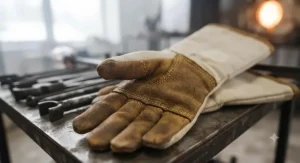
Glass Furnace Gloves for Studio vs Industrial Kiln Use
Studio glassblowing and industrial glass manufacturing share the same underlying hazard — radiant heat from molten material — but the equipment context differs enough to affect glove choice. A small studio furnace glory hole is typically a fixed, known-distance reach, which is why gloves like the RAPICCA 16-Inch or Newtex Zetex Plus mitts, sized for hand and forearm coverage at that specific distance, dominate the hobbyist and small-studio market.
Industrial glass manufacturing settings often involve conveyor lines, larger furnace openings, and longer, more repetitive shift-based exposure, which pushes toward heavier-duty aluminized gauntlets and rotational glove-replacement schedules rather than a single “forever pair.” The interpretation for buyers: if you’re outfitting a hobbyist studio, prioritize dexterity and cuff length; if you’re speccing PPE for a production environment, prioritize certified ratings, replacement frequency, and compliance documentation over comfort alone.
What to Expect: Real-World Performance
On paper, a 932°F rating sounds like near-total protection. In practice, what that number actually buys you is a several-second buffer — enough time to react, reposition, or set something down safely, not indefinite immunity from a furnace’s full heat. Reviewers and studio veterans alike describe the sensation less as “feeling nothing” and more as “feeling warmth build gradually,” which is exactly the early-warning signal a well-designed glove is supposed to give you.
Expect leather-based gloves like the RAPICCA or OZERO pairs to soften and mold to your hand shape within the first few sessions, improving comfort but requiring more frequent palm inspections as that flexibility increases. Expect aramid and Zetex options like the Newtex and Wale Apparatus gloves to hold their shape longer but run noticeably warmer on your own skin during extended wear, since the same insulation blocking furnace heat also traps your body heat inside the glove.
Artistic Glasswork Protection Beyond the Gloves
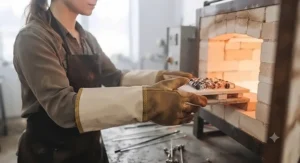
Gloves are one piece of a larger safety picture for anyone doing serious artistic glasswork. Safety glasses or didymium lenses rated for the specific wavelengths glass furnaces emit protect eyesight that no glove can substitute for, and heat-resistant aprons or sleeves cover the forearm and torso areas gloves don’t reach. Studios that take this seriously tend to standardize their full kit rather than treating gloves as a stand-alone purchase — a pattern reflected in how established teaching studios structure their own safety protocols and equipment requirements for students and visiting artists alike, per Corning Museum of Glass’s published studio safety guidance.
Footwear matters too — closed-toe, non-melting shoes are standard in any working hot shop, since dropped glass or splatter at floor level is a genuine and underdiscussed hazard. None of this diminishes the importance of the glove itself; it simply means a great pair of hot glass handling gloves is the centerpiece of a safety kit, not the entirety of one.
Glass Manufacturing Safety & Regulations Guide
In the United States, hand protection in any workplace — studio, school, or industrial glass manufacturing facility — falls under OSHA’s general PPE standard, 29 CFR 1910.138, which requires employers to select gloves based on an actual evaluation of the specific hazards present, not a generic policy. That means a studio manager is expected to document why a given glove was chosen for furnace work versus cold-glass handling, rather than issuing one type of glove for every task.
For independent studios and hobbyists, there’s no equivalent legal mandate, but the underlying logic still applies: match the PPE to the documented hazard. Buying a glove rated for the actual peak temperature and contact duration you’ll encounter — and pairing it with cut-resistant gloves for cold-working — mirrors exactly what a compliant industrial safety program would require, just applied at a smaller scale.
✨ Ready to Gear Up? Compare all seven picks one more time before your next studio session — the right pair pays for itself the first time it saves your hand.
Kiln Operation Handling: A Buyer’s Decision Framework
If your primary task is lifting kiln lids, checking fusing schedules, or handling controller dials, choose a lightweight, separated-finger glove like the Delphi Hot Gloves because dexterity and quick, frequent use matter more than maximum heat tolerance. If your primary task is reaching into an open furnace glory hole multiple times per session, choose a long-cuff, high-heat-rated glove like the RAPICCA 16-Inch or Newtex Zetex Plus mitts because forearm coverage and radiant-heat performance are non-negotiable. If your budget is genuinely tight but you still need certified protection, choose the OZERO 14-Inch EN407 Certified Gloves because independent lab testing at a low price point beats an unverified higher number from a cheaper competitor. If your work is entirely torch-based rather than furnace-based, choose the Wale Apparatus Dragon Glove for its seamless dexterity advantage.
Long-Term Cost & Maintenance
| Glove | Typical Lifespan (Active Studio Use) | Price Range | Replacement Value |
|---|---|---|---|
| Newtex Zetex Plus Mitts | 6-12 months | $70-$100 range | Best for daily furnace exposure |
| RAPICCA 16-Inch Gloves | 3-6 months | $20-$30 range | Strong value for mixed furnace/kiln use |
| OZERO 14-Inch Gloves | 3-6 months | $15-$25 range | Best cost-per-certification |
| Wells Lamont 1059L | 6-12 months (general use only) | $12-$20 range | Cheapest, but not furnace-rated |
Looking at long-term ownership rather than sticker price alone changes the math considerably. The Newtex Zetex Plus Mitts cost roughly three to four times as much upfront as the RAPICCA pair but, in a genuinely active furnace-facing role, often deliver comparable or longer service life because the material was engineered for that exact exposure rather than adapted from welding use. Treating any hot glove as a consumable rather than a one-time purchase is the healthiest mental model here — expect to budget for replacements every few months in an active studio, and resist the temptation to keep using a pair well past visible wear just because it hasn’t failed yet.
Frequently Asked Questions
❓ What temperature do hot glass handling gloves need to withstand?
❓ Can I use welding gloves for glassblowing?
❓ Are Kevlar gloves safe for touching molten glass directly?
❓ How often should I replace my hot glass gloves?
❓ Do I need different gloves for kiln work versus furnace work?
Conclusion
Hot glass handling gloves aren’t a single product category so much as a spectrum matched to a spectrum of hazards — from a quick kiln-lid peek to hours of daily furnace gathering. The Newtex Zetex Plus Glassblower’s Mitts earn their premium price for anyone doing real molten-glass work, the Wale Apparatus Dragon Glass Fiber Kevlar Glove covers torch-based lampworking beautifully, and budget-conscious buyers have genuinely solid, lab-certified options in the OZERO 14-Inch and RAPICCA 16-Inch gloves. Round out any studio kit with the Delphi Hot Gloves for kiln duty and the SHOWA Glass Handling Gloves for the cold-side cut hazards a heat glove was never built to solve.
The through-line across every product here is the same: match the glove to the actual task in front of you, read past the headline temperature number, and treat these as consumables you replace on a schedule rather than gear you wear until it visibly fails. Do that, and the seven pairs above will keep your hands exactly where they belong — safely on the pipe, not in urgent care.
Recommended for You
- 7 Best Industrial Oven Gloves for Commercial Kitchens (2026)
- 7 Best Silicone Heat Resistant Gloves for Commercial Kitchens (2026)
- Nomex Heat Resistant Gloves: 7 Best Picks Ranked for 2026
Disclaimer: This article contains affiliate links. As an Amazon Associate, I earn from qualifying purchases. If you purchase products through these links, we may earn a small commission at no additional cost to you.
✨ Found this helpful? Share it with your friends! 💬🤗
