
In This Article
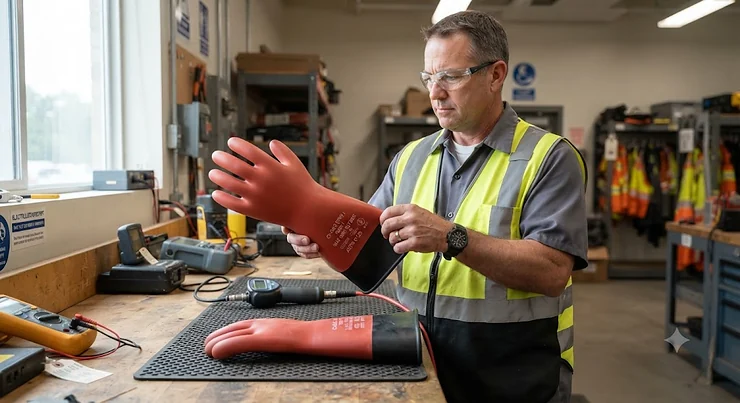
Somewhere between “this glove looks thick enough” and an actual arc flash incident report sits every bad decision ever made about hand protection near live conductors. high voltage insulating gloves are not a fashion category, and they’re not something you eyeball at a hardware counter. They’re dielectric-rated rubber gauntlets, proof-tested at multiples of their rated voltage, built to stand between a lineman’s palm and tens of thousands of volts.
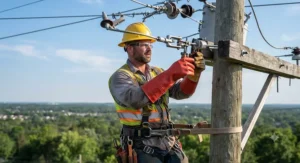
high voltage insulating gloves are rubber gauntlets manufactured and tested under ASTM D120 to withstand specific proof-test voltages by class (00 through 4), used by electrical and utility workers to prevent shock when working on or near energized equipment. The right pair depends entirely on the voltage you’re actually exposed to — not the voltage you assume.
That distinction matters because glove classes aren’t interchangeable, and getting it wrong isn’t a minor mistake — it’s the kind of gap that shows up in incident investigations. Whether you’re outfitting a substation crew or buying your first pair as an apprentice electrician, this guide walks through seven real, currently available products spanning Class 0 through Class 4, plus the standards, testing rules, and pairing gear (like leather protectors) that make rubber gloves actually work the way they’re supposed to. For broader context on how insulating gloves fit into a complete PPE ensemble, the personal protective equipment overview on Wikipedia is a useful starting reference.
We’ll cover class 3 insulating gloves and class 4 insulating gloves specifically, since those two categories cause the most confusion among buyers moving up from low-voltage work. We’ll also dig into transmission line glove safety, break down the full voltage class chart, explain the glove retesting interval OSHA actually enforces, and walk through leather protector pairing — because a rubber glove without its leather shell is only doing half its job.
Quick Comparison Table
Before the deep dive, here’s the fast version — seven real products, their voltage classes, and who each one suits best.
| Product | Class / Max Voltage (AC) | Length | Best For |
|---|---|---|---|
| Salisbury Electriflex NG316RB | Class 3 / 26,500V | 16″ | Distribution linemen, best all-rounder |
| Novax by PIP 147-0-11 | Class 0 / 1,000V | 11″ | Budget entry, low-voltage electricians |
| Novax by PIP 147-SK-2 Kit | Class 2 / 17,000V | 14″ | Mid-range industrial maintenance |
| Salisbury GK114B Kit | Class 1 / 7,500V | 14″ | Best value bundled kit |
| Cementex IG4-18 | Class 4 / 36,000V | 18″ | Premium transmission-level work |
| Mitchell Instrument Class 4 Kit | Class 4 / 36,000V | 16″ | Full-kit premium transmission setup |
| Salisbury ILP Goatskin Protector | Accessory (non-rated) | 12″-14″ | Mechanical protection for any class |
A quick scan of that table tells you most of what you need before spending a dime: your voltage exposure dictates your class, and class dictates almost everything else about price and bulk. Notice that the two Class 4 options both land at the top of the price spectrum — that’s not a coincidence, since higher classes require thicker rubber walls and more rigorous proof testing. The Salisbury GK114B Kit stands out as the practical middle ground for anyone who wants gloves and leather protectors bundled together instead of sourced separately.
💬 Just one click — help others make better buying decisions too!😊
Top 7 High Voltage Insulating Gloves: Expert Analysis
1. Salisbury Electriflex NG316RB — best all-rounder for distribution voltages
The Salisbury Electriflex NG316RB is the glove most linemen already know by feel, and for good reason — Salisbury built the Electriflex line specifically to be more pliable than older rubber formulations. This 16-inch Class 3 glove is rated for a maximum use voltage of 26,500V AC and proof-tested at 30,000V AC, which puts it squarely in distribution-line territory rather than transmission work. Made from Type I natural rubber, it’s engineered around flexibility first — Honeywell markets it as noticeably more supple than standard Class 3 rubber, which matters more than it sounds like it should when you’re gripping a hot-line clamp for twenty minutes straight.
Based on the spec comparison against other Class 3 gloves on the market, the contrasting red interior isn’t decoration — it’s a wear indicator, so a nick or thinning spot on the black outer layer shows up as a visible red patch, flagging the glove for removal before it becomes a liability. This is the pair for utility crews doing 15kV-25kV distribution work who need dexterity for switch operation and hardware handling, not bulk substation gear. Reviewers consistently note that the extra flexibility reduces hand fatigue on long shifts compared to stiffer Class 3 gloves from other manufacturers, though a few mention that the softer rubber shows cosmetic wear slightly faster — a tradeoff most linemen accept gladly in exchange for dexterity.
Pros:
- ✅ Noticeably more flexible than standard Class 3 rubber
- ✅ Color-contrast interior flags wear before failure
- ✅ Well-suited to fine motor tasks like switching
Cons:
- ❌ Softer rubber may show cosmetic wear sooner
- ❌ Not rated for transmission-level voltages above 26.5kV
Pricing generally falls in the $440-$550 range depending on length and cuff style, and given how frequently these get retested and eventually retired, that price reflects a working tool rather than a shelf item — for crews doing daily distribution work, it’s a reasonable value.
2. Novax by PIP 147-0-11 — most affordable entry point for Class 0 work
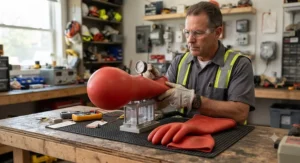
The Novax by PIP 147-0-11 is where a lot of electricians start, and it’s worth taking seriously rather than treating it as a throwaway starter glove. This 11-inch Class 0 glove is rated for a maximum use voltage of 1,000V AC, manufactured using PIP’s aqueous dip process rather than the solvent-based method some competitors still use — a detail that sounds technical but translates into a rubber compound that retains more of its natural elasticity over the glove’s service life.
What most buyers overlook about entry-level Class 0 gloves is that “budget” doesn’t mean “compromised” here — the 147-0-11 still meets full ANSI/ASTM D120 and NFPA 70E requirements, it’s just built for a lower voltage ceiling than the industrial classes. It’s the right call for residential electricians, panel work, and control-cabinet troubleshooting where you’re working around 480V systems or lower, not for anyone stepping up to medium-voltage equipment. Aggregated reviewer sentiment on this glove is generally positive around comfort and dexterity for fine work, with a recurring theme that the contoured shape reduces the “boxing glove” feel some cheaper Class 0 gloves have.
Pros:
- ✅ Aqueous-dip rubber retains flexibility longer
- ✅ Comfortable, contoured fit for panel and control work
- ✅ Full ANSI/ASTM D120 compliance at a low price point
Cons:
- ❌ Limited to 1,000V — unsuitable for medium or high voltage
- ❌ Shorter 11-inch length offers less forearm coverage
At around $90-$110 a pair, this is genuinely one of the cheapest ways into compliant insulated glove use, which makes it a sensible first purchase for apprentices before they’re assigned to higher-voltage crews.
3. Novax by PIP 147-SK-2 Kit — best mid-range kit for industrial maintenance
The Novax by PIP 147-SK-2 Kit bumps things up to Class 2, rated for a maximum use voltage of 17,000V AC and 25,500V DC — a jump that covers a lot of industrial and light utility scenarios without pushing into full transmission-class bulk. Sold as a kit rather than bare gloves, it typically bundles the rubber gloves with protectors and a storage bag, which matters because a rubber glove stored loose in a tool bag is a rubber glove that’s one stray screwdriver away from a puncture.
Here’s what to weigh with a Class 2 kit like this: it’s the natural landing spot for maintenance electricians working around 4kV-15kV distribution equipment, MV switchgear, or industrial plant feeders — voltage levels too high for Class 0 or 1 but not demanding the stiffness and bulk of a Class 3 or 4 glove. On paper this means better dexterity retention than higher classes at a voltage rating still well above most in-plant work. Reviewers frequently mention the kit format as a practical selling point, since it removes the guesswork of matching compatible protector sizes separately.
Pros:
- ✅ Bundled kit removes glove/protector size-matching hassle
- ✅ 17kV rating covers most industrial MV scenarios
- ✅ Aqueous-process rubber for better long-term flexibility
Cons:
- ❌ Bulkier than Class 0/1 gloves, reduces fine dexterity
- ❌ Not rated for full transmission-line voltages
Kits like this typically run in the $150-$220 range depending on size and included accessories — a reasonable middle price point once you account for not having to separately source protectors.
4. Salisbury GK114B Kit — best value bundled kit overall
The Salisbury GK114B Kit is a genuinely smart buy for anyone who wants everything in one box: Class 1 rubber gloves, leather protectors, and a glove bag, rated for a maximum use voltage of 7,500V AC when paired with the included leather protectors. Class 1 sits in an interesting spot on the voltage class chart — high enough for a lot of real utility and industrial work, low enough to stay noticeably more affordable and flexible than Class 2 and above.
Based on the spec comparison, the proof-test voltage here is 10,000V AC and 40,000V DC, giving a healthy safety margin over the 7,500V max-use rating — that gap between proof test and use voltage is exactly what makes rubber insulating gloves fundamentally different from work gloves that merely claim “insulated” on a retail tag. This kit is well-suited to electricians who work a mix of panel-level and light distribution voltage without needing the bulk of a Class 3, and the fact that OSHA gives new gloves 12 months from manufacture date to enter service means this kit has a real shelf window before it needs its first electrical test. Reviewer sentiment around Salisbury’s kit format is consistently favorable regarding fit and included accessories, with the leather protectors drawing particular praise for the goatskin’s durability.
Pros:
- ✅ Complete kit — gloves, protectors, and bag included
- ✅ 7,500V rating covers a wide range of common tasks
- ✅ Goatskin protectors add real puncture resistance
Cons:
- ❌ Class 1 ceiling too low for higher-voltage substation work
- ❌ Kit bulk is higher than buying rubber gloves alone
At around $300-$350 for the complete kit, this represents strong value once you factor in that protectors and a proper storage bag are mandatory purchases anyway, not optional add-ons.
5. Cementex IG4-18 — premium pick for transmission-level voltage
The Cementex IG4-18 steps into Class 4 territory, rated for a maximum use voltage of 36,000V AC — the top of the standard glove classification range and the pair you reach for when you’re working transmission lines or high-voltage substation equipment rather than distribution circuits. At 18 inches, it offers substantially more forearm coverage than the shorter gloves further down this list, which matters when reach and clearance become safety variables in themselves.
What the spec sheet won’t tell you, but field experience with Class 4 gear consistently shows, is that this voltage class trades dexterity for margin — natural rubber this thick simply doesn’t move like a Class 0 glove, and workers switching up from lower classes need a genuine adjustment period. Cementex chlorinates the gloves for comfort and shapes them anatomically to offset some of that stiffness, and the product is compliant with OSHA 1910.137, OSHA 1910.268, and NFPA 70E in addition to exceeding ASTM D120. This is the glove for transmission technicians and substation crews, not for anyone doing panel work where a Class 4’s bulk would be actively counterproductive.
Pros:
- ✅ 36,000V rating covers transmission-level work
- ✅ 18″ length adds meaningful forearm coverage
- ✅ Multi-standard compliance (OSHA, NFPA 70E, ASTM D120)
Cons:
- ❌ Significant dexterity tradeoff versus lower classes
- ❌ Heavier and stiffer, requiring an adjustment period
Expect a price in the $500-$650 range for gloves at this class and length — a genuinely premium cost, but one that’s proportional to the rubber volume and testing rigor required to certify a glove at this voltage.
6. Mitchell Instrument Class 4 36kV Kit — best full-kit premium transmission setup
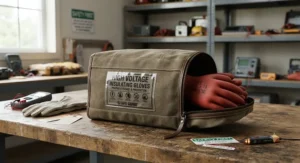
The Mitchell Instrument Class 4 36kV Kit takes the same voltage-class ceiling as the Cementex pair above and wraps it into a complete working kit — 16-inch Class 4 rubber gloves, leather protectors, cotton glove liners, and a glove bag, all rated to the same 36,000V AC maximum use voltage. The inclusion of liners is worth pausing on: cotton liners aren’t just for cold-weather comfort, they also wick sweat that would otherwise degrade the interior of the rubber glove over repeated donning and doffing.
Here’s what to weigh against the Cementex option: this kit trades two inches of length (16″ versus 18″) for a fully assembled system, which suits crews who’d otherwise have to separately source liners and protectors in matching sizes anyway. On paper this means fewer procurement headaches for safety managers outfitting an entire crew at once. Aggregated buyer feedback on Class 4 kits like this one tends to emphasize the value of receiving correctly-matched components together, since mismatched leather protector sizing is a surprisingly common and easily avoidable error in the field.
Pros:
- ✅ Complete kit avoids component-matching errors
- ✅ Cotton liners improve comfort and glove longevity
- ✅ Full Class 4 protection at 36,000V AC
Cons:
- ❌ Shorter 16″ length than the standalone Cementex 18″ option
- ❌ Highest price point of the seven products here
This complete kit typically lands in the $550-$700 range, which is a reasonable premium once you price out sourcing liners, protectors, and a bag individually for a Class 4 setup.
7. Salisbury ILP Goatskin Leather Protector Gloves — essential companion for every class
The Salisbury ILP Goatskin Leather Protector Gloves aren’t rubber insulating gloves at all — they’re the mechanical shell every rubber glove above needs to actually survive a work shift, which is exactly why this entry belongs on the list. Made from top-grain goatskin with a contrasting vinyl-backed cuff for visibility, these protectors go over the rubber glove to absorb the cuts, abrasions, and punctures that would otherwise compromise the insulating layer underneath.
Based on the spec comparison against generic work gloves sometimes mistaken for protectors, the goatskin construction and steam-pressed curved fit on hand forms are what separate a real ASTM F696-compliant protector from an ordinary leather glove — the standard exists specifically because a protector that doesn’t fit the rubber glove properly can bunch, restrict dexterity, or fail to protect the palm area under load. Reviewers consistently flag the non-metallic buckle as a small but important detail, since any metal hardware near an energized conductor defeats the point of insulated PPE entirely. This is not an optional accessory for occasional use — OSHA’s own standard treats leather protectors as required equipment except in narrowly defined exceptions.
Pros:
- ✅ ASTM F696-compliant mechanical protection layer
- ✅ Non-metallic hardware avoids conductive risk
- ✅ Extends the working life of the rubber glove underneath
Cons:
- ❌ Provides zero dielectric protection on its own
- ❌ Requires size-matching to the specific rubber glove
Pricing runs roughly $35-$50 per pair depending on length and cuff style, which is a small line item next to the cost of the rubber gloves they protect — and arguably the cheapest insurance policy in this entire lineup.
Practical Usage Guide: Setup, Inspection & the First 30 Days
Getting a new pair of high voltage insulating gloves into service isn’t as simple as pulling them on and heading to the job site. Every glove ships with a manufacture and test-stamp date, and OSHA gives you a 12-month window from that initial test date to put unused gloves into service — miss that window and they need retesting before day one, even if they’ve never touched a conductor.
On day one, do an air test before anything else: roll the cuff to trap air inside, gently compress the glove, and listen and feel for leaks along the fingers and palm, since a pinhole invisible to the eye will still leak air under pressure. Pair the rubber glove with a correctly sized leather protector immediately — wearing rubber gloves without protectors, even briefly “just to check something,” is one of the fastest ways to introduce an undetected puncture. During the first 30 days, get in the habit of a daily visual inspection for swelling, discoloration, embedded debris, or texture changes before every single use, not just the first one. A common mistake new users make is storing gloves folded in a tool bag; instead, keep them in their bag unfolded and away from direct sunlight, ozone sources, and chemical exposure, since UV and ozone degrade natural rubber faster than mechanical wear does.
⚡ Ready to Gear Up Safely?
🔍 Compare current listings for the picks above and check availability before your next shift. Properly fitted, properly tested insulating gloves are the difference between routine work and a preventable incident — don’t wait until an inspection catches what you should have caught yourself.
Real-World Scenarios: Matching Gloves to the Job
Consider three different workers, because the “right” glove genuinely depends on who’s wearing it. A residential electrician doing panel swaps and circuit troubleshooting in occupied homes, working almost exclusively below 600V, has no practical need for anything beyond a Class 0 glove like the Novax by PIP 147-0-11 — anything heavier just adds bulk without adding relevant protection. An industrial maintenance tech at a manufacturing plant, moving between 4kV motor control centers and standard 480V panels throughout the day, is better served by a Class 2 setup like the Novax by PIP 147-SK-2 Kit, since it covers the plant’s higher-voltage equipment without the stiffness penalty of Class 3 or 4.
Now picture a transmission-line technician working substations and high-voltage feeders regularly exposed to 30kV-plus equipment. For that worker, nothing below Class 4 makes sense, and the choice between the Cementex IG4-18 and the Mitchell Instrument Class 4 36kV Kit comes down to whether liners and a bundled kit matter more than an extra two inches of cuff length. In every one of these three scenarios, the leather protector isn’t optional gear layered on top for a specific job — it’s baseline equipment across all three, just sized differently to match the rubber glove underneath.
How to Choose High Voltage Insulating Gloves
Picking the right pair comes down to working through a short list of criteria in order, rather than starting with brand or price:
- Identify your actual working voltage — not your facility’s nameplate voltage, but the highest voltage you’ll realistically be exposed to, since that number determines your minimum required class.
- Add a safety margin, don’t cut it close — most safety programs choose the class rated meaningfully above the working voltage rather than the bare minimum, precisely because proof-test voltage includes intentional headroom.
- Match length to your task — longer gloves (16″-18″) add forearm coverage for reach-heavy substation work; shorter gloves (11″-14″) suit panel and cabinet work where dexterity matters more.
- Confirm Type I versus Type II rubber — Type II is ozone-resistant, a meaningful factor if you work outdoors or near ozone-generating equipment like transformers.
- Budget for protectors and liners as mandatory, not optional — a rubber glove’s total cost of ownership always includes a leather protector; price it as one purchase, not two separate decisions.
- Check the manufacture date before buying — a glove sitting on a shelf for 10 months already has a shortened runway before its first required test.
- Verify size using a proper hand measurement, not a rough guess — an ill-fitting glove reduces both dexterity and the mechanical fit that leather protectors depend on.
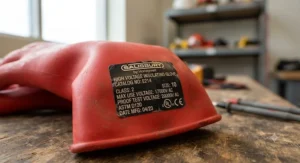
Class 3 Insulating Gloves vs Class 4 Insulating Gloves
class 3 insulating gloves and class 4 insulating gloves get confused constantly, and the difference isn’t subtle once you look at the numbers. Class 3 gloves carry a maximum use voltage of 26,500V AC, proof-tested at 30,000V AC — solidly in distribution-line and switching territory. Class 4 gloves push to a maximum use voltage of 36,000V AC, proof-tested at 40,000V AC, putting them in transmission-line and high-voltage substation territory.
The practical difference goes beyond the voltage number on a spec sheet. Class 4 gloves use noticeably more rubber to achieve that higher dielectric rating, which means real, measurable losses in dexterity and increases in hand fatigue over a shift compared to Class 3. Reviewers who’ve worked in both classes consistently describe the jump from Class 3 to Class 4 as more noticeable than the jump from Class 2 to Class 3, largely because of that thickness increase. The decision between them should never be about which one “seems safer” in the abstract — it should be a direct match to documented working voltage, with Class 4 reserved specifically for transmission-level exposure rather than treated as a universally “better” upgrade from Class 3.
Voltage Class Chart: ASTM D120 Ratings Explained
Every rubber insulating glove sold in the U.S. is classified under ASTM D120 into one of six classes, each with a defined proof-test voltage and maximum use voltage. Here’s the full breakdown:
| Class | Max Use Voltage (AC) | Max Use Voltage (DC) | AC Proof-Test Voltage |
|---|---|---|---|
| Class 00 | 500V | 750V | 2,500V |
| Class 0 | 1,000V | 1,500V | 5,000V |
| Class 1 | 7,500V | 11,250V | 10,000V |
| Class 2 | 17,000V | 25,500V | 20,000V |
| Class 3 | 26,500V | 39,750V | 30,000V |
| Class 4 | 36,000V | 54,000V | 40,000V |
Reading this table correctly means understanding that the proof-test voltage is always well above the max-use voltage by design — that gap is the manufacturer’s built-in safety margin, not a marketing number. According to the OSHA electrical protective equipment standard, 29 CFR 1910.137, gloves and other insulating equipment must be marked with their class directly on the cuff, which is the one detail workers should verify every single time they pick up an unfamiliar pair rather than assuming based on color or thickness.
💬 Just one click — help others make better buying decisions too!😊
Transmission Line Glove Safety: Field Practices That Matter
transmission line glove safety extends well beyond picking the correct class off the voltage class chart. Field crews working transmission voltages need to maintain what’s often called minimum approach distance awareness even while gloved, since insulating gloves protect against contact but don’t eliminate the arc-flash risk from proximity alone. Cuff gap clearance is another detail that gets overlooked — insulating gloves need adequate clearance between the top of the glove cuff and any arc-flash-rated sleeve or clothing layered above it, since a gap that’s too small on higher classes can create a tracking path across the boundary.
According to OSHA’s eTool on insulating gloves and sleeves for electric power work, gloves must be inspected before each day’s use in addition to their scheduled electrical retesting, and any equipment showing holes, tears, embedded objects, or texture changes must be pulled from service immediately rather than used “just for this one task.” Crews working transmission lines specifically should also never assume a Class 3 glove is “close enough” for transmission voltages — the gap between 26,500V and 36,000V rated equipment isn’t a rounding error, it’s the entire margin the higher class exists to provide.
Glove Retesting Interval: How Often You Actually Need to Test
The glove retesting interval isn’t a suggestion — it’s a hard OSHA requirement, and it trips up more safety programs than almost any other PPE compliance point. Rubber insulating gloves must be electrically tested before first issue and every six months thereafter once they’re in active service. If a glove has been electrically tested but sits unissued, it can’t go into service unless that test happened within the previous 12 months — meaning a glove can effectively expire on a shelf before a worker ever puts it on.
A useful practice many crews adopt is an alternating glove-color program, using one color scheme for gloves due in the first half of the testing cycle and a different one for the second half, creating an instant visual check during daily inspections. Any glove exposed to chemical contamination, suspected damage, or used for any reason without its leather protector needs retesting immediately regardless of where it sits in the six-month cycle, since those events can compromise the rubber’s insulating properties in ways that daily visual inspection alone won’t catch. According to an industry breakdown of electrical glove testing requirements, the six-month clock applies uniformly across all glove classes, from Class 00 through Class 4 — there’s no exception for lower voltage classes just because the consequences of a failure seem smaller.
Leather Protector Pairing: Why Rubber Alone Isn’t Enough
leather protector pairing is the part of insulating glove safety that gets treated as an afterthought far too often, and it shouldn’t be. A rubber insulating glove is a dielectric barrier; it has essentially no resistance to cuts, punctures, or abrasion from tools, wire ends, or rough hardware. The leather protector worn over it is what actually survives contact with the physical world on the job site, sacrificing itself so the rubber underneath stays intact.
Pairing correctly means matching protector size to glove size exactly — a protector that’s too loose bunches at the palm and creates pressure points that can eventually work a pinhole into the rubber beneath it, while one that’s too tight restricts the natural flex of the glove and accelerates wear at the seams. OSHA’s standard does carve out a few narrow exceptions where protectors aren’t strictly required — largely limited to low-voltage Class 00 and Class 0 work under specific controlled conditions — but for anything Class 1 and above, treating protectors as optional is a compliance gap waiting to be found during an audit. What most buyers overlook when pricing out a glove purchase is that the protector isn’t an accessory line item to skip if the budget’s tight — it’s functionally part of the glove system, and a properly maintained protector will often outlast several pairs of the rubber gloves it protects.
Common Mistakes When Buying High Voltage Insulating Gloves
The most frequent buying mistake is matching gloves to a facility’s general voltage reputation rather than the specific voltage a worker will actually contact — “it’s a substation, so I need Class 4” isn’t always true if the actual task involves lower-voltage control circuits within that same facility. A close second is skipping the manufacture-date check, buying gloves that already have a shortened service window before they even ship. Buyers also commonly underestimate protector and liner costs, budgeting only for the rubber gloves and getting surprised by the real total cost of a compliant kit.
Sizing is another recurring error — measuring hand circumference loosely instead of following the manufacturer’s specific measurement method leads to gloves that are technically the “right class” but functionally uncomfortable enough that workers are tempted to skip them for quick tasks. Finally, treating the leather protector purchase as separate and optional, rather than as part of one integrated buying decision alongside the rubber glove itself, remains one of the most preventable gaps in an otherwise compliant PPE program.
Long-Term Cost & Maintenance
The sticker price of high voltage insulating gloves is only part of the real cost of ownership. Every glove requires electrical retesting on the six-month cycle discussed above, and that testing — whether done in-house with proper equipment or outsourced to a certified lab — is a recurring cost that needs budgeting from day one, not treated as a surprise expense down the line. Add a leather protector, potential liners, and a proper storage bag, and the true cost of a working Class 2 or higher setup typically runs 20-40% above the bare rubber glove price alone.
Where the ROI argument actually favors higher-quality gloves is longevity: gloves stored and inspected properly, worn consistently with correctly matched protectors, often pass six-month retests for multiple cycles before requiring replacement, while poorly maintained pairs — folded improperly, exposed to sunlight, or worn without protectors even occasionally — frequently fail their very first retest. Viewed over a two-year working life, a premium glove with proper protector pairing and storage discipline often costs less per year of service than a cheaper pair replaced twice as often due to preventable damage.
Features That Actually Matter (And Those That Don’t)
Marketing copy around insulating gloves loves to emphasize color options and cuff styles, but a few features genuinely affect safety and usability while others are mostly cosmetic. What actually matters: the ASTM class rating stamped on the cuff, Type I versus Type II ozone resistance if you work outdoors, the contrasting interior color used as a wear indicator, and — critically — the manufacture and test-date stamp that determines your service window. What matters less than it seems: color choice beyond the wear-indicator function, brand-specific “comfort” marketing claims that aren’t tied to a measurable spec, and cuff style (bell versus straight) which is largely a preference issue rather than a safety one.
Reviewers across multiple glove classes consistently point to fit and flexibility as the features that most affect real-world usability day to day, more so than any marketed “innovation” that doesn’t show up in the ASTM test results. When comparing two gloves of the same class, the honest differentiator usually comes down to rubber formulation and manufacturing process — like the aqueous dip process Novax uses — rather than anything visible on a spec sheet at a glance.
Frequently Asked Questions
❓ What voltage do I need Class 2 insulating gloves for?
❓ How often must rubber insulating gloves be retested?
❓ Can I use rubber insulating gloves without leather protectors?
❓ What's the difference between Class 3 and Class 4 gloves?
❓ How do I know what size insulating gloves to buy?
Conclusion
Choosing high voltage insulating gloves ultimately comes down to one non-negotiable question: what voltage will you actually be exposed to, and does the glove in front of you carry a genuine, ASTM D120-certified rating to match it? Everything else — flexibility, cuff length, kit bundling, brand reputation — matters, but only after that first question is answered honestly. Among the seven products covered here, the Salisbury Electriflex NG316RB remains the strongest all-around pick for distribution-level work, the Salisbury GK114B Kit offers the best bundled value for Class 1 tasks, and the Cementex IG4-18 or Mitchell Instrument Class 4 36kV Kit are the right calls once transmission-level voltage enters the picture.
Whichever pair you choose, remember that the rubber glove is only one half of a working system — the Salisbury ILP Goatskin Leather Protector Gloves or an equivalent properly sized protector complete it, and the six-month retesting cycle keeps it honest over time. Buy for the voltage you actually face, pair it correctly, test it on schedule, and the gear will do exactly what it’s designed to do.
Recommended for You
- Arc Flash Gloves for Electrical Work: 7 Life-Saving Picks (2026)
- Electrician Work Gloves Under $50: 7 Best Picks for 2026
- Class 0 Rubber Insulating Gloves: 7 Top ASTM Picks (2026)
Disclaimer: This article contains affiliate links. As an Amazon Associate, I earn from qualifying purchases. If you purchase products through these links, we may earn a small commission at no additional cost to you.
✨ Found this helpful? Share it with your friends! 💬🤗
