
In This Article
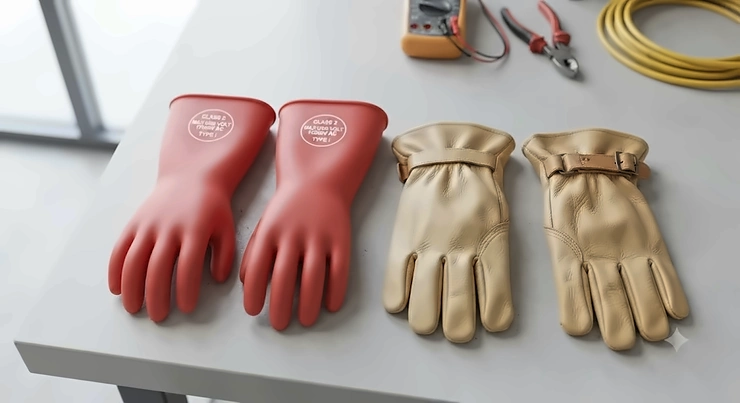
Here’s a sentence that should scare you a little: rubber insulating gloves alone can get punctured by something as ordinary as a stray wire strand, a burr on a panel edge, or a screw you didn’t see — and you might not notice until the glove fails at the worst possible moment. That’s the entire reason the debate over leather protector gloves vs rubber insulating gloves exists in the first place, and it’s also why the two aren’t really rivals at all. They’re teammates.
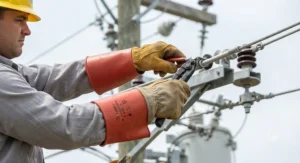
leather protector gloves vs rubber insulating gloves is really a question about two halves of one system: the rubber glove is the part that actually stops electricity from reaching your skin, while the leather glove goes over it to stop the rubber from getting nicked, scraped, or punctured during the shift. Skip the leather half, and you’re trusting a thin sheet of natural rubber to survive an entire day of climbing ladders, handling conduit, and grabbing metal edges — which is asking a lot from something as delicate as a balloon with better manners.
We dug through manufacturer spec sheets, OSHA’s own regulatory text, and aggregated review sentiment from electricians and linemen who actually wear this gear daily, so what follows isn’t a rehashed Amazon listing. It’s a genuine comparison, backed by OSHA’s electrical protective equipment standard, that walks through when you need which glove, how they work together, and which real products are worth your money in 2026.
Quick Comparison Table: Leather Protector vs Rubber Insulating Gloves
Before diving into all seven products, here’s the fast answer for anyone skimming on a lunch break.
| Feature | Leather Protector Gloves | Rubber Insulating Gloves |
|---|---|---|
| Primary job | Mechanical protection (cuts, punctures, abrasion) | Electrical insulation (shock prevention) |
| Provides shock protection alone? | No — never | Yes, when undamaged and rated correctly |
| Typical material | Top-grain goatskin or cowhide | Natural rubber or rubber/neoprene blend |
| Voltage rating | None (mechanical only) | Class 00 through Class 4 (up to 36kV) |
| Replacement trigger | Visible wear, seam failure, cuff tearing | Any cut, pinhole, swelling, or failed air test |
| Typical price range | Around $35-$90 per pair | Around $80-$400+ per pair depending on class |
Best For: Leather protectors excel at extending glove life and adding mechanical toughness; rubber insulating gloves are non-negotiable for any actual shock protection.
Reading the table straight through, the real takeaway is that these two products aren’t competing for the same job — they’re stacked, not swapped. A Cementex Class 2 rubber glove with zero leather cover will degrade three or four times faster on a rough job site than the same glove worn under a protector, and a leather protector with no rubber glove underneath provides exactly zero shock protection, full stop. Budget-wise, most crews spend more on replacing prematurely damaged rubber gloves than they would have spent on leather protectors in the first place, which is the whole ROI argument in a nutshell.
💬 Found this comparison useful? A quick share helps other electricians find it too!😊
Top 7 Leather Protector and Rubber Insulating Gloves: Expert Analysis
We picked a mix of budget, mid-range, and premium options across both categories — because the “best” glove combination for leather protector glove sizing and voltage needs depends entirely on your job, not just your wallet.
1. Salisbury E011Y Class 0 Rubber Insulating Glove — most affordable entry point for low-voltage work
The standout here is price-to-protection ratio: this is one of the cheapest ways into certified low-voltage rubber insulation without cutting corners on the ASTM D120 testing that actually matters. The glove is rated Class 0, meaning a maximum use voltage around 1,000V AC, and it’s proof-tested well above that threshold before it ever ships. The two-color yellow-over-black construction is a small but genuinely useful design touch — if the outer yellow layer wears through anywhere, the black underneath shows through immediately, which turns a routine visual inspection into a much faster process. Based on the spec comparison against pricier Class 0 gloves, the 11-inch length is the main trade-off: it covers the wrist and lower forearm but won’t give you the reach of a 14-inch glove if you’re working in tighter panel spaces where your arm goes in past the wrist. Reviewers consistently note that the rubber stays flexible and comfortable through extended wear, without the stiffness that cheaper import gloves sometimes develop after a few months in a truck. What most buyers overlook about this model is that it’s explicitly designed to pair with a leather protector — Salisbury sells this exact glove bundled into kits for a reason, and running it bare is not how the manufacturer intends it to be used.
Pros:
- ✅ Genuinely affordable Class 0 certified protection
- ✅ Two-tone design speeds up daily visual inspection
- ✅ Comfortable, flexible rubber for all-day wear
Cons:
- ❌ 11-inch length limits reach in deep panels
- ❌ Class 0 only covers voltages up to 1,000V
Price sits in the mid-$90s to low-$100s range depending on retailer, and for anyone doing strictly low-voltage residential or light commercial work, that’s a solid value entry point into certified protection.
2. Salisbury Goatskin Leather Protector Glove — best budget leather shield for everyday duty
The standout feature is the pull-strap design, which sounds minor until you’ve tried to yank a sweaty leather glove off after eight hours — it genuinely speeds up the on/off process during frequent glove changes. Constructed from imported goatskin, the glove balances the two things leather protectors are supposed to balance and usually don’t: toughness against punctures and enough dexterity that you can still feel a screwdriver in your hand. Here’s what the spec sheet won’t tell you, but reviewers note anyway — goatskin tends to break in faster and stays softer than cowhide alternatives, which matters if you’re wearing these ten hours a day. Based on the spec comparison with premium leather protectors, this model skips the reinforced 3D-fingertip construction that pricier gloves use, so dexterity for fine work like stripping small-gauge wire is noticeably reduced. The orange safety cuff is a small but smart touch for high-visibility job sites where a supervisor needs to confirm PPE compliance at a glance. Available in 10-inch through 15-inch lengths, sizing correctly to match your rubber glove length is essential — a mismatch here is one of the most common compliance mistakes on job sites.
Pros:
- ✅ Fast on/off with pull-strap design
- ✅ Goatskin stays soft and flexible over time
- ✅ Available across multiple lengths for sizing match
Cons:
- ❌ No reinforced fingertip for fine dexterity work
- ❌ Thinner leather than premium cowhide options
At roughly $35-$50 per pair depending on length, this is one of the most cost-effective ways to extend the service life of any Class 00-2 rubber glove you already own.
3. NOVAX LPG-12 Leather Protector Glove — best ergonomic fit for Class 1 and 2 gloves
The standout advantage is the goatskin grain palm paired with a split-leather cuff — a combination built specifically to fit snugly over Class 1 and Class 2 rubber gloves without the bunching that generic protectors sometimes cause at the wrist. At 12 inches, this glove is purpose-sized rather than a one-length-fits-all compromise, and NOVAX explicitly recommends stepping up to their 13-inch version if you’re running 16 or 18-inch Class 2 rubber gloves, since the wider glove former needs the extra material to seat correctly. What most buyers overlook about protector sizing is that too tight a fit accelerates wear on both the leather and the rubber glove underneath through constant friction, while too loose a fit lets grit and debris work their way between the layers. Reviewers consistently report that the goatskin palm holds up well against abrasion from conduit and panel edges without stiffening up, and the added wrist protection from the split-leather cuff is a noticeable step up from bare-cuff designs. On paper, this means fewer mid-shift adjustments and a more secure seal between rubber and leather layers, which is exactly the kind of detail that matters for a glove combination for electrical safety that actually holds up under real conditions.
Pros:
- ✅ Purpose-fit for Class 1 and Class 2 rubber gloves
- ✅ Split-leather cuff adds wrist protection
- ✅ Abrasion-resistant without stiffening
Cons:
- ❌ Needs upsizing for 16-18 inch rubber gloves
- ❌ Sizes only run 8-12, no smaller options
Expect to pay somewhere in the $45-$65 range, positioning this as a genuine mid-tier step up from generic import protectors.
4. Salisbury GK114B Class 1 Glove Kit (Rubber + Leather + Bag) — best all-in-one combo for field crews
The standout here is simplicity: one SKU gets you a matched Class 1 rubber glove, a properly sized leather protector, and a storage bag, which removes the guesswork of pairing components yourself. Class 1 gloves carry a proof test voltage of 10,000V AC with a max use voltage around 7,500V AC when worn with the included leather protectors — a meaningful step up from Class 0 for crews working around distribution-level voltages. Based on the spec comparison, the kit format genuinely saves money versus buying rubber gloves and leather protectors separately at retail, and it guarantees the sizing between the two pieces actually matches, which isn’t always the case when components are sourced from different manufacturers. Reviewers consistently mention that the included canvas bag is a small but appreciated touch, since proper storage — fingers up, away from folding creases — is itself an OSHA-referenced care requirement that’s easy to ignore without a dedicated bag. What the spec sheet won’t tell you, but field reports suggest, is that the 14-inch length variant is worth the small price bump over 11-inch if you’re regularly reaching into deep switchgear cabinets. This is a genuinely strong option for anyone building out a new crew’s PPE from scratch rather than piecing together mismatched gear.
Pros:
- ✅ Matched rubber glove and leather protector sizing
- ✅ Class 1 rating covers distribution-level voltage work
- ✅ Includes proper storage bag for compliance
Cons:
- ❌ Higher upfront cost than buying components separately later
- ❌ 11-inch base version limits reach in deep panels
Kits run roughly $165 to $335 depending on length and color, which — spread across two matched, certified components plus storage — actually compares favorably to buying pieces individually.
5. Cementex TruFit High Voltage Leather Protectors — best 3D-finger ergonomics for all-day comfort
The standout feature is the redesigned palm and 3D-finger construction, which is a genuinely different approach from flat-pattern leather protectors — the conforming fit around the rubber glove noticeably reduces hand fatigue during long shifts. Built from premium top-grain cowhide with a wrist cinch strap, these protectors are engineered specifically for use over Class 1 through Class 4 rubber gloves, meaning they’re built for higher-voltage work where mechanical protection matters even more because the underlying rubber is thicker and stiffer to begin with. Here’s what most buyers overlook: the cinch strap isn’t just a comfort feature — a properly cinched cuff keeps debris from working down between the leather and rubber layers, which is exactly the failure mode that leads to unnoticed rubber glove punctures. Reviewers consistently report that the ergonomic palm design translates into real dexterity gains over older flat-cut protectors, which matters enormously when you’re doing anything more delicate than gripping a hot stick. On the durability side, aggregated feedback suggests the premium cowhide holds up longer under repeated flexing than the thinner goatskin used in budget protectors, though that comes with a firmer break-in period initially. All Cementex leather protectors meet ASTM F696 standards, which is the specification governing leather protectors for rubber insulating gloves.
Pros:
- ✅ 3D-finger design reduces hand fatigue
- ✅ Rated for Class 1 through Class 4 use
- ✅ Cinch strap seals out debris at the cuff
Cons:
- ❌ Firmer break-in period than goatskin options
- ❌ Premium pricing versus standard protectors
Expect a price range in the $60-$90 territory, positioned as a premium mechanical-protection upgrade rather than a budget accessory.

6. Cementex Class 2 Insulating Rubber Gloves — best high-voltage rubber for 17kV systems
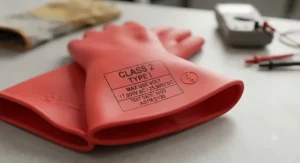
The standout advantage is the voltage headroom: Class 2 gloves carry a proof test voltage of 20,000V AC with a max use voltage of 17,000V AC, putting them squarely in the range needed for higher-distribution-voltage utility and industrial work where a Class 0 or Class 1 glove simply wouldn’t be rated high enough. Every rubber product ships electrically tested with a “Plain English” stamp identifying the test date and max use voltage directly on the glove, which is a meaningful trust signal — you’re not relying on a box label that could get separated from the actual pair. Based on the spec comparison against Class 1 gloves, the thicker rubber wall needed to hit Class 2 ratings does reduce fingertip dexterity somewhat, a trade-off that’s simply inherent to higher voltage classes rather than a manufacturing shortfall. What the spec sheet won’t tell you, but experienced linemen note, is that Class 2 gloves benefit enormously from a properly fitted leather protector precisely because the added bulk makes it harder to instinctively avoid sharp edges — the leather layer compensates for reduced tactile feedback. Reviewers consistently point to the natural rubber construction as offering a good balance of flexibility and durability for the voltage class, without the brittleness some synthetic blends develop in cold weather. Available in black, red, or yellow, color coding here isn’t cosmetic — some sites use it to visually confirm glove class at a glance during safety walkthroughs.
Pros:
- ✅ Class 2 rating covers up to 17,000V AC
- ✅ On-glove test stamp confirms certification date
- ✅ Natural rubber holds flexibility in varied temps
Cons:
- ❌ Reduced dexterity versus lower voltage classes
- ❌ Requires more frequent retesting given higher-risk use
Pricing typically falls in the $150-$250 range for the rubber glove alone, before adding a leather protector — which, given the voltage class, isn’t optional.
7. NOVAX Class 2 Rubber Insulating Glove, Straight Cuff, 16″ — best reach and coverage for linemen
The standout feature is the 16-inch length combined with Class 2’s 17,000V max use rating, giving linemen and substation crews significantly more forearm coverage than the standard 14-inch options most competitors default to. NOVAX’s natural rubber construction is built to combine dielectric performance with flexibility and durability, and the gloves are tested to ASTM standards at a NAIL-accredited lab, with each pair shipped with a dated test stamp and lab report for compliance recordkeeping. Based on the spec comparison, this is one of the few Class 2 gloves offering the 16-inch length as a standard option rather than a special order, which matters if your job regularly puts your forearm near energized conductors rather than just your hand. Here’s what most buyers overlook — at this length, NOVAX explicitly recommends stepping up to their 13-inch leather protector rather than the standard 12-inch version, because the larger glove former needs the extra material for a secure fit. Reviewers consistently note the care instructions are stricter than lower-class gloves: warm water washing, low-heat tumble drying, and storage finger-tips-up in a dedicated glove bag away from ozone sources, all of which extend service life meaningfully if actually followed. Aggregated feedback also flags this as a strong option for hybrid/EV automotive service work, where 17,000V coverage with extended reach is increasingly relevant as vehicle battery systems scale up in voltage.
Pros:
- ✅ 16-inch length gives extended forearm coverage
- ✅ NAIL-accredited lab testing with dated report
- ✅ Suited to emerging EV/hybrid high-voltage work
Cons:
- ❌ Requires upsized leather protector to match
- ❌ Stricter care routine than lower voltage classes
Price generally lands in the $180-$280 range, reflecting both the extended length and the accredited lab testing documentation included with each pair.
Top 7 Products at a Glance
| # | Product | Type | Voltage/Class | Best For |
|---|---|---|---|---|
| 1 | Salisbury E011Y Class 0 | Rubber insulating | Up to 1,000V | Budget low-voltage entry |
| 2 | Salisbury Goatskin Protector | Leather protector | N/A (mechanical) | Everyday budget protection |
| 3 | NOVAX LPG-12 | Leather protector | N/A (mechanical) | Class 1-2 ergonomic fit |
| 4 | Salisbury GK114B Kit | Combo kit | Up to 7,500V | New crew PPE builds |
| 5 | Cementex TruFit | Leather protector | N/A (mechanical) | Long-shift comfort |
| 6 | Cementex Class 2 | Rubber insulating | Up to 17,000V | Utility/industrial high voltage |
| 7 | NOVAX Class 2 16″ | Rubber insulating | Up to 17,000V | Linemen, extended reach |
Looking across this table, a clear pattern emerges: as voltage class climbs, so does the argument for pairing rubber gloves with a properly sized leather protector, since higher classes mean thicker, less tactile rubber that benefits more from the mechanical backup. Budget-conscious buyers doing occasional low-voltage work can reasonably start with the Salisbury E011Y and a basic Salisbury Goatskin Protector, while crews doing regular Class 2 utility work should treat the leather layer as mandatory rather than optional.
Benefits vs Traditional Alternatives
| Approach | Shock Protection | Mechanical Durability | Typical Lifespan |
|---|---|---|---|
| Rubber glove alone (no leather) | Full, until first puncture | Poor — fails fast on rough sites | Weeks to a few months |
| Leather glove alone (no rubber) | None — false sense of security | Good | Months to a year |
| Rubber + leather protector system | Full, and preserved longer | Strong | Rubber: 6-12 months typical; leather: 1-3+ years |
The analysis here is straightforward but worth spelling out: wearing rubber gloves without leather protectors is the single fastest way to shorten their working life, since unprotected rubber accumulates the small nicks and abrasions that eventually turn into failed air tests. Wearing leather alone is arguably worse, not better, because it can create a false sense of protection against a hazard it was never designed to stop. The combined system is the only configuration that satisfies both the shock-prevention and mechanical-durability requirements simultaneously, which is exactly why OSHA and ASTM treat the pairing as a system rather than two unrelated products.
✨ Build Your Complete Glove System Today!
🔍 Don’t leave your protection half-finished. Pair a properly rated rubber insulating glove with a matched leather protector, and check current availability before your next job.
Practical Usage Guide: Setup, Inspection, and First 30 Days
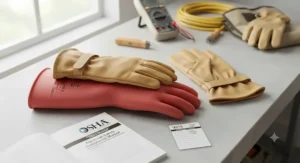
Getting a new glove combination for electrical safety into service correctly matters as much as picking the right class. Start every shift with a visual inspection — stretch the rubber glove and look for pinholes, swelling, or discoloration along the palm and fingers, since these are the earliest signs of degradation. Follow that with an air test: roll the cuff to trap air inside, then squeeze and listen or feel for leaks, a step OSHA specifically references as part of routine glove maintenance. In the first 30 days, the most common mistake is skipping the leather protector “because it’s just a quick job” — this is precisely how gloves get punctured on tasks that seemed too minor to bother with proper layering. Store gloves fingertip-up in a dedicated bag, never folded, and keep them away from direct sunlight, ozone sources, and petroleum products that degrade rubber prematurely. Rotate multiple pairs if your job involves daily wear, since constant flexing accelerates rubber fatigue, and schedule periodic dielectric retesting according to your glove’s class — higher classes generally require more frequent recertification given the greater consequence of failure.
Real-World Scenario: Matching Gloves to Your Job
Consider three different profiles. First, a residential electrician doing panel swaps and outlet work rarely exceeding 240V — here, a Salisbury E011Y Class 0 glove paired with a Salisbury Goatskin Protector covers the voltage range comfortably while keeping costs down, since the job rarely involves rough mechanical hazards beyond typical panel edges. Second, an industrial maintenance tech working around 4,160V distribution panels several times a week needs the extra headroom of the Salisbury GK114B Class 1 kit, where the matched rubber-and-leather bundle simplifies compliance and the 7,500V max use voltage provides real safety margin. Third, a utility lineman working 13.8kV distribution lines needs the Cementex Class 2 or NOVAX Class 2 16″ glove, paired with the Cementex TruFit or upsized NOVAX leather protector — at this voltage and job intensity, skipping the leather layer isn’t a shortcut, it’s a liability. In each case, the deciding factors are the same: known system voltage, frequency of mechanical hazard exposure, and how often the gloves need to come off and go back on during a shift.
Buyer’s Decision Framework
If your system voltage is under 1,000V and mechanical hazards are minimal, choose a Class 00 or Class 0 rubber glove with a budget leather protector, because the added cost of a higher class buys you nothing at that voltage. If your voltage sits between 1,000V and 7,500V, choose a Class 1 kit like the Salisbury GK114B, since it bundles matched sizing and removes guesswork. If your voltage runs up to 17,000V or your job involves extended forearm exposure, choose a Class 2 glove such as the Cementex Class 2 or NOVAX Class 2 16″, paired with a premium protector like the Cementex TruFit, because reduced dexterity at this class makes the mechanical backup more important, not less. And if you’re outfitting a new crew from scratch, prioritize combo kits over piecing together components separately, since matched sizing reduces both fitting errors and the odds of an improperly paired glove combination for electrical safety making it into the field.
How to Choose the Right Glove Combination
- Confirm your actual system voltage first. Never guess — pull it from equipment labels or ask your safety officer, since choosing a glove class is meaningless without this number.
- Select a rubber glove class that exceeds your working voltage with margin. Industry guidance generally recommends choosing a class rated above your expected exposure, not right at the edge.
- Match your leather protector length to your rubber glove length. A 14-inch rubber glove under a 10-inch protector leaves exposed rubber vulnerable to punctures.
- Check ASTM F496 clearance requirements between the leather cuff and rubber bead. Minimum distances increase with glove class, from half an inch at Class 00/0 up to four inches at Class 4.
- Factor in dexterity needs for your specific tasks. Higher voltage classes mean thicker, stiffer rubber — if your work demands fine motor control, this trade-off deserves real weight in your decision.
- Budget for retesting, not just purchase price. Rubber insulating gloves require periodic dielectric retesting, and that recurring cost should factor into your total cost of ownership.
- Buy from manufacturers who ship dated test stamps. A glove without a visible, traceable test date is a compliance and safety gap waiting to surface during an audit.
Common Mistakes When Buying Insulating Gloves
The most frequent error is buying rubber gloves and leather protectors from mismatched size systems, resulting in a protector that bunches at the wrist or leaves a rubber gap exposed — exactly the failure ASTM F496’s clearance table is designed to prevent. A close second is treating leather protectors as optional accessories rather than a required component, a mistake that shows up constantly in aggregated review sentiment from buyers who initially skipped the leather layer and regretted it after an early puncture. Buyers also frequently underestimate retesting costs, budgeting for the initial purchase but not the recurring dielectric testing that keeps gloves legally usable. Another common pitfall is choosing a voltage class that matches expected exposure exactly rather than with safety margin, leaving no buffer for transient overvoltages or measurement error. Finally, many buyers skip daily air testing simply because it takes an extra thirty seconds — a habit that erodes the entire safety case these gloves are built around.
Leather Protector Gloves vs Rubber Insulating Gloves: The Detailed Comparison
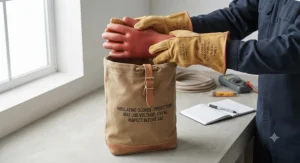
Zooming out from individual products, the leather protector gloves vs rubber insulating gloves question really comes down to function versus function, not brand versus brand. Rubber insulating gloves are the only component in this system rated for actual dielectric protection — they’re tested to specific proof-test voltages under ASTM D120 and must be periodically retested to stay in service. Leather protector gloves carry zero voltage rating and are tested instead to ASTM F696, a specification governing mechanical durability, not electrical performance. What most buyers overlook is that these standards were written assuming the two products would be used together, not interchangeably — the clearance distances, sizing charts, and even the way manufacturers cross-reference their own product lines (NOVAX pairing specific protector lengths to specific glove lengths, for instance) all assume a combined system. On paper, that means asking “which one is better” is the wrong question; the right one is “which specific pair of each am I using, and are they sized to work together.” According to Ansell’s electrical safety FAQ, mechanical hazards like cuts, abrasions, and punctures are common enough on real job sites that leather protection is recommended in the large majority of electrical work scenarios, not just high-risk edge cases.
What to Expect: Real-World Performance
On paper, glove specs look clean and absolute — a Class 2 glove is rated to 17,000V, full stop. In practice, real-world performance is shaped by variables the spec sheet doesn’t capture: ambient temperature affects rubber flexibility, sweat and oils from skin contact gradually degrade rubber over months of use, and the sheer number of don/doff cycles per shift accelerates wear far faster than occasional use would suggest. Reviewers consistently describe a noticeable “break-in” period with premium leather protectors, where initial stiffness gives way to a more comfortable, conforming fit after roughly two to four weeks of regular use. Dexterity also degrades somewhat as rubber gloves age, even before they fail testing, which is why many experienced electricians rotate in a fresh pair well before the glove technically fails inspection. What most buyers don’t anticipate is how much a properly fitted leather protector improves grip confidence — knowing your rubber glove is backed by a mechanical layer changes how cautiously (or not) you handle sharp edges throughout the day.
Long-Term Cost and Maintenance
Total cost of ownership for this glove system extends well past the sticker price. Rubber insulating gloves typically need dielectric retesting every six months for higher voltage classes under regular use, a recurring cost that can approach or exceed the original purchase price over a glove’s working life. Leather protectors, by contrast, have no mandatory electrical retesting since they carry no electrical rating, but they do wear out mechanically and should be replaced at the first sign of seam failure, thinning, or torn stitching. Cost-per-use math favors investing in a slightly pricier premium leather protector like the Cementex TruFit if you’re wearing gloves daily, since the extended lifespan spreads the higher purchase price across more shifts than a budget protector would survive. Rubber gloves, meanwhile, should be budgeted as a recurring line item rather than a one-time purchase — expect to replace them well before you’d expect based on visible wear alone, since internal degradation from ozone or petroleum exposure isn’t always visible to the eye.
Features That Actually Matter (And Those That Don’t)
Voltage class and proof-test voltage matter enormously — these aren’t marketing numbers, they’re the entire safety case for the glove. A visible, dated test stamp matters just as much, since it’s your on-the-spot proof of current certification during a safety audit. Leather type (goatskin versus cowhide) matters less for safety and more for comfort and break-in feel — both meet the same ASTM F696 mechanical standard when properly certified. Color coding matters more for workplace visual management than for any inherent performance difference between, say, a black glove and a yellow one of the same class. Cuff style — straight versus gauntlet — is largely a preference and fit question rather than a safety differentiator, so don’t let marketing language oversell a cosmetic choice as a safety upgrade.
Puncture Resistance Ratings and Rubber Glove Puncture Protection Explained
Rubber glove puncture protection isn’t something manufacturers assign a standalone numeric puncture resistance rating to, the way you might see with cut-resistant work gloves rated on an ANSI scale — instead, puncture resistance for rubber insulating gloves is addressed indirectly, through wall thickness by class and through the mandatory pairing with leather protectors. Higher glove classes generally use thicker rubber, which does improve baseline puncture resistance somewhat, but the far bigger factor in real-world puncture protection is whether a leather protector is worn at all. Reviewers and safety trainers consistently point out that most in-service glove failures traced back to punctures happened during unprotected use, not from any inherent flaw in the rubber itself. If puncture resistance is your top priority — say, you’re working around sharp conduit edges or unfinished metalwork daily — the smartest lever to pull isn’t upgrading rubber glove class, it’s investing in a heavier-duty leather protector like the Cementex TruFit and being disciplined about wearing it every single time the rubber glove goes on.
The Glove Layering System Explained
The glove layering system is simple in concept: rubber glove closest to skin for insulation, leather protector over it for mechanical defense, and in some cold-weather or high-comfort setups, a thin cotton liner underneath the rubber glove for moisture control and added comfort. Layering order matters — the leather always goes outermost, never between skin and rubber, since its entire job is absorbing mechanical stress before it reaches the insulating layer. ASTM F496 governs the clearance distance required between the top of the leather cuff and the rubber glove’s bead, with that minimum gap increasing as glove class rises, from half an inch at Class 00/0 up to a full four inches at Class 4. Skipping or shortcutting this layering system is one of the most preventable ways gloves fail early, and it’s also one of the easiest habits to fix once a crew understands why the order and fit actually matter.
Leather Protector Glove Sizing Guide
Leather protector glove sizing starts with matching length to your rubber glove length — a mismatch here is the single most common sizing error, since a too-short protector leaves rubber exposed exactly where mechanical hazards are most likely to occur. Beyond length, hand sizing typically runs on a numeric scale from around size 7 up through size 12, based on palm circumference and finger length, and most manufacturers publish sizing charts specific to their glove formers. As NOVAX notes, gloves that run to larger lengths (16-18 inches) sometimes require sizing up to the next protector size specifically because the wider rubber glove former underneath needs the extra room. Oversized protectors reduce dexterity and can bunch uncomfortably at the wrist, while undersized ones restrict circulation and accelerate wear on both layers through constant friction. When in doubt, sizing recommendations from the manufacturer of your specific rubber glove — not a generic chart — will give the most reliable fit, since formers vary slightly between brands even at nominally the same class.
Safety, Regulations, and OSHA 1910.137 Compliance
OSHA 1910.137 is the federal standard governing electrical protective equipment in U.S. workplaces, and it specifically addresses design requirements, voltage withstand testing, in-service inspection, and the maximum time allowed between a glove’s manufacture date and its entry into service. Under the standard, rubber insulating equipment must be capable of withstanding the voltages it will realistically encounter, including transient overvoltages, not just steady-state line voltage. Employers are required to certify that electrical protective equipment has passed specified tests, and that certification needs to identify both the equipment and the test dates — documentation that becomes far easier when gloves ship with a visible, dated test stamp. NFPA 70E, while not itself a law, is frequently referenced alongside OSHA’s General Duty Clause during enforcement actions, and it provides the practical framework many employers use to build their electrical safety programs around glove selection, PPE categories, and arc flash risk assessment. Staying compliant isn’t just about buying the right class of glove once — it’s about maintaining an ongoing inspection and retesting cadence that keeps your documentation and your equipment aligned.
✨ Stay Compliant, Stay Protected!
🔍 Review your current glove inventory against OSHA 1910.137 testing intervals this week. A five-minute compliance check now beats a failed audit later.

FAQ
❓ What's the difference between leather protector gloves and rubber insulating gloves?
❓ Can you use rubber insulating gloves without leather protectors?
❓ How often do rubber insulating gloves need to be retested?
❓ What size leather protector do I need for a 16-inch rubber glove?
❓ Do leather protector gloves provide any electrical protection on their own?
Conclusion
At the end of the day, leather protector gloves vs rubber insulating gloves isn’t really a competition — it’s a partnership, and treating it as an either/or choice is how gloves end up failing early or, worse, how workers end up under-protected on the job. The right approach starts with knowing your actual system voltage, choosing a rubber glove class with real safety margin above that number, and pairing it with a properly sized leather protector rather than treating that second layer as optional. Whether you land on the budget-friendly Salisbury E011Y and Salisbury Goatskin Protector combo for light residential work, or step up to the Cementex Class 2 and Cementex TruFit pairing for serious utility voltage, the underlying principle stays the same: match the gear to the job, inspect it daily, and budget for retesting as a recurring cost rather than an afterthought. Get that system right, and the gloves stop being a compliance checkbox and start being what they were actually designed to be — genuine, reliable protection for your hands.
✨ Ready to Upgrade Your Glove System?
🔍 Take your electrical safety setup to the next level with a properly matched rubber-and-leather combination. Check current pricing and availability on the picks above before your next shift — your hands will thank you.
Recommended for You
- Arc Flash Gloves for Utility Workers: 7 Best Picks for 2026
- Rubber Insulating Gloves for Electricians: 7 Best Picks (2026)
- High Voltage Insulating Gloves: 7 Trusted Picks for 2026
Disclaimer: This article contains affiliate links. As an Amazon Associate, I earn from qualifying purchases. If you purchase products through these links, we may earn a small commission at no additional cost to you.
✨ Found this helpful? Share it with your friends! 💬🤗
