
In This Article
Here’s a fact that should stop every HVAC tech mid-sip of their gas-station coffee: most electrical injuries on the job don’t happen at 480V panels behind lockout tags. They happen at 24V and 120V control circuits, thermostats, and low-voltage terminal strips — the stuff that “feels safe” because the number next to the volts symbol looks small. It isn’t small. It’s just quiet about it. That’s exactly why low voltage gloves for HVAC technicians exist as their own category of gear, distinct from the bulky high-voltage lineman gauntlets you see utility crews wearing on power poles.

This guide breaks down seven real, currently available options — voltage-rated insulating gloves and the dexterity-focused work gloves techs actually reach for on control panel and thermostat wiring tasks — and explains, in plain terms, what each one is actually good for. We dug into manufacturer specs, ASTM and OSHA documentation, and aggregated review sentiment from real buyers rather than inventing anecdotes, because an affiliate article that just parrots an Amazon listing isn’t worth your time (or, frankly, ours).
Quick note before we dive in: “low voltage” in electrical-safety terms usually means anything up to 1,000V, which is a wider window than most people assume — it covers everything from a 24V thermostat wire to a 480V rooftop unit disconnect. We’ll unpack exactly what that means for glove selection as we go, including where dexterity gloves stop being enough and voltage-rated rubber needs to come out of the bag.
What Are Low Voltage Gloves for HVAC Technicians?
Low voltage gloves for HVAC technicians are hand protection rated or designed for work on electrical systems up to 1,000V — either voltage-rated rubber insulating gloves (Class 00 or Class 0 under ASTM D120) for energized work, or dexterity-focused work gloves for de-energized control panel, wiring, and thermostat tasks where cut and abrasion protection matter more than dielectric rating. OSHA’s 1910.137 electrical protective equipment standard is the regulatory backbone behind these classifications, and it’s worth a skim before buying anything.
That distinction — rated versus non-rated — is the single most important thing to understand before you buy anything, and it’s one a lot of Amazon listings gloss over completely.
Quick Comparison Table
| Product | Type | Max Voltage / Cut Rating | Price Range | Best For |
|---|---|---|---|---|
| Salisbury by Honeywell E0011 | Class 00 rubber insulating | 500V AC | Around $60-$85 | Budget entry into rated gloves |
| Enespro Class 0 Premium Kit | Class 0 rubber insulating kit | 1000V AC / 1500V DC | $150-$200 range | Most complete rated kit |
| Salisbury by Honeywell E011 | Class 0 rubber insulating | 1000V AC / 1500V DC | $90-$130 range | Highest headroom, still flexible |
| MAGID Leather Lineman Protectors | Leather over-glove | N/A (mechanical only) | Under $45 | Extending rubber glove life |
| Mechanix Wear M-Pact HP Plus | Dexterity/cut-resistant | ANSI A4-A5 cut | $25-$35 range | Everyday control panel work |
| Ironclad Command Impact 360 Cut A5 | Dexterity/cut-resistant | ANSI A5 cut | $20-$30 range | Sheet metal + panel combo days |
| Honeywell Imperio Cut Pro | Dexterity/cut-resistant | ANSI A5 (Level 5) cut | Under $20 | Budget-friendly daily driver |
Looking at this lineup, the split is deliberate: the top three entries are voltage-rated rubber that actually protects against shock on energized circuits, while the bottom three are dexterity gloves that protect your knuckles and fingertips but do nothing electrically. The MAGID Leather Lineman Protectors sit in between as the accessory nobody budgets for and everybody eventually needs. If your work regularly puts bare skin near live conductors — even 24V thermostat leads feeding into a transformer-backed circuit — a rated glove belongs in your bag, full stop.
💬 Just one click — help others make better buying decisions too!😊
Top 7 Low Voltage Gloves for HVAC Technicians: Expert Analysis
1. Salisbury by Honeywell E0011 — best budget entry into voltage-rated protection
The Salisbury by Honeywell E0011 is an 11-inch Class 00 rubber insulating glove, and it’s the glove most techs mean when they say “I finally got a real electrical glove” instead of just tougher work gloves. Rated to a maximum use voltage of 500V AC under ASTM D120, it’s built through a seamless dipping process with natural rubber that stays pliable in cold trucks and hot attics alike — a detail that matters more than it sounds, since stiff rubber is rubber nobody actually wears. Based on the spec comparison against the pricier Class 0 options below, the E0011 covers the exact voltage range most HVAC control circuits, thermostat transformers, and low-voltage relay panels actually operate in, which makes it the logical first rated glove for a residential or light-commercial tech rather than someone routinely opening 480V disconnects. Reviewers consistently report that sizing runs true when measured against the palm-circumference chart, and a recurring theme in aggregated feedback is that the seams hold up well through repeated air-testing and storage in a glove bag, though a handful of buyers note the glove needs a leather protector for anything involving sheet-metal edges nearby.
Pros:
- ✅ ASTM D120 Class 00 rating covers common HVAC control voltages
- ✅ Seamless natural rubber stays flexible in varied temperatures
- ✅ Widely stocked in sizes 7-12, including half sizes
Cons:
- ❌ 500V ceiling means no headroom for higher-voltage panels
- ❌ Needs a leather protector glove for abrasion-heavy tasks
At around $60-$85 for a pair, the E0011 delivers real ASTM-tested dielectric protection for less than the cost of most premium dexterity gloves, and for most residential HVAC control work, that’s money well spent before it’s needed rather than after.
2. Enespro Class 0 Premium Electrical Gloves Kit — most complete rated kit out of the box
The Enespro Class 0 Premium Kit bundles 11-inch Class 0 rubber gloves with matching leather protectors and a canvas storage bag, and that “kit” framing isn’t marketing fluff — it solves the single most common compliance gap techs run into, which is owning rated gloves but not the mechanical protectors OSHA expects alongside them for most tasks. Rated to 1,000V AC and 1,500V DC, tested and date-stamped per ANSI/ASTM D120 Class 0 requirements, this kit gives a commercial HVAC tech real headroom above typical 480V equipment while still meeting NFPA 70E and CSA Z462 documentation expectations. What most buyers overlook about kits like this is the storage bag isn’t a throwaway extra — insulating rubber degrades faster with UV and ozone exposure, and a proper bag is cheap insurance against having to replace gloves early. Reviewers consistently note the leather protectors fit snugly rather than loosely (a common complaint with mismatched third-party protectors), and aggregated feedback highlights the flexibility of the rubber even with the leather layer on top, though a few users mention the kit runs slightly bulkier than buying components separately.
Pros:
- ✅ Complete kit — gloves, leather protectors, storage bag included
- ✅ 1000V AC / 1500V DC rating with real headroom for commercial work
- ✅ NFPA 70E and CSA Z462 documentation for compliance records
Cons:
- ❌ Premium price relative to buying components separately
- ❌ Bulkier fit than a standalone rubber glove alone
In the $150-$200 range, this is priced like the investment it is — for a commercial HVAC crew doing regular energized diagnostics, one kit per tech is a defensible line item, not an indulgence.
3. Salisbury by Honeywell E011 — highest voltage headroom without losing dexterity
Where the E0011 covers Class 00, its sibling the Salisbury E011 steps up to Class 0, rated for a maximum use voltage of 1,000V AC. Constructed from the same seamless insulating rubber family and available in the same broad size range, it’s the glove techs reach for when the job crosses into commercial three-phase equipment, rooftop package units, or anything running closer to 480V line-to-line. Here’s what the spec sheet won’t tell you outright: Class 0 rubber is thicker than Class 00 by design (it has to survive a higher proof-test voltage), so you do trade a small amount of fingertip feel for that extra 500 volts of ceiling — a fair trade when the alternative is being underprotected. On paper, this means techs who bounce between residential thermostat wiring and commercial control panels are better served buying one Class 0 pair than two separate rated gloves, since Class 0 covers Class 00’s voltage range and then some. Aggregated review sentiment describes the glove as noticeably more substantial in hand than budget no-name options, and a recurring note in feedback is that colors (black, blue, red, yellow) help crews visually sort gloves by size or assignment at a glance.
Pros:
- ✅ 1000V AC rating covers nearly all HVAC-adjacent voltages
- ✅ One glove replaces separate Class 00 and mid-tier options
- ✅ Color-coded options simplify crew inventory management
Cons:
- ❌ Slightly reduced fingertip dexterity versus Class 00
- ❌ Requires separate leather protectors, sold apart
Priced around $90-$130 per pair, the E011 costs more than the Class 00 option, but for a tech who genuinely doesn’t know in advance what voltage tomorrow’s service call involves, that headroom is the whole point.
4. MAGID Leather Lineman Protector Gloves — the layer that keeps your rated gloves alive
It’s easy to treat leather protector gloves as an afterthought, but MAGID’s lineman protectors are arguably the highest-ROI item on this entire list, because rubber insulating gloves worn without a mechanical outer layer wear out fast against sheet-metal burrs, screw threads, and rough panel edges. These are cut to work over rubber gloves specifically — not a generic leather work glove repurposed for the job — with reinforced fingertips and a pull-strap-and-buckle closure that keeps them snug against the rubber underneath instead of bunching. Based on OSHA’s own 1910.137 guidance, protector gloves aren’t optional for most Class 00 and Class 0 rated work except under narrow limited-use conditions requiring extra finger dexterity, so pairing rated rubber with a leather layer isn’t a nice-to-have, it’s the documented standard practice. What most buyers overlook is that protectors extend rubber glove service life dramatically — punctures and cuts are the top reason rated gloves fail their six-month retest, and a $30-$40 leather layer is far cheaper than a $90 rubber replacement. Reviewers consistently mention the tan leather breaks in fast without going stiff, and aggregated feedback flags the buckle closure as more secure than Velcro alternatives that loosen over a shift.
Pros:
- ✅ Purpose-cut to fit snugly over rubber insulating gloves
- ✅ Extends rated glove service life against punctures and cuts
- ✅ Buckle closure stays secure through a full work shift
Cons:
- ❌ Adds bulk that reduces fine dexterity further
- ❌ Sold separately from the rubber gloves they protect
At under $45 a pair, these protectors cost a fraction of a single replacement rubber glove, which makes skipping them one of the more expensive false economies a tech can make.
5. Mechanix Wear M-Pact HP Plus — the everyday driver for control panel and wiring work
Not every task on an HVAC service call is energized work — most of it is de-energized panel access, thermostat terminal wiring, and general mechanical assembly, and that’s where a dedicated dexterity glove earns its keep. The Mechanix Wear M-Pact HP Plus pairs a nitrile-coated palm with a synthetic leather build tested to roughly ANSI A4-A5 cut resistance, striking a real balance between sheet-metal and copper-tubing protection and the finger sensitivity needed to land small terminal screws inside a crowded control panel. What most buyers overlook about nitrile coatings specifically is that they grip better than bare leather on oily condenser coils and refrigerant-slicked fittings, which matters more on a humid rooftop than most spec sheets convey. The touchscreen-capable fingertip pads mean a tech can check a mobile diagnostic app or snap a photo of a wiring diagram without stripping gloves off mid-task — a small thing that saves real minutes across a service day. Reviewers consistently report the two-piece palm pattern reduces material bunching during repeated grip-and-release motions, and with a large review base skewing strongly positive, a common theme is that the gloves stay flexible even after machine washing, though a few buyers note the coating shows wear faster on rough masonry or brick work than on typical HVAC surfaces.
Pros:
- ✅ ANSI A4-A5 cut resistance for sheet metal and copper work
- ✅ Touchscreen-compatible fingertips for diagnostic apps
- ✅ Nitrile coating grips well on oily or wet surfaces
Cons:
- ❌ Zero electrical rating — not for any energized work
- ❌ Coating wears faster against masonry than metal surfaces
At roughly $25-$35 per pair, this is the glove most techs should own several of, since it’s disposable enough to replace regularly and cheap enough not to hesitate.
6. Ironclad Command Impact 360 Cut A5 — best for days that mix sheet metal and panel work
When a service call swings from wrestling a return-air plenum into place to fine terminal wiring on a thermostat sub-base within the same hour, the Ironclad Command Impact 360 Cut A5 is built for exactly that whiplash. It combines ANSI A5 cut resistance with TPR knuckle and finger impact protection, memory foam palm padding to cut vibration fatigue from power tools, and a synthetic leather palm that remains touchscreen-responsive. Here’s the practical read: A5 cut resistance is a meaningful step up from the A4 territory most general work gloves occupy, which matters when a tech is regularly handling freshly cut sheet-metal edges or duct straps that shred lower-rated gloves within weeks. Reviewers consistently praise the reduction in hand fatigue on days involving a lot of impact drivers or reciprocating saws, crediting the memory foam pads specifically, and aggregated feedback highlights reliable touchscreen response across multiple phone models — genuinely useful when pulling up a wiring diagram mid-job. The most common critique in real feedback is that the trigger-finger impact strips can interfere with fine motor tasks like seating small screws, and some users note the absence of a wrist strap makes the gloves easy to misplace between trucks.
Pros:
- ✅ ANSI A5 cut resistance handles sharp sheet-metal edges
- ✅ Memory foam palm reduces power-tool vibration fatigue
- ✅ Reliable touchscreen response for on-the-fly diagnostics
Cons:
- ❌ Impact strips can interfere with precision screw work
- ❌ No wrist strap, making gloves easier to lose between jobs
In the $20-$30 range, this pair earns its keep on mixed-task days where a single glove needs to handle both rough metal and fiddly wiring without a mid-job swap.
7. Honeywell Imperio Cut Pro — the budget-friendly daily driver
Not every technician needs — or wants to pay for — premium impact protection every single day, and that’s the gap the Honeywell Imperio Cut Pro fills. Built on a polyurethane base with a nitrile coating, it delivers Level 5 ANSI/ISEA 105 cut resistance, the same top-tier cut category as pricier competitors, in a lighter, roughly 8-ounce package that many techs find more comfortable for all-day wear. Based on the spec comparison, the trade here is straightforward: you give up the impact padding and reinforced knuckle protection of the Ironclad and Mechanix options in exchange for a lighter glove and a noticeably lower price point, which is a reasonable trade for techs whose day leans more toward wiring, diagnostics, and light assembly than heavy sheet-metal fabrication. What the spec sheet won’t tell you, but reviewers note, is that the thinner profile actually improves feel on small connector work like thermostat wiring nuts and low-voltage terminal blocks compared to bulkier cut-resistant gloves. Aggregated review sentiment describes the fit as true-to-size across S through XL, and a common theme is that buyers stock multiple pairs specifically because the price makes frequent replacement painless rather than a budgeting decision.
Pros:
- ✅ Level 5 ANSI/ISEA 105 cut resistance at a low price point
- ✅ Lightweight 8 oz build improves fine terminal-wiring feel
- ✅ Affordable enough to replace often without hesitation
Cons:
- ❌ No impact or knuckle protection for rougher mechanical work
- ❌ Thinner profile offers less abrasion durability over time
At under $20 a pair, the Imperio Cut Pro is the easiest “just buy three” recommendation on this list — cheap enough to keep spares in every truck.
How to Choose Low Voltage Gloves for HVAC Technicians
Picking the right glove isn’t about finding the “best” one in some abstract sense — it’s about matching the glove to the actual voltage and task risk in front of you. Here’s the decision logic, step by step:
- Identify whether the task is energized or de-energized. If you’re working inside a live panel, on an energized thermostat transformer, or anywhere lockout/tagout hasn’t fully isolated the circuit, only a voltage-rated glove belongs on your hand.
- Match the glove class to the actual voltage exposure. Class 00 covers up to 500V; Class 0 covers up to 1,000V AC. Most residential HVAC control circuits sit well under 500V, but commercial rooftop units and three-phase disconnects can approach or exceed that ceiling.
- Add a leather protector for any rated glove used near sharp edges. Rubber alone is vulnerable to mechanical damage that compromises its dielectric integrity, even if the cut looks minor.
- Choose dexterity gloves by cut-resistance level, not just brand name. ANSI A4-A5 is a sensible baseline for HVAC sheet metal and copper work; going lower sacrifices real protection to save a few dollars.
- Weigh touchscreen compatibility for diagnostic-heavy roles. Techs who lean on mobile apps for readings and wiring references benefit disproportionately from touchscreen-capable fingertips.
- Check your glove’s retest and inspection schedule before every energized task. A rated glove that hasn’t been air-tested and visually inspected that day isn’t functionally different from an unrated one.
- Buy in pairs, not singles — literally and figuratively. Keep a rated set and a dexterity set in every truck so the choice is never “use the wrong glove because it’s the only one on hand.”
According to OSHA’s 1910.137 standard, rubber insulating equipment meeting ASTM D120 specifications for gloves is considered compliant with the regulation’s performance requirements — which is why buying gloves explicitly marked with their ASTM D120 class matters more than any marketing claim about “high voltage protection.”
Practical Usage Guide: Getting the Most from Your Gloves
Owning the right glove is only half the job — using and maintaining it correctly is what actually keeps you protected. Start every energized task with an air test on rubber insulating gloves: roll the cuff to trap air inside, then listen and feel for leaks along the seams and fingertips. This takes under a minute and catches the pinhole punctures that visual inspection alone misses. Store rated gloves in their canvas bag, away from direct sunlight, sharp tools, and extreme heat — a glove bag tossed loose in a hot truck bed degrades faster than one kept in a dedicated case, since UV and ozone exposure are the two biggest silent killers of insulating rubber.
For dexterity gloves, the maintenance bar is lower but not zero: machine-wash nitrile-coated gloves on a gentle cycle and air-dry them, since heat from a dryer can crack the coating prematurely. In the first 30 days with any new glove, most techs make the same mistake — they skip the sizing double-check and end up with gloves that are a half-size too big, which reduces both grip feel and cut-resistance margin at the seams. Take five minutes on day one to confirm palm circumference against the manufacturer’s chart rather than relying on generic S/M/L labeling, which varies noticeably between brands. Finally, mark your rated gloves’ retest date somewhere visible — a label inside the cuff works fine — so a glove overdue for its six-month electrical test doesn’t quietly stay in rotation past its safe service window.
Real-World Scenarios: Which Gloves Fit Your Day
The residential service tech. Spends most days on thermostat swaps, blower motor diagnostics, and control board troubleshooting in single-family homes, rarely exceeding 240V single-phase. For this profile, a Class 00 rated pair like the Salisbury by Honeywell E0011 covers nearly every scenario, paired with a set of Honeywell Imperio Cut Pro gloves for the mechanical side of the job — duct work, filter changes, and panel removal.
The commercial rooftop crew member. Regularly opens three-phase disconnects on packaged units, works around 480V equipment, and handles heavier sheet metal during installs. This profile needs the voltage headroom of the Salisbury by Honeywell E011 or the full Enespro Class 0 Premium Kit, backed up by Ironclad Command Impact 360 gloves for the demolition and fabrication portions of an install day.
The apprentice building a kit from scratch. Budget-conscious, still learning which tasks demand which glove, and needs gear that won’t punish a sizing mistake financially. Starting with the Honeywell Imperio Cut Pro for daily mechanical work and a single Salisbury E0011 pair for supervised energized tasks gives real protection without overcommitting before experience refines their preferences.
Problem → Solution: Common HVAC Glove Headaches
Problem: Rubber gloves feel too stiff for fine terminal wiring. Solution: Confirm you’re in Class 00 rather than Class 0 rubber for low-voltage-only tasks — the thinner Class 00 construction, like the Salisbury E0011, restores meaningfully more fingertip feel.
Problem: Dexterity gloves get shredded on sheet-metal edges within weeks. Solution: Step up to an ANSI A5-rated option like the Ironclad Command Impact 360 Cut A5 rather than repeatedly replacing lower-rated gloves that weren’t built for the hazard.
Problem: Rated gloves keep failing early retest inspections. Solution: Pair every rubber glove with MAGID Leather Lineman Protectors — punctures from unprotected handling are the single biggest driver of early glove failure.
Problem: Gloves slow down mobile diagnostic app use. Solution: Prioritize touchscreen-capable fingertips, standard on the Mechanix Wear M-Pact HP Plus and several competitors, rather than removing gloves repeatedly throughout a shift.
Problem: Budget doesn’t stretch to a full rated-glove kit. Solution: Buy the rubber gloves and leather protectors as separate line items — a Salisbury E0011 pair plus MAGID protectors often costs less than a bundled premium kit while covering the same core need.
Common Mistakes When Buying Low Voltage Electrical Gloves
The single most common mistake is buying based on the word “insulated” alone without checking the ASTM class and maximum use voltage — plenty of thin rubber gloves marketed for general electrical work carry no verifiable class rating at all. A close second is skipping leather protectors entirely, treating them as optional accessories rather than the mechanical shield that keeps rated rubber in service. Techs also frequently oversize their gloves “for comfort,” not realizing that excess material at the fingertips reduces both dexterity and the effective cut-resistance margin near seams. Another recurring error is assuming a dexterity glove’s cut rating implies any electrical protection whatsoever — as this breakdown of ANSI/ISEA 105 and EN 388 cut standards explains, both standards specifically test the force required for a blade to cut through glove material, with nothing in the test measuring electrical resistance at all. Finally, buyers routinely forget the retest interval entirely, treating a rated glove as a one-time purchase rather than PPE with a documented service life requiring periodic electrical testing.
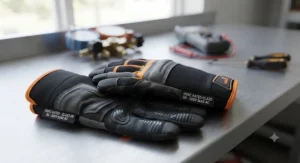
1000V Rated Gloves vs Everyday Dexterity Gloves
| Factor | 1000V Rated Gloves (Class 0) | Dexterity Gloves |
|---|---|---|
| Electrical protection | Tested to 1000V AC / 1500V DC | None — mechanical only |
| Cut/abrasion protection | Moderate, reduced by rubber design | High (ANSI A4-A5 typical) |
| Fine motor dexterity | Reduced by rubber thickness | High, often touchscreen-capable |
| Required testing | Air test daily, electrical retest every 6 months | None mandated |
| Best For | Salisbury by Honeywell E011, Enespro Class 0 Premium Kit | Mechanix Wear M-Pact HP Plus, Ironclad Command Impact 360 |
The table makes the trade-off obvious once it’s laid out side by side: 1000V rated gloves protect against shock but sacrifice mechanical dexterity and durability, while dexterity gloves protect against cuts and abrasion but offer zero electrical safety margin. Neither category is a substitute for the other, which is exactly why most working HVAC techs end up owning both rather than trying to find one glove that does everything. If your job regularly touches energized circuits above 50V, treat the rated glove as non-negotiable safety equipment and the dexterity glove as everyday-use PPE for the other 80% of the job.
✨ Ready to Build Your Glove Kit?
🔍 Take your HVAC toolkit to the next level with a properly matched glove setup. Click on any highlighted product above to check current pricing and availability. The right combination keeps you protected on energized calls and dexterous on everything else!
Dexterity Gloves for Control Panels and Thermostat Wiring
Control panel and thermostat wiring work sits in an odd middle ground: the circuits involved are frequently low-voltage (24V control transformers, for instance), but the task itself demands the kind of fine finger control that thick rubber simply can’t deliver. This is where the case for dexterity gloves gets nuanced rather than absolute. If a circuit is confirmed de-energized through proper lockout/tagout and verification, a well-fitted dexterity glove like the Honeywell Imperio Cut Pro protects against incidental screw edges and panel burrs without fighting you on small terminal connections. But confirmation matters — “probably off” is not the same as verified de-energized, and OSHA’s own guidance draws a specific exception here: protector gloves aren’t required with Class 00 rubber gloves under limited conditions specifically because small parts manipulation demands unusually high finger dexterity, which tells you how seriously the standard takes this exact tension between safety and feel.
For thermostat wiring specifically, most residential systems run at 24V AC from a step-down transformer, which falls comfortably under even a Class 00 glove’s 500V ceiling with enormous margin — but low current at low voltage still isn’t zero risk, particularly around the transformer’s primary side, which typically carries full line voltage. The practical approach most experienced techs settle into: dexterity gloves for confirmed de-energized wiring and panel assembly, Class 00 or Class 0 rubber whenever there’s any doubt about isolation, and never relying on “it’s just low voltage” as a substitute for actually checking.
Control Panel Safety: Regulations and Compliance Guide
Control panel work sits squarely inside the scope of both OSHA’s electrical protective equipment standard and NFPA 70E’s broader workplace safety framework, and understanding how the two relate clarifies a lot of confusion techs run into. Under the same 1910.137 standard, if the voltage doesn’t exceed 250 volts AC or 375 volts DC, protector gloves aren’t required alongside Class 00 gloves under limited-use conditions specifically when small equipment and parts manipulation demands unusually high finger dexterity — a narrow, task-specific exception rather than a blanket allowance. Beyond design and use requirements, OSHA’s own guidance on insulating gloves and sleeves notes that rubber insulating gloves must be electrically tested at intervals of no more than six months, following test methods described in ASTM F496 for the in-service care of insulating gloves and sleeves.
NFPA 70E complements OSHA’s baseline requirements by adding risk-assessment and PPE-selection procedures on top of the regulatory floor. As the Wikipedia overview of NFPA 70E describes it, the standard addresses employee workplace electrical safety requirements and focuses on practical safeguards that also allow workers to remain productive within their job functions, covering electrical conductors and equipment installed within buildings and other structures. For an HVAC technician, the practical compliance checklist boils down to: know your panel’s confirmed voltage before touching it, use a glove class rated for that voltage with margin, keep retest documentation current, and treat “de-energized” as a verified state rather than an assumption.
Long-Term Cost & Maintenance of Insulating Gloves
| Cost Factor | Budget Path (Class 00 + separate protectors) | Kit Path (Premium bundled kit) |
|---|---|---|
| Upfront cost | Lower, components bought separately | Higher, but complete out of the box |
| Retest/testing burden | Same 6-month interval either way | Same 6-month interval either way |
| Replacement frequency | Depends on protector use and care | Often lower — protectors already matched |
| Best For | Salisbury E0011 + MAGID Leather Protectors | Enespro Class 0 Premium Kit |
Looking at the true cost of ownership rather than sticker price alone, the gap between the budget path and the kit path narrows considerably once you factor in replacement frequency. A rated glove that fails early retest because it wasn’t paired with proper leather protection ends up costing more over two years than a slightly pricier kit that included matched protectors from day one. The real long-term cost driver isn’t the glove class you pick — it’s whether the glove gets properly cared for, air-tested daily, and retested on schedule; neglect erodes the value of even the premium option faster than a well-maintained budget setup depreciates.
Frequently Asked Questions
❓ What voltage do low voltage gloves for HVAC technicians protect against?
❓ Do I need rated gloves for thermostat wiring?
❓ How often do insulating gloves need to be retested?
❓ Can dexterity gloves replace voltage-rated gloves?
❓ What's the difference between Class 00 and Class 0 gloves?
Conclusion
Low voltage gloves for HVAC technicians aren’t a single product — they’re a small system of gear that needs to match the actual risk in front of you on any given call. A Class 00 or Class 0 rated glove like the Salisbury by Honeywell E0011 or Salisbury by Honeywell E011 belongs in every truck that touches energized circuits, backed by MAGID Leather Lineman Protectors to keep that rubber in service longer. For the other 80% of a typical day — panel assembly, thermostat wiring on confirmed de-energized circuits, and general mechanical work — a dexterity glove like the Mechanix Wear M-Pact HP Plus, Ironclad Command Impact 360 Cut A5, or budget-friendly Honeywell Imperio Cut Pro protects your hands without fighting your fine motor control.
The core principle worth carrying away from all of this: match the glove class to the confirmed voltage, never assume “low” means “safe,” and treat protector gloves and retest schedules as part of the equipment rather than optional extras. Gear this cheap, relative to what it protects, isn’t the place to cut corners.
✨ Don’t Miss These Exclusive Deals!
🔍 Take your HVAC glove kit to the next level with these carefully selected products. Click on any highlighted item above to check current pricing and availability. The right gloves keep you protected on energized calls and dexterous on everything else!
Recommended for You
- Class 2 High Voltage Gloves for Lineman: 7 Trusted Picks (2026)
- Leather Protector Gloves vs Rubber Insulating Gloves: 7 Picks (2026)
- Arc Flash Gloves for Utility Workers: 7 Best Picks for 2026
Disclaimer: This article contains affiliate links. As an Amazon Associate, I earn from qualifying purchases. If you purchase products through these links, we may earn a small commission at no additional cost to you.
✨ Found this helpful? Share it with your friends! 💬🤗
