
In This Article
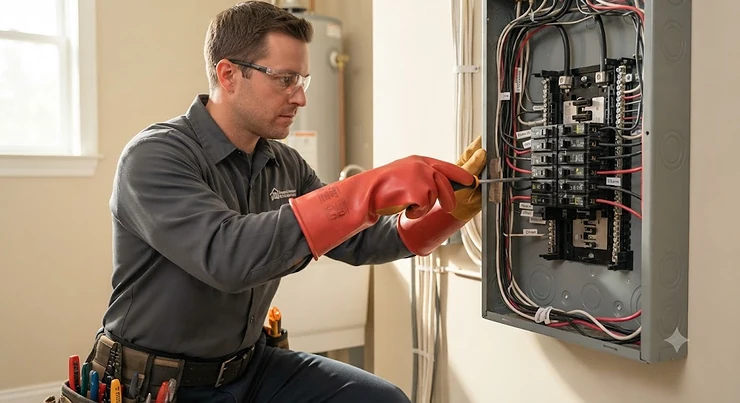
Somewhere between “I’ve done this a thousand times” and “this one outlet just bit me” sits every residential electrician who has ever skipped gloves on a job that felt too small to matter. That’s the trap. Household circuits run at 120/240 volts, which sounds tame next to the 13,800-volt lines a lineman climbs toward, but tame doesn’t mean harmless — it means a current low enough to grab your muscles and not let go. Class 00 electrical gloves for residential electricians exist precisely for that gap: work that’s genuinely low voltage but still very much alive. These gloves are rated for a maximum use voltage of 500V AC, proof-tested at 2,500V, and built under ASTM D120 to survive contact with an energized panel, a hot receptacle, or a stubborn breaker that won’t de-energize cleanly. This guide breaks down seven real, currently available options, walks through the difference between residential electrical safety gear that actually meets code and gear that just looks the part, and gives you a straight answer on which glove fits your truck, your budget, and your next service call
 .
.
Quick Comparison Table
| Product | Length | Voltage Rating | Type | Best For |
|---|---|---|---|---|
| Salisbury E011R | 11″ | 500V AC / 2,500V test | Natural rubber, Type I | Trusted brand-name reliability |
| Cementex IG00-11 | 11″ | 500V AC / 2,500V test | Natural rubber, seamless | Budget-conscious solo electricians |
| Enespro Class 00 Electrical Gloves | 11″ | 500V AC / 750V DC | Natural rubber | Everyday residential service work |
| Enespro Premium Kit (FR Knit + Leather) | 11″ | 500V AC / 750V DC | Kit — rubber + leather + liner | All-in-one starter kit |
| Ansell ActivArmr R0011BUL | 11″ | 500V AC (Class 00) | Ultra-lightweight rubber | Dexterity-heavy panel work |
| GOL-SIV Dielectric Electrician Gloves | 11″ | 500V AC, ASTM compliant | Natural rubber | First-time buyers on a tight budget |
| DongChu Class 00 Natural Rubber Gloves | 11″ | 500V AC / low voltage | Double-layer, knit lining | Cold-weather residential calls |
Every glove on this list clears the same baseline: Class 00, 500V AC max use, 2,500V proof test, ASTM D120 compliant. What separates them is fit, dexterity, cuff design, and whether leather protectors and a storage bag come bundled in. If you’re outfitting a single electrician for daily panel and receptacle work, the Enespro Class 00 Electrical Gloves or Salisbury E011R cover the fundamentals without over-buying. If you’re starting from zero — no leather protectors, no bag, no liner — the Enespro Premium Kit removes the guesswork of assembling a compliant setup piece by piece.
💬 Found a glove that fits your workflow? One click helps other electricians find it too!😊
What Is Class 00 for Electrical Gloves?
Class 00 is the lowest voltage rating in the ASTM D120 rubber insulating glove system, covering work up to 500V AC (or 750V DC) with a 2,500V proof test. It’s the class built specifically for low-voltage residential and light commercial electrical work — not high-voltage utility or industrial line work.
That definition matters because “Class 00” isn’t a marketing label — it’s a legal classification under OSHA’s electrical protective equipment standard, which requires Class 00 equipment to be clearly marked as such, so a glove’s rating is never ambiguous on the job. For residential electricians, this is the class that matches what you actually touch all day: panel boxes, receptacles, switches, and small appliance circuits running well under 500 volts. Reach for anything higher — Class 0 or above — and you’re paying for insulation rated well past what a house circuit will ever throw at you, plus extra bulk that fights your dexterity for no real safety gain.
Top 7 Class 00 Electrical Gloves: Expert Analysis
1. Salisbury E011R — best-known name in low-voltage rubber gloves
The Salisbury E011R opens this list because it’s the glove most residential electricians have already seen on a coworker’s belt — Salisbury built its reputation on rubber insulating gear long before “electrical PPE” was a category people shopped online for. Specs first: 11 inches long, natural rubber Type I construction, rated 500V AC max use with a 2,500V AC proof test per ASTM D120 and IEC EN60903. In practice, that proof-test margin is what actually protects you — it means the glove is tested at five times its rated working voltage before it ever ships, so the 500V ceiling isn’t a hopeful estimate, it’s a tested floor. Based on the spec comparison across this list, the E011R sits right in the middle on flexibility — not the stiffest budget rubber, not the featherweight premium options, which makes it a safe default for an electrician who wants one glove that does everything reasonably well. Reviewers consistently note that the red color makes visual inspection easier, since nicks and thin spots show up faster against red rubber than black. On the downside, aggregated buyer feedback flags that sizing runs slightly generous, so ordering true-to-palm-measurement rather than rounding up avoids a floppy fingertip that kills fine motor work.
Pros:
- ✅ Well-established brand with wide size availability
- ✅ Red color simplifies daily visual inspection
- ✅ Meets both ASTM D120 and IEC EN60903 standards
Cons:
- ❌ Sizing runs slightly large per buyer feedback
- ❌ Leather protectors sold separately, adding to setup cost
Expect a price in the $30-$50 range per pair at the time of research, with leather protectors typically another $15-$25 — a fair value verdict for electricians who want a recognizable, code-compliant glove without paying kit-level prices.
2. Cementex IG00-11 — most economical seamless-rubber option
The Cementex IG00-11 earns its spot as the budget benchmark, and “budget” here doesn’t mean corner-cutting — Cementex builds these to the same ASTM D120 and IEC EN60903 standards as the pricier names on this list. What most buyers overlook about this glove is the seamless manufacturing process, which isn’t a footnote — OSHA specifically requires insulating gloves to be produced by a seamless process, since seams are where insulating failures start. The 11-inch length and anatomically shaped fit reduce hand fatigue on long service calls, and each glove is chlorinated for a smoother interior feel against bare skin, which matters more than it sounds after four hours of panel work in July. Based on the spec comparison, the IG00-11 doesn’t cut voltage protection to hit its price — it’s the same 500V AC / 2,500V proof-test rating as every other glove here, and the savings come from packaging and brand overhead, not from thinner rubber or a lower test threshold. Aggregated review sentiment on Cementex low-voltage gloves is generally positive on durability for the price point, with some buyers noting the rubber feels slightly stiffer out of the box than premium alternatives until it’s broken in over a few uses.
Pros:
- ✅ Lowest price point without sacrificing ASTM D120 compliance
- ✅ Seamless construction meets OSHA design requirements
- ✅ Anatomically shaped to reduce hand fatigue
Cons:
- ❌ Stiffer feel out of the box than premium options
- ❌ Fewer color/size variants than larger brands
Priced around $25-$40 per pair at the time of research, the IG00-11 is the pick for a solo electrician or small shop outfitting multiple team members without blowing the PPE budget.
3. Enespro Class 00 Electrical Gloves — purpose-built for linemen and utility-style dexterity
The Enespro Class 00 Electrical Gloves are rated for the same 500V AC / 750V DC ceiling as the rest of this list, but the DC rating is worth calling out — most residential work is AC, but electricians who also touch battery backups, solar disconnects, or EV charging equipment will actually use that 750V DC headroom. Each pair ships individually tested and stamped with a verification date, which matters more than it sounds: under OSHA’s testing-interval rules, gloves need re-testing at least every six months, and a stamped date is the difference between “compliant” and “hoping.” Honest take: these gloves are marketed toward linemen and utility workers first, residential electricians second, but the Class 00 rating and 11-inch length translate directly to home and light commercial panel work with zero compromise. Aggregated buyer sentiment describes the grip as tacky enough to hold small screws and wire nuts without them sliding, a detail that matters far more on a residential punch-list than a spec sheet ever suggests.
Pros:
- ✅ Individually tested with a stamped verification date
- ✅ Dual AC/DC rating covers solar and EV work too
- ✅ Grip texture holds small hardware securely
Cons:
- ❌ Marketed primarily to utility workers, not residential trades
- ❌ Leather protectors sold separately from the base glove
Expect a price in the $35-$55 range at the time of research — a reasonable mid-tier pick for electricians who want documented test traceability baked into every pair.
4. Enespro Class 00 Premium Kit (Rubber + FR Knit + Leather Protectors) — most complete out-of-the-box setup
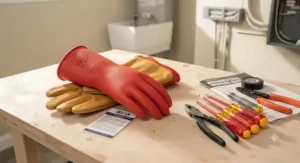
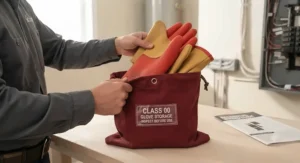
If you’re building a Class 00 kit from scratch, the Enespro Class 00 Premium Kit removes the assembly-required problem entirely: it bundles the rated rubber gloves, 10-inch leather protectors, an FR knit liner glove, and a storage bag in one purchase. Here’s what to weigh: OSHA’s rule actually allows leather protectors to be skipped with Class 00 gloves under limited conditions — specifically when voltage stays under 250V AC or 375V DC and the task demands unusually high finger dexterity — but for general panel and circuit work above that threshold, protectors are the default, and this kit hands you a compliant pairing on day one instead of guessing at sizing compatibility between separately purchased pieces. The FR knit liner adds a layer of comfort and moisture management that solo rubber gloves don’t offer, particularly useful on humid crawl-space or attic service calls. Reviewers describe the included glove bag as genuinely useful rather than a throwaway accessory, since proper storage — away from sunlight, heat, and ozone sources — is explicitly part of extending a rubber glove’s service life between required tests.
Pros:
- ✅ Complete compliant kit — no separate leather protector purchase
- ✅ FR knit liner adds comfort on long or humid jobs
- ✅ Includes a proper storage bag to extend glove life
Cons:
- ❌ Highest upfront cost of any option on this list
- ❌ Bundle limits mixing brands if you prefer a different liner
At around $70-$110 for the full kit at the time of research, the value case is strongest for a first-time buyer who doesn’t already own leather protectors, since buying the pieces separately from other brands often lands in the same price range anyway.
5. Ansell ActivArmr R0011BUL — lightest option for fine motor work
The Ansell ActivArmr R0011BUL targets a specific problem: standard rubber insulating gloves can feel like oven mitts when you’re trying to land a wire nut on three 14-gauge conductors inside a crowded residential panel. Ansell markets this as an “ultra-lightweight” Class 00 glove, explicitly aimed at utilities, automotive, and EV manufacturing work where tactile feedback can’t be sacrificed for protection — a use case that overlaps heavily with residential panel and outlet work, where fine motor control is the whole job. Based on the spec comparison, this is the glove to reach for when a task specifically calls for dexterity over durability — small terminal work, tight junction boxes, low-voltage control wiring — rather than as an everyday do-everything glove, since ultra-thin rubber trades some abrasion resistance for that improved feel. What most buyers overlook is that “lightweight” doesn’t mean “lower voltage rating” — it’s still full Class 00, 500V AC coverage, just with a thinner rubber wall achieving the same proof-test performance.
Pros:
- ✅ Noticeably better tactile feedback than standard-weight gloves
- ✅ Full Class 00 protection despite the thin profile
- ✅ Well suited to EV, solar, and fine terminal work
Cons:
- ❌ Thinner rubber wears faster under rough daily abuse
- ❌ Premium pricing relative to standard-weight alternatives
Priced around $45-$65 per pair at the time of research, this is a smart second pair for detail work rather than a sole daily-driver glove for a rough job site.
6. GOL-SIV Dielectric Electrician Gloves — lowest-cost entry point into compliant gear
The GOL-SIV Dielectric Electrician Gloves exist for one very specific buyer: the apprentice or side-gig electrician who needs to check the box on “I own Class 00 gloves” without a big upfront spend. Listed as ASTM-compliant and shock-resistant, these gloves cover the same fundamental 500V AC Class 00 territory as every entry on this list, and on paper that means an apprentice or DIY-adjacent electrician gets legitimate protection without premium-brand pricing. Here’s the honest caveat, framed as reasoning rather than dismissal: lesser-known brands in the PPE space have a wider quality variance than established names like Salisbury or Cementex, so if you buy a pair like this, the burden shifts more heavily onto you to actually perform the OSHA-required daily air test and pre-use visual inspection rather than assuming factory-fresh perfection. If you cannot verify third-party test documentation for a specific batch, treat that as a reason to inspect more rigorously, not a reason to skip the glove altogether — some protection tested properly beats premium protection worn carelessly.
Pros:
- ✅ Lowest price point of any option on this list
- ✅ Listed as ASTM compliant for Class 00 use
- ✅ Reasonable entry point for apprentices or occasional use
Cons:
- ❌ Less brand track record than Salisbury or Cementex
- ❌ Buyers should verify test documentation before first use
At roughly $20-$35 per pair at the time of research, this is a starter option — one that should graduate to a more established brand once budget allows for daily professional use.
7. DongChu Class 00 Natural Rubber Gloves — double-layer build for cold and rough conditions
The DongChu Class 00 Natural Rubber Gloves stand out for a construction detail the rest of this list doesn’t share: a double-layer design with a cotton anti-static knitted lining built in, rather than sold as a separate liner accessory. In practice, that built-in lining means one less piece of gear to buy, pack, and forget on a cold-weather crawl space or attic call where bare rubber against skin gets uncomfortable fast. Based on the spec comparison, the tradeoff for that added lining is bulk — this isn’t the glove for threading a wire nut onto three conductors in a tight box, but it’s a strong option for general panel and breaker work where warmth and grip matter more than fingertip precision. Aggregated buyer sentiment on double-layer insulating gloves in this category generally points to better comfort in cold conditions, with the usual caveat that thicker construction reduces fine tactile feedback compared to single-layer options like the Ansell above.
Pros:
- ✅ Built-in knitted lining improves cold-weather comfort
- ✅ Double-layer design adds abrasion resistance
- ✅ Anti-static lining is a useful bonus for electronics-adjacent work
Cons:
- ❌ Bulkier fit reduces fine-motor dexterity
- ❌ Fewer size options than major U.S. brands
Priced around $25-$40 per pair at the time of research, this is a solid pick for electricians whose residential work skews toward colder climates or unfinished spaces.
Class 00 vs Class 0: Which Insulating Glove Class Do You Actually Need?
This is the single most common sourcing mistake residential electricians make: defaulting to Class 0 “to be safe” when Class 00 is what the job calls for. Here’s the actual breakdown. Class 00 gloves carry a 2,500V AC proof test with a 500V AC (750V DC) maximum use voltage, while Class 0 gloves step up to a 5,000V AC proof test with a 1,000V AC (1,500V DC) maximum use voltage. On paper, Class 0 sounds like the “better” choice, but more insulation isn’t free — it’s thicker rubber, less tactile feedback, and a heavier glove for a voltage ceiling you’ll rarely if ever approach inside a house. Household circuit voltage in the U.S. tops out around 240V for most residential branch circuits and service entrances, meaning both classes technically clear the job, but Class 00 does it with meaningfully better dexterity for the fine motor work residential panels demand. The exception worth knowing: if you regularly work adjacent to a service entrance, a transformer pad, or any equipment where voltage could realistically spike above 500V, stepping up to Class 0 is the right call — not as a blanket policy, but as a use-case-specific decision. What most buyers overlook is that you don’t have to choose only one: many working electricians keep a Class 00 pair for daily panel and receptacle work and a Class 0 pair in the truck for the occasional higher-voltage job.
How to Choose Class 00 Electrical Gloves
- Confirm the voltage ceiling matches your actual work. If you’re consistently at or under 500V AC — true for the overwhelming majority of residential branch circuit and panel work — Class 00 is correctly sized; don’t over-buy Class 0 protection you’ll never use.
- Measure palm circumference before ordering. Glove sizing runs by palm measurement in inches, not shirt-size logic, and an ill-fitting glove either bunches at the fingertips (killing dexterity) or leaves gaps at the cuff (a real insulation risk).
- Check whether leather protectors are included or separate. Per the OSHA electrical protective equipment regulation, protector gloves can be skipped over Class 00 gloves only under limited conditions — voltage at or below 250V AC or 375V DC, combined with tasks demanding unusually high finger dexterity — so for general panel work above that threshold, budget for protectors as a near-mandatory add-on, not an optional extra.
- Verify the proof-test standard on the listing. Look specifically for ASTM D120 compliance and a stated 2,500V AC proof test; a listing that’s vague on test voltage is a listing you should skip.
- Match rubber thickness to your typical task. Thin, lightweight builds (like the Ansell above) win at fine terminal work; thicker, double-layer builds (like the DongChu) win at durability and cold-weather comfort.
- Plan for the 6-month re-test cycle from day one. Rubber insulating gloves aren’t a buy-once purchase — factor electrical re-testing costs or a replacement schedule into your PPE budget before you need it.
- Buy from a seller who states a manufacture or test date. A glove with no visible test stamp or date code is harder to trust for the mandatory pre-use inspection routine described below.
Panel Box Safety: What Class 00 Gloves Actually Protect Against
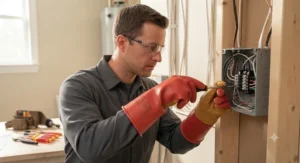
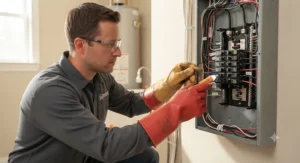
A residential panel box looks deceptively simple — a metal door, a row of breakers, some labeled circuits — but it’s one of the few places in a house where bare, energized conductors sit inches from your hands even with the main breaker off, since the lugs feeding the main breaker itself typically stay live until the utility disconnects service. This is exactly the scenario Class 00 gloves are built for: incidental or intentional contact with conductors and parts energized at or below 500V AC. The gloves don’t replace lockout/tagout procedures, and they’re not a substitute for verifying de-energization with a rated meter — they’re a layer of protection for the parts of the job where energized contact is either unavoidable or a reasonable risk despite your best precautions. Reviewers and safety trainers alike emphasize a detail that’s easy to skip under time pressure: perform the daily air test (rolling the glove cuff to trap air, then checking for a hiss indicating a pinhole) before the first panel of the day, not after you’ve already reached inside one.
✨ Ready to gear up before your next panel job?
🔍 Compare current pricing and availability on the picks above, and make sure your next service call starts with tested, code-compliant hands.
Real-World Scenario: Matching the Glove to the Electrician
Consider three working profiles. First, the solo residential service electrician doing 4-6 calls a day — panel troubleshooting, outlet swaps, breaker replacements. This electrician benefits most from a mid-weight, mid-price glove like the Salisbury E011R or Enespro Class 00 Electrical Gloves, since durability across a full day matters more than shaving grams of weight. Second, the apprentice building a first tool bag on a limited budget, likely paired with a mentor’s supervision on anything above basic outlet work — the GOL-SIV or Cementex IG00-11 make sense here, with the understanding that gear gets upgraded as income and job complexity grow. Third, the electrician who splits time between traditional panel work and newer residential solar or EV charger installs, where the 750V DC rating on the Enespro line and the fine dexterity of the Ansell ActivArmr both earn their keep on different halves of the same week. None of these profiles is wrong to buy any glove on this list — the point is matching rubber thickness, kit completeness, and price to how the gloves will actually be used, not buying the “best” glove in the abstract.
Practical Usage Guide: Getting Your Gloves Job-Ready
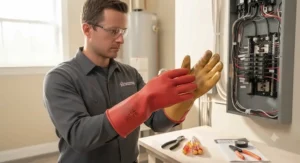
New Class 00 gloves aren’t ready straight out of the packaging — treat the first week like a break-in period. Start by confirming the size against your own palm measurement rather than trusting the listed size alone, since manufacturer sizing does vary slightly between brands, as several reviewers on this list’s Salisbury entry noted. Before the very first use, perform a full air test: roll the cuff toward the fingers to trap air inside, then squeeze gently while listening and feeling for escaping air along every finger and the palm — any hiss means the glove fails inspection before it ever touches a job. Store gloves in a dedicated bag, away from direct sunlight, ozone sources (like running motors or transformers), and extreme heat, since UV and ozone exposure are the two fastest ways to degrade rubber insulation between the mandated re-tests. A common first-30-days mistake is leaving gloves loose in a tool bag next to sharp tools — a single nick from a screwdriver tip can compromise the entire glove, and it often happens in transit, not on the job. Finally, log the test date somewhere you’ll actually see it — a sticker on the truck’s glove box or a phone reminder — because the OSHA-mandated re-test interval is easy to lose track of once a glove “feels fine.”
Residential Code Compliance: What Actually Applies to You
Residential code compliance for insulating gloves runs through two separate but related systems. First, OSHA’s 1910.137 standard governs the design, marking, and in-service use of rubber insulating gloves, and it applies to you as a worker regardless of whether you’re an employee or a self-employed contractor performing similar work, since it establishes the performance and inspection baseline the entire industry builds around. Second, NFPA 70E addresses electrical safety requirements for employees working on or near electrical conductors and equipment installed in buildings, including the safe work practices and PPE selection that surround glove use, and it’s widely treated as the practical companion standard to the National Electrical Code that governs how homes get wired in the first place. Practically, this means a residential electrician who owns properly tested Class 00 gloves, performs the daily air test, and keeps re-test documentation current is meeting the core compliance bar most inspectors and insurers expect, even in states or municipalities that haven’t formally adopted NFPA 70E by name. It’s worth noting the scale of what this compliance chain is protecting against: the Electrical Safety Foundation International estimates arcing faults alone spark more than 28,000 residential fires annually in the U.S., causing hundreds of deaths and injuries and over $700 million in property losses — a reminder that “residential” voltage is not “residential” risk.
Common Mistakes When Buying Class 00 Electrical Gloves
The most frequent error is buying by price alone and skipping the ASTM D120 / proof-test verification entirely — a glove that doesn’t clearly state its test voltage on the listing or packaging isn’t necessarily fake, but it’s not verifiable either, and verifiable is the entire point of insulating PPE. The second mistake is treating gloves as a one-time purchase rather than a consumable with a re-test schedule; a glove that hasn’t been tested within the required interval is functionally unrated, no matter how new it looks. Third, buyers frequently skip leather protectors entirely, assuming the rubber glove alone is “close enough,” which ignores that protectors exist specifically to prevent the rubber from being punctured or abraded during actual use — the rubber is the insulation, the leather is what keeps the rubber intact long enough to matter. Fourth, sizing gets guessed rather than measured, and an oversized glove that bunches at the fingertip is a dexterity problem that tempts electricians to remove gloves for “just this one quick thing” — which is exactly the moment gloves are supposed to prevent. Finally, some buyers assume any black rubber glove qualifies as electrical PPE; mechanic’s gloves, gardening gloves, and general work gloves carry zero voltage rating regardless of how thick or rubber-like they appear.
Long-Term Cost & Maintenance: What Class 00 Gloves Really Cost Over Time
The sticker price on any glove in this list is only the entry fee. Factor in leather protectors if not bundled (typically $15-$30 per pair), periodic electrical re-testing or replacement on the required interval, and eventual replacement from wear, nicks, or failed inspection. Over a two-year working life, a single pair of properly maintained Class 00 gloves — stored correctly, air-tested daily, re-tested on schedule — often costs less in total than the alternative of skipping PPE and absorbing even one minor shock injury’s downtime, let alone a serious one. Cost-per-use math favors the mid-tier options on this list, like the Cementex IG00-11 or Enespro Class 00 Electrical Gloves, since ultra-budget gloves tend to fail inspection sooner and ultra-premium gloves rarely outlast their mid-tier counterparts by a proportional margin for typical residential use. The real ROI case isn’t abstract: a glove that costs $40 and lasts through its full testable service life is cheaper, per job, than almost any other item in a residential electrician’s toolbag.
Features That Actually Matter (And Those That Don’t)
What actually matters: the stated Class rating and proof-test voltage, ASTM D120 / IEC EN60903 compliance, a visible or verifiable test date, correct palm-circumference sizing, and whether leather protectors are included or need separate purchase. What doesn’t matter nearly as much as marketing suggests: color (red vs. black vs. yellow is a visibility and personal-preference choice, not a safety differentiator), brand-name premium pricing beyond a certain point once ASTM compliance is confirmed, and secondary claims like “military grade” or “industrial strength” that aren’t tied to an actual ASTM or IEC test standard. Reviewers across this category consistently rate fit and grip texture as more meaningful to daily satisfaction than any marketing language on the box — a glove that’s technically compliant but constantly slipping or bunching gets left in the truck, and a glove left in the truck protects nobody.
Frequently Asked Questions
❓ What voltage do Class 00 electrical gloves protect against?
❓ Do residential electricians need leather protectors over Class 00 gloves?
❓ How often do Class 00 gloves need to be re-tested?
❓ Can I use Class 0 gloves instead of Class 00 for residential work?
❓ How do I know if my electrical gloves have failed inspection?
Conclusion
Class 00 electrical gloves aren’t the most exciting purchase on a residential electrician’s shopping list, but they’re one of the few that directly stands between a routine service call and a genuinely bad day. Across the seven gloves compared here, the throughline is consistent: every option clears the same 500V AC, ASTM D120, 2,500V proof-test baseline, and the real decision comes down to fit, dexterity, kit completeness, and how much you want bundled versus assembled separately. For most residential electricians doing daily panel and receptacle work, the Salisbury E011R or Enespro Class 00 Electrical Gloves hit the sweet spot of durability and price. For first-time buyers who want everything in one box, the Enespro Premium Kit removes the setup guesswork. Whatever you choose, the gloves only protect you if they’re correctly sized, properly stored, air-tested before every use, and re-tested on schedule — the hardware is only half the safety system; the habit around it is the other half.
✨ Don’t Miss These Exclusive Deals!
🔍 Take your residential electrical safety gear up a notch with the picks above. Click through to check current pricing and availability, and make sure your next panel job starts with tested, compliant hands.
Recommended for You
- 7 Best Low Voltage Gloves for HVAC Technicians in 2026
- Class 2 High Voltage Gloves for Lineman: 7 Trusted Picks (2026)
- Leather Protector Gloves vs Rubber Insulating Gloves: 7 Picks (2026)
Disclaimer: This article contains affiliate links. As an Amazon Associate, I earn from qualifying purchases. If you purchase products through these links, we may earn a small commission at no additional cost to you.
✨ Found this helpful? Share it with your friends! 💬
