
In This Article
Let’s be honest — nobody thinks about hand protection until there’s blood on the cutting board. I’ve been there. One overconfident mandoline pass, one slippery oyster, one moment of distraction near a boning knife, and suddenly you’re Googling “how many stitches does a finger cut need.” That’s exactly why metal mesh cut gloves deserve a spot in every serious kitchen drawer and on every industrial workbench.
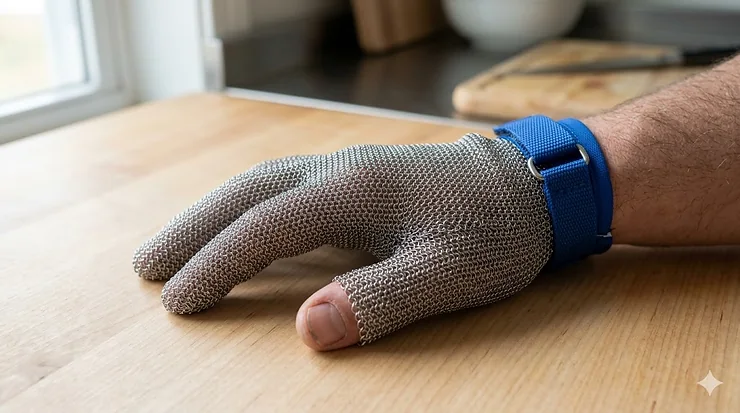
Metal mesh cut gloves are protective handwear constructed from interlocked or woven stainless steel rings or wire — essentially modern chainmail — engineered to stop blade contact before it reaches skin. Unlike fabric alternatives, the metal ring construction physically deflects sharp edges rather than just slowing them down. They’re rated under the ANSI/ISEA 105 standard on a scale of A1 to A9, with A9 representing the highest cut resistance available on the market today.
The demand is real: according to data cited by the Occupational Safety and Health Administration (OSHA), there were nearly 239,000 nonfatal hand injuries in private industry in a single reporting period. More telling? ISEA reports that 71% of hand injuries could have been prevented with proper PPE — yet 70% of workers don’t wear any hand protection at all.
Whether you’re a professional butcher, a weekend oyster shucker, an industrial worker dealing with sheet metal, or a home chef who’s tired of bandaging fingers, this guide covers seven real, currently available products on Amazon with honest expert analysis so you can stop guessing and start protecting.
Quick Comparison: Top 7 Metal Mesh Cut Gloves at a Glance
| Product | Protection Level | Material | Best For | Price Range |
|---|---|---|---|---|
| Schwer ProGuard-X PM5201 | ANSI A9 | 361L Stainless Steel Rings | Pro butchers, oyster shucking | $25–$40 |
| Schwer SlicePro PR1706 | ANSI A9 | Stainless Steel Mesh | Commercial kitchens, mandoline | $18–$30 |
| Dowellife Chainmail Glove | ANSI A9 | 304/316 Steel + HPPE Yarn | Home cooks, knife training | $15–$28 |
| Aillary Level 9 Kitchen Glove | Level 9 | Stainless Steel Wire Mesh | Machine washable everyday use | $12–$22 |
| ARCLIBER Level 9 Butcher Glove | Level 9 | Stainless Steel Wire Mesh | Meat processing, fish filleting | $12–$20 |
| Schwer ANSI A9 Flex Glove | ANSI A9 | Steel Wire + HPPE Fiber | Light industrial, woodworking | $15–$25 |
| Caprihom Chainmail Glove | A9-Equivalent | Stainless Steel Rings | Budget-friendly full mesh option | $10–$18 |
Looking at this table, the Schwer ProGuard-X PM5201 stands out as the premium choice for maximum protection in professional food processing environments, while the Dowellife and Aillary options deliver nearly equivalent cut resistance at a fraction of the price — making them ideal for home kitchens. Budget shoppers who still want true chainmail construction should look closely at Caprihom; it sacrifices some refinement but not core protection.
💬 Just one click — help others make better buying decisions too! 😊
Top 7 Metal Mesh Cut Gloves: Expert Analysis
1. Schwer ProGuard-X ANSI A9 Chainmail Glove PM5201
If you’re going to own one chainmail glove for serious professional use, the Schwer ProGuard-X PM5201 is the benchmark everything else gets compared to. Built from 361L stainless steel with individually welded rings, this glove achieves ANSI A9 — the absolute ceiling of cut resistance — meaning it can withstand over 6,000 grams of cutting load before failure. That’s not marketing fluff; individually welded rings matter because they prevent the chain from separating under lateral blade pressure, something looser-linked alternatives can’t guarantee.
What most buyers overlook: the reversible five-finger design means you buy one glove and it works on either hand, eliminating the need for left/right pairs. The stainless steel wrist clasp (not a fabric velcro strap) is also a hygienic game-changer in wet environments — no fabric band to harbor bacteria. Buyers on Amazon consistently praise the secure fit and describe it as “armor for the kitchen.” Best suited for professional butchers, oyster shucking operations, and commercial fish processors.
✅ Individually welded rings for maximum structural integrity
✅ Reversible for left or right hand
✅ All-metal hardware stays hygienic in humid environments
❌ Heavier than fabric alternatives —takes an adjustment period
❌ Metal-on-skin can feel scratchy without a liner glove
Price range: around $25–$40. Worth every cent for professional daily use.
2. Schwer SlicePro ANSI A9 Cut Resistant Glove PR1706
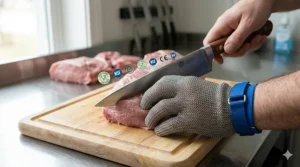
The SlicePro PR1706 is Schwer’s slightly streamlined A9 offering — same protection level as the ProGuard-X but with a pre-curved design that gives it a more natural hand position during extended tasks. This matters more than it sounds. After 30 minutes of slicing meat or using a mandoline slicer, a straight-fingered glove creates fatigue in the palm; the pre-curved shape reduces that tension noticeably.
Food grade certified and PFAS-free (an increasingly important specification as more kitchens audit their PPE for chemical compliance), the PR1706 covers the entire hand and features an adjustable wrist closure. In my experience, this is the go-to recommendation for commercial kitchen workers who are on their feet for eight hours and need protection that doesn’t feel like a punishment. Customers call it comfortable for long sessions and reliable on wet, slippery surfaces. Best for: line cooks, professional mandoline users, and anyone in food processing who works with blades for hours at a stretch.
✅ Pre-curved design reduces hand fatigue during extended wear
✅ PFAS-free certification for health-conscious workplaces
✅ Adjustable wrist closure for a secure, customizable fit
❌ Single glove per package — budget for one per hand if needed
❌ Stiffer than hybrid fabric-steel options for fine motor tasks
Price range: $18–$30. Strong value for a certified A9 food-grade glove.
3. Dowellife Chainmail Glove (ANSI A9, Model B0963T9WDT)
The Dowellife A9 chainmail glove punches well above its price category. Constructed from approximately 5,000 interlocked 304/316 stainless steel rings — the same grade of steel used in surgical instruments — it delivers legitimate ANSI A9 protection with a yellow OSHA-aligned wrist strap that boosts visibility in busy commercial kitchens. That strap detail seems minor until you’re in a packed kitchen and need supervisors to confirm PPE compliance at a glance.
Here’s what the spec sheet won’t tell you: the included white nylon inner liner glove is actually essential, not optional. Metal mesh directly on bare skin gets uncomfortable after 15 minutes. With the liner, extended wear becomes genuinely manageable. Touchscreen-compatible fingertips are an unexpected bonus — you can check recipes on a tablet or pull up a cutting order without pulling the glove off. Excellent for teaching knife skills to beginners and for cooks with hand tremors. Machine washable and food-grade certified.
✅ ~5,000 welded steel rings for comprehensive full-hand coverage
✅ Includes nylon inner liner for comfort during extended wear
✅ Touchscreen-compatible fingertips — rare for true chainmail
❌ OSHA yellow wrist strap is prominent — not everyone’s preference aesthetically
❌ Food debris can get trapped in mesh rings if not cleaned promptly
Price range: $15–$28. Outstanding value for a professional-grade A9 glove.
4. Aillary Level 9 Cut Resistant Kitchen Glove
The Aillary Level 9 glove earns its place on this list specifically because of one feature most competitors skip: it’s genuinely machine washable. Sounds basic, but most chainmail gloves require hand-washing or careful dishwasher placement. The Aillary goes straight into a regular laundry cycle, which for home cooks who use it daily — oyster Sundays, weekly fish prep, frequent mandoline work — is a practical quality-of-life win that adds up fast.
Made from stainless steel wire mesh, it delivers Level 9 puncture and cut defense suitable for wood carving, meat cutting, and mandoline slicing. The design fits either hand (ambidextrous) and covers all five fingers fully. Customer feedback on Amazon consistently highlights ease of maintenance and the fact that it doesn’t feel excessively heavy during typical kitchen tasks. It’s not the choice for an industrial meat processing plant, but for the serious home cook or small restaurant prep cook, it’s genuinely one of the most practical options available. Best for: everyday home kitchen use, small restaurant prep, and anyone who values easy maintenance.
✅ Machine washable — rare and genuinely useful for daily kitchen use
✅ Ambidextrous five-finger coverage
✅ Level 9 protection at an accessible price point
❌ Not as structurally rigid as individually welded ring designs
❌ Wire mesh construction slightly less durable under extreme commercial workloads
Price range: $12–$22. Best value pick for home kitchen everyday use.
5. ARCLIBER Level 9 Stainless Steel Wire Mesh Butcher Glove
The ARCLIBER Level 9 occupies a useful niche: it’s built specifically with butcher-and-processor use cases in mind, meaning the proportions and wrist sizing lean toward users handling large bone-in cuts, whole fish, and other awkward-shaped items that require a glove to stay firmly in place under lateral grip pressure. The stainless steel wire mesh construction provides Level 9 cut resistance, and the adjustable wrist strap keeps the glove from shifting even during forceful cuts.
What sets ARCLIBER apart is the attention to coverage depth — the glove extends further toward the wrist than many competitors, offering a bit more forearm protection during deep-bowl meat processing. For oyster shucking specifically, that extra coverage matters because the knife force is often directed toward the wrist side. Amazon buyers in food service consistently mention durability after months of heavy use. Not the most elegant glove in the lineup, but arguably the most purpose-built for raw protein processing. Best for: butchers, seafood processors, fish market workers, and hunters processing game.
✅ Extended wrist coverage for deep-bowl and forearm protection
✅ Designed specifically for meat and protein processing tasks
✅ Durable construction holds up to months of commercial use
❌ Less flexible for light kitchen tasks like peeling or slicing vegetables
❌ Heavier weight than hybrid wire-fabric options
Price range: $12–$20. Solid specialist choice for serious meat and seafood work.
6. Schwer ANSI A9 Flex Cut Resistant Glove (Model B07QKLY31J)
Not all Schwer A9 gloves are chainmail. This model uses a different construction approach — a tightly woven blend of high-strength steel wire, HPPE fiber, and polyester — that achieves ANSI A9 protection while remaining significantly lighter and more flexible than traditional metal mesh. Think of it as the difference between chainmail armor and a kevlar vest: both stop blades; one is far easier to move in.
The practical upshot: this glove is far better suited to tasks requiring fine motor control — detailed woodworking, glass handling, industrial assembly, and precision food prep where dexterity matters as much as protection. The CTC-certified A9 rating was verified in 2022, and the glove has maintained strong reviews since. It won’t have the same puncture defense as solid chainmail (the interlocked ring structure is simply better at stopping blade tips), but for slice and cut resistance in light industrial settings, it delivers. Best for: light industrial workers, woodworkers, glass handlers, and kitchen tasks requiring high dexterity.
✅ ANSI A9 protection in a significantly lighter, more flexible glove
✅ Better dexterity for fine motor tasks than solid chainmail
✅ Touchscreen compatible and breathable for extended wear
❌ Lower puncture resistance compared to true ring-link chainmail
❌ More prone to wear at the fingertips under continuous heavy grinding
Price range: $15–$25. The smart pick when dexterity matters as much as protection.
7. Caprihom Chainmail Glove (Stainless Steel Metal Mesh)
The Caprihom Chainmail Glove rounds out this list as the most accessible entry point into true metal ring chainmail protection. It won’t win awards for fit refinement or additional features — no inner liner included, no premium hardware — but the core stainless steel interlocked ring construction genuinely works, and for buyers who are trying metal mesh cut gloves for the first time before committing to a premium model, it’s a risk-free way to learn whether the format suits your workflow.
Amazon buyers describe it as a reliable glove for oyster shucking, basic butchery, and fish filleting when used with a separately purchased cotton glove liner underneath for comfort. The adjustable metal snap-fastener wrist closure keeps sizing flexible across different hand shapes. It’s not the glove for professional daily commercial use, but it’s a perfectly legitimate weekend warrior and hobby-level protector. Best for: occasional home use, hobbyists new to chainmail gloves, budget-conscious first-time buyers.
✅ True interlocked ring chainmail at the most accessible price point
✅ Adjustable metal snap-fastener wrist closure
✅ Good introduction to metal mesh protection format
❌ No liner included — purchase separately for comfortable extended wear
❌ Less polished finish and fit compared to Schwer or Dowellife options
Price range: $10–$18. Best entry-level true chainmail option on Amazon.
✨ Don’t Miss These Exclusive Deals!
🔍 Take your hand protection to the next level with these expert-selected metal mesh cut gloves. Click any highlighted product name to check current pricing and availability on Amazon. Your fingers will thank you! 🧤
How to Use and Maintain Your Metal Mesh Cut Gloves the Right Way
Getting the most out of a metal mesh glove comes down to a few habits most buyers skip.
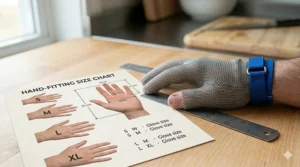
Sizing first. Measure your dominant hand’s palm circumference (wrap a tape measure just below the knuckles) and match it to the manufacturer’s size chart. A glove that’s too large will shift during cutting — which defeats the purpose entirely. Too tight and the rings will press uncomfortably against your knuckles during extended grip.
Always wear a liner. Unless the glove explicitly includes one (like the Dowellife), purchase a thin nylon or cotton inner glove separately. Metal mesh directly on bare skin becomes uncomfortable within minutes, especially in warmer kitchens. A liner also improves grip on wet surfaces.
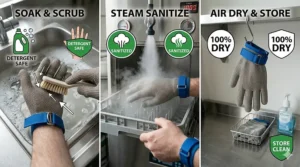
Post-use cleaning. Rinse immediately after protein work — meat juices, fish, and shellfish liquids degrade metal over time if left to sit. For most stainless steel mesh gloves, running them under hot water with dish soap and a soft brush clears debris effectively. Machine washable models (like the Aillary) go straight into a lingerie bag to prevent tangling. Always air dry; heat from a dryer can cause micro-corrosion in lower-grade steel.
Inspect the rings regularly. Run your thumb across the surface monthly. A broken or opened ring creates a weak point the size of a needle — small, but enough for a blade tip to find. If you spot a damaged ring, replace the glove; repair is not worth the safety risk.
Storage: hang it or lay it flat. Bunching a chainmail glove in a drawer deforms the ring links over time and weakens the mesh structure.
Who Needs Which Glove? Real-World Scenarios
The professional butcher or seafood processor: You’re working eight-plus hours handling bone-in cuts, oysters, and whole fish. The blades are heavy and sharp. Go with the Schwer ProGuard-X PM5201 or the ARCLIBER Level 9 for maximum protection and extended-wear durability. The investment pays for itself in one avoided ER visit.
The home cook who loves the mandoline: You use it weekly but not daily. The Aillary Level 9 or Dowellife Chainmail hits the sweet spot — genuine A9-level protection, machine washable, and light enough that you’ll actually reach for it instead of leaving it in the drawer. At the $15–$22 range, there’s no reason not to own one.
The woodworker or light industrial worker: Traditional chainmail can interfere with fine grip on tools. The Schwer ANSI A9 Flex Glove (B07QKLY31J) gives you ANSI A9 cut resistance in a lighter, more dexterous form that doesn’t feel like wearing a gauntlet. Ideal for glass handling, sheet metal work, and carving.
The first-timer testing the format: Start with the Caprihom before committing to a $35 premium model. Learn how chainmail fits your workflow, and upgrade once you know what features matter to you.
How to Choose the Right Metal Mesh Cut Gloves: 6 Expert Criteria
1. Match the ANSI level to the actual task. ANSI A9 is not always necessary. Mandoline slicing at home warrants A9; peeling vegetables does not. The ISEA hand protection guide provides task-matching frameworks. Over-specifying wastes money; under-specifying creates risk.
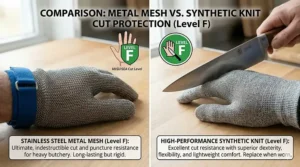
2. True chainmail vs. woven steel wire. Interlocked ring chainmail offers better puncture resistance (blade tips can’t find gaps between rings). Woven steel-wire-fiber hybrids offer better dexterity and lighter weight. Know which you’re buying.
3. Food grade certification. If the glove touches food, verify the food-grade claim — not just “food safe materials” marketing language, but an actual certification. PFAS-free status is becoming a meaningful criterion in 2026.
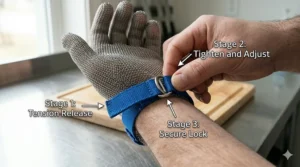
4. Fit and adjustability. A glove that shifts mid-cut is as dangerous as no glove. Look for adjustable wrist closures (metal clasp preferred over velcro in wet environments) and verify the size chart before ordering.
5. Liner compatibility. Unless a liner is included, budget for a $5–$8 nylon inner glove. Comfort drives compliance — if the glove hurts to wear, you won’t wear it.
6. Cleaning method. Machine washable gloves have a clear advantage for home cooks. Commercial environments with dishwashers or industrial sinks have more flexibility, but ease of cleaning affects how often the glove actually gets sanitized.
Common Mistakes When Buying Metal Mesh Cut Gloves
Assuming “cut resistant” means cut proof. No glove on this list — or on the market — is indestructible. ANSI A9 means it can withstand 6,000+ grams of cutting load in a standardized test. Real-world blade angles, speeds, and forces vary. These gloves dramatically reduce injury risk; they do not eliminate it.
Ignoring puncture resistance. Oyster knives, boning knife tips, and wood chisels apply point-force rather than edge force. Traditional chainmail handles this better than woven alternatives, but check the product’s puncture rating separately from its cut rating.
Buying only one glove. Most products are sold as single gloves. Professional users typically need one for the holding hand and a lighter glove on the cutting hand. Budget accordingly.
Skipping the liner. Covered above, but worth repeating: a $7 nylon liner transforms an uncomfortable glove into one you’ll actually use every time.
Relying on gloves alone near power tools. Per OSHA 1910.138, gloves are a last resort in the hierarchy of controls. Around rotating blades, bandsaws, or powered slicers, the glove itself can get caught. Metal mesh cut gloves are for manual blade work only.
Metal Mesh Cut Gloves vs. Fabric Cut-Resistant Gloves: Which Wins?
| Feature | Metal Mesh (Chainmail) | Fabric Cut-Resistant (HPPE/Kevlar) |
|---|---|---|
| Best protection level | ANSI A9 (maximum) | Up to ANSI A9 (with metal fiber blends) |
| Puncture resistance | ✅ Excellent | ⚠️ Variable |
| Dexterity | ⚠️ Lower | ✅ Higher |
| Comfort for long wear | ⚠️ Requires liner | ✅ More comfortable |
| Hygiene / Food grade | ✅ Easy to sanitize | ⚠️ Depends on materials |
| Durability | ✅ Very long lasting | ❌ Wears down over time |
| Price | ⚠️ Moderate–high | ✅ More affordable |
| Best use case | Butchery, oyster shucking, fishery | Light cutting, glass handling, general work |
The honest take: for professional food processing and tasks with high puncture risk, traditional metal chainmail wins. For industrial applications requiring all-day dexterity — and for users who simply won’t tolerate the weight — fabric-hybrid A9 gloves (like the Schwer ANSI A9 Flex) are legitimate alternatives. For most kitchen use, a true metal mesh glove at A9 is the clear winner because the traditional chainmail technology has been blocking blade contact for centuries — and stainless steel doesn’t degrade the way cut fibers do.
ANSI Safety & Compliance: What Every Buyer Needs to Know
Understanding the ANSI/ISEA 105-2024 standard isn’t just for safety managers — it’s the framework that tells you whether the glove you’re buying actually protects you. According to the standard, cut resistance levels A1 through A9 are determined by the ASTM F2992 test method, measuring how many grams of cutting load a blade requires to cut through the glove material over a 20mm distance. A9 requires withstanding 6,000+ grams — roughly equivalent to the weight of a full-grown cat pressing down on a razor blade.
For kitchen and food service, ANSI A6 is generally the minimum recommended for mandoline use; A8 or A9 is appropriate for professional butchery and oyster shucking. For industrial work involving sheet metal edges, glass, or metal fabrication, A4–A6 typically suffices, with A7–A9 reserved for extreme hazard environments.
OSHA’s hand protection standard (29 CFR 1910.138) requires employers to provide appropriate hand protection — and per a December 2024 revision to OSHA 1926.95, gloves must now properly fit each employee. Gloves that are too large are an OSHA compliance issue, not just a comfort one. For more detail, review OSHA’s hand protection requirements directly.
Frequently Asked Questions About Metal Mesh Cut Gloves
❓ What is the difference between ANSI A9 and Level 5 cut protection in metal mesh cut gloves?
❓ Are metal chainmail gloves food grade and safe to use with raw meat and seafood?
❓ Can metal ring gloves be used for woodworking and industrial tasks, not just kitchen use?
❓ How often should I replace my metal mesh cut gloves?
❓ Do metal mesh cut gloves protect against puncture and cut defense from oyster knives?
Conclusion
Choosing the right metal mesh cut gloves isn’t complicated once you know what to look for — but the wrong choice can mean the difference between a productive day and an urgent care visit. For professional food processing environments, the Schwer ProGuard-X PM5201 and Schwer SlicePro PR1706 set the standard. For everyday home kitchen use, the Dowellife Chainmail Glove and Aillary Level 9 deliver genuine A9 protection at a price that makes sense. If dexterity is your priority, the Schwer ANSI A9 Flex is the outlier worth considering. And if you’re testing the format for the first time, the Caprihom gives you a real chainmail experience without the premium commitment.
The most important move you can make? Stop treating hand protection as optional. The hand injuries documented by OSHA, the BLS, and workplace safety researchers are overwhelmingly preventable — and a glove that costs $15–$40 is a remarkably low price to pay for keeping all your fingers intact.
✨ Don’t Miss These Exclusive Deals!
🔍 Ready to protect your hands? Click any highlighted product above to check current pricing and availability on Amazon. These metal mesh cut gloves are some of the best-reviewed options on the market right now — grab yours before stock runs out! 🧤🛡️
Recommended for You
- Steel Mesh Cut Resistant Gloves: 7 Best Options Protecting Professionals in 2026
- 7 Best Dyneema Cut Resistant Gloves That Actually Work (2026)
- 7 Best HPPE Cut Resistant Gloves 2026: Ultimate Protection Guide
Disclaimer: This article contains affiliate links. As an Amazon Associate, I earn from qualifying purchases. If you purchase products through these links, we may earn a small commission at no additional cost to you.
✨ Found this helpful? Share it with your friends! 💬🤗
