
In This Article
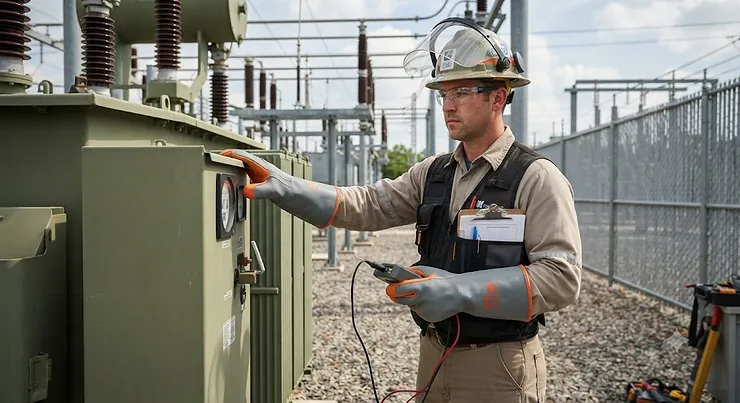
Ask any twenty-year lineman what keeps them up before a storm-restoration callout, and hands rarely come up in the conversation — until something goes wrong. Then hands are the only thing anyone talks about. Choosing arc flash gloves for utility workers isn’t a box to check on a PPE form; it’s the difference between walking away from an arc event and not walking away at all. Arc flash gloves for utility workers are hand protection rated to resist the intense heat of an electrical arc, either as arc-rated leather work gloves or as rubber insulating gloves worn beneath leather protectors, and they’re built to keep skin intact when everything else on the line goes sideways.
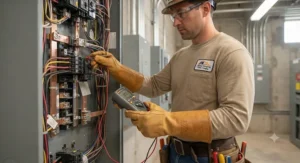
This guide breaks down seven real, currently available options — from budget-friendly Class 0 kits to premium weatherproof gear built for eight-hour storm shifts — and explains what actually matters when you’re standing at the base of a pole in January with a crew waiting on you. We’ll cover the difference between insulating rubber gloves and arc-rated leather, how the arc flash boundary changes what you need to wear, and where utility lineman PPE gloves earn their keep versus where they fall short. Every recommendation here is grounded in published specs, manufacturer documentation, and aggregated review sentiment — not marketing copy dressed up as advice. Under OSHA’s electric power generation, transmission, and distribution standard, hand protection selection isn’t optional paperwork — it’s a documented, voltage-specific decision, and getting it right the first time saves you a second trip to the truck.
Quick Comparison Table
Before the deep dive, here’s the fast version for anyone standing in a supply-house aisle with five minutes to decide.
| Glove / Kit | Rating / Class | Best For |
|---|---|---|
| Salisbury Electriflex NG214RB | Class 2, 17,000V AC max use | Dexterity-heavy live-line work |
| NSA ArcGuard KITGC2 Premium Kit | Class 2, 17,000V AC / 25,500V DC | All-in-one crew-standard kit |
| Enespro ArcGuard Class 2 Kit | Class 2, 17,000V AC / 25,500V DC | Budget-conscious crews and fleets |
| Youngstown FR Waterproof Leather Utility | Arc-rated leather, weatherproof | Wet, cold, and storm-restoration shifts |
| Endura 378GKGE Goatskin | 36 cal/cm², NFPA 70E Category 3 | Everyday light-duty arc protection |
A quick read of that table tells most of the story: rubber-insulating kits like the NSA ArcGuard KITGC2 Premium Kit and the Enespro ArcGuard Class 2 Kit are the workhorses for anyone touching energized distribution voltage, while arc-rated leather options like the Youngstown FR Waterproof Leather Utility and the Endura 378GKGE Goatskin cover tasks where dielectric protection isn’t the primary hazard but heat and cuts are. Notice that price isn’t listed here on purpose — glove pricing shifts constantly with material costs and glove class, so treat any number you see elsewhere as a moving target and check current pricing before you buy. The right pick almost always comes down to voltage exposure first, weather conditions second, and dexterity needs third.
💬 Found the table useful? Save it, share it with your crew lead, and skip the guesswork on the next PPE order.
Top 7 Arc Flash Gloves for Utility Workers: Expert Analysis
Here’s the full lineup, budget through premium, with the reasoning behind each pick spelled out rather than just the spec sheet copied over.
| # | Product | Arc/Voltage Rating | Price Range | Best For |
|---|---|---|---|---|
| 1 | Salisbury Electriflex NG214RB | Class 2, 17,000V AC | $170–$230 range | Flexible high-voltage line work |
| 2 | NSA ArcGuard KITGC2 Premium Kit | Class 2, 17,000V AC/25,500V DC | $300–$360 range | Complete standardized crew kit |
| 3 | Enespro ArcGuard Class 2 Kit | Class 2, 17,000V AC/25,500V DC | $220–$280 range | Budget fleet purchasing |
| 4 | Cementex Class 0 Insulating Kit | Class 0, 1,000V max | $120–$170 range | Low-voltage distribution and meter work |
| 5 | Youngstown FR Waterproof Leather Utility | Arc-rated, water-resistant | $80–$100 range | Outdoor crews in wet weather |
| 6 | Youngstown FR Waterproof Ultimate | Arc-rated, insulated, waterproof | $115–$140 range | Winter storm restoration |
| 7 | Endura 378GKGE Goatskin | 36 cal/cm², Cat 3 | Under $20 per pair (bulk) | Daily light-duty arc protection |
Look closely and a pattern emerges: the middle of this table is dominated by insulating rubber systems rated for actual dielectric protection, while the top and bottom lean toward dexterity and everyday wear. The NSA ArcGuard KITGC2 Premium Kit justifies its higher price with the FR knit liner and leather protectors bundled in, which is exactly the kind of “hidden cost avoided” that a bare pair of rubber gloves doesn’t offer. Meanwhile, the Endura 378GKGE Goatskin exists in a different category entirely — it’s not a dielectric glove, and treating it like one would be a serious mistake covered later in this guide.
1. Salisbury Electriflex NG214RB — most flexible Class 2 rubber for live-line dexterity
The standout here is flexibility: Salisbury markets Electriflex as roughly 30% more pliable than its standard rubber insulating line, and that number matters more than it sounds. Rated Class 2 with a max use voltage of 17,000V AC and 25,500V DC, this 14-inch natural-rubber glove meets ANSI/ASTM D120 and comes in a contrasting black-exterior, red-interior construction so cuts and thin spots show up fast during a pre-use inspection. What most buyers overlook about rubber insulating gloves in general is that the class rating only protects you if the glove passes inspection and air-test every single time — a flexible glove that’s easier to inspect and easier to work small connectors in is a genuine safety upgrade, not a comfort perk. Reviewers consistently note the reduced hand fatigue during long switching operations compared to stiffer Class 2 gloves from a decade ago, though a handful mention the softer rubber shows nicks a little faster and needs closer daily checks.
Pros:
- ✅ Noticeably better dexterity for small-parts handling
- ✅ Contrasting colors make pinhole inspection easier
- ✅ Meets ASTM D120 for Class 2 dielectric protection
Cons:
- ❌ Softer rubber may show wear marks sooner
- ❌ Requires leather protectors purchased separately
Priced in the $170–$230 range depending on length and cuff style, this is a solid mid-tier pick — the extra dexterity pays for itself the first time you’re threading a connector at height instead of fighting your gloves.
2. NSA ArcGuard KITGC2 Premium Kit — most complete all-in-one glove kit
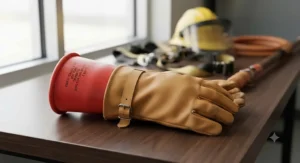
The standout feature is completeness: this kit ships with Class 2 rubber insulating gloves, an FR knit liner, 12-inch leather protectors, and a glove bag, so nothing gets left off the truck. Rated for a max use voltage of 17,000V AC / 25,500V DC and compliant with ASTM F1506, NFPA 70E-2015, and OSHA 29 CFR 1910.269, it’s built specifically around utility, electrical cooperative, and contractor workflows rather than general industrial use. Based on the spec comparison against buying components separately, bundling the FR knit liner in is a smart move — that liner adds dexterity and comfort without touching the dielectric rating, something a lot of crews discover the hard way after buying bare gloves and immediately needing a liner anyway. Aggregated buyer feedback across supplier listings points to consistent praise for the glove bag keeping protectors from scuffing the rubber in truck storage, with occasional notes that the bundled knit liner runs a touch large for smaller hands.
Pros:
- ✅ Bundles gloves, liner, protectors, and bag together
- ✅ Compliant with OSHA 1910.269 and NFPA 70E-2015
- ✅ Standardizes gear across an entire crew easily
Cons:
- ❌ Highest upfront cost of the kits reviewed
- ❌ Knit liner sizing runs slightly large
At a $300–$360 range per kit, this is the premium choice for utilities that want one SKU per worker rather than assembling components from three different vendors.
3. Enespro ArcGuard Class 2 Kit — best value complete glove kit
The standout feature is value: this kit hits the same Class 2, 17,000V AC / 25,500V DC rating as pricier bundles while trimming the price by focusing on the essentials — 14-inch rubber gloves, 10-inch leather protectors, and a bag. Each pair ships individually tested and stamped with a verification date, which matters practically because your safety officer needs that date on file for the mandated retest cycle, not just a label that looks official. Here’s what to weigh: this kit skips the FR knit liner included in pricier bundles, so if your crew wears cotton or synthetic liners already, you’re not paying for something you’d throw away anyway. Reviewer sentiment on major retail listings trends positive on fit and dielectric confidence, with a smaller number of comments noting the leather protectors feel thinner than premium competitors after a season of daily use.
Pros:
- ✅ Same Class 2 rating at a lower total cost
- ✅ Individually tested with a stamped verification date
- ✅ Straightforward kit without unnecessary extras
Cons:
- ❌ No FR knit liner included in the base kit
- ❌ Leather protectors feel thinner over time
Landing in the $220–$280 range, this is the pick for utilities equipping a large fleet where per-unit savings add up fast without cutting the actual dielectric protection.
4. Cementex Class 0 Insulating Kit — most affordable entry point for distribution voltage
The standout feature is accessibility: a Class 0 kit rated for voltages up to 1,000V AC covers the bulk of meter work, service-entrance tasks, and lower-voltage distribution jobs that don’t need the bulkier Class 2 or Class 4 gear. Built to ASTM D120 with a companion leather protector included, it’s the glove most likely to live in a service truck that also handles residential and light commercial calls rather than transmission-line work exclusively. On paper this means a lighter, more dexterous glove for tasks where a heavier Class 2 rubber glove would just slow a worker down without adding meaningful protection for the voltage actually present — matching class to actual exposure is the whole game, and Class 0 is honest about its lower ceiling rather than overselling it. Available documentation and supplier notes describe consistent reliability for the voltage range it’s rated for, though — as with any Class 0 glove — it should never be substituted onto a job that’s actually Class 1 or higher exposure.
Pros:
- ✅ Budget-friendly for low-voltage distribution tasks
- ✅ Lighter and more dexterous than higher-class gloves
- ✅ ASTM D120 compliant leather protector included
Cons:
- ❌ Not rated for higher-voltage transmission work
- ❌ Requires a separate kit for mixed-voltage crews
At $120–$170 range, it’s the smart budget add for utilities that run mixed fleets and don’t want every truck stocked with unnecessarily heavy Class 2 gear.
5. Youngstown FR Waterproof Leather Utility — best weatherproof arc-rated work glove
The standout feature is exactly what the name promises: an arc-rated, water-resistant leather utility glove built for crews who can’t wait for good weather to finish a job. It combines FR-treated leather with a waterproof membrane and an insulated liner option, giving outdoor electrical crew safety gear a real answer to the “my hands are soaked by 10am” problem that plain leather gloves never solve. Based on the construction, the waterproof barrier addresses a genuine gap in a lot of arc-rated leather lines, which tend to assume dry conditions and leave crews choosing between protection and comfort during rain or slush. Reviewers frequently mention that the waterproofing holds up through a full shift of wet-weather work, with a recurring note that break-in takes a week or two before the leather softens to a comfortable fit.
Pros:
- ✅ Genuinely waterproof, not just water-resistant marketing
- ✅ Arc-rated leather construction for cut and heat protection
- ✅ Comfortable for extended outdoor line maintenance shifts
Cons:
- ❌ Stiff out of the box until broken in
- ❌ Not a substitute for dielectric rubber gloves
Priced around $80–$100 range, it’s a strong mid-tier pick specifically for anyone whose job description includes “rain or shine.”
6. Youngstown FR Waterproof Ultimate — warmest option for winter storm restoration
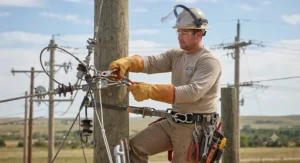
The standout feature is insulation stacked on top of waterproofing: this is the glove built for the 2am ice-storm callout where cold hands are as dangerous as anything else on the pole. It adds a heavier insulated lining to the same waterproof, arc-rated leather platform, trading a little dexterity for a meaningful jump in cold-weather comfort during overhead line maintenance in genuinely brutal conditions. What the spec sheet won’t tell you, but crew reports suggest, is that this trade-off is worth it specifically for extended outdoor exposure — anything under two hours in moderate cold and the lighter Leather Utility model above is probably the better call. Aggregated feedback highlights strong warmth retention during multi-hour storm-restoration shifts, alongside honest notes that fine motor tasks like small connector work feel noticeably clumsier in the thicker glove.
Pros:
- ✅ Significant warmth advantage for winter storm work
- ✅ Waterproof and arc-rated leather construction
- ✅ Holds up well across multi-hour cold shifts
Cons:
- ❌ Reduced dexterity for fine motor tasks
- ❌ Overkill for mild-weather or short-duration jobs
At a $115–$140 range, this is the premium weatherproof pick for utilities in northern climates running winter storm crews.
7. Endura 378GKGE Goatskin — lightest everyday arc-rated leather glove
The standout feature is everyday practicality: a goatskin driver-style glove with a 36 cal/cm² arc rating, NFPA 70E Category 3 classification, and ANSI/ISEA 105 Cut Level A4 — an economical option built for daily-wear tasks rather than specialty high-voltage jobs. Its ParaActiv engineered-yarn liner delivers 360-degree cut protection alongside contact heat protection rated to 500 degrees Fahrenheit, which in practice means a crew member handling tools, hardware, and general groundwork gets real thermal and cut protection without the bulk of a full rubber-and-leather system. Here’s what most buyers overlook: this glove is not a dielectric glove, and no amount of arc rating changes that — it belongs on tasks where arc flash and cuts are the risk but direct contact with energized conductors is not. Sold by the dozen for fleet purchasing, review sentiment across supplier catalogs consistently frames it as a reliable, affordable daily-driver glove, with the occasional comment that the goatskin stretches slightly with heavy use.
Pros:
- ✅ Solid 36 cal/cm² arc rating for everyday tasks
- ✅ ANSI Cut Level A4 protection built into the liner
- ✅ Affordable enough to stock by the case
Cons:
- ❌ No dielectric protection whatsoever
- ❌ Leather stretches slightly with heavy daily use
At under $20 per pair when bought by the dozen, it’s the easiest fleet-wide upgrade for crews still using plain, unrated leather work gloves for daily tasks.
Practical Usage Guide: Setting Up and Maintaining Your Arc Flash Gloves
Getting a new pair of arc flash gloves for utility workers into service correctly matters as much as picking the right rating in the first place. Start with an air test on any rubber insulating glove before its first use and before every subsequent shift — roll the cuff, trap air inside, and listen and feel for leaks along the entire surface, checking fingertips and web areas especially closely since that’s where pinholes show up first. Store rubber gloves unfolded in a dedicated glove bag away from direct sunlight, ozone sources, and extreme temperature swings, since UV exposure and ozone both accelerate rubber degradation faster than normal wear does. Log the retest date stamped on each glove and track the mandated inspection interval — most utilities run this on a strict calendar rather than trusting memory, and for good reason.
A common first-30-days mistake is skipping the break-in period on new leather arc-rated gloves and then complaining about stiffness on the job — work them by hand or wear them for short stretches during non-critical tasks first. Another frequent slip is mixing kit components between workers, which sounds harmless until a Class 2 rubber glove ends up paired with a mismatched leather protector size that bunches at the fingertips and reduces dexterity right when it matters. For underground utility work specifically, grit and moisture in vaults and manholes accelerate protector wear, so a quick wipe-down and visual check before storage extends usable life meaningfully compared to just tossing gear back in the truck bin.
✨ Don’t Miss These Exclusive Deals!
🔍 Take your utility lineman PPE gloves lineup to the next level with these carefully researched picks. Click through to check current pricing and availability on any option above — proper hand protection is one upgrade you’ll never regret.
Real-World Scenarios: Matching Gloves to the Crew
Consider three different callouts and how the glove choice actually changes. A distribution technician doing overhead line maintenance on a 13.8kV circuit needs Class 2 rubber protection at minimum — something like the NSA ArcGuard KITGC2 Premium Kit or the Enespro ArcGuard Class 2 Kit, worn with leather protectors every single time, no exceptions, because the voltage exposure demands actual dielectric protection rather than arc-rated leather alone.
A groundman handling hardware, running tools, and doing general support work around the crew — no direct energized contact — is well served by something like the Endura 378GKGE Goatskin for daily cut and light arc protection without the bulk of a rubber system that isn’t necessary for that role. And a storm-restoration crew working underground utility work in vaults during a January ice event needs the Youngstown FR Waterproof Ultimate layered appropriately with whatever dielectric protection the specific task requires, because cold, wet hands slow reaction time and increase mistakes regardless of how good the arc rating is on paper.
The throughline across all three scenarios: match the glove to the actual hazard and actual environment, not to whatever’s cheapest or whatever’s already in the truck. A budget-conscious utility running mixed voltage work benefits from stocking at least one Class 0 kit like the Cementex Class 0 Insulating Kit alongside Class 2 gear rather than over-equipping every truck with the heaviest option available.
Buyer’s Decision Framework: Choosing Fast Without Guesswork
If you’re standing in a supply aisle or scrolling a catalog with limited time, here’s a simple framework. If your task involves direct or potential contact with energized conductors above 1,000V, choose a Class 2 rubber insulating kit with leather protectors, because arc-rated leather alone does not provide dielectric protection at that exposure. If your task is strictly low-voltage distribution or metering work, a Class 0 kit is sufficient and considerably lighter to work in for an entire shift. If your task involves no direct energized contact but real arc flash and cut exposure — groundwork, tool handling, general crew support — an arc-rated leather glove like the Endura 378GKGE Goatskin covers the actual hazard without unnecessary bulk.
If your crew regularly works in rain, snow, or extended cold exposure, prioritize a weatherproof arc-rated option like the Youngstown FR Waterproof Leather Utility or the Youngstown FR Waterproof Ultimate over a standard leather glove, since a glove that’s technically rated but soaked through by mid-shift stops protecting dexterity and judgment even if the material rating holds. And if budget is the binding constraint across an entire fleet, standardize on one solid mid-tier kit like the Enespro ArcGuard Class 2 Kit rather than mixing premium and bargain gear across trucks, since consistency in training and inspection habits matters more than any single glove’s marginal spec advantage.
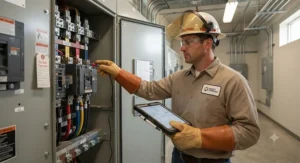
How to Choose Arc Flash Gloves for Utility Workers
Choosing the right pair comes down to five practical steps rather than a long checklist.
- Identify your actual voltage exposure first. Everything else follows from this — a Class 0, Class 2, or higher rating isn’t a preference, it’s determined by the job.
- Confirm compliance with ASTM D120 and, where applicable, NFPA 70E. These standards exist because informal “close enough” ratings have gotten people hurt.
- Decide whether you need dielectric protection or arc-rated leather. They solve different problems, and confusing the two is the single most common buying mistake covered in the next section.
- Weigh weather and duration realistically. A glove that’s technically rated but miserable to wear for eight hours in the rain gets swapped out for something unsafe by hour three.
- Check the retest and inspection requirements before you buy. A glove that’s cheaper upfront but harder to inspect or track costs more in labor and risk over its service life.
Reviewers and safety officers who’ve stocked utility lineman PPE gloves for years tend to agree on one thing: buying based on voltage exposure and realistic working conditions beats buying based on price alone almost every time.
What to Expect: Real-World Performance
On paper, a Class 2 rubber glove rated to 17,000V AC sounds like it should feel identical regardless of brand. In practice, dexterity differences between models like the Salisbury Electriflex NG214RB and older-generation rubber gloves show up the moment you’re threading a small connector forty feet up — stiffer rubber means more forearm fatigue by the end of a long switching operation, and that fatigue compounds mistakes late in a shift. Arc-rated leather gloves like the Endura 378GKGE Goatskin feel almost identical to unrated work gloves in daily use, which is exactly the point — the protection is invisible until the one moment it matters, and that’s honestly the best-case outcome for any PPE.
Weatherproof options change the performance conversation entirely. A worker in the Youngstown FR Waterproof Leather Utility on a rainy overhead line maintenance job reports a completely different experience than the same task in standard leather — not because the arc rating changed, but because dry, warm hands make every task faster and safer. That’s the part a spec sheet alone will never fully communicate.
Common Mistakes When Buying Arc Rated Gloves
The single most common and most dangerous mistake is assuming arc-rated leather gloves provide dielectric shock protection — they don’t, and treating a 36 cal/cm² leather glove like a substitute for Class 2 rubber on an energized task is a genuinely serious safety gap, not a technicality. A close second is buying the correct rubber glove class but skipping the leather protector, which exists specifically to prevent the punctures and nicks that compromise the rubber glove’s dielectric integrity underneath.
Another frequent misstep is ignoring the mandated retest cycle because a glove “looks fine” — rubber degrades in ways that aren’t always visible, which is exactly why the periodic dielectric retest exists rather than relying on a visual check alone. Buyers also commonly underestimate weather conditions, equipping crews with standard leather gloves for jobs that regularly involve rain or snow, then wondering why gloves get swapped for unrated alternatives mid-shift out of simple discomfort. Finally, some utilities standardize on the cheapest kit across the entire fleet regardless of actual voltage exposure on different jobs, which either under-protects high-voltage crews or unnecessarily burdens low-voltage crews with bulkier gear than the task requires.
Arc Flash Gloves vs Rubber Insulating Gloves with Leather Protectors
These two categories get confused constantly, and the confusion has real safety consequences. Arc-rated leather gloves — like the Endura 378GKGE Goatskin or the Youngstown FR Waterproof Leather Utility — are tested to resist ignition and limit heat transfer during an arc flash event, but they carry no dielectric rating and provide no protection against electric shock from direct contact with an energized conductor. Rubber insulating gloves worn with leather protectors — like the Salisbury Electriflex NG214RB or the kits from NSA and Enespro — are dielectric-rated by class and voltage, and the leather protector’s job is purely mechanical: preventing cuts, abrasions, and punctures that would otherwise compromise the rubber’s insulating integrity.
| Category | Protects Against | Requires Leather Protector? | Typical Use |
|---|---|---|---|
| Arc-rated leather gloves | Heat, flame, cuts | No (are the protector-equivalent) | Tasks without direct energized contact |
| Rubber insulating gloves | Electric shock (by class/voltage) | Yes, always | Direct or potential energized contact |
The table above simplifies a distinction that trips up even experienced crews under time pressure: rubber gloves need the leather layer to survive mechanically, while arc-rated leather gloves are complete on their own for the hazard they’re designed to address. As detailed in e-Hazard’s overview of the ASTM arc-rated glove test method, the two testing standards — ASTM D120 for dielectric rubber and the newer ASTM F2675 for arc-rated hand protection — measure fundamentally different properties, which is exactly why one glove can’t substitute for the other regardless of how high its arc rating number looks.
Understanding the Arc Flash Boundary and Matching Glove Class
The arc flash boundary is the calculated distance from a potential arc source within which a person could receive a second-degree burn if an arc flash occurred, and it directly determines what PPE — including gloves — a worker needs before crossing into that zone. According to Wikipedia’s overview of arc flash hazards, incident energy is expressed in calories per square centimeter, and that number is what arc-rated glove specifications like the 36 cal/cm² rating on the Endura 378GKGE Goatskin are actually measuring against.
In practice, this means glove selection isn’t a one-time decision made at purchase — it’s re-evaluated per task, based on the specific equipment, voltage, and calculated incident energy at that job site. A worker operating within the arc flash boundary on switchgear rated for a higher incident energy than a given glove’s arc rating is under-protected regardless of how new or expensive that glove is. Utilities that take this seriously document incident energy calculations per equipment category and issue PPE — gloves included — matched to that documented exposure, rather than issuing a single “one glove fits all tasks” standard across the fleet.
Weatherproof Arc Rated Gloves for Outdoor Electrical Crews
Weather is the variable that standard PPE guidance often underweights, and it shouldn’t be. Outdoor electrical crew safety gear has to perform in conditions no indoor electrician ever has to consider — driving rain during a storm callout, standing water in a trench during underground utility work, or single-digit temperatures during overnight restoration after an ice storm. Weatherproof arc rated gloves like the Youngstown FR Waterproof Leather Utility and its heavier sibling, the Youngstown FR Waterproof Ultimate, exist specifically to close that gap.
The core trade-off worth understanding: waterproofing and insulation both add bulk, and bulk reduces fine-motor dexterity. That’s a reasonable trade for a lineman working overhead line maintenance during a multi-hour ice storm, where cold, wet hands are a bigger risk to safe task completion than slightly reduced dexterity. It’s a worse trade for a fifteen-minute meter check on a dry afternoon, where a lighter, more dexterous glove gets the job done faster with no meaningful downside. Matching weatherproofing level to actual shift length and weather exposure — rather than defaulting to the heaviest option available — keeps crews both safer and more efficient across a full season of varied conditions.
Long-Term Cost & Maintenance for Utility Lineman PPE Gloves
The sticker price on any pair of utility lineman PPE gloves is only part of the real cost. Rubber insulating gloves require periodic dielectric retesting on a mandated schedule, and that testing — whether done in-house or through a third-party lab — carries its own recurring cost that should be budgeted alongside the initial purchase. Leather protectors and arc-rated leather gloves wear out through mechanical abrasion rather than age alone, meaning a crew working rough terrain or underground utility work daily will cycle through protectors faster than a crew doing lighter overhead work, regardless of brand.
Buying a slightly more expensive, better-constructed kit like the NSA ArcGuard KITGC2 Premium Kit can actually reduce total cost of ownership if its more durable leather protectors and better-organized glove bag extend usable service life compared to a bargain kit that needs replacing twice as often. On the other end, bulk-purchasing arc-rated leather like the Endura 378GKGE Goatskin by the dozen for daily-wear tasks keeps per-unit cost low precisely because that category isn’t subject to the same dielectric retest requirements as rubber insulating gloves — a cost difference worth factoring into fleet-wide PPE budgeting rather than comparing sticker prices alone.
Frequently Asked Questions
❓ What's the difference between Class 0 and Class 2 insulating gloves?
❓ Do arc-rated leather gloves protect against electric shock?
❓ How often do rubber insulating gloves need to be retested?
❓ Can I wear rubber insulating gloves without leather protectors?
❓ Are weatherproof arc rated gloves worth the extra cost?
Conclusion
Picking the right arc flash gloves for utility workers really comes down to three honest questions: what voltage am I actually exposed to, what conditions am I working in, and how long is my shift going to run. Get those three answers straight and the rest of the decision — Class 0 versus Class 2, arc-rated leather versus rubber insulating, standard versus weatherproof — mostly answers itself. The seven options covered here span budget entry points like the Cementex Class 0 Insulating Kit all the way to premium weatherproof gear like the Youngstown FR Waterproof Ultimate, and every one of them earns its spot for a specific kind of crew and a specific kind of day on the job.
No glove on this list is a universal answer, and that’s the point — the worst outcome in PPE selection isn’t picking the “wrong” brand, it’s matching the wrong category of protection to the actual hazard in front of you. Take the voltage exposure and working conditions seriously, check current pricing before you buy since it shifts constantly, and equip your crew — or yourself — with gear that matches the job rather than gear that’s simply on the shelf.
Recommended for You
- Rubber Insulating Gloves for Electricians: 7 Best Picks (2026)
- High Voltage Insulating Gloves: 7 Trusted Picks for 2026
- Arc Flash Gloves for Electrical Work: 7 Life-Saving Picks (2026)
Disclaimer: This article contains affiliate links. As an Amazon Associate, I earn from qualifying purchases. If you purchase products through these links, we may earn a small commission at no additional cost to you.
✨ Found this helpful? Share it with your friends! 💬🤗
