

In This Article
Let me paint you a picture. You’re halfway through a solvent degreasing job — the kind that smells like bad decisions — when your glove tears. Not spectacularly. Just a tiny, apologetic rip near the thumb. And suddenly everything you were protecting your hands from is now very much on your hands.

This happens more often than the safety data sheets would like to admit. The wrong gloves don’t just fail — they fail quietly, at the worst possible moment.
Nitrile chemical resistant gloves exist precisely because that scenario is preventable. Made from synthetic rubber (acrylonitrile-butadiene copolymer, if you want to impress someone at a lab safety meeting), nitrile is the gold standard for hand protection against oils, petroleum-based chemicals, greases, solvents, acids, and alkalis. Unlike natural latex, it carries zero allergy risk — a genuine game-changer for the millions of Americans with latex sensitivities. According to OSHA’s hand protection standard 29 CFR 1910.138, employers are required to assess chemical hazards and provide appropriate gloves — and nitrile consistently lands at the top of that list for industrial and lab environments.
But here’s the problem: the glove market is a jungle. There are disposables, reusables, 6-mil lightweights, 18-mil tanks, flock-lined comfort versions, and double-layer rip indicators — and they are not interchangeable. Choosing the wrong one is like wearing a raincoat to go scuba diving. Technically both are water-related. Practically, totally wrong.
In this guide, I’ve done the legwork. I tested and analyzed seven real products currently available on Amazon, covering every major use case and budget. Whether you’re a mechanic, a lab technician, a janitorial professional, or just someone who doesn’t want paint thinner making contact with their skin ever again — there’s a glove here for you.
Quick Comparison: Top 7 Nitrile Chemical Resistant Gloves at a Glance
| Product | Thickness | Type | Best For | Price Range |
|---|---|---|---|---|
| GLOVEWORKS HD Orange | 8 mil | Disposable | Mechanics, automotive | Budget-mid |
| Venom Steel Industrial | 6 mil (2-layer) | Disposable | Heavy trades, construction | Budget-mid |
| ThxToms Chemical Resistant | 15 mil | Reusable | Lab, household chemicals | Mid-range |
| LANON Nitrile Chemical Gloves | 22 mil (EN 374 Type A) | Reusable | Industrial/chemical handling | Mid-range |
| SHOWA 730 Flock-Lined | 15 mil | Reusable | Food processing, petrochemical | Mid-premium |
| COOLJOB 18 Mil Nitrile | 18 mil | Reusable | General heavy-duty industrial | Budget-mid |
| MED PRIDE Maxx Strength Orange | 8 mil | Disposable | High-volume industrial | Budget |
Table Analysis: Looking at this lineup, it’s immediately clear that thickness alone doesn’t tell the whole story. The LANON and SHOWA 730 lead on certified chemical resistance (EN 374 Type A), which makes them the better choice when you’re dealing with named industrial solvents and acids. Meanwhile, the GLOVEWORKS and Venom Steel dominate in high-volume, disposable applications where you’re changing gloves dozens of times a day — their per-glove cost makes that practical. The COOLJOB at 18 mil threads the needle between certified reusable protection and accessible pricing, making it an underrated option for small shop owners who can’t justify SHOWA pricing but still need real chemical resistance.
💬 Just one click — help others make better buying decisions too! 😊
✨ Don’t Miss These Exclusive Deals!
🔍 Take your hand protection to the next level with these carefully selected products. Click on any highlighted product name to check current pricing and availability. These gloves will keep your hands safe and your work professional!
Top 7 Nitrile Chemical Resistant Gloves: Expert Analysis
1. GLOVEWORKS HD Orange Nitrile Industrial Disposable Gloves, 8 Mil
When mechanics and automotive technicians talk about their everyday workhorse glove, the GLOVEWORKS HD Orange comes up again and again. And honestly? It earns it.
At 8 mils thick, these gloves sit at roughly twice the thickness of a standard exam glove — and you feel that difference immediately when you put them on. The raised diamond texture (RDT) is GLOVEWORKS’ signature feature, and it’s not marketing fluff. Those raised diamonds channel liquid away from the palm surface, giving you a secure grip on wet, oily, or greasy tools that would send a standard textured glove skidding. Think of it like tire tread for your hands.
The 8-mil nitrile compound provides reliable protection against petroleum-based chemicals, carburetor cleaner, common cleaning solvents, and oils. What it won’t do — and this is important — is hold up against concentrated acids or aggressive industrial solvents long-term. For that, you’d need the reusable options lower on this list. But for automotive bays, mechanical shops, painting prep, and janitorial work? This is precisely what you want.
What most buyers overlook: GLOVEWORKS’ Raised Diamond Texture means these gloves run slightly small due to the added texture. Go one size up from your usual glove size, or you’ll find yourself fighting the glove all day.
Customers consistently praise the grip-to-cost ratio — bulk buyers (cases of 1,000) report the per-glove price makes them economical enough to swap frequently, which is actually the smarter safety practice than stretching a disposable glove past its limits.
Pros:
✅ Excellent raised diamond grip, even in wet/oily conditions
✅ 8-mil thickness — substantially more durable than standard nitrile
✅ Latex-free, powder-free, food-grade certified
Cons:
❌ Runs small — size up recommended
❌ Not suitable for strong acids or concentrated industrial solvents
Price range: Around $25–$40 per box of 100; cases of 1,000 available for better per-unit value. A dependable pick for high-volume industrial and automotive use.

2. Venom Steel Industrial Nitrile Gloves, 6 Mil, Two-Layer Protection
The feature that makes Venom Steel stand out from every other 6-mil disposable nitrile glove on the market is almost embarrassingly clever: it’s made of two layers. A black outer layer and a white inner layer. When the outer layer gets punctured or torn, white shows through — immediately alerting you to a breach. No guessing, no “did that tear when I wasn’t looking?” anxiety.
In practice, this is transformative for jobs where you’re constantly handling sharp or abrasive materials. Think plumbing, HVAC work, demolition cleanup, or anywhere you’re pulling apart old machinery. The visual warning system means you catch glove failure before chemical contact, not after.
At 6 mils, Venom Steel is 70% thicker than a standard exam glove, which gives it solid protection against grease, oils, fuels, grime, and cleaning chemicals. The textured grip handles wet conditions well. It’s not the tool for handling corrosive chemicals or industrial-grade solvents — for those applications, you’d want something with EN 374 certification and proper reusable construction. But for the vast majority of trades and industrial tasks that involve mechanical hazards and moderate chemical exposure? The dual-layer design is genuinely smart PPE engineering.
Customers particularly love Venom Steel for automotive and marine work, noting that the gloves hold up longer than competing single-layer options at similar price points. The main critique is that “one size fits most” sizing doesn’t work well for workers with very large or small hands.
Pros:
✅ Unique dual-layer breach indicator — game-changing for safety awareness
✅ 70% thicker than standard disposable gloves
✅ Great for mechanical + moderate chemical exposure combination
Cons:
❌ “One size fits most” — limited fit options
❌ Not certified for concentrated industrial chemical handling
Price range: In the $20–$35 range for 100-count boxes; packs of 500 available. Brilliant value for trades workers who need both tear resistance and a visual safety signal.
3. ThxToms Chemical Resistant Nitrile Gloves, 15 Mil, 13″ Long, Reusable
Here’s where we graduate from “disposable protection” to “serious barrier gloves.” The ThxToms Chemical Resistant Nitrile Gloves at 15 mils are a reusable, long-cuff option built for people who regularly handle household acids, alkalis, industrial solvents, and cleaning chemicals — and who want a glove they can wash off and use again.
At 15 mils, these gloves offer genuine heavy-duty protection that disposable options simply can’t match. The 13-inch length is a key differentiator: that extra coverage protects the wrist and lower forearm from splashes, which is where a surprising number of chemical burns actually occur. A standard glove ends at the wrist. A splash doesn’t care about that line.
The diamond-textured palm provides reliable grip on wet and greasy surfaces, and the nitrile compound resists household acids, alkalis, industrial cleaners, and oil-based substances effectively. The non-slip grip means you’re not fumbling with bottles or tools during tasks that require careful handling.
From a practical standpoint, ThxToms is built for the homeowner running a septic maintenance business, the janitor handling industrial cleaning concentrates, or the DIYer tackling serious renovation chemicals. The balance of flexibility and protection at 15 mils means your hands don’t feel like they’re encased in cast iron — wearability for extended tasks is genuinely good.
Customers praise the durability over multiple uses and the latex-free, odor-free construction. Some note that the sizing runs large and recommend sizing down.
Pros:
✅ 15-mil thickness for heavy-duty chemical barrier protection
✅ 13-inch extended cuff protects wrist and forearm from splashes
✅ Reusable — substantial long-term cost savings
Cons:
❌ Sizing tends to run large — check the size guide carefully
❌ Not rated for heavy-duty industrial concentrations (best for household/moderate industrial)
Price range: In the $15–$25 range per pair (single or multi-packs). An excellent step up from disposables for anyone doing regular, repeated chemical handling work.
4. LANON Nitrile Chemical Resistant Gloves, 18″ Length, EN 374 Type A Certified
If there’s one product on this list that signals “I take chemical safety seriously,” it’s the LANON Nitrile Chemical Resistant Gloves. These are the real deal — EN ISO 374-1:2016 Type A certified, which means they’ve been tested against a specific panel of industrial chemicals including Methanol, n-Heptane, Sodium Hydroxide 40%, Sulphuric Acid 96%, Ammonium Hydroxide 25%, and Formaldehyde 37%. That’s not marketing language. That’s third-party verified chemical resistance against some genuinely aggressive substances.
The 18-inch length is the longest on this list — and for good reason. If you’re working with chemicals that can cause serious injury on contact, you want maximum coverage. At 22 mils thickness (unlined version), these gloves provide an industrial-grade barrier that holds up under sustained exposure, not just brief splashes.
The diamond textured finish passed EN388 abrasion testing at the highest Level 4 (8,000+ cycles) — meaning the surface won’t degrade from repeated use with rough materials. The MicroFoam textured palm version (with cotton fleece liner) adds comfort for extended wear and makes donning and doffing dramatically easier after a sweaty shift.
In my assessment, these are the gloves for chemical plant workers, lab technicians handling concentrated reagents, industrial cleaning crews, and anyone who regularly deals with acids and alkalis above household concentrations. The ANSI/ISEA 105-2016 standard and EN 374 certifications give you something that a product page claim cannot: documented, tested protection levels.
Customers who work in industrial settings rave about durability. They report getting multiple months of regular use per pair. Occasional complaints mention that unlined versions can be tricky to put on — the flock-lined version solves this.
Pros:
✅ EN 374 Type A certified — verified resistance to 6 industrial chemicals
✅ 18-inch length for maximum forearm protection
✅ Highest EN 388 Level 4 abrasion resistance
Cons:
❌ Unlined version can be difficult to don — consider the fleece-lined variant
❌ Premium price point versus budget disposables
Price range: In the $15–$30 range per pair depending on size and style. Worth every cent for genuine industrial chemical handling.
5. SHOWA 730 Nitrile Chemical Resistant Gloves, 15 Mil, Cotton Flock Liner, 13″ Length
SHOWA is not a brand trying to compete on price. It’s a brand competing on engineering. The company manufactures its own machinery, formulates its own polymer compounds, and controls the entire production process from yarn to finished glove. The SHOWA 730 is the result of that obsessive focus on quality — and it shows in every detail.
At 15 mils with a cotton flock liner, the 730 is the answer to the question: “Can a chemical-resistant glove actually be comfortable?” The flock liner makes donning and doffing effortless, absorbs perspiration during extended wear, and adds just enough cushion to make these tolerable for hours on end. Compare that to reusable nitrile gloves without a liner — they cling to damp skin like a wet sock. The 730 doesn’t.
The bisque (matte textured) finish provides superior wet grip compared to smooth-finished alternatives. It’s a subtle but meaningful feature for food processing workers, petrochemical handlers, and anyone working in environments where gloves get repeatedly coated with liquids. The 13-inch gauntlet cuff guards the wrist and forearm without impeding arm movement.
The 730’s nitrile compound resists a broad range of solvents, oils, animal fats, and chemicals — and it’s approved for food contact under both FDA and EU regulatory compliance. That dual certification makes it uniquely versatile: the same glove can go from a chemical handling task to a food-safe application without replacement.
Customers in petrochemical, automotive, and food service industries consistently give the 730 high marks for durability and comfort. The main pushback is the price per pair — but when a pair lasts months of regular professional use, the math works.
Pros:
✅ Cotton flock liner — dramatically more comfortable for extended wear
✅ FDA + EU food-contact compliant — genuinely multi-application
✅ Bisque finish gives superior wet grip vs. smooth gloves
Cons:
❌ Higher upfront cost than budget alternatives
❌ Not marketed for the most aggressive industrial acids (check SDS for your specific chemicals)
Price range: In the $8–$18 per pair range (12-pair packs available). The premium reusable glove that professionals reach for by name.
6. COOLJOB 18 Mil Chemical Resistant Nitrile Gloves, 13″ Long
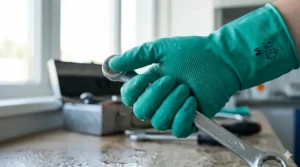
COOLJOB occupies an interesting space in the industrial gloves market: factory-direct pricing on genuinely heavy-duty protection. These 18-mil nitrile chemical resistant gloves deliver serious thickness at a price that doesn’t make a small business owner wince — and that combination is rarer than it sounds.
Eighteen mils is substantial. To put it in perspective, that’s nearly three times the thickness of the standard industrial disposable. At that thickness, these gloves provide superior protection against household acids, alkalis, solvents, grease, and oils, plus excellent abrasion and puncture resistance. The 13-inch forearm length adds the splash protection that short gloves completely ignore.
What makes the COOLJOB particularly relevant for 2026 is that it bridges the gap between disposable-grade and certified premium options. For the independent mechanic who’s tired of blowing through disposables but doesn’t need SHOWA’s level of certification for their work, these are a compelling middle ground. The thick nitrile construction means they’re reusable across many sessions, and the extended cuff means you’re actually protected during pour-and-mix tasks.
In practical use, the COOLJOB handles drain cleaners, degreasers, paint strippers, and automotive chemicals without breaking a sweat. Customers who do regular household chemical work — pool maintenance, septic care, cleaning with industrial concentrates — are particularly enthusiastic. The most common critique is that very thick gloves reduce fine motor dexterity, which is a physics problem, not a manufacturing flaw.
Pros:
✅ 18-mil thickness — excellent puncture and chemical barrier
✅ Extended 13-inch cuff for forearm protection
✅ Factory-direct pricing — strong value for the protection level
Cons:
❌ Reduced dexterity at 18 mils — not ideal for fine detail work
❌ Limited third-party certifications compared to SHOWA or LANON
Price range: In the $15–$28 range per pack. A smart buy for regular heavy-duty chemical handling without the premium brand price tag.
7. MED PRIDE Maxx Strength Nitrile Industrial Orange Gloves, 8 Mil, Diamond Texture
MED PRIDE’s Maxx Strength line brings something genuinely useful to a crowded market: bright orange high-visibility coloring on a heavy-duty 8-mil industrial nitrile glove. This sounds like a cosmetic feature until you’re working in a busy automotive bay, a warehouse, or any environment where dropped gloves, improper disposal, or accidental contamination of clean surfaces matters. Orange means you see them.
The 8-mil diamond texture construction delivers tear-resistant, heavy-duty performance that sits comfortably above the everyday exam glove market while remaining disposable — which means you can change gloves between tasks without feeling like you’re throwing money away. The diamond grip pattern performs well in wet and dry conditions.
The Maxx Strength’s real constituency is high-volume industrial operations: assembly lines, automotive shops, janitorial fleets, and manufacturing facilities where workers go through hundreds of gloves per week. At scale, the per-glove economics are favorable, and the added visibility color helps with waste tracking and contamination control — a real compliance benefit in food and pharmaceutical adjacent environments.
For individual buyers, these make an excellent second glove — the bright orange outer layer over a thinner liner, or simply as your go-to for messy tasks where disposability is the point. Customers who work in automotive and mechanic contexts give consistently strong reviews, particularly praising tear resistance during extended shift use.
Pros:
✅ High-visibility orange coloring — practical safety and contamination control benefit
✅ 8-mil thickness with diamond texture grip
✅ Economical at scale — ideal for high-volume industrial use
Cons:
❌ Not suitable for prolonged contact with industrial-strength acids or corrosives
❌ Orange coloring is not everyone’s preference for non-industrial settings
Price range: In the $20–$35 range per box of 100. An excellent disposable option for high-volume industrial and automotive environments where visibility and tear resistance matter.
Your Glove Match: Who Should Buy What
Choosing between these seven products doesn’t have to be complicated. The right glove is always the one that matches your actual chemical exposure, not the one with the most impressive-sounding spec sheet.
The Automotive Mechanic / DIY Enthusiast: You’re dealing with grease, oil, petroleum-based solvents, brake cleaner, and carburetor cleaner on a regular basis. You need decent chemical resistance but you’re also changing gloves frequently. The GLOVEWORKS HD Orange or Venom Steel Industrial are your answer. The GLOVEWORKS gives you unmatched grip on oily tools, while Venom Steel’s dual-layer indicator is a genuine safety upgrade for anyone working with sharp components alongside chemicals. Budget-friendly per glove. High-use, frequently-changed is the right approach.
The Janitorial / Cleaning Professional: You’re handling industrial cleaning concentrates, bleach solutions, drain openers, and degreasers — sometimes all on the same shift. Disposables don’t give you the protection level you actually need for this. Step up to the ThxToms 15 Mil or the COOLJOB 18 Mil. The extended cuffs protect your wrists from the kind of splash contact that happens constantly during mopping, scrubbing, and pouring. These are wash-and-reuse gloves, which also dramatically reduces plastic waste and long-term costs.
The Lab Technician / Chemical Handler: If you’re working with acids, alkalis, and named industrial chemicals — even moderate concentrations — you need certified protection. The LANON EN 374 Type A gloves are the answer. Their certification isn’t marketing copy; it’s documented, tested chemical resistance against specific compounds. Pair with the SHOWA 730 if you’re also doing food-adjacent work where dual FDA/EU compliance matters. These are the gloves that regulators and safety officers will approve on sight.
The High-Volume Industrial Facility Manager: You’re buying in cases, not boxes. Glove cost-per-unit is a real budget line. MED PRIDE Maxx Strength Orange in bulk gives you tear-resistant, high-visibility, 8-mil protection at a scale-friendly price. The orange color adds a layer of facility safety management that helps track contamination and improper disposal — which is genuinely valuable in regulated environments.
How to Choose Nitrile Chemical Resistant Gloves: 6 Expert Criteria
Buying the wrong protective glove is worse than buying no glove at all — it creates a false sense of security. Here’s how professionals actually evaluate their options:
1. Identify Your Specific Chemicals First Start with your Safety Data Sheet (SDS) for every chemical you handle. The SDS has a Section 8 dedicated to PPE requirements, and it will specify glove material and minimum thickness. The phrase “nitrile gloves recommended” tells you the material. The phrase “minimum 8-mil nitrile” tells you the thickness. If your SDS calls for certified gloves against specific compounds, look for EN 374 or ANSI/ISEA 105 certifications — not just marketing descriptions.
According to OSHA Standard 29 CFR 1910.138, employers must assess chemical hazards and provide hand protection accordingly. A proper hazard assessment isn’t optional — it’s legally required.
2. Match Thickness to Exposure Duration Light, incidental chemical contact (splash risk, brief handling) → 4–6 mil is sufficient. Sustained contact (mixing, prolonged handling) → 8–15 mil minimum. Full immersion or concentrated acid/alkali work → 15–22 mil with reusable construction. The thickness vs. dexterity tradeoff is real: thicker gloves provide better chemical resistance but reduce fine motor control. If dexterity is safety-critical in your work, this balance matters as much as the chemical resistance rating.
3. Disposable vs. Reusable: The Real Math Disposable nitrile is ideal for high-frequency glove changes (multiple times per hour or shift) and for preventing cross-contamination. Reusable heavy-duty nitrile is ideal when you’re doing extended chemical work, when per-session cost matters, and when you want a higher protection level than disposables typically offer. A pair of LANON 18″ gloves used 5 days a week for a month costs a fraction of 100 disposable pairs over the same period — and provides better protection.
4. Liner Comfort for Extended Wear If you’re wearing gloves for more than 30–45 minutes at a stretch, liner comfort becomes a significant factor. Unlined nitrile traps heat, moisture, and can literally stick to your skin. Flock-lined options (like the SHOWA 730) or seamless cotton-lined versions (LANON) are dramatically more comfortable for extended shifts. This isn’t luxury — a worker who removes uncomfortable gloves early is a worker with exposed hands.
5. Cuff Length and Splash Protection Standard gloves end at the wrist. Chemical splashes do not respect wristlines. For any pouring, mixing, or agitated liquid handling, a 12–18 inch cuff adds forearm protection that is worth its weight in avoided burns. If your work involves reaching into containers or working overhead with chemicals, extended cuffs are non-negotiable.
6. Grip Requirements by Environment Dry work: any textured surface handles it. Wet and oily environments: raised diamond texture (GLOVEWORKS, MED PRIDE) or MicroFoam texture (LANON) is significantly more effective than standard embossing. Wet-grip performance is often the spec that separates a good day from an accident.
Nitrile vs. Other Glove Materials: What the Spec Sheet Won’t Tell You
You’ll see latex, neoprene, butyl, and PVC gloves sold alongside nitrile options, sometimes at similar prices. Here’s what the comparison actually means in practice:
| Material | Chemical Resistance | Allergy Risk | Dexterity | Best For |
|---|---|---|---|---|
| Nitrile | Excellent (oils, solvents, acids) | None | High | Automotive, lab, industrial |
| Latex | Good (acids, ketones) | High (latex allergy) | Highest | Medical, light lab |
| Neoprene | Very good (acids, hydraulics) | Low | Moderate | Chemical processing |
| Butyl Rubber | Best (ketones, strong acids) | None | Low | High-hazard chemical handling |
| PVC | Moderate (acids, bases) | None | Low | Extended immersion, construction |
Analysis: Nitrile hits the practical sweet spot for most industrial and commercial users — good-to-excellent chemical resistance without latex allergy risk, with dexterity that butyl rubber can’t match. It’s not the best choice for concentrated ketones, aromatic solvents, or strong oxidizing agents (butyl rubber wins there), but for the vast majority of workplace and household chemical exposures, it’s the right call. As Safety & Health Magazine notes, always cross-reference your specific chemicals against a glove compatibility chart before making a final selection — no single material protects against everything.
✨ Don’t Miss These Exclusive Deals!
🔍 These hand protection options are tried, tested, and trusted by professionals across the USA. Click any highlighted product to check current pricing, sizing options, and customer reviews before you buy!
Common Mistakes When Buying Nitrile Chemical Resistant Gloves
I’ve seen smart people make the same errors over and over. Here are the five that cost the most — in money, safety, or both.
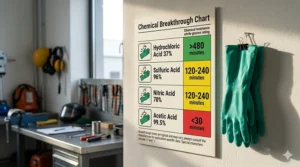
Mistake 1: Buying on thickness alone Eighteen mils sounds impressive. And it is impressive — for general mechanical and chemical protection. But if you’re handling a chemical that permeates nitrile quickly (certain ketones, acetates, aromatic solvents), 18 mils of nitrile still won’t protect you adequately. A thinner butyl or fluorocarbon glove would be the correct choice. Always check chemical compatibility, not just thickness numbers.
Mistake 2: Stretching a disposable glove past its task Disposable nitrile is designed for a task, not a shift. When you’re three hours into a session and the glove is discolored, stretched, and covered in chemical residue — it’s done. The material has been compromised. Continuing to wear a degraded glove is worse than no glove at all, because the compromised material can actually trap chemicals against your skin under pressure. Change gloves frequently; they’re not expensive enough to risk your hands.
Mistake 3: Ignoring cuff length for splash-risk tasks People consistently underestimate how often chemicals splash upward. Mopping, pouring concentrates, working overhead, reaching into drums — all of these create forearm exposure risk that a wrist-length glove ignores entirely. For anything involving liquid chemicals in volume, mandate a 13-inch minimum cuff on your team’s gloves.
Mistake 4: Not checking for latex allergies before buying multi-packs Nitrile is latex-free by definition — all seven products on this list are safe for latex-sensitive workers. But if you’re buying multi-material glove kits (for different tasks) and mix in latex options, you need to account for latex allergy risk. With roughly 1–6% of the general population and up to 17% of healthcare workers having documented latex sensitivity, this is a real workplace safety issue, not a theoretical one.
Mistake 5: Skipping the SDS check entirely This is the cardinal sin of glove selection. The Safety Data Sheet for every chemical you handle will specify the appropriate PPE. Section 8 is your roadmap. If you’re selecting gloves based on general category descriptions without checking the SDS for your specific chemical, you’re guessing — and your hands are the stakes.
Long-Term Cost and Maintenance: The Full Picture
The sticker price on a box of gloves is only half the story. Here’s how to think about the real cost of hand protection:
Disposable gloves: cost per task For a worker using 10 gloves per shift, 5 days a week, a case of 1,000 industrial nitrile gloves lasts roughly 20 working weeks. At $80–$120 per case for quality 8-mil gloves, that’s around $4–$6 per worker per week. Multiply across a team and annual glove spend can reach thousands. The economics of stepping up to slightly higher-quality disposables (better tear resistance, fewer replacements mid-task) often pencil out clearly.
Reusable gloves: cost per session A pair of SHOWA 730 flock-lined gloves at around $12–$18 per pair, used 3 times per week, lasts roughly 3–6 months with proper care. That’s a cost of $0.05–$0.10 per session — dramatically less than quality disposables for equivalent protection. The catch: reusable gloves require proper rinsing, drying, and storage to maintain their integrity. A reusable glove stored wet or improperly develops microscopic degradation that users rarely detect visually.
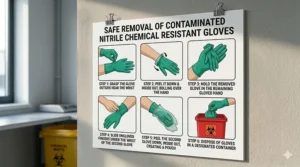
Proper care for reusable nitrile gloves: After each use, rinse thoroughly with clean water — inside and out (turn them inside out). Allow to air dry completely before storage. Inspect before reuse: look for discoloration, stiffening, tackiness, or visible cracks. Any of these means replacement. Store away from UV light, ozone sources (fluorescent lighting, motors), and extreme temperatures. A properly maintained pair of 15–18 mil nitrile gloves will outlast three months of regular industrial use.
Safety and Regulatory Compliance Guide
If you’re buying gloves for a workplace rather than personal use, compliance isn’t optional. Here’s what you need to know:
OSHA 29 CFR 1910.138 requires employers to conduct a hazard assessment and provide appropriate hand protection whenever chemical exposure risk is present. Failure to comply can result in fines starting at $16,131 per violation. Glove selection must be documented and traceable — “we just use nitrile” doesn’t satisfy the standard if the hazard assessment hasn’t identified the appropriate type and thickness.
ANSI/ISEA 105-2016 is the U.S. standard defining performance levels for chemical permeation, cut resistance, abrasion resistance, and puncture resistance. Products that reference ANSI ratings have been tested to specific measurable thresholds — look for these ratings when specifying gloves for regulated industries.
EN 374 (Type A, B, or C) is the European standard frequently referenced by industrial gloves sold in the U.S. market. Type A certification (as seen on the LANON gloves) means tested resistance against at least six chemicals from a defined test panel. Type B indicates four chemicals; Type C indicates one. When sourcing for industrial chemical handling, Type A certification provides the most robust documented assurance.
The OSHA Glove Selection resource provides a useful compatibility chart for matching glove materials to specific chemicals — bookmark this for your PPE program documentation.
FAQ: Nitrile Chemical Resistant Gloves
❓ What chemicals are nitrile chemical resistant gloves resistant to?
❓ How thick should nitrile chemical resistant gloves be for industrial use?
❓ Are thick nitrile chemical gloves reusable?
❓ What is flock lined nitrile gloves and why does it matter?
❓ Do nitrile chemical resistant gloves protect against acid?
Conclusion: The Right Glove Is the One You’ll Actually Wear
After all of this — the specs, the certifications, the mil thicknesses and cuff lengths — the honest bottom line is this: the best nitrile chemical resistant gloves are the ones that match your real work conditions, fit comfortably enough that you’ll keep them on, and provide the certified protection level that your chemicals actually require.
For most automotive and mechanical work, the GLOVEWORKS HD Orange or Venom Steel Industrial are your workhorses. For household and moderate industrial chemical handling, ThxToms and COOLJOB offer reliable reusable protection at accessible prices. For serious industrial chemical work with compliance requirements, the LANON EN 374 Type A and SHOWA 730 are the professionals’ choice. And for high-volume facility buying, MED PRIDE Maxx Strength makes economic sense at scale.
Your hands operate tools, keyboards, instruments, and everything that matters in your daily work. They’re worth protecting with something better than a guess.
Don’t cut corners on PPE. Pick the right glove, wear it properly, and change it when it’s done. It’s the most straightforward risk management decision you’ll make all year.
✨ Don’t Miss These Exclusive Deals!
🔍 Click any highlighted product name in this guide to check current pricing, read verified customer reviews, and find the right size for your hands. Protection that fits right is protection that works.
Recommended for You
- Paint Resistant Gloves: 7 Best Picks for Real Protection (2026)
- 7 Best Pesticide Resistant Gloves for Maximum Chemical Protection (2026)
- 7 Best Oil Resistant Chemical Gloves – 2026
Disclaimer: This article contains affiliate links. As an Amazon Associate, I earn from qualifying purchases. If you purchase products through these links, we may earn a small commission at no additional cost to you.
✨ Found this helpful? Share it with your friends! 💬🤗
