
In This Article
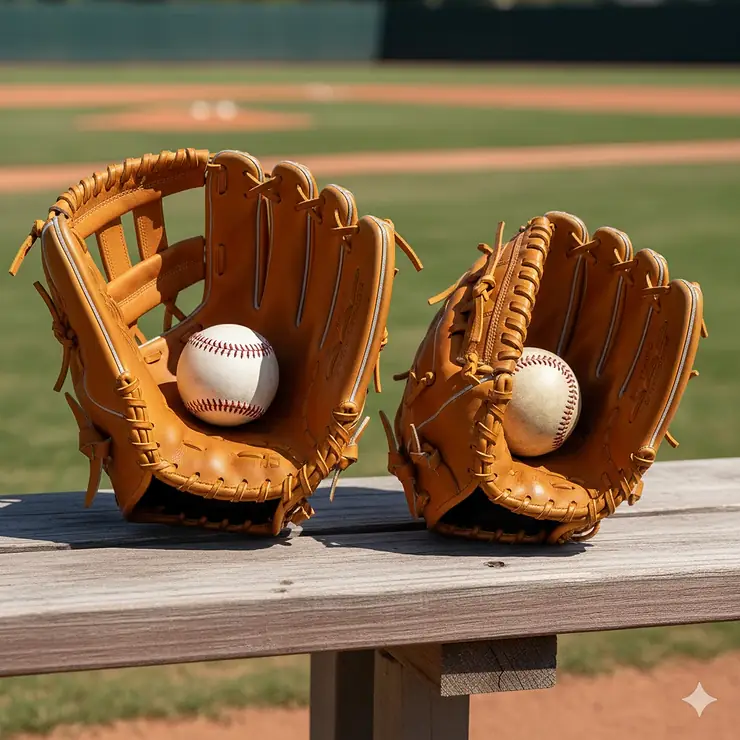
Every infielder gets a glove. The guy at first gets a scoop. A first base glove is the strange cousin in the equipment bag: long, wide, crescent-shaped, and built less for fielding than for absorbing everyone else’s mistakes. A wild throw in the dirt? That’s yours. A rocket sailing toward the dugout rail? Also yours.
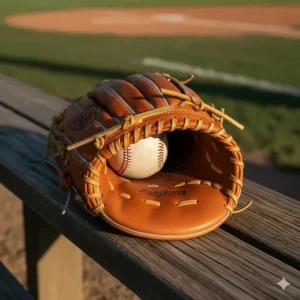
If you’re shopping for a first base glove in 2026, you’ve probably noticed the problem. Every listing promises a “deep pocket” and “pro-level leather,” and almost none of them explain what that means for your actual hand. This guide closes that gap.
Here’s the plan. You’ll get seven real mitts across budget, mid-range, premium, and youth tiers. The analysis rests on published specs and whatever review data genuinely exists (for a few of these mitts it’s thinner than you’d hope, and I’ll say so). You’ll also get a clear explanation of the rules that decide whether your shiny new baseball first base glove is legal on game day.
For background on why the position needs its own gear, Wikipedia’s first baseman overview walks through the short hop and the tag play. Those are the two hardest things a first baseman does, and both get easier with a proper mitt.
A quick note on method. Everything below comes from spec sheets, retailer listings, league rulebooks, and published reviews. It does not come from me squatting at first base with a stopwatch. Prices appear as ranges because they move constantly, so check current pricing before you buy.
Ready? Let’s scoop.
Quick Comparison: 7 Best First Base Gloves at a Glance
Before the deep dive, here’s the whole field on one screen. Skim it, pick a tier, then read the full breakdowns below.
| Pick | Length | Tier | Best For | Price Range |
|---|---|---|---|---|
| Rawlings Heart of the Hide 13″ | 13″ | Premium | Varsity, college, and adult players who want maximum reach | $300-$350 |
| Wilson A2000 1679 | 12.5″ | Premium | Serious players who want a lighter-feeling, durable build | $260-$330 |
| Mizuno Pro Select 12.5″ | 12.5″ | Premium | Higher-level players who want premium leather with a faster break-in | Around $300 |
| Wilson A1000 1620 | 12.5″ | Mid-range | Teens stepping up to a real first base mitt | $130-$200 |
| Rawlings Sandlot 12.5″ | 12.5″ | Budget | Rec-league and part-time first basemen | $70-$100 |
| Rawlings Encore 12″ | 12″ | Youth value | Ages 8-14, and leagues with a 12″ cap | $90-$170 |
| Mizuno Prospect 12.5″ | 12.5″ | Youth value | Ages 9-12 (league rules permitting) | $50-$75 |
Looking at the comparison above, the Rawlings Sandlot 12.5″ and Mizuno Prospect 12.5″ set the floor for budget-conscious buyers. The Wilson A2000 1679 and Mizuno Pro Select 12.5″ are where serious money buys premium leather and refined construction. If reach is your top priority, the Rawlings Heart of the Hide 13″ is the only pick that uses the rulebook’s full 13 inches, though younger players should stay at 12 to 12.5 inches. Length alone doesn’t decide fit, so hand size, league rules, and break-in tolerance matter just as much.
💬 Just one click — help others make better buying decisions too!😊
Top 7 First Base Gloves: Honest Expert Analysis
Each pick below gets the same treatment: what the specs mean in practice, who the mitt actually suits, and what reviewers say, with the caveat flagged wherever the review pool is too small to trust.
1. Rawlings Heart of the Hide 13″ First Base Mitt — maximum legal reach for elite hands
Thirteen inches is the longest a first base glove can legally be, and that extra reach over the common 12.5-inch size is the whole pitch. Bat Digest’s 2026 glove rankings named this Heart of the Hide 13-inch mitt its top first-base pick, with scoring finalized in late May 2026.
Here’s what the spec means in practice. More leather out front lets you snag throws that sail wide and scoop short hops before they get cute with the dirt. The trade-off is control. A mitt this size leans on premium steer-hide leather, the Heart of the Hide series’ calling card. One retailer’s product copy says the series has been worn by Gold Glove winners since 1958. Expect a longer, more deliberate break-in than anything cheaper on this list.
Based on the spec comparison, this is a mitt for full-grown hands: varsity, college, and adult-league first basemen who keep losing the stretch battle. It’s overkill for a 12-year-old and flatly illegal in leagues that cap mitts at 12 inches.
Reviewer sentiment is the thin spot. The retail pages I found carry only a couple of reviews for the 13-inch version, so there’s no trustworthy average to quote. The strongest signal here is the expert ranking, not crowd opinion.
Pros:
- ✅ Longest reach the rulebook permits
- ✅ Premium steer-hide leather built for seasons of use
- ✅ Top-ranked first-base pick in a 2026 roundup
Cons:
- ❌ Stiffer, slower break-in than budget mitts
- ❌ Too big for most youth hands and leagues
Expect the low-to-mid $300s. For a committed player who’ll lean on it for years, the value verdict is “fair, with an asterisk for break-in patience.”
2. Wilson A2000 1679 12.5″ First Base Mitt — lighter back without giving up toughness
Wilson’s A2000 line is the glove other lines get compared to. The 1679 is its 12.5-inch first base mitt, which Wilson’s own listing calls its longest. The headline trick is the SuperSkin back, a synthetic panel Wilson says is twice as strong as leather at half the weight.
Why care? A first base mitt hangs off your hand for every inning, and fatigue turns clean stretches into dropped balls. Keeping the palm in Pro Stock Select leather (an American steerhide) while trimming weight up top is a smart trade. Dual welting, two leather strips along each finger back, is the quieter upgrade. It’s meant to stop the pocket from collapsing and to make the break-in last. Dri-Lex wrist lining and flat finger binding add a drier, less rubbed-raw feel.
My read: this is the choice for serious players who want a premium build and a lighter feel on the hand.
Reviewers give it 4.7 to 4.9 stars on retailer pages, but on only three to seven reviews apiece. The comments are short, so treat that as a mild thumbs-up rather than a verdict. Worth noting: the sibling A2000 SuperSkin 1620 sits near three stars on one specialty retailer’s page, so the badge alone isn’t a guarantee. Also, retailers describe this pattern’s web differently (single post on some pages, double horizontal bars on others), so confirm the listing before ordering.
Pros:
- ✅ SuperSkin back keeps the mitt lighter on the hand
- ✅ Dual welting supports pocket shape
- ✅ Breathable Dri-Lex wrist lining
Cons:
- ❌ Review pool is tiny
- ❌ Listings disagree on web description
Roughly the $260-$330 range, with some third-party listings running higher. It’s good value if you’ll play at least three seasons.
3. Mizuno Pro Select 12.5″ First Base Mitt — premium steerhide with a faster break-in
Mizuno’s pitch here is leather processing. The Pro Select shell is premium steer hide that, per one retailer’s description, goes through a heating-and-softening process twice. The idea is a quicker break-in without sacrificing toughness. Durable leather lacing, a two-piece closed web, and a conventional open back round out the 12.5-inch pattern.
What does that mean at the bag? A closed web gives a sturdier, more structured pocket for hard-hit throws, while the open back keeps the hand cooler. Pre-softened premium leather matters most to players who can’t afford three weeks of a mitt that won’t close. Think of the high school junior who gets a new mitt in February and has a game in March.
This is a good fit for higher-level players who want premium materials but dread the stiff-leather wait. A retailer Q&A describes the fit as a standard one, so extreme-hand-shape players should try before committing.
On reviews, I couldn’t verify an aggregate rating for this exact model, so I won’t invent one. Retailer Q&A is positive on its suitability for competitive players, but that’s seller commentary, not buyer data.
Pros:
- ✅ Premium steer hide with a processed, quicker break-in
- ✅ Closed web builds a structured pocket
- ✅ Durable leather lacing
Cons:
- ❌ No verifiable review average
- ❌ Premium pricing, close to the Wilson
Around the $300 mark. It’s worth it if break-in time is your enemy; otherwise compare it to the Wilson above.
4. Wilson A1000 1620 12.5″ First Base Mitt — game-ready leather from an A2000 factory
The A1000 is Wilson’s step-down line, but it’s built in the same factory as the A2000. The 1620 uses full-grain leather meant to feel game-ready quickly, and a single break point design. That means the mitt folds in one place and plays more like an infield glove than a stiff scoop.
Practically, that single hinge makes closing the mitt on a throw easier and speeds up the transfer. It’s a real advantage for newer first basemen still learning to catch rather than trap. Add a reinforced single post web, Dri-Lex wrist lining, and flat finger binding, and the spec sheet reads like a smaller A2000. One retailer lists it as designed for players ages 12 and up.
Honestly, this is the most sensible stepping-stone for a teen who’s outgrown a youth mitt but doesn’t need a $300 glove.
Review data is small and mixed. One listing shows 3.5 stars across two reviews, while a separate listing carries a lone one-star rating. That’s far too little to conclude anything, so read recent reviews on the exact colorway you’re considering.
Pros:
- ✅ Single break point eases closing and transfers
- ✅ Full-grain leather ready quickly
- ✅ Built in Wilson’s A2000 factory
Cons:
- ❌ Tiny, mixed review pool
- ❌ Not the lightest, most refined option
Roughly the $130-$200 range depending on colorway and retailer. That’s strong mid-tier value.
5. Rawlings Sandlot 12.5″ First Base Mitt — vintage oiled leather at a rec-ball price
The Sandlot series is Rawlings’ vintage-looking, budget-friendly line. This 12.5-inch version uses full-grain oiled shell leather, a Modified Pro H web, an open back, Zero Shock palm pads, and padded finger back linings. One distributor lists its break-in at roughly 80% factory, 20% player.
Translation: it’s mostly pre-worked, so you can be playing catch within days rather than weeks. The Modified Pro H web is built to scoop balls from the dirt, and the palm pad takes some sting out of repeated throws. Retailer Q&A also notes it has five individual finger slots rather than a finger-shift design, so it feels a little less mitten-like than a pure scoop.
The best fit is a rec-league or part-time first baseman, or a high school player who only plays the bag occasionally. A retailer Q&A answer says as much, suggesting it for ages 13-15 or high schoolers who play first periodically.
I couldn’t find a meaningful review average for it, so lean on the specs and the one-year warranty retailers list instead.
Pros:
- ✅ Mostly factory broken in
- ✅ Zero Shock palm pad for sting
- ✅ Easy on the budget
Cons:
- ❌ Not built for daily, high-level play
- ❌ Thin review data
Typically the $70-$100 range. For occasional first basemen, it’s among the best value plays here.
6. Rawlings Encore 12″ First Base Mitt — youth mitt built to protect a young hand
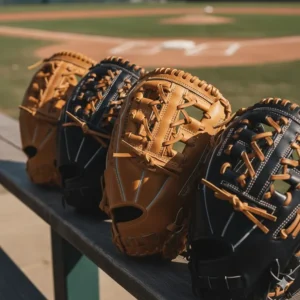
The Encore is a youth-focused mitt with a 12-inch length, all-leather construction, an extended web base, and a reinforced palm pad. The adjustable pull-lace wrist strap lets the hand opening be customized. Rawlings advertises roughly a 65% factory, 35% player break-in. Retailers describe the web a few different ways (single post, double bar, and Pro H all show up), so confirm the exact listing.
The extended base and extra palm padding matter because young hands feel every throw. Less sting means fewer flinches, and fewer flinches mean better catches. The 12-inch length also fits the common youth cap, which makes it a safe pick for league play.
Rawlings’ sizing chart places youth (7 to 12 years old) first basemen at 11.5 to 12 inches, so this sits right at the top of that range. One retailer’s Q&A says it isn’t fully game-ready and might take about two weeks for an 11-year-old, so buy ahead of the season.
Reviewers are encouraging but few: roughly 4.4 stars across five reviews at one specialty retailer, and short five-star comments on another retailer’s page.
Pros:
- ✅ Extra palm padding for young hands
- ✅ Adjustable pull-lace fit
- ✅ 12-inch length fits common youth caps
Cons:
- ❌ Needs a couple of weeks of break-in
- ❌ Price varies widely between retailers
Plan on roughly $90 to $170. Shop around, because the spread is large.
7. Mizuno Prospect 12.5″ First Base Mitt — easy-close design for new first basemen
Mizuno built this youth mitt around PowerClose technology, a flex-hinge design meant to make closing easier for small hands. It uses full-grain pigskin leather, a Parashock palm pad, and Mizuno’s “Less 2 Lacing” web tweak, which removes the last two lace loops to boost flexibility along the closing axis.
Why that matters: young players often trap the ball against their body instead of catching it in the pocket. A mitt that closes easily teaches the right habit. Mizuno’s own copy frames it that way too.
The catch is the length. At 12.5 inches, this mitt exceeds the 12-inch cap that Little League’s rulebook has historically applied to first basemen, so verify your league’s current rule before buying.
Sentiment is positive but tiny. One parent review calls it a good fit for ages 9 to 12, and a three-rating eBay listing averages about 4.7, with one reviewer calling it near-perfect for an advanced 12U player.
Pros:
- ✅ PowerClose hinge eases closing
- ✅ Parashock palm pad cuts sting
- ✅ Lowest price on this list
Cons:
- ❌ 12.5″ may break a 12″ league cap
- ❌ Very small review sample
Usually the $50-$75 range in U.S. listings. It’s strong value where the length is legal.
Top 7 First Base Gloves Compared: Specs, Prices, and Ratings
Here’s the same field again, this time with leather, review signal, and price side by side.
| Glove | Length | Leather / Build | Review Signal | Price Range | Best For |
|---|---|---|---|---|---|
| Rawlings Heart of the Hide 13″ | 13″ | Premium steer hide | Few reviews; top pick in a 2026 ranking | $300-$350 | Varsity, college, adult |
| Wilson A2000 1679 | 12.5″ | Pro Stock Select steerhide, SuperSkin back | 4.7-4.9 on very small samples | $260-$330 | Durability seekers |
| Mizuno Pro Select 12.5″ | 12.5″ | Processed premium steer hide | No verified average | Around $300 | Quick break-in at a high level |
| Wilson A1000 1620 | 12.5″ | Full-grain leather | Tiny and mixed | $130-$200 | Teens, high school role players |
| Rawlings Sandlot 12.5″ | 12.5″ | Full-grain oiled shell | Thin pool | $70-$100 | Rec and part-time play |
| Rawlings Encore 12″ | 12″ | All-leather, extended web base | About 4.4 across five reviews | $90-$170 | Ages 8-14, 12″ caps |
| Mizuno Prospect 12.5″ | 12.5″ | Full-grain pigskin | About 4.7 across three ratings | $50-$75 | Ages 9-12 where legal |
The table makes one thing obvious: review data on first base mitts is sparse across the board, so specs, league rules, and fit should drive the decision more than star ratings. The Wilson A1000 1620 is the quiet value play in the middle, while the Rawlings Encore 12″ and Mizuno Prospect 12.5″ compete directly for young players. The three premium options are separated mostly by break-in philosophy, with the Mizuno Pro Select 12.5″ pre-softened, the Wilson A2000 1679 lighter, and the Rawlings Heart of the Hide 13″ biggest.
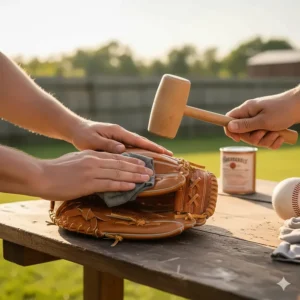
How to Break In a First Base Glove (Without Wrecking the Pocket)
A new mitt is a negotiation. Your hand wants it soft; the leather wants to stay stiff. Here’s a sensible way to win.
Know your starting point. Break-in varies by line. The Rawlings Sandlot 12.5″ is advertised as mostly factory broken in, the Rawlings Encore 12″ as roughly two-thirds, and premium leather like the Rawlings Heart of the Hide 13″ generally asks for the most patience.
A simple first-two-weeks routine:
- Days 1-3: Flex the mitt by hand, open and close it dozens of times, and work the heel and the pocket line.
- Days 4-7: Play catch with a real baseball, focusing on catching in the pocket rather than the fingertips.
- Week two: Use a glove mallet (a common break-in tool sold alongside gloves) to pound the pocket, then store the mitt with a ball inside and a wrap or band around it.
Avoid these first-30-day mistakes:
- Drowning the leather in oil, which can leave it heavy and mushy
- Using heat shortcuts like ovens or microwaves
- Flattening the pocket by stuffing the mitt under a mattress
- Skipping the wrist-strap adjustment, which makes a good first base glove baseball players swear by feel like a bad one
Maintenance schedule: wipe off dirt and sweat after games, condition lightly a few times a season, and check the laces before opening day. A relace is far cheaper than a new mitt.
Real-World Scenarios: Matching a First Base Glove to Your Player
Specs are abstract. Players aren’t. Here are four profiles with budgets, environments, and frequency of use.
Scenario 1: the 10-year-old in a 12-inch league. The player is a rec-league kid in a league with a 12-inch cap, playing two games a week with a $75-$150 budget. The Rawlings Encore 12″ fits both the cap and the padding needs. Baseball 1st base gloves for this age should favor legality and palm protection over length.
Scenario 2: the 15-year-old who splits time between first and the outfield. Playing 40-plus games a year on a $100-$200 budget, he’d benefit from the Wilson A1000 1620 for its easier closing and quick break-in. If money is tighter and first base is occasional, the Rawlings Sandlot 12.5″ works.
Scenario 3: the adult rec-league first baseman. Playing around 25 games a season on turf-and-dirt fields with a budget under $100, the Rawlings Sandlot 12.5″ covers it with minimal fuss.
Scenario 4: the varsity senior or college player. Playing every day with a $250-plus budget, the choice is between Rawlings Heart of the Hide 13″ (reach), Wilson A2000 1679 (lighter), and Mizuno Pro Select 12.5″ (fast break-in). The deciding factor is how much time you have before the season starts.
The throughline: match the mitt to the league’s size cap and the hand first, then to the budget. Reach is the last thing to chase.
✨ Ready to Gear Up at the Bag?
🔍 Narrow your shortlist to the one or two mitts that match your league’s size cap, your hand, and your budget. Then click any highlighted product name to check current pricing and availability. A well-matched first base glove makes every throw from your infield look a little more accurate than it was! ⚾
First Base Glove Problems and Solutions
Even the right mitt can misbehave. These are the most common headaches, with fixes.
Problem 1: balls pop out of the pocket. This usually means the pocket is too flat, too stiff, or the mitt is too large. Re-shape the pocket with catch and a mallet, and make sure you’re closing the mitt rather than trapping the ball. Easy-close designs like the Mizuno Prospect 12.5″ and Wilson A1000 1620 can help here.
Problem 2: stinging palms. Look at padding. The Rawlings Sandlot 12.5″ lists Zero Shock palm pads, the Mizuno Prospect 12.5″ a Parashock pad, and the Rawlings Encore 12″ a reinforced palm pad.
Problem 3: the mitt feels like a brick. Premium leather takes time. If the calendar is the problem, a pre-softened option like the Mizuno Pro Select 12.5″ shortens the wait.
Problem 4: it’s too big for the player. More length isn’t automatically better. Drop down a size, because a mitt the hand can’t control makes every catch harder.
Problem 5: a suspiciously cheap listing. During research I ran across what looked like a lookalike storefront, with a slightly misspelled brand name, listing a premium mitt at a fraction of its normal price. That’s a classic red flag. Buy from the brand or an established retailer, and check the seller name, domain spelling, and return policy.
What Is a First Base Glove?
A first base glove, usually called a first base mitt, is a long, wide, heavily padded glove built specifically for the player at first base. It’s shaped like a scoop so the fielder can pick bad throws out of the dirt and stretch for wide ones. Baseball rules cap its length at 13 inches.
The design exists because the position is a catch-first job. A first baseman takes throws from every infielder, and many of them are rushed, low, or off line. The classic description is a mitten-like shape with extra padding. Modern designs vary, though, and some mitts keep individual finger slots while others use a finger-shift layout.
The size has crept up over time. Custom glove maker Pete Vinci told Last Word on Sports in 2020 that mitts were around 11 inches long about forty years earlier, and the modern standard is 12.5 to 13. That’s why a first base baseball glove from the 1980s looks almost tiny next to today’s.
Compared with a catcher’s mitt, a first base mitt carries less padding and weight, which is why it’s easier to wear for nine innings. Compared with a fielder’s glove, it trades flexibility for reach.
How to Choose a First Base Glove: 7 Steps
- Check the league rulebook first. A 13-inch mitt is legal in MLB and NCAA, but youth leagues often cap length at 12 inches. Legality beats everything else.
- Match length to age and hand. Rawlings’ sizing chart puts youth (7-12) first basemen at 11.5″-12″ and adults (12+) at 12″-13″.
- Get the throwing hand right. A right-hand-throw (RHT) mitt goes on the left hand, so lefty throwers need left-hand-throw (LHT) models.
- Decide your break-in tolerance. Mostly factory-broken-in mitts like the Rawlings Sandlot 12.5″ suit tight schedules; premium leather rewards patience.
- Look at web and back. Closed webs add structure; open backs and H-webs trade some structure for breathability and scooping ability.
- Check the palm padding. Zero Shock, Parashock, and reinforced palm pads exist because first basemen absorb a lot of throws.
- Set the budget by seasons of use. A growing kid may use a mitt for a couple of seasons; an adult can spread a premium cost over many.
Baseball 1st Base Gloves for Young Players
For youth, think in terms of ranges rather than a single number. Baseball 1st base gloves in the 11.5″-12″ range fit most 7-to-12-year-olds, and the best picks prioritize easy closing and palm padding over fancy leather.
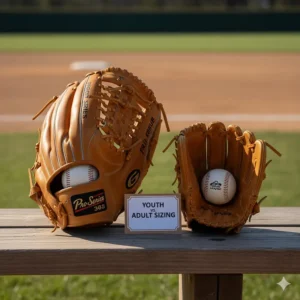
Baseball First Base Glove vs Fielder’s Glove vs Catcher’s Mitt
Three pieces of gear, three very different jobs. Here’s the quick version.
| Type | Typical Length | Padding | Best For |
|---|---|---|---|
| First base glove | 12″-13″ | Extra palm and heel padding | Scooping and stretching, such as with the Rawlings Sandlot 12.5″ |
| Fielder’s glove | Roughly 11.25″-12.75″ by position | Lighter | Ground balls and quick transfers, such as the Wilson A1000 1620‘s infield-style feel |
| Catcher’s mitt | Larger; NCAA allows any dimension | Heaviest | Receiving pitches |
Reading the table, the first base glove sits in the middle: bigger and more protective than a fielder’s glove, lighter and more mobile than a catcher’s mitt. That’s why a first base baseball glove can feel clumsy on ground balls but unbeatable on throws.
Under baseball rules, mitts are reserved for catchers and first basemen, while other fielders wear a standard glove. If you play multiple positions, a single mitt won’t cover them all.
Baseball First Base Glove Rules: Size Limits and Legal Pitfalls
Nobody wants to lose an out to a measuring tape. Here’s what the rulebooks say.
MLB. Official Baseball Rule 3.05 allows a leather first baseman’s glove or mitt up to 13 inches long and 8 inches wide across the palm. The space between the thumb and finger sections can’t exceed 4 inches at the top or 3.5 inches at the base. The web can’t measure more than 5 inches from top to thumb crotch, and it can’t be deepened into a net-type trap. The mitt may be of any weight.
NCAA. NCAA Rule 1-13 mirrors the 13-inch length and 8-inch width limit and sets a crotch-area cap of 5 inches in length, 4.5 inches at the top, and 3.5 inches at the base. A violator gets reasonable time to fix it, and if not, faces ejection. If a play is made with illegal equipment, the offense can take the play or have it voided.
Youth leagues. Little League’s rulebook has historically capped first basemen’s mitts at 12 inches, according to league resources. Confirm the current rule with your league.
So a baseball first base glove that’s perfect in the cage can still be illegal in the game. Check the number on the mitt, then check the rulebook.
Features That Actually Matter in First Base Gloves (And Those That Don’t)
Marketing copy loves adjectives. Here’s how to filter them.
What matters
- Fit and length. A mitt you can control beats a longer one you can’t.
- Pocket depth and web. This is where the catch happens.
- Palm padding. It protects the hand and keeps you from flinching.
- Break-in level. Factory percentage tells you how soon the mitt will be playable.
- Leather quality. Full-grain pigskin on youth mitts like the Mizuno Prospect 12.5″ is a sensible choice, while premium steer hide on the Mizuno Pro Select 12.5″ makes sense at higher levels.
What matters less
- Colorway and logo size
- “Limited edition” labels
- Exotic-sounding names with no function behind them
The honest truth about first base gloves is that the differences between mid-priced and premium models are mostly refinement and longevity, not magic. A well-fitted Wilson A1000 1620 will outperform an ill-fitting premium mitt every time.
First Base Glove Baseball Costs: Price, Value, and Maintenance
A mitt’s sticker price is only half the story. Spread it over the seasons you’ll actually use it.
| Tier | Example | Price Range | Illustrative Cost per Season | Value Verdict |
|---|---|---|---|---|
| Premium | Rawlings Heart of the Hide 13″ | $300-$350 | About $50-$58 over six seasons | Fair for committed players |
| Mid-range | Wilson A1000 1620 | $130-$200 | About $43-$67 over three seasons | Strong middle ground |
| Budget | Rawlings Sandlot 12.5″ | $70-$100 | About $35-$50 over two seasons | Great for casual use |
| Youth | Mizuno Prospect 12.5″ | $50-$75 | About $25-$38 over two seasons | Smart for growing hands |
These per-season figures are illustrative, not guarantees, since actual use varies. Still, they show why a youth mitt can be cheaper per season than a premium one, and why a premium mitt only pays off if you keep it for years.
Maintenance adds modest costs: conditioner, an occasional relace, and a mallet if you want one. Retailers list roughly one-year warranties on several of these brands, so keep your receipt.
Frequently Asked Questions
❓ Does a left-handed first baseman need a different first base glove?
❓ Can an outfielder or shortstop wear a first base mitt?
❓ How much should I spend on a first base glove for a growing kid?
❓ How can I avoid counterfeit or lookalike first base glove listings?
❓ Is a used first base mitt worth buying?
Conclusion: Pick the Mitt That Fits Your Hand, Your League, and Your Budget
If you take one idea from this guide, make it this: the best first base glove is the one that’s legal in your league, fits your hand, and matches your budget, in that order. Everything else is polish.
For elite reach, the Rawlings Heart of the Hide 13″ is the ceiling. For a lighter premium build, the Wilson A2000 1679 makes a strong case, and the Mizuno Pro Select 12.5″ is the answer when break-in time is short. The Wilson A1000 1620 is the smart mid-range step-up, the Rawlings Sandlot 12.5″ covers casual play, and the Rawlings Encore 12″ and Mizuno Prospect 12.5″ are the youth options (with the Prospect’s length needing a league check).
As former minor league first baseman Austin Byler put it in Last Word on Sports, “you take more throws than any player but the catcher.” That’s reason enough to pick your mitt carefully.
Disclaimer: This article contains affiliate links. As an Amazon Associate, I earn from qualifying purchases. If you purchase products through these links, we may earn a small commission at no additional cost to you.
✨ Found this helpful? Share it with your friends! 💬🤗
