
In This Article
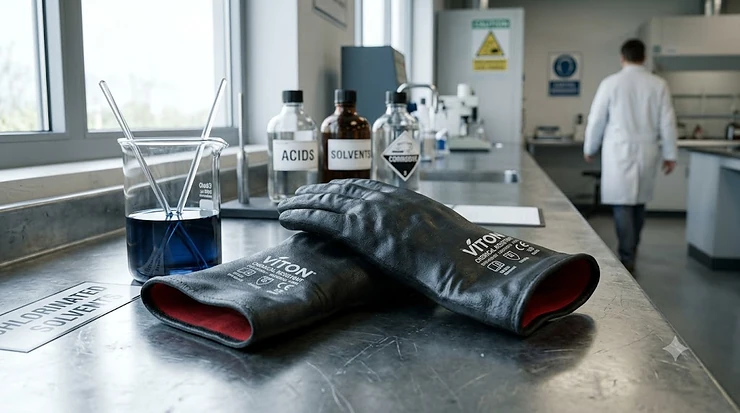
Let’s be direct: not all chemical gloves are created equal. If you’re handling benzene, toluene, chlorinated solvents, or polychlorinated biphenyls (PCBs), that $8 pair of nitrile gloves from a hardware store is about as useful as a paper umbrella in a hurricane. You need viton chemical resistant gloves — and specifically, you need the right ones.
Viton (the trade name Chemours uses for its fluoroelastomer rubber, technically classified as FKM) is the gold standard of chemical-resistant glove materials. No other rubber comes close to its permeation resistance against aromatic hydrocarbons and chlorinated solvents. According to OSHA’s hand protection guidelines, selecting the proper glove material for the specific chemical exposure is one of the most critical decisions a safety manager or worker can make — and Viton consistently tops the resistance charts for the most aggressive chemical families.
What makes Viton so special? It’s a fluoroelastomer — meaning fluorine atoms are bonded into the polymer backbone, creating an extraordinarily stable molecular structure that aggressive chemicals simply can’t penetrate efficiently. The spec sheet will tell you it resists aromatics, aliphatics, and chlorinated solvents. What the spec sheet won’t tell you is that this material essentially laughs at the chemicals that would dissolve lesser gloves in under an hour.
I’ve reviewed dozens of gloves across price ranges, construction methods, and use cases to bring you this definitive 2026 guide. Whether you’re a petrochemical plant operator, a hazmat responder, a laboratory technician, or a small-shop mechanic doing solvent work, there’s a Viton option in this list built for your exact situation. Let’s cut through the noise.
Quick Comparison Table: Top Viton Chemical Resistant Gloves at a Glance
| Product | Thickness | Length | Construction | Best For | Price Range |
|---|---|---|---|---|---|
| SHOWA 892 (12 mil) | 12 mil | 12″ | Viton over Butyl, Unlined | Precision work, labs | $30–$50 |
| SHOWA 890 (28 mil) | 28 mil | 14″ | Viton over Butyl, Unlined | Heavy-duty industrial | $50–$80 |
| Best Glove 890-10 | 28 mil | 14″ | Unsupported Viton | Broad chemical exposure | $45–$75 |
| SHOWA 892-07 (Size 7) | 12 mil | 12″ | Viton over Butyl, Unlined | Smaller hands, lab use | $30–$50 |
| SHOWA 892 Unlined | 12 mil | 12″ | Viton over Butyl | General industrial | $25–$45 |
| SHOWA 890 Rolled Cuff | 28 mil | 14″ | Viton over Butyl | Hazmat, military apps | $55–$85 |
| North by Honeywell F284 | 28 mil | 14″ | Unsupported Viton | PCB/aromatic handling | $60–$90 |
Looking at this table, a clear pattern emerges: the 12-mil gloves (SHOWA 892 variants) dominate when dexterity matters, while the 28-mil options (SHOWA 890 and North F284) are the call when immersion risk or extended contact is on the table. Budget buyers can start with the SHOWA 892 Unlined for reliable everyday protection, but if you’re working with PCBs, concentrated aromatics, or hazmat scenarios, the extra investment in the 28-mil tier is non-negotiable.
💬 Just one click — help others make better buying decisions too! 😊
✨ Don’t Miss These Exclusive Deals!
🔍 Take your hand protection to the next level with these carefully selected Viton gloves. Click any highlighted product to check current pricing and availability on Amazon. Your safety is worth every penny!
Top 7 Viton Chemical Resistant Gloves: Expert Analysis
1. SHOWA 892 Viton Over Butyl Chemical Resistant Safety Glove (12 mil, 12″)
The SHOWA 892 is the workhorse of the Viton glove market, and if you’ve spent any real time in chemical safety circles, you’ve seen this glove on more hands than any other. At 12 mil thick with a 12-inch cuff length, it hits the sweet spot between genuine chemical protection and the hand feel you need to actually do precision work.
The dual-layer construction is where it earns its reputation. A Viton fluoroelastomer outer layer sits over an unlined butyl rubber substrate — two of the best chemical-resistant materials in the world working in concert. In practice, this means you’re protected against benzene, toluene, xylene, most chlorinated solvents, PCBs, and concentrated acids simultaneously. The smooth finish and rolled cuff make donning and doffing quick, which matters when you’re in the middle of a process and need to move fast.
Who is this for? Laboratory technicians, chemical plant operators doing sample collection, and anyone who needs reliable aromatic hydrocarbon protection without losing the ability to grip small fittings or handle instruments. Users consistently praise the dexterity — at 12 mil, your fingers aren’t swimming in rubber. The most common complaint is that unlined gloves can get uncomfortable during very long wear sessions, which is a fair trade-off for the protection level delivered.
✅ Excellent benzene/toluene resistance
✅ Good hand feel for precision work
✅ Trusted SHOWA manufacturing quality
❌ Unlined — can feel clammy in hot environments
❌ 12″ length leaves forearms exposed in splash scenarios
In the $30–$50 range, this is the best value viton chemical resistant glove for everyday laboratory and industrial use.
2. SHOWA 890 Viton Over Butyl Chemical Resistant Safety Glove (28 mil, 14″)
If the SHOWA 892 is the everyday driver, the SHOWA 890 is the tank. Twenty-eight mil of Viton-over-Butyl construction with a 14-inch cuff — this glove was engineered for the applications where a good chemical barrier isn’t enough; you need a great one. It’s 16 mil thicker than the 892, and that extra material isn’t padding — it’s dramatically extended permeation breakthrough times against the most aggressive chemicals.
The 14-inch cuff length is a real-world differentiator that people underestimate until they’ve had a splash event. That extra two inches of forearm coverage can mean the difference between going home clean and spending time at the occupational health clinic. The SHOWA 890 is specifically designed for handling halogenated hydrocarbons, military-grade hazmat scenarios, Level A suit ensembles, and PCB disposal operations — applications where the North American safety standards demand your highest-performing glove.
This is the glove for chemical processing workers, hazmat first responders, and oil refinery personnel who work with chlorinated solvents regularly. Reviewers in industrial settings note it holds up through repeated chemical exposures far longer than lighter alternatives, making the per-use cost lower than it initially appears. Yes, dexterity is reduced compared to the 892 — but for the exposure levels this glove addresses, you’re not supposed to be doing fine motor work anyway.
✅ Superior permeation resistance at 28 mil
✅ 14″ cuff for forearm protection
✅ Rated for PCBs, hazmat, military applications
❌ Reduced dexterity vs. thinner options
❌ Higher initial cost
Priced in the $50–$80 range, this is the premium choice for high-exposure industrial environments.
3. Best Glove 890-10 Best Viton Smooth Finish Gloves (28 mil, 14″, XL)
Don’t let the “Best Glove” branding confuse you — this is the legacy SHOWA product line under a previous naming convention, and the 890-10 model in XL is a stalwart that’s been in industrial safety catalogs for years for a reason. Unsupported Viton construction at 28 mil with a smooth finish gives this glove a broad chemical resistance profile that covers aliphatic and aromatic hydrocarbons, chlorinated solvents, and most concentrated acids.
What distinguishes the Best Glove 890-10 from the newer SHOWA 890 line is subtle but meaningful for industrial buyers: this is an unsupported Viton design, meaning the Viton fluoroelastomer stands alone without a butyl substrate. For certain solvent families, pure Viton offers marginally faster donning and a slightly more natural hand shape. For size XL workers — a size that’s often underserved in premium glove lines — having this reliably in stock on Amazon is genuinely valuable.
This is the right call for large-handed workers in petrochemical environments or chemical processing, especially those who’ve found other gloves in this category tend to fit poorly at XL. Buyer feedback consistently highlights durability and chemical resistance, with several reviews from industrial safety managers noting these have replaced gloves that previously needed replacement every few weeks.
✅ Confirmed in-stock availability on Amazon
✅ Unsupported Viton for broad chemical coverage
✅ XL sizing — great for larger hands
❌ Older-style product versus newer SHOWA lineup
❌ Smooth finish offers less grip on wet surfaces
In the $45–$75 range, this is a reliable workhorse for XL users and industrial buyers.
4. SHOWA Gloves 892-07 Showa Best Viton Glove (12 mil, Size 7)
Size matters — and in safety gloves, nobody talks about it enough. The SHOWA 892-07 is the Size 7 variant of the flagship 892 line, and it exists for a very specific reason: a glove that’s too large creates bunching at the fingertips that destroys tactile sensitivity and, more dangerously, can cause grip failures during chemical handling. For workers with smaller hands, this is the correct choice.
At 12 mil and 12 inches, the technical specs are identical to the broader 892 family: Viton fluoroelastomer over butyl, excellent resistance to benzene, toluene, xylene, and chlorinated solvents, smooth finish with rolled cuff. But in Size 7, the anatomical fit is precise enough that laboratory technicians handling small sample vials or delicate instrument connections will immediately notice the difference in control.
Laboratories are the natural home for this product. Pharmaceutical research, analytical chemistry, environmental testing labs — anywhere that requires chemical resistance plus the ability to handle micropipettes, small fittings, or precise instruments without removing your gloves. The spec sheet won’t tell you this, but in Size 7, the SHOWA 892’s already-good dexterity becomes genuinely impressive.
✅ Proper sizing for smaller hands
✅ Excellent precision and tactile feedback
✅ Full Viton-over-butyl chemical protection
❌ Limited to size 7 — not for larger hands
❌ Unlined — requires cotton liner glove for long wear
Available in the $30–$50 range. Ideal for lab professionals and precision chemical work.
5. SHOWA 892 Unlined Viton Over Butyl Glove (Classic Series, 1 Pair)
This is the predecessor in the SHOWA 892 family — a glove that’s been quietly doing the job in industrial settings since before the current SHOWA 890/892 rebranding. If you’re a safety manager who standardized on this product years ago, it’s still available on Amazon and still delivers the same fundamental protection profile: Viton over Butyl, 12 mil, unlined, rolled cuff.
What’s interesting about this listing is that it often comes in at a slightly lower price point than the current-generation SHOWA 892, making it the practical budget pick for workplaces that need solid FKM gloves without the premium of the newest product revision. The protection chemistry is identical — fluoroelastomer rubber with superior permeation resistance against aromatics and chlorinated solvents. What you’re giving up is potentially some manufacturing refinements in the newer models, like slightly improved seam construction.
For general industrial maintenance, solvent cleaning operations, and chemical handling tasks that don’t involve full immersion or extended contact, this is a genuinely smart buy. Companies that go through significant glove volume will find the cost savings meaningful at scale.
✅ Lower price point than current-gen SHOWA 892
✅ Proven, time-tested construction
✅ Broad chemical family coverage
❌ Older product revision
❌ Availability can vary — check stock before ordering in bulk
Typically in the $25–$45 range — the budget-conscious entry into real Viton protection.
6. SHOWA 890 Unlined Viton Over Butyl Glove, Rolled Cuff (28 mil, Classic)
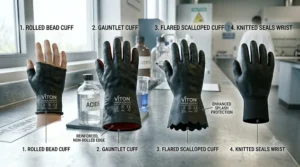
Think of this as the heavy-duty sibling to Product #5 — the classic SHOWA 890 series in its rolled-cuff, 28-mil configuration. The rolled cuff design is a practical feature that industrial buyers sometimes overlook: it creates a natural liquid barrier at the cuff line, preventing chemical run-off from entering the glove during overhead work or arm-reaching tasks.
Twenty-eight mil of Viton-over-Butyl is what you reach for when your SDS says “extreme permeation risk” or when your task involves splashes rather than just incidental contact. This is the version to specify for Level A suit ensemble compatibility, hazmat response, and the kind of PCB or high-aromatic-content work that makes safety officers nervous. The SHOWA 890 series has found its way into military chemical defense applications for exactly this reason — it’s not just industrial-grade, it’s defense-grade.
Reviewers in hazmat and emergency response settings consistently note that the 890’s thick construction holds integrity through challenging conditions other gloves wouldn’t survive. One recurring buyer note: size up half a size from your usual, as the thick material can feel tight on the knuckles if you go true-to-size.
✅ Rolled cuff design prevents chemical run-off
✅ Military and hazmat application rated
✅ 28 mil for maximum barrier protection
❌ Size up recommendation — fit can run small
❌ Premium price for premium protection
In the $55–$85 range. The serious professional’s choice for the most demanding chemical environments.
7. North by Honeywell F284 Viton Chemical Gloves (28 mil, 14″)
If SHOWA dominates the Viton glove conversation, North by Honeywell’s F284 is the serious alternative that safety professionals in petrochemicals and hazmat response have trusted for decades. Made from premium Viton fluoroelastomer at 28 mil with a 14-inch cuff, the F284 delivers on the fundamental promise of FKM gloves — exceptional permeation resistance against PCBs, aniline, benzene, and polychlorinated triphenyls — while adding a design feature SHOWA’s lineup doesn’t emphasize: an ergonomic curved finger and hand construction.
That ergonomic curve sounds like marketing copy until you’ve worn straight-construction gloves for four hours and your hand cramps up. The F284’s anatomical shape reduces hand fatigue during extended wear by following the natural resting position of your fingers, which translates to fewer rest breaks and better task focus in long-duration applications. For EHS professionals who rotate through extended monitoring tasks or lab technicians doing multi-hour sample preparation, this is a real productivity and safety benefit.
Honeywell’s quality control reputation in industrial PPE is well-established, and the F284 benefits from that ecosystem — consistent manufacturing tolerances, reliable sizing, and available through third-party safety distributors on Amazon. It’s the premium pick for buyers who want an alternative to the SHOWA family without compromising a single micron of chemical protection.
✅ Ergonomic curved construction reduces hand fatigue
✅ Premium Honeywell quality control
✅ Superior PCB and aniline resistance at 28 mil
❌ Higher price point than SHOWA equivalents
❌ Less widely stocked — check availability before bulk ordering
Available in the $60–$90 range. The ergonomics-forward choice for long-duration hazardous material work.
How to Choose the Right Viton Chemical Resistant Gloves: A Step-by-Step Framework
Buying Viton gloves without a decision framework is like ordering a custom suit without measurements — you might get lucky, but you probably won’t. Here’s how to think through the selection systematically.
Step 1: Identify your specific chemical exposure. Pull the Safety Data Sheet (SDS) for every chemical you handle. Viton excels against aromatics (benzene, toluene, xylene), chlorinated solvents (methylene chloride, trichloroethylene), and PCBs. It is not recommended for ketones (acetone, MEK) — a detail that bites people who assume “best chemical glove” means “best for everything.”
Step 2: Determine your contact type. Incidental splash exposure? A 12-mil glove like the SHOWA 892 is appropriate. Direct handling or immersion risk? You need 28 mil — the SHOWA 890 or North F284. The CDC/NIOSH chemical agent guidelines provide breakthrough time data that makes this decision quantitative rather than guesswork.
Step 3: Match thickness to your dexterity requirements. Twelve-mil gloves let you operate instruments, handle small fittings, and feel what you’re gripping. Twenty-eight mil gives you protection but costs you precision. If you need both, layer: wear the 28-mil for transport and setup, switch to a 12-mil for detailed manipulation.
Step 4: Get the cuff length right. Twelve inches works for bench work with no overhead component. Fourteen inches is the standard for any task involving reaching up, leaning over containers, or handling overhead piping. Whenever in doubt, go longer — a longer cuff costs nothing in protection but can save you from a forearm exposure.
Step 5: Choose your size with care. Viton gloves run slightly small due to material stiffness. When in doubt, size up. An ill-fitting glove is a safety hazard, not a minor inconvenience.
Step 6: Verify your budget against your risk level. Spending $30 on a 12-mil glove for benzene exposure in a low-risk environment is smart. Spending $30 on that same glove for PCB handling in a remediation site is false economy. Match the investment to the consequence of failure.
Step 7: Check your regulatory requirements. Some industries have specific standards — OSHA 29 CFR 1910.138 for general industry, specific EPA regulations for hazmat handlers. Ensure your selected gloves meet or exceed applicable standards.
Real-World Scenarios: Matching Viton Gloves to Your Specific Situation
Here’s where most buying guides fail — they describe products without connecting them to the person holding the screen. Let’s fix that.
The Laboratory Technician. You’re analyzing environmental samples, handling organic solvent standards, and working with benzene and toluene solutions in a ventilated hood. You’re not immersing your hands; you’re making controlled transfers with micropipettes. The right call: SHOWA 892-07 (if your hands are Size 7) or SHOWA 892 in your correct size. Twelve mil is sufficient, the dexterity is critical, and the Viton-over-Butyl construction covers your entire chemical exposure list. Budget: $30–$50 per pair with 6–12 months of multi-use lifespan at typical lab usage.
The Chemical Plant Operator. You’re sampling product streams, handling chlorinated solvents during maintenance shutdowns, and occasionally dealing with unplanned spills. Your exposure events range from “careful pour” to “unexpected splash.” The smart choice: SHOWA 890 (28 mil, 14″) as your standard issue. The extra thickness and longer cuff are insurance, and in your environment, insurance pays for itself the first time something unexpected happens. Budget $55–$80 per pair; given reduced replacement frequency versus cheaper alternatives, the economics work in favor of buying premium.
The Hazmat First Responder. You’re suiting up for spill response involving PCBs, mixed aromatic solvents, or unknown chemical mixtures. You need the highest barrier available, compatibility with Level A suits, and confident regulatory coverage. Your answer: North by Honeywell F284 or SHOWA 890 Rolled Cuff. Both are rated for these applications. The North F284’s ergonomic construction is the tiebreaker for long-duration response operations where hand fatigue becomes a safety issue in itself. Budget $60–$90 per pair; in this application, cost per pair is the wrong metric — cost per safe operation is the right one.
The Industrial Maintenance Worker. You’re doing periodic solvent-based cleaning, degreasing components, handling fuel systems in petrochemical environments. Your chemical exposure is moderately severe but your tasks require grip and tool manipulation. The SHOWA 892 (12 mil) handles most of your profile, but if you’re doing any work with high-aromatic content refinery products, the SHOWA 890 is the more defensible choice. Budget $30–$80 depending on exposure level; assess honestly and don’t rationalize down to a cheaper option to save $20 per pair.
Common Mistakes When Buying Viton Chemical Resistant Gloves (And How to Avoid Them)
Mistake #1: Assuming all “chemical resistant” gloves are equivalent. Nitrile, latex, neoprene, and Viton all carry the phrase “chemical resistant” somewhere in their marketing. The differences are enormous. Nitrile breaks down rapidly in aromatic hydrocarbons. Latex offers no meaningful protection against organic solvents. Viton’s fluoroelastomer chemistry is in a completely different protection tier. If your SDS indicates aromatic or chlorinated solvent exposure, you need FKM gloves — not a generic “chemical resistant” option.
Mistake #2: Ignoring breakthrough time. A glove can resist a chemical — right up until it doesn’t. Every protective material has a breakthrough time: the point at which the chemical permeates through the material and reaches your skin. Thicker Viton (28 mil) has significantly longer breakthrough times than 12-mil options against aggressive solvents. For extended-contact or immersion tasks, choosing the thinner glove to save money or gain dexterity is a risk calculation that often goes wrong.
Mistake #3: Using Viton for ketones. Viton fluoroelastomers degrade rapidly in the presence of ketones — acetone, MEK, MIBK. This is the most common dangerous misconception about Viton gloves. If your process involves ketones, you need butyl rubber. For mixed chemical environments containing both aromatics and ketones, consult a chemical resistance chart and consider double-gloving with different materials.
Mistake #4: Wrong sizing. We mentioned this in the buying guide, but it deserves separate emphasis. A glove that’s too large creates bunching at the fingertips — dramatically reducing grip security and tactile feedback. Too small and the material thins at stress points, reducing both breakthrough time and physical durability. Viton gloves typically run slightly small; size up if borderline.
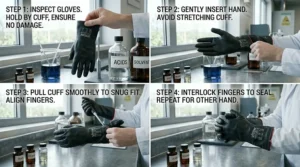
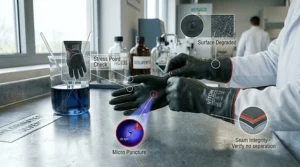
Mistake #5: Neglecting inspection before each use. Viton gloves are reusable, but that doesn’t mean they’re invincible. Before each use, inflate the glove by rolling the cuff down to seal it and pressing firmly — any pinhole leaks will be immediately obvious. Check for surface discoloration, stiffening, or tackiness, which indicate chemical degradation. A compromised Viton glove offers false security, which is more dangerous than no glove at all.
Viton vs. Butyl vs. Nitrile: What the Spec Sheet Won’t Tell You
The glove material comparison is a conversation that most buyers avoid because it requires reading past the marketing. Here’s the honest breakdown.
| Material | Best Against | Weakness | Typical Use |
|---|---|---|---|
| Viton (FKM) | Aromatics, chlorinated solvents, PCBs, acids | Ketones, steam | Petrochemical, hazmat, labs |
| Butyl Rubber | Ketones, esters, gas permeation | Aliphatic/aromatic hydrocarbons | Chemical processing, gas exposure |
| Nitrile | Oils, some acids, abrasion | Aromatic hydrocarbons, chlorinated solvents | Automotive, food service, light chemical |
| Neoprene | Moderate acid/base, oils | Not for concentrated solvents | General purpose, light chemical |
The table above has an analysis that most safety professionals know but don’t always communicate clearly: there is no single glove material that protects against everything. Viton dominates for aromatic hydrocarbons and chlorinated solvents but is explicitly wrong for ketone exposure. Butyl protects against ketones but provides inferior aromatic protection. Understanding this distinction isn’t optional — it’s the foundation of competent glove selection.
The premium you pay for viton chemical resistant gloves versus nitrile is real but contextually irrelevant when the alternative is chemical exposure. In benzene work, for example, the cost difference between Viton and nitrile is approximately $20–$40 per pair; the cost of benzene-related health consequences is orders of magnitude higher.
For environments with mixed chemical exposures (common in maintenance and remediation work), the answer is often to consult SHOWA’s chemical resistance database or a similar manufacturer resource, then select the glove that covers the highest-risk chemical in your exposure profile.
Long-Term Viton Glove Maintenance: Making Your Investment Last
Here’s something Amazon product listings categorically don’t tell you: how you store and maintain Viton gloves dramatically affects their service life. Done correctly, a pair of SHOWA 890 gloves can serve reliably through dozens of uses. Done wrong, you’ll be replacing them far more frequently than necessary.
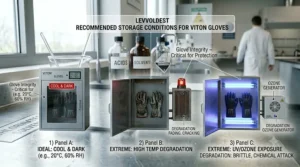
Storage: Keep Viton gloves away from UV light, ozone sources (including electric motors and welding equipment), and extreme temperatures. Fluoroelastomers are UV-stable but not UV-immune — prolonged sunlight exposure accelerates surface degradation. Store flat or hung, never folded, to prevent crease formation that can become crack nucleation points over time.
Cleaning: After chemical use, rinse externally with clean water, then wash with mild soap. Never use organic solvents to clean Viton gloves — the irony of destroying a chemical-resistant glove with cleaning solvents is real. Allow to air dry completely before storage; moisture trapped inside a stored glove promotes microbial growth and material degradation.
Inspection schedule: For high-frequency users, inspect before every use (inflation test as described above). For lower-frequency applications, inspect every 30 days minimum. Document inspection dates — in regulated industries, maintaining glove inspection records is both a safety practice and a compliance requirement.
Discard triggers: Visible discoloration indicating chemical attack, surface tackiness, reduced flexibility at cold temperatures, any detectable holes or seam separation. The cost of a new pair of gloves is never worth the risk of a compromised barrier.
FAQ: Your Viton Chemical Resistant Glove Questions Answered
❓ What chemicals are viton chemical resistant gloves best for?
❓ Are FKM gloves the same as viton chemical resistant gloves?
❓ How long do viton gloves last before needing replacement?
❓ Can I use viton chemical resistant gloves for ketone solvents like acetone?
❓ What thickness viton glove do I need for benzene handling?
Conclusion: The Right Viton Gloves Are a Non-Negotiable Safety Investment
There’s a temptation in personal protective equipment purchasing to treat gloves as a commodity — pick the cheapest option that technically meets the label criteria and move on. In most PPE categories, this approach is defensible. For chemical-resistant gloves in aromatic hydrocarbon and chlorinated solvent environments, it’s genuinely dangerous.
Viton chemical resistant gloves exist at their price point because nothing cheaper does the same job. The SHOWA 892 for laboratory precision work, the SHOWA 890 for heavy industrial exposure, the North by Honeywell F284 for extended hazmat operations — each of these products represents decades of materials science and safety engineering applied to a specific problem.
The seven gloves in this guide cover every legitimate Viton application from introductory lab use to military-rated hazmat response. Start with your SDS, match your chemical profile to the appropriate material, select the thickness that fits your contact type, and get the sizing right. Do those four things, and you’ve done what actually matters in glove selection.
Your hands work every day. They deserve protection that actually works.
✨ Ready to Protect Your Hands the Right Way?
🔍 Click any product in this guide to check current pricing and availability on Amazon. Whether you need precision laboratory protection or heavy-duty industrial coverage, the right Viton glove is waiting for you!
Recommended for You
- Best PVC Chemical Resistant Gloves in 2026: 7 Trusted Picks
- Best Butyl Rubber Chemical Gloves in 2026: 7 Expert Picks That Won’t Let You Down
- 7 Best Neoprene Chemical Resistant Gloves in 2026
Disclaimer: This article contains affiliate links. As an Amazon Associate, I earn from qualifying purchases. If you purchase products through these links, we may earn a small commission at no additional cost to you.
✨ Found this helpful? Share it with your friends! 💬🤗
