
In This Article
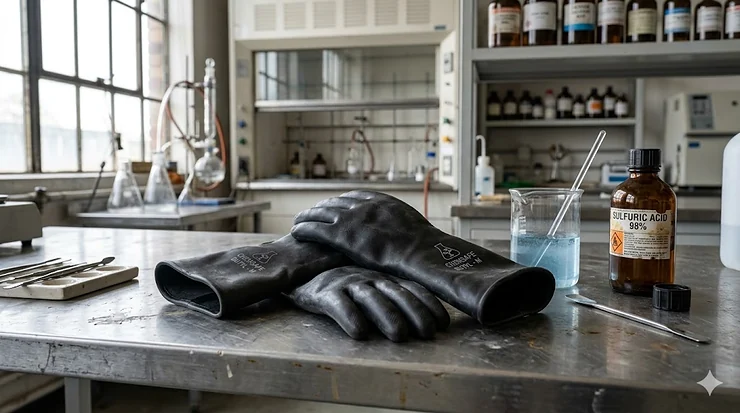
If you’ve ever held your breath while opening a drum of MEK, wiped down aircraft hydraulic lines with tricresyl phosphate, or spent eight hours in a lab handling oxygenated solvents — you already know that not all gloves are created equal. Not even close. Nitrile handles a lot. Neoprene handles more. But when the chemical you’re working with eats through both of them like they’re tissue paper? That’s where butyl rubber chemical gloves enter the room and change everything.
Butyl rubber is the gold standard of chemical-resistant hand protection — the material that, according to OSHA’s Chemical Protective Clothing guidance, offers among the highest permeation resistance to gases, water vapors, and a broad spectrum of toxic oxygenated compounds. What does that mean in plain English? It means butyl polymer gloves don’t just sit on your skin while chemicals slowly seep through. They form an actual molecular barrier — dense, tightly bonded, almost imperious. For ketones like acetone and MEK, esters like ethyl acetate and tricresyl phosphate, and gas and vapor permeation scenarios, butyl is essentially the last line of defense standing between your hands and serious harm.
In this guide, we’ve done the deep work: researching real products currently available on Amazon, analyzing authentic customer feedback, and running each option through a practical lens — who needs it, why, and whether the price tag is worth it. Whether you’re a lab technician, a hazmat responder, an aviation mechanic handling Skydrol, or a painter working with aggressive strippers, there’s a pair here for you.
Quick Comparison: Top 7 Butyl Rubber Chemical Gloves at a Glance
| Product | Thickness | Length | Grip | Best For | Price Range |
|---|---|---|---|---|---|
| SHOWA 878 | 28 mil | 14″ | Smooth/Rough | Heavy-duty industrial | $40–$55/pair |
| SHOWA 874 | 14 mil | 14″ | Rough | Versatile daily use | $25–$40/pair |
| MCR Safety CP25 | 25 mil | 14″ | Smooth/Rough | US-made heavy-duty | $45–$65/pair |
| MCR Safety CP7 | 7 mil | 14″ | Smooth | Dexterity-focused tasks | $15–$28/pair |
| North by Honeywell B131 | 13 mil | 11″ | Smooth/Rough | Lab & precision work | $30–$45/pair |
| Guardian Equipment CP-14 | 14 mil | 14″ | Smooth | Budget-friendly industrial | $25–$38/pair |
| SHOWA 890 Viton Over Butyl | 28 mil | 14″ | Smooth | Extreme chemical exposure | $55–$80/pair |
Reading this table clearly shows the fork in the road: if your main concern is dexterity and you’re not facing extreme vapor permeation, the MCR Safety CP7 at 7 mil makes daily tasks far less fatiguing. But bump up your risk exposure to concentrated acids, gas permeation, or prolonged ketone contact, and the SHOWA 878 at 28 mil justifies every extra dollar. The SHOWA 890 sits alone at the very top — it’s the option for when “good enough” simply isn’t an option.
💬 Just one click — help others make better buying decisions too! 😊
✨ Don’t Miss These Exclusive Deals!
🔍 Take your hand safety to the next level with these carefully selected butyl rubber chemical gloves. Click on any highlighted product to check current pricing and availability on Amazon. Your hands will thank you.
Top 7 Butyl Rubber Chemical Gloves: Expert Analysis
1. SHOWA 878 Butyl Chemical Resistant Safety Glove
The SHOWA 878 is what safety managers reach for when they stop messing around. At 28 mil thick and 14 inches long with an unlined construction, this glove means serious business — and it’s been the go-to for corrosive chemical environments for decades.
Specs that actually matter: The 28-mil butyl wall isn’t just marketing. That thickness translates to measurably longer breakthrough times against ketones and esters — the two chemical families that demolish most other glove materials within minutes. The 14-inch length protects well up the forearm, which matters enormously if you’re doing any kind of pouring, dipping, or overhead handling where splash drip is a reality. Available in both smooth (878) and rough (878R) grip configurations, the rough version adds traction for wet or oily conditions where smooth butyl can become slippery.
The SHOWA 878 is ideal for workers in chemical manufacturing, pharmaceutical production, and hazmat response who need uncompromising permeation protection and can accept a slight reduction in manual dexterity. This isn’t a glove for fine motor work — the thickness makes that essentially impossible. But for bulk chemical handling? Nothing in this price range competes.
Customers consistently praise the durability and thick feel, noting the glove “doesn’t flex like a thin glove, but that’s actually reassuring when you’re holding a container of concentrated sulfuric acid.” Several industrial buyers report reusing pairs for extended periods without visible degradation.
✅ Highest permeation resistance in the lineup
✅ Available smooth and rough grip
✅ Rolls over hazmat suit cuffs easily
❌Reduced dexterity due to thickness
❌ Stiffer in cold environments
In the $40–$55 range per pair, the SHOWA 878 delivers premium protection that pays for itself in liability avoidance alone.

2. SHOWA 874 Butyl Chemical Resistant Safety Glove
Think of the SHOWA 874 as the 878’s more nimble sibling. At 14 mil thick — exactly half the wall thickness — it keeps the same 14-inch length and unlined butyl construction, but gives you noticeably better feel and flexibility throughout a full shift.
The 14-mil construction still delivers excellent ketone and ester resistance, but the thinner wall means faster fatigue cycles. Meaning: it will eventually get compromised faster than a 25 or 28 mil glove in continuous high-concentration exposure. What it gives you back, though, is the ability to actually grip things, turn valves, handle glassware, and move tools without fighting the glove the whole time. SHOWA’s unlined butyl also means no liner to trap sweat or contamination — which matters for labs or cleanrooms where decontamination matters.
This is the glove I’d recommend to laboratory technicians, analytical chemists, and anyone in quality control who handles esters and ketones for hours but needs to actually read instruments and pipette without taking off their gloves every ten minutes. The rough grip (874) variant makes it a strong pick for automotive chemistry work — think fuel additives, brake fluid handling, and paint stripping compounds.
Customer reviews highlight the glove’s “better-than-expected” flexibility and the fact that it doesn’t feel like wearing oven mitts — a common complaint about heavier butyl options. Several users specifically mention it as their preferred choice for handling lacquer thinners.
✅ Better dexterity than 25-28 mil alternatives
✅ Unlined for easy decontamination
✅ Touchscreen compatible (certain variants)
❌ Shorter breakthrough time vs. thicker options
❌ Can feel stiff in cold conditions below 40°F
The $25–$40 price range makes SHOWA 874 one of the best values in the butyl gloves for chemicals category.
3. MCR Safety CP25 Butyl Rubber Gloves
Here’s something you rarely see in PPE anymore: a product actually manufactured domestically using a process the company is willing to talk about in detail. MCR Safety’s CP25 is produced via a solution-dipped process that, as the company puts it, creates a tighter molecular structure than most alternatives — and that claim holds up.
At 25 mil and 14 inches with a gauntlet-style rolled cuff, the CP25 splits the difference between the SHOWA 878’s brute-force protection and the 874’s dexterity. The gauntlet cuff is a meaningful design feature: it creates a positive seal around the wrist that rolled-bead cuffs don’t quite match, particularly useful when working in confined spaces or when wearing coveralls without wrist closures. Available in both smooth (CP25) and rough (CP25R) finishes, the rough variant is particularly effective for aviation mechanics working with Skydrol hydraulic fluid — a chemical that destroys lesser gloves with shocking speed.
The CP25 has been “battle tested in conflicts around the world,” according to MCR — language that sounds like marketing until you realize these gloves are genuinely used in military chemical decontamination and CBRN response scenarios. For industrial users, that pedigree translates to a glove that’s genuinely overbuilt for most everyday chemical tasks, which is exactly the kind of margin you want.
Customer reviews praise the domestic manufacturing quality and the fact that gloves arrive consistent pair to pair — a problem with some imported alternatives where thickness can vary noticeably.
✅ Domestic US manufacturing, tight QC
✅ Gauntlet cuff for better wrist seal
✅ Excellent ketone and ester resistance
❌ Pricier than comparable imports at similar thickness
❌ Smooth finish can be slippery on wet surfaces
Expect to pay in the $45–$65 range — premium pricing for premium American manufacturing.
4. MCR Safety CP7 Butyl Rubber Gloves
At 7 mil, the MCR Safety CP7 is the thinnest unsupported butyl gloves on this list — and that’s precisely the point. When your job involves delicate manipulation, reading gauges, or working in environments where glove bulk creates its own hazard (think electrical panel work with chemical exposure, or pharmaceutical compounding), the CP7 gives you butyl protection in a format thin enough to actually function as a glove rather than a mitt.
Make no mistake: 7 mil butyl still dramatically outperforms 15-mil nitrile against ketones and esters. The chemical resistance chemistry of butyl rubber doesn’t require thickness — it requires molecular density. The CP7’s solution-dipped construction means you’re still getting the same impermeation characteristics as the thicker MCR products, just with less dwell time before breakthrough under prolonged direct contact. For intermittent exposure tasks — dispensing, sampling, lab transfers — that breakthrough timeline is rarely a practical concern.
Where the CP7 shines: analytical labs, quality control sampling, and any task where you need to feel what your hands are doing. A technician working with acetone wipes for surface preparation doesn’t need 25 mils of rubber. They need a glove that doesn’t make them work twice as hard for half the precision.
Customers who work in electronics manufacturing and semiconductor fabs consistently rate the CP7 highly, noting that it’s one of the few butyl options that doesn’t make you feel like you’ve lost a finger’s worth of sensation.
✅ Best dexterity in the butyl category
✅ Same chemical chemistry as thicker MCR gloves
✅ Great for frequent glove changes
❌ Shorter service life under sustained exposure
❌ Not appropriate for splash immersion scenarios
Price range around $15–$28 per pair — the most accessible entry point into real butyl protection.
5. North by Honeywell B131 Butyl Glove
The North by Honeywell B131 takes a different approach to the unsupported butyl gloves category: instead of going longer, it prioritizes fit. At 13 mil thick and 11 inches long — shorter than most competitors — the B131 is engineered with a curved hand and finger design that mirrors the natural resting position of the human hand.
That ergonomic detail sounds small. It isn’t. Standard straight-hand glove molds create a claw-like tension in your fingers during extended use — you’re constantly working against the glove’s shape. The B131’s curved construction means you hold tools, open containers, and manipulate equipment with significantly less hand fatigue over a full shift. For lab workers who wear gloves for four to six continuous hours, that’s the difference between a productive afternoon and a cramped, tired mess by 3pm.
The 11-inch length is notably shorter than the 14-inch standard on most industrial butyl gloves. This is worth flagging: if your work involves any splash risk above wrist level, you’ll want to pair the B131 with longer sleeve protection. In controlled lab settings, pharmaceutical environments, and automotive chemical applications without significant splash risk, the 11-inch length is more than adequate.
Available in smooth (B131) and rough Grip-Saf (B131R) versions, the B131R’s textured palm makes it the better choice for wet environments. Both remain flexible and sensitive at lower temperatures — a spec that matters more than people realize if your lab runs cold or your storage area isn’t climate-controlled.
✅ Ergonomic curved hand design reduces fatigue
✅ Flexible in cold temperatures
✅ Ideal for airline maintenance and haz-mat response
❌ 11″ length offers less forearm protection
❌ Less suited for high-splash industrial environments
Expect to pay in the $30–$45 range per pair — a fair premium for genuine ergonomic innovation.
6. Guardian Equipment CP-14 Smooth Finish Butyl Gloves
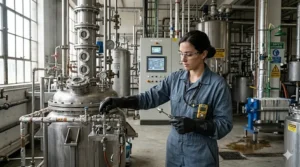
The Guardian Equipment CP-14 has earned Amazon’s Choice status — and in this product category, that badge isn’t accidental. At 14 mil and 14 inches with a smooth finish, it delivers a solid, balanced spec sheet at a price point that makes it the obvious entry-level pick for budget-conscious buyers who refuse to compromise on actual chemical protection.
What most people overlook about the CP-14: it’s frequently the first butyl glove that automotive shops, small-batch chemical users, and maintenance teams reach for — not because they’ve done a rigorous spec comparison, but because it arrives quickly, fits consistently, and doesn’t fall apart after two weeks of regular use. That reliability-per-dollar ratio is genuinely hard to beat in this market.
The smooth finish makes sense for most light-to-medium chemical applications: lab bench work, pesticide handling, solvent cleaning, and general hazardous material handling. Where it starts to show its limits is in high-demand industrial scenarios involving continuous immersion in concentrated ketones or sustained vapor exposure — for those, you’ll want to step up to the 25-mil MCR or the SHOWA 878. But for the researcher who handles acetone-based cleaning solutions twice a week? The CP-14 is everything they need and nothing they don’t.
Amazon reviewers particularly appreciate the consistent sizing and the fact that the gloves arrive in reliably good condition — something that, believe it or not, can’t be said for all chemical gloves sold through third-party channels.
✅ Amazon’s Choice — reliable availability
✅ Balanced price-to-protection ratio
✅ Good for general chemical handling
❌ Smooth finish can slip on wet surfaces
❌ Not suitable for extreme vapor permeation scenarios
In the $25–$38 range, the Guardian CP-14 is the smartest budget pick in the gas and vapor permeation barrier category.
7. SHOWA 890 Viton Over Butyl Chemical Resistant Safety Glove
And then there’s the SHOWA 890 — a glove that makes the 878 look almost casual. The 890 layers Viton fluoroelastomer over a butyl rubber substrate, creating a two-material barrier that handles chemicals the others simply won’t. We’re talking chlorinated solvents, aromatic hydrocarbons, and a handful of concentrated chemicals that eat through pure butyl given enough contact time.
The Viton outer layer is essentially the material of last resort in the glove world. It’s used in aerospace seals, nuclear plant gaskets, and chemical handling in environments where a material failure is not an inconvenience — it’s an incident. Layered over butyl rubber’s already exceptional vapor permeation resistance, the 890 creates a composite barrier that covers virtually the entire chemical threat spectrum in industrial settings.
At 28 mil and 14 inches, the 890 is unquestionably the most protective glove on this list. It’s also, predictably, the one that sacrifices the most dexterity. This is not a glove for precision tasks. This is a glove for hazmat response teams, chemical emergency responders, and workers in facilities handling the most aggressive compounds on a MSDS sheet.
The 890 is listed on Amazon and typically available through industrial supply sellers via the platform. Customer feedback tends to come from specialized industry users who note that the additional cost over standard butyl is “absolutely worth it for the peace of mind and the protection documentation.”
✅ Highest-level protection via Viton/Butyl composite
✅ Covers virtually all industrial chemical threats
✅ Accepted in hazmat-grade response protocols
❌ Most expensive option on this list
❌ Limited dexterity — not for precision tasks
Price range of $55–$80 per pair — and worth every dollar for the right application.
How to Use Butyl Rubber Chemical Gloves Correctly: A Practical Usage Guide
Buying the right glove is step one. Using it correctly is where most people quietly go wrong — and it’s where injuries actually happen.
Before putting them on: inspect every pair visually and with a simple air inflation test. Roll the cuff down, trap air inside, and squeeze gently. If air escapes, the glove has a puncture. This takes fifteen seconds and has prevented countless chemical exposures. OSHA’s PPE selection guidance specifically recommends pre-use inspection as a non-negotiable step.
During use: Know your breakthrough time. Every glove has one — even 28-mil butyl will eventually allow permeation under sustained direct contact with high-concentration ketones. For the SHOWA 878 and MCR CP25, breakthrough times against acetone typically exceed 60 minutes. For 7-mil options like the CP7, that number drops significantly. Time your tasks accordingly, and rotate gloves before reaching that limit.
The don’t-touch-your-face rule: sounds obvious, but contamination through hand-to-face contact remains a leading cause of chemical exposure even among PPE users. Keep a dedicated doffing station, and remove gloves with the inside-out technique every time — grab the outside of one glove, peel it off, and use the clean inside of that glove to peel the second one off without touching its exterior.
Storage: Store butyl rubber gloves away from UV light, ozone sources (motors, fluorescent lights), and heat. Butyl degrades with ozone exposure much faster than most users realize — a glove stored near a running motor for six months may look fine while being significantly compromised internally.
Replacement schedule: Don’t wait for visible damage. If you’re using gloves in regular contact with concentrated chemicals, establish a rotation schedule based on the glove’s rated breakthrough time, not its visible condition.
Buyer’s Decision Framework: Which Butyl Glove Is Actually Right for You?
The glove aisle (virtual or physical) is full of impressive-sounding specs. Here’s a simpler way to cut through the noise:
If you handle ketones or esters occasionally in a lab or maintenance setting — choose the North by Honeywell B131 or MCR Safety CP7. Both give you genuine butyl protection without the stiffness of heavier-gauge options. The B131’s ergonomic curve is a particularly nice touch for sustained wear.
If you work in automotive, aviation, or industrial chemical processing — the MCR Safety CP25 or SHOWA 878 is your bracket. The CP25’s gauntlet cuff and domestic manufacturing make it ideal for aerospace (especially Skydrol applications). The SHOWA 878 wins on raw thickness and permeation resistance for industrial chemical manufacturing environments.
If your budget is tight but you need real butyl protection — Guardian Equipment CP-14 is the honest answer. Don’t let the lower price point talk you out of it; the chemistry is the same as more expensive options at this thickness.
If you’re in hazmat response, emergency preparedness, or handling multiple unknown chemicals — there’s no reasonable argument against the SHOWA 890. Yes, it costs more. Yes, it’s stiffer. But when the stakes involve unknown chemical mixtures, the Viton/Butyl composite is the only choice that gives you a comprehensive barrier.
If your primary concern is dexterity — MCR Safety CP7. Nothing else on this list comes close to its combination of real butyl chemistry and practical, wearable thinness.
Butyl Rubber vs. Other Chemical Glove Materials: What the Data Actually Shows
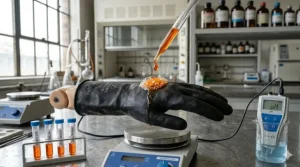
Most glove buyers make the same mistake: they shop by price category rather than chemical compatibility. Here’s the honest comparison.
| Material | Ketone Resistance | Ester Resistance | Gas/Vapor Barrier | Dexterity | Typical Thickness |
|---|---|---|---|---|---|
| Butyl Rubber | Excellent | Excellent | Best available | Moderate | 7–28 mil |
| Neoprene | Good | Fair | Good | Good | 15–30 mil |
| Nitrile | Fair | Poor | Poor | Excellent | 4–8 mil |
| Natural Latex | Poor | Poor | Poor | Excellent | 5–15 mil |
| Viton/Butyl Composite | Excellent | Excellent | Best available | Poor | 25–30 mil |
The table tells the story bluntly: nitrile, which dominates the disposable glove market for good reason in many applications, offers essentially no meaningful protection against ketones in any realistic workplace concentration. Butyl rubber isn’t competing with nitrile — it’s playing a completely different game. Neoprene occupies a useful middle ground but falls short on vapor permeation, which matters enormously when you’re working in enclosed spaces with volatile compounds. For anyone whose chemical profile includes ketones, esters, or any gas and vapor permeation concern, butyl polymer gloves aren’t a premium option — they’re the appropriate option.
One nuance worth noting: butyl rubber doesn’t perform as well against aliphatic hydrocarbons (gasoline, mineral spirits, petroleum naphtha) as neoprene does. If your work spans both categories, a chemical resistance chart consultation — available from most manufacturers and through OSHA’s chemical protective clothing resources — is essential before you commit.
How to Choose Butyl Rubber Chemical Gloves: 6 Criteria That Actually Matter
Skip the marketing copy. Here’s what to evaluate:
1. Thickness (mil): More is not always better — it’s about matching thickness to your exposure profile. Light intermittent contact with moderate concentrations: 7–14 mil. Sustained or high-concentration exposure: 25–28 mil. Don’t pay for protection you don’t need, but don’t shortchange yourself on protection you do.
2. Length: 14 inches is standard for industrial use and covers most forearm splash scenarios. 11 inches (North B131) is appropriate for controlled lab environments where splash is unlikely. If you’re doing overhead work or anything involving liquid transfer from above waist height, 14 inches minimum.
3. Lined vs. unlined: Unlined butyl gloves are easier to decontaminate and preferred in clean environments. They also telegraph hand fatigue more quickly. Lined options (not covered in this guide but worth noting) offer more comfort for extended wear but retain contamination in the liner material.
4. Grip finish: Smooth for clean, controlled environments. Rough/textured for any wet, oily, or outdoor scenario. This is a less exciting decision than thickness, but the wrong grip choice on a slippery surface can cause a drop — which in chemical handling is not a minor event.
5. Chemical compatibility: Consult a permeation data chart for your specific chemicals. Butyl excels against ketones and esters but has known gaps against aromatic and aliphatic hydrocarbons. The Wikipedia entry on butyl rubber gives a solid overview of the polymer’s chemical properties if you want to go deeper into the science.
6. Reusability and service life: Unsupported butyl gloves are reusable within their service life, but that life is finite and exposure-dependent. Establish a replacement schedule. Don’t wait for visible failure.
Common Mistakes When Buying Butyl Rubber Chemical Gloves
These errors show up constantly — and they’re all avoidable.
Choosing by brand name alone. SHOWA and MCR Safety both make excellent butyl gloves — but at wildly different thickness levels. A SHOWA 874 at 14 mil and a SHOWA 878 at 28 mil share a manufacturer, not a protection profile. Always confirm the model number and thickness for the actual glove in your cart.
Ignoring breakthrough time for your specific chemicals. Most manufacturers publish permeation data, and most buyers never look at it. The 60-minute breakthrough time against acetone on a 25-mil glove sounds comfortable until you realize your task takes 90 minutes. Know your numbers.
Buying the wrong size. Butyl is stiffer than nitrile. A glove that’s slightly too large creates finger-tip bunching that destroys dexterity and increases fatigue. Size up one step from your usual if you’re between sizes, but measure your hand span and compare it to the manufacturer’s size chart before ordering — especially for the ergonomically-shaped North B131.
Storing gloves badly. That drawer next to the fluorescent light ballast? Not where butyl lives. Ozone exposure accelerates material degradation invisibly. Store flat, dark, cool, and away from electrical equipment.
Not testing before committing to bulk. For hazmat teams or industrial purchasers buying in case quantities, order one or two pairs first. Confirm the thickness consistency, check the fit, and run a pre-use inflation test. A contaminated case of substandard gloves is an expensive mistake.
Real-World Performance: What Specs Don’t Tell You
Spec sheets are honest but incomplete. Here’s what extended real-world use reveals about butyl rubber chemical gloves in ways that a number printed on a package simply can’t.
Cold-weather performance matters more than most buyers plan for. Standard butyl rubber stiffens noticeably below 50°F. For outdoor chemical handling in northern climates, this becomes a genuine safety issue — a glove you can barely flex is a glove that increases drop risk. The North by Honeywell B131 is specifically engineered for cold-temperature flexibility, and it shows. The thicker MCR and SHOWA options become noticeably brick-like in cold storage environments.
The rolled cuff is a decontamination feature, not just a style choice. When you doff a glove, the cuff rolls inside-out, keeping the contaminated exterior surface away from your skin. A glove with a proper rolled or beaded cuff doesn’t just fit better — it’s a genuine component of contamination control protocol. This is particularly relevant for hazmat response gloves.
Butyl gets stiffer as it ages, even without chemical exposure. A pair stored for 18 months will feel noticeably stiffer than fresh stock of the same model. If you’re building an emergency supply cache, rotate stock regularly and inspect before use.
Users consistently underestimate the value of matching grip to task. The smooth-finish SHOWA 878 in wet conditions becomes something between slippery and dangerous. The rough 878R on dry surfaces sometimes feels almost tacky — excellent for grip but exhausting for fine manipulation. Buy according to your actual task environment, not just the higher-rated option in each brand lineup.
FAQ: Butyl Rubber Chemical Gloves
❓ Are butyl rubber chemical gloves reusable?
❓ What chemicals are butyl gloves for chemicals best at resisting?
❓ Can I use unsupported butyl gloves for lab work?
❓ How do I know when butyl polymer gloves need to be replaced?
❓ Do butyl rubber chemical gloves protect against gas and vapor permeation?
Conclusion: The Right Butyl Glove Is the One You’ll Actually Wear
Here’s the honest truth about hand protection: the technically superior glove does exactly zero good if it sits on a shelf because it’s too stiff, too bulky, or too expensive to use regularly. The best butyl rubber chemical gloves are the ones that match your specific work, your chemical environment, and your tolerance for the trade-offs between protection and dexterity.
For most industrial and lab users, the SHOWA 874 or Guardian Equipment CP-14 will cover the vast majority of real-world scenarios at a price point that makes regular replacement realistic. If you’re handling Skydrol in an aviation shop or running a manufacturing line with concentrated esters, the MCR Safety CP25’s domestic construction and gauntlet cuff make it the logical step up. For the precision-focused user who needs to feel their fingertips, the MCR CP7 or North B131 are the options that make butyl actually wearable for a full shift.
And if you’re working in hazmat response or facing truly unknown chemical mixtures? Get the SHOWA 890 and stop negotiating with risk.
One final thought: glove selection is a safety decision, not a shopping decision. Before purchasing, confirm your specific chemical compatibility, check your manufacturer’s permeation data, and consult OSHA’s guidelines on PPE selection at osha.gov if you have any doubt. Your hands — all 27 bones and approximately 17,000 touch receptors per palm — are worth the ten minutes of research.
✨ Don’t Miss These Exclusive Deals!
🔍 Ready to protect your hands the right way? Click any highlighted glove to check current availability and pricing on Amazon. Updated picks, real products, no guesswork.
Recommended for You
- 7 Best Neoprene Chemical Resistant Gloves in 2026
- 7 Best Nitrile Chemical Resistant Gloves 2026
- Paint Resistant Gloves: 7 Best Picks for Real Protection (2026)
Disclaimer: This article contains affiliate links. As an Amazon Associate, I earn from qualifying purchases. If you purchase products through these links, we may earn a small commission at no additional cost to you.
✨ Found this helpful? Share it with your friends! 💬🤗
