

In This Article
Walk into any freezer dock at 6 a.m. and you’ll spot the tell within thirty seconds: the picker who keeps yanking a glove off to fix a label, and the one who never does. That difference usually isn’t grit. It’s the glove. gloves for cold storage employees are purpose-built hand protection — insulated, grip-enhanced, and often cut or impact rated — designed for workers who handle frozen product, cartons, and equipment for hours at temperatures that would send an ordinary winter glove into early retirement. Ordinary gloves fail here because a cold storage shift isn’t a five-minute dash to the mailbox; it’s eight, ten, sometimes twelve hours of continuous cold contact, wet cartons, and repetitive grip.

This guide exists because most “best winter gloves” roundups are written for people shoveling driveways, not for order pickers running a scanner gun at -10°F for a full shift. We researched real, currently available products — checking specs, insulation weights, ANSI cut and impact ratings, and aggregated review sentiment — rather than recycling a generic list. You’ll find seven specific gloves spanning budget, mid-range, and premium price points, a full breakdown of how cold and repetition combine to create hand strain, and practical guidance for building a rotation system that actually survives a real facility’s laundry schedule. Whether you’re outfitting a single crew or restocking supply for an entire distribution center, OSHA’s cold stress guidance is a useful baseline to keep in mind as you read — insulated gloves are one of the agency’s core recommendations for preventing cold-related injury.
We’ll also dig into cold storage facility gloves specifically, because a walk-in cooler at 34°F and a blast freezer at -20°F genuinely call for different equipment, and treating them the same is one of the most common (and expensive) mistakes facilities make.
Quick Comparison Table
| Glove | Insulation / Rating | Grip Feature | Best For |
|---|---|---|---|
| Ergodyne ProFlex 850 | 150g, -5°F to -20°F | Silicone palm pattern | All-around freezer picking |
| RefrigiWear PolarForce | -30°F comfort rating | Kevlar-reinforced thumb crotch | Deep freezer / blast freezer |
| Youngstown Glove Kevlar Cut Resistant | ANSI A4 cut, insulated | Textured synthetic palm | Case and box handling |
| Wells Lamont FX3 Extreme Dexterity | 60g Thinsulate | TPR knuckle, textured leather | Scanning, picking, fine tasks |
| Mechanix Wear ColdWork M-Pact | Thinsulate insulated | Armored knuckle guard | Dock and pallet work |
| RefrigiWear Iron-Tuff Leather | 200g fiberfill, -30°F | Pre-curved leather palm | Budget-conscious crews |
| RefrigiWear Stretch Glove Liners | Acrylic/spandex | N/A (liner layer) | Rotation systems, layering |
Looking at the spread above, there’s no single “best” glove for every cold storage facility gloves program — the right pick depends on temperature, task, and how long a worker’s hands stay in contact with frozen surfaces. Facilities running mixed tasks (some picking, some case-breaking, some dock work) typically end up stocking two or three of these rather than standardizing on one. Budget shouldn’t be the only lens either: a glove that gets removed mid-shift because it’s too bulky or doesn’t grip well isn’t actually saving money, it’s creating a safety gap.
💬 Already comparing options? Tap any bolded glove above to check its current price and availability before it’s out of stock in your size.
Top 7 Gloves for Cold Storage Employees: Expert Analysis
1. Ergodyne ProFlex 850 Insulated Freezer Gloves — best all-around grip and warmth balance
The Ergodyne ProFlex 850 earns its spot at the top of this list because it doesn’t try to be everything — it’s built specifically for freezer work and nails the basics. With 150 grams of insulation and a comfort rating spanning -5°F to -20°F, it’s dialed in for the temperature range most cold storage pickers actually work in, rather than overshooting into deep-freeze territory where dexterity suffers. The silicone-pattern palm and reinforced thumb saddle mean this is genuinely one of the better grip gloves for cold storage tasks involving cardboard, plastic totes, and metal racking — surfaces that get slick fast once frost forms.
Based on the spec comparison, the neoprene cuff and lightweight insulation construction is what lets this glove maintain dexterity through a full shift instead of turning into a stiff mitt after an hour. Reviewers consistently note that the touchscreen-capable fingers hold up better than expected for scanning barcodes without stripping the glove off — a small detail that adds up across hundreds of scans per shift. This is the glove we’d point a new hire toward first: it’s forgiving, versatile, and doesn’t demand the buyer already know exactly which niche hazard they’re protecting against.
Pros:
- ✅ Balanced warmth and dexterity for full-shift wear
- ✅ Touchscreen-capable without removing the glove
- ✅ ANSI A2 cut and level 5 abrasion resistance
Cons:
- ❌ Not rated for sustained deep-freeze exposure below -20°F
- ❌ Silicone grip can wear thin with daily heavy use
Expect to pay in the mid-$20s to low-$30s range for a pair, and given the balance of insulation and grip, that’s solid value for a glove built specifically around cold storage facility gloves use cases rather than general winter wear.
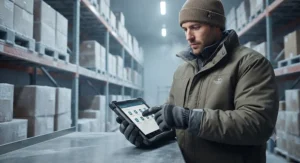
2. RefrigiWear PolarForce Gloves — built for -30°F deep freezer duty
When the job moves from a standard freezer into blast-freezing or extended deep-cold storage, the RefrigiWear PolarForce Gloves are the upgrade path. Rated to a -30°F comfort level, this glove is designed for workers spending sustained time in the coldest zones of a facility — think loading blast freezers or working extended shifts in sub-zero holding rooms rather than quick in-and-out picks. The Kevlar-reinforced thumb crotch is a small but telling detail: that’s the spot where gloves fail first under repeated grip-and-release motion, and reinforcing it specifically signals RefrigiWear designed this around real freezer failure points rather than generic winter-glove templates.
What most buyers overlook about extreme-cold gloves is that raw insulation weight isn’t the only factor — a precurved, ergonomic fit matters just as much, because a flat-cut glove forces the hand to fight the material with every grip, accelerating fatigue over a long shift. The precurved fit here reduces that resistance. Aggregated reviewer sentiment across freezer-glove buying guides consistently flags this line for touchscreen compatibility on the thumb and forefinger, letting workers log inventory counts without breaking cold-glove protocol. If your crew works in anything colder than a typical -10°F freezer aisle, this is the category to shop in first, and it holds up well against other long shift cold gloves options at a similar price point.
Pros:
- ✅ Comfort-rated to -30°F for sustained deep-cold work
- ✅ Kevlar-reinforced thumb crotch resists early failure
- ✅ Touchscreen-ready thumb and forefinger
Cons:
- ❌ Bulkier fit reduces fine-motor dexterity
- ❌ Premium price relative to standard freezer gloves
Price typically falls in the $30-$45 range, which tracks with the specialized insulation and reinforcement — a reasonable trade for facilities where -20°F and colder is the daily norm rather than the exception.
3. Youngstown Glove Kevlar Cut Resistant Waterproof Winter Gloves — best cut protection for case handling
Cold storage work isn’t just cold — it’s full of box cutters, banding straps, torn cardboard edges, and metal shelving corners, and the Youngstown Glove Kevlar Cut Resistant Waterproof Winter Gloves are built around that reality. Certified to ANSI/ISEA 105 cut level A4 and puncture level 3, this glove sits at the intersection of thermal protection and mechanical hazard defense, which matters most for workers breaking down cases, cutting shrink wrap, or handling packaging with exposed staples and bands. The Kevlar lining running through the entire glove — not just the palm — is what pushes the cut rating this high.
Here’s what the spec sheet won’t tell you, but reviewers note: waterproof winter gloves with this level of cut protection tend to run slightly stiffer out of the box, and buyers report a break-in period of a few shifts before the 3D ergonomic pattern really conforms to the hand. Once broken in, though, the combination of waterproofing and cut resistance means workers aren’t choosing between staying dry and staying protected from lacerations — a genuinely useful trade-off for facilities where knife use is routine. This is the glove worth stocking for any crew whose job description includes “and also opens boxes with a blade” alongside “handles frozen product.”
Pros:
- ✅ ANSI/ISEA cut level A4 protection throughout
- ✅ 100% waterproof and windproof triple-layer construction
- ✅ Puncture resistant to ANSI level 3
Cons:
- ❌ Stiffer fit requires a short break-in period
- ❌ Heavier than dexterity-focused alternatives
At roughly $35-$55 a pair depending on retailer, it’s a mid-to-premium investment that pays off fastest in roles with real cutting and puncture exposure, not pure picking.
4. Wells Lamont FX3 Extreme Dexterity Winter Work Gloves — best dexterity for scanning and picking
Some cold storage roles are less about brute cold and more about fine motor work — scanning labels, sorting SKUs, handling small parts — and that’s the lane the Wells Lamont FX3 Extreme Dexterity Winter Work Gloves occupy. With 60 grams of 3M Thinsulate insulation, this is a lighter-weight option than the deep-freeze specialists on this list, trading some raw warmth for a synthetic leather palm and spandex back that flexes with the hand instead of against it. Based on the spec comparison, that lower insulation weight is a deliberate choice rather than a shortcoming: Wells Lamont built this line for tasks where losing tactile feedback costs more productivity than losing a few degrees of warmth.
Reviewers consistently note the touchscreen-capable thumb and forefinger as a standout feature for RF-scanner-heavy roles, and the TPR knuckle protection adds a layer of impact defense without bulking up the palm. What most buyers overlook is that this glove isn’t meant for prolonged blast-freezer exposure — it’s the right call for cooler zones (32°F to roughly 20°F) and high-frequency handling tasks where dexterity is the priority. Pairing it with a liner on the coldest days extends its usable range considerably, which is exactly the kind of layering approach we cover later in this guide.
Pros:
- ✅ Excellent dexterity for scanning and fine handling
- ✅ TPR knuckle protection without added bulk
- ✅ Touchscreen-compatible thumb and forefinger
Cons:
- ❌ Lower insulation weight limits deep-freeze use
- ❌ Less puncture protection than heavier-duty options
Priced around $20-$30, this is one of the more accessible grip gloves for cold storage picking roles where speed and precision matter as much as warmth.
5. Mechanix Wear ColdWork M-Pact Winter Work Gloves — best impact protection for dock work
Loading docks and pallet-handling zones bring a different hazard profile than freezer aisles: crushed fingers from shifting pallets, impacts from dropped product, and repeated contact with hard equipment edges. The Mechanix Wear ColdWork M-Pact Winter Work Gloves address that directly with armored knuckle protection layered over Thinsulate insulation, extending Mechanix’s mechanic-glove impact design into cold-weather territory. This is a glove built less around raw thermal specs and more around the mechanical hazards that show up wherever forklifts, pallet jacks, and dock plates are in daily use.
Here’s what tends to get missed: impact protection and cold insulation aren’t naturally compatible, because rigid impact panels can restrict the flex needed for dexterity in cold-stiffened hands. Mechanix’s approach — segmented armor over a flexible base — is a reasonable compromise, and aggregated reviewer feedback on the broader ColdWork line points to solid wind and water resistance holding up in dock environments where doors open and close constantly, creating drafts that ordinary insulated gloves handle poorly. For dock crews specifically, this is a stronger fit than the pure-warmth options on this list.
Pros:
- ✅ Armored knuckle protection for dock and pallet hazards
- ✅ Wind and water resistant for drafty dock zones
- ✅ Machine washable for easier upkeep
Cons:
- ❌ Less insulation depth than dedicated deep-freeze gloves
- ❌ Bulkier knuckle guard can catch on tight spaces
Expect a price point in the $35-$45 range, justified by the impact-rated construction that pure thermal gloves simply don’t offer.

6. RefrigiWear Iron-Tuff Insulated Leather Gloves — toughest budget leather workhorse
Not every facility has a premium PPE budget, and the RefrigiWear Iron-Tuff Insulated Leather Gloves prove that budget-conscious doesn’t have to mean under-protected. With 200 grams of fiberfill-plus-foam insulation over a tricot lining and a comfort rating down to -30°F, the thermal spec actually rivals gloves costing twice as much. Kevlar-reinforced seams, thumb crotch, and fingertips address the exact failure points that wear out cheaper leather gloves fastest, and RefrigiWear’s claim of roughly four times the strength of natural leather tracks with the reinforced-seam construction.
Based on the spec comparison, this glove’s value proposition is straightforward: it’s not chasing touchscreen features or ultralight dexterity, it’s built for durability and warmth at a price that makes replacing a torn pair a non-event rather than a budget conversation. Reviewers of RefrigiWear’s Iron-Tuff line consistently frame it as the “workhorse” option — not the most refined glove on a shelf, but one that survives daily abuse across a long shift with minimal complaint. For facilities outfitting large crews where every dollar matters, this is where the budget tier of gloves for cold storage employees genuinely holds up.
Pros:
- ✅ 200g insulation rated to -30°F at a budget price
- ✅ Kevlar-reinforced seams resist early tearing
- ✅ Pre-curved ergonomic fit reduces hand fatigue
Cons:
- ❌ No touchscreen compatibility
- ❌ Less refined grip texture than silicone-palm competitors
At roughly $15-$25 a pair, this is the value pick on the list — genuinely capable cold protection without the premium price tag.
7. RefrigiWear Stretch Glove Liners — best liner for a rotation system
The most overlooked product on this list isn’t a standalone glove at all — it’s the RefrigiWear Stretch Glove Liners, an acrylic-and-spandex layer designed to be worn underneath a primary work glove. Liners solve a problem none of the six gloves above can fully solve alone: moisture management across a full shift. Hands sweat even in freezing conditions, and once that moisture is trapped against the skin, insulation performance drops fast — a liner wicks it away and can be swapped mid-shift or between shifts without replacing the entire glove.
What most buyers overlook about a proper glove liner rotation is that it’s not just a comfort upgrade, it’s a cost-control and hygiene measure. A facility that issues two or three liners per worker alongside a single durable outer glove extends that glove’s usable life significantly, since the liner — not the outer shell — absorbs most of the sweat and odor buildup. Reviewers of stretch glove liners note the flexible fit adapts to most hand sizes, which simplifies bulk purchasing for larger crews. We cover exactly how to structure a liner rotation in the transformation section below.
Pros:
- ✅ Wicks moisture away from skin during long shifts
- ✅ Extends the usable life of outer work gloves
- ✅ Stretch fit accommodates most hand sizes
Cons:
- ❌ Provides minimal standalone protection or insulation
- ❌ Sold by the dozen, which is a larger upfront buy
Liners typically run $10-$20 per dozen pairs, making them one of the cheapest ways to meaningfully extend the life and comfort of any glove on this list.
Benefits vs. Traditional Winter Gloves
| Factor | Ordinary Winter Glove | Purpose-Built Cold Storage Glove |
|---|---|---|
| Insulation design | General warmth, not task-tested | Matched to freezer temperature bands |
| Grip in wet/frost conditions | Often smooth palm, slick when frosted | Silicone or textured palm for wet grip |
| Durability under daily use | Designed for occasional outdoor wear | Reinforced seams for daily 8+ hour shifts |
| Best For | Casual outdoor errands, commuting | Cold storage facility gloves programs |
The gap here isn’t subtle: a ski glove or a general hardware-store winter glove is engineered for occasional exposure, not eight-hour daily contact with frozen cartons and metal racking. Purpose-built cold storage gloves account for repeated wet-dry cycles, grip loss from frost, and the accumulated wear of a five-day work week, which is exactly why generic winter gloves tend to fail — coatings crack, seams split, and grip degrades — well before their cold storage counterparts. If your team currently issues off-the-shelf ski gloves and complains about hands going numb by lunch, this comparison table is your evidence for why the switch pays for itself in reduced turnover and fewer dropped cases.
✨ Don’t Miss These Exclusive Deals!
🔍 Compare current pricing and availability on any glove above — stock and sizes shift fast during peak season.
Building a Glove Liner Rotation System for Long Shifts
A single pair of gloves, however well-made, isn’t designed to survive an entire week of daily eight-to-twelve-hour cold storage shifts without a break. This is where a glove liner rotation earns its keep. The basic system: issue each worker one durable outer glove (something like the RefrigiWear Iron-Tuff Insulated Leather Gloves or Ergodyne ProFlex 850) paired with three to five RefrigiWear Stretch Glove Liners, rotated daily or even mid-shift if hands sweat heavily.
The mechanics are simple but easy to skip under time pressure. At the start of a shift, the worker pulls a fresh, dry liner from a labeled bin — color-coding by size speeds this up considerably. Damp liners go into a separate hamper rather than back into circulation, and get laundered on a set schedule (most acrylic-spandex blends tolerate regular machine washing). The outer glove itself gets a quick visual check for cracking, seam separation, or flattened insulation before each shift; a good rule of thumb is retiring the outer shell once insulation feels noticeably thinner than a new pair or the coating starts to crack.
The biggest first-30-day mistake facilities make is skipping the labeling step, which leads to liners piling up unsorted and workers grabbing whatever’s dry regardless of size — a fit problem that quietly undercuts dexterity and warmth alike. A second common misstep is treating the outer glove as disposable and skipping liners entirely, which burns through the more expensive component fast. Done right, a rotation system roughly doubles the effective service life of the outer glove while keeping hands measurably drier through a long shift cold gloves routine.
Real-World Scenarios: Matching Gloves to the Job
Consider three workers on the same facility floor, each needing a different setup. First, a new order picker working a -10°F freezer aisle for eight-hour shifts, mostly handling cardboard totes and a scanner gun — the Ergodyne ProFlex 850 is the natural fit here, balancing grip, touchscreen use, and moderate insulation without the bulk that would slow down repetitive picking motions.
Second, a case-breaker on the receiving dock who spends the day cutting shrink wrap and banding straps off incoming pallets in a 28°F cooler — cut resistance matters more than deep-freeze insulation for this role, making the Youngstown Glove Kevlar Cut Resistant Waterproof Winter Gloves the better match, since a laceration risk from a box cutter is the more immediate hazard than sustained sub-zero exposure.
Third, a maintenance technician who splits time between a -20°F blast freezer and general dock work involving pallet jacks and occasional impact hazards. This worker benefits from having two gloves in rotation: the RefrigiWear PolarForce Gloves for extended blast-freezer tasks, and the Mechanix Wear ColdWork M-Pact Winter Work Gloves for dock and equipment work where crush and impact risk is higher than cold exposure. Budget-conscious facilities running large seasonal crews, meanwhile, often standardize on the RefrigiWear Iron-Tuff Insulated Leather Gloves across the board and layer in liners as needed — a workable middle ground when task-by-task customization isn’t practical.
Common Glove Problems in Cold Storage (And How to Fix Them)
Problem: Hands go numb before the shift ends. This usually signals insufficient insulation for the actual temperature band, not a defective glove. Match the comfort rating to the coldest zone the worker regularly enters, and consider adding a liner rather than assuming a thicker outer glove is the only fix — thickness alone can reduce dexterity without meaningfully improving warmth.
Problem: Gloves keep coming off mid-task. If workers are removing gloves to handle labels, scanners, or small parts, the fix isn’t discipline — it’s dexterity. Swap toward a glove built for fine motor work, like the Wells Lamont FX3 Extreme Dexterity Winter Work Gloves, rather than repeating warnings about PPE compliance that a bulkier glove can’t actually satisfy.
Problem: Grip fails on frosted cartons. Smooth-palm gloves lose traction fast once condensation freezes on box surfaces. Silicone-pattern or textured palms — the kind found on the Ergodyne ProFlex 850 — hold grip meaningfully better in these conditions.
Problem: Gloves smell and wear out fast. This is almost always a moisture-management issue rather than a durability defect. A liner rotation, discussed above, addresses this directly by keeping sweat away from the outer shell.
Problem: Cuts from packaging despite wearing gloves. Standard insulated gloves without a cut rating won’t stop a box cutter or banding strap edge. This calls for an ANSI-rated cut-resistant option like the Youngstown Glove Kevlar Cut Resistant Waterproof Winter Gloves, not just “thicker” gloves.
How to Choose Gloves for Cold Storage Employees
What is the right glove for cold storage work? In short, it’s a glove matched to your facility’s actual temperature range, task type (grip, dexterity, or impact-heavy), and shift length — not simply the warmest option available. Here’s how to work through that decision systematically:
- Map your temperature zones. A 34°F cooler, a -10°F freezer aisle, and a -20°F blast freezer each call for different insulation weights; don’t issue one glove facility-wide without checking this first.
- Identify the dominant hazard beyond cold. Cuts from packaging, impacts from pallets, or fine-motor scanning work each point toward a different glove category, as covered in the product breakdowns above.
- Check the shift length, not just the temperature. A worker in a freezer for fifteen minutes tolerates a lighter glove than one there for a full eight-hour shift.
- Prioritize grip texture for wet or frosted handling. Silicone or textured palms consistently outperform smooth palms once condensation and frost enter the picture — a meaningful factor in cold storage facility gloves selection that specs alone won’t fully capture.
- Build in a liner rotation from day one. Treating liners as an afterthought is one of the most common and easily avoidable cost mistakes facilities make.
- Verify ANSI ratings match real hazards. A cut-resistance rating (like the A4 rating on Kevlar-lined gloves) only matters if cutting tasks are actually part of the job — don’t overpay for protection against a hazard your team doesn’t face.
- Plan for replacement cycles up front. Budget for regular glove replacement rather than waiting for visible failure, which usually means protection has already degraded.
Grip Gloves for Cold Storage: Why Grip Matters More Than Warmth
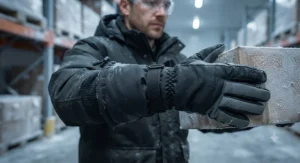
It’s tempting to shop for cold storage gloves purely by insulation rating, but grip failure is arguably the more common — and more dangerous — problem on the floor. A dropped case isn’t just a productivity hit; it’s a foot-injury risk, a product-damage cost, and in refrigerated environments, a slip hazard once that dropped item creates ice on the floor. Grip gloves for cold storage work address this with textured or silicone-pattern palms specifically engineered to hold traction on frost-covered cardboard, plastic totes, and metal shelving — surfaces that turn genuinely slick within minutes of exposure to a freezer’s humidity.
Here’s what most buyers overlook: cold itself directly degrades grip strength, independent of any glove. Reduced blood flow to the fingers in cold conditions measurably weakens a worker’s natural grip force, meaning the glove’s own traction has to compensate for something the body is actively losing. That’s precisely why a smooth-palm glove that feels fine in a mild garage doesn’t hold up the same way in a working freezer — the human grip weakens while the surface gets slicker, a double hit that only a properly textured palm offsets. When comparing specs side by side, weigh grip texture at least as heavily as insulation weight, especially for picking and case-handling roles.
How Cold Exposure Increases Repetitive Strain Risk
Repetitive strain in cold environments compounds in ways that aren’t obvious from the outside. Cold temperatures reduce peripheral nerve conduction and stiffen the small muscles and tendons in the hand, meaning the same repetitive grip-and-release motion a worker performs hundreds of times per shift requires more effort in a freezer than it would at room temperature. Add in the reduced dexterity from bulky insulation, and workers often unconsciously grip harder than necessary just to maintain control — a pattern that accelerates fatigue and raises injury risk over weeks and months, not just within a single shift.
According to ergonomics research summarized by the CDC’s NIOSH program, forceful and repetitive hand exertions are established risk factors for musculoskeletal disorders, and cold exposure is recognized as a compounding factor alongside vibration and repetition rather than an isolated issue. In practice, this means glove choice is genuinely part of an ergonomics program, not just a comfort decision. A glove that fits well, preserves dexterity, and doesn’t force a worker to over-grip to compensate for stiffness or bulk directly reduces the cumulative strain that builds toward conditions like tendinitis or carpal tunnel syndrome over a career in cold storage work. Facilities serious about reducing long-term hand injury claims should treat glove fit and rotation as an ergonomics line item, not just a PPE checkbox.
Gloves for Food Distribution Centers and Cold-Chain Logistics
Food distribution centers carry an added layer of complexity beyond a standalone cold storage facility: constant transitions between temperature zones, food-contact hygiene requirements, and often higher throughput expectations than a static warehouse. Workers here frequently move between a 34°F cooler, a loading dock at ambient temperature, and a -10°F freezer within the same hour, which makes condensation and re-freezing on glove surfaces a bigger practical problem than in a single-temperature facility.
For this environment, low-lint, easy-to-clean gloves matter more than in general warehousing, since food-contact-adjacent areas often have housekeeping standards that plain leather gloves don’t meet as cleanly as synthetic alternatives. The Wells Lamont FX3 Extreme Dexterity Winter Work Gloves and Ergodyne ProFlex 850 both suit this kind of mixed-zone, high-frequency-handling work reasonably well, since their lighter insulation profiles tolerate the in-and-out temperature transitions better than deep-freeze-only gloves, which can feel clammy once a worker steps back into a warmer zone. Cold-chain logistics operations — third-party distributors moving product between refrigerated trucks and storage — face similar transition challenges, and the same reasoning applies: prioritize gloves that perform reasonably across a temperature range rather than gloves optimized for one extreme.
Long-Term Cost and Glove Replacement Cycles
| Glove Type | Approx. Price Range | Typical Replacement Cycle | Best Value Scenario |
|---|---|---|---|
| RefrigiWear Iron-Tuff Leather | $15-$25 | 2-4 months, heavy daily use | Large crews, tight PPE budgets |
| Ergodyne ProFlex 850 | $25-$35 | 3-5 months | Balanced daily-use programs |
| RefrigiWear PolarForce | $30-$45 | 4-6 months | Deep-freeze specialist roles |
Looking strictly at sticker price undersells the real cost comparison, because a $15 glove replaced every two months adds up to more annual spend than a $30 glove lasting five months — and that’s before accounting for the productivity cost of workers whose hands go numb or whose grip fails mid-shift. Facilities running a liner rotation, as detailed earlier, consistently report longer service life out of the outer glove, since moisture — not raw wear from handling — is often what shortens a glove’s usable lifespan fastest. When budgeting, it’s worth tracking real replacement frequency for a quarter before locking into a single glove program, since actual conditions in your facility may differ from the general ranges above.
Safety, Regulations, and OSHA Compliance for Cold Storage Hand Protection
Hand protection in cold storage settings falls under general PPE requirements rather than a cold-specific standard. OSHA’s hand protection standard, 29 CFR 1910.138, requires employers to select appropriate hand protection based on an evaluation of the hazards workers actually face — including, explicitly, harmful temperature extremes alongside cuts, punctures, and abrasion risks. That means a documented hazard assessment, not just a default glove order, is the compliant approach: facilities should evaluate each role’s actual temperature exposure, task hazards, and shift duration before settling on a standard-issue glove.
Beyond compliance paperwork, the practical safety case is straightforward: cold stress and reduced dexterity both increase the likelihood of dropped loads, slower reaction time around moving equipment, and cumulative strain injuries discussed earlier in this guide. A documented glove program — one that specifies which glove goes with which role and temperature zone, backed by manufacturer insulation data — gives safety teams a defensible standard to point to during audits or after an incident, rather than relying on informal judgment calls made on the warehouse floor.
👉 Ready to outfit your crew? Compare the top picks above and match each role to its right-fit glove today.

Frequently Asked Questions
❓ What gloves are best for working in a freezer all day?
❓ How often should cold storage workers replace their gloves?
❓ Are leather or synthetic gloves better for cold storage?
❓ Do cold storage gloves need to be cut resistant?
❓ Can I use ski gloves for cold storage work?
Conclusion
There’s no single “best” glove here — there’s a best-fit glove for your facility’s temperature zones, task mix, and shift length. A picker running a scanner in a -10°F aisle needs something different than a case-breaker cutting bands on the dock, and both differ from a maintenance tech splitting time between a blast freezer and general equipment work. What ties this whole guide together is the idea that cold storage facility gloves aren’t a single SKU decision — they’re a small system involving the right outer glove, a liner rotation to manage moisture and extend service life, and a replacement cycle that accounts for real wear rather than waiting for visible failure.
If you’re outfitting a team, start with the temperature mapping step from our “How to Choose” section, layer in grip and cut-resistance needs based on actual tasks, and don’t skip the liner rotation — it’s the cheapest lever in this entire guide for extending glove life and keeping hands genuinely comfortable through a long shift. Whichever of the seven gloves above ends up in your cart, matching it honestly to the job in front of your team will do more for safety and productivity than chasing the single “warmest” option on the shelf.
Recommended for You
- 7 Best Thinsulate Lined Work Gloves for Construction Workers (2026)
- 7 Best wool lined work gloves for winter under $25 (2026)
- Thermal Work Gloves for Outdoor Labor: 7 Tough 2026 Picks
Disclaimer: This article contains affiliate links. As an Amazon Associate, I earn from qualifying purchases. If you purchase products through these links, we may earn a small commission at no additional cost to you.
✨ Found this helpful? Share it with your friends! 💬🤗
