
In This Article
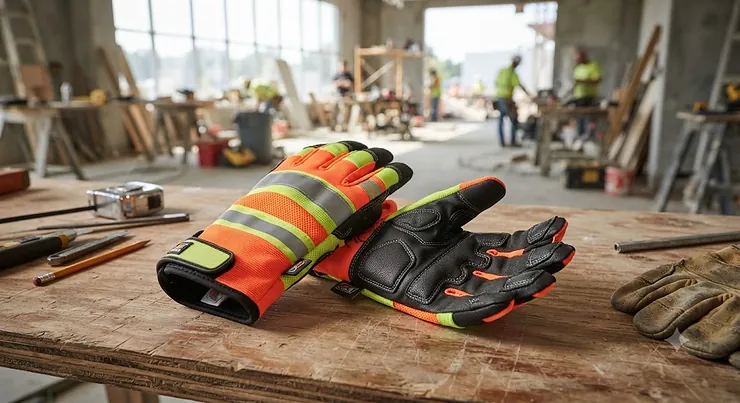
Here’s a fact that trips up a lot of safety managers: your crew can be wearing a full hi-viz vest, a hard hat with reflective tape, and a wide, glowing smile, and still get missed by a skid-steer operator backing up at dusk — because the one part of their body doing the actual signaling, the hand, is wrapped in a dull gray glove. Hands are what wave down traffic, flag a crane operator, and signal “stop right there” to a dump truck. If that hand disappears into the visual noise of a jobsite, the rest of the outfit is only doing half its job. That’s the whole case for hi-viz work gloves for construction sites in one paragraph, and it’s the reason this guide exists.
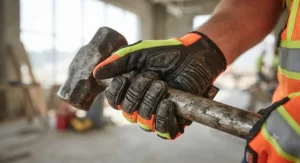
We’re going to walk through seven real, currently available gloves that cover the budget-to-premium spectrum, explain what the ANSI ratings stamped on the packaging actually mean in practice, and get specific about which glove fits which kind of job — because a flagger standing roadside all day has very different needs than a framer running a nail gun. Hand injuries remain one of the most common categories of on-the-job harm in construction, and construction laborers routinely work with hand tools, power tools, and equipment like air hammers and cement mixers that put fingers and hands directly in harm’s way. Visibility and hand protection aren’t competing priorities — the best gloves on this list handle both.
One more thing before we dive in: this article contains affiliate links, and if you buy through one, we may earn a small commission at no extra cost to you. Full disclosure is at the bottom, but we wanted it up top too, because transparency shouldn’t be buried.
Quick Comparison Table
| Glove | Best For | ANSI Cut Level | Price Range |
|---|---|---|---|
| Ergodyne ProFlex 7141 | Heavy-duty cut + impact work | A4 | $25-$35 range |
| MCR Safety PD6901 Predator | High-impact mechanical tasks | A9 (impact-rated) | $18-$28 range |
| Ergodyne ProFlex 7021 | Everyday all-around jobsite use | A2 | $12-$18 range |
| Superior Glove Dexterity S18TXNT | Maximum cut resistance with dexterity | A9 | $22-$32 range |
| MCR Safety Ninja Ice N9690HV | Cold-weather roadside work | N/A (insulated) | $14-$22 range |
| Ergodyne ProFlex 818WP | Wet and winter jobsites | N/A (waterproof) | Around $35-$40 |
| HANDLANDY Hi-Vis Reflective Gloves | Budget-friendly everyday wear | A2-equivalent | Under $15 |
Looking at this lineup, there’s no single “best” glove — there’s a best glove for what your crew is actually doing that day. The Ergodyne ProFlex 7141 and Superior Glove Dexterity S18TXNT sit at the top of the cut-resistance spectrum, which matters if your team handles sheet metal, rebar, or glazing. The HANDLANDY Hi-Vis Reflective Gloves cost less than a fast-food lunch and still deliver touchscreen use and reflective trim, making them a smart pick for general labor crews who go through gloves fast. And if your jobsite runs through winter, the Ergodyne ProFlex 818WP and MCR Safety Ninja Ice N9690HV solve a problem the other five simply don’t address: keeping fingers functional at 28°F.
💬 Found a glove that matches your crew’s needs? Tap through and check today’s price before it changes!
Top 7 Hi-Viz Work Gloves for Construction Sites: Expert Analysis
1. Ergodyne ProFlex 7141 — best for heavy-duty cut and impact protection
The standout here is the combination most gloves don’t manage to pull off at once: real cut resistance and real knuckle protection, without turning your hands into oven mitts. Built from high-performance polyethylene (HPPE) fiber, the Ergodyne ProFlex 7141 carries an ANSI/ISEA 105 cut level A4 rating, which puts it well above the basic work gloves most crews default to, and it adds molded TPR armor across the knuckles and fingers for impact protection — a detail that matters more than it sounds like it should. Based on the spec comparison, A4 cut resistance is the level you actually want when guys are handling conduit, sheet metal edges, or rebar ties all day, since anything below A3 tends to get sliced through within a shift or two of that kind of abuse.
What most buyers overlook about this model is the WSX nitrile dip on the palm, which is designed to stay grippy even when the glove gets wet or oily — a common failure point on cheaper coated gloves that turn slick the moment they touch hydraulic fluid. Reviewers consistently report that the TPR knuckle guards hold up well against accidental hammer strikes and pinch points around scaffolding, though a few note the extra material reduces fine-motor tasks like tying small knots or handling fasteners. That’s a fair trade-off for a glove built primarily for heavy handling and hazard resistance rather than delicate assembly work.
Pros:
- ✅ A4 cut resistance handles sharp metal and rebar edges
- ✅ TPR knuckle armor adds real impact protection
- ✅ WSX nitrile coating grips well in wet, oily conditions
Cons:
- ❌ Bulkier fit reduces dexterity for fine tasks
- ❌ Higher price point than basic A2 gloves
At around $25-$35 a pair, the Ergodyne ProFlex 7141 sits at the premium end of this list, but for crews working demolition, ironwork, or heavy material handling, the cut-plus-impact combo is worth the extra cost over a basic glove that only checks one box.
2. MCR Safety PD6901 Predator — best for high-impact mechanical work
This one earns its “Predator” name from an ANSI A9 impact and abrasion rating that’s built for guys constantly banging their hands against steel, rigging hardware, and equipment frames. The hi-viz shell isn’t an afterthought bolted onto a mechanic’s glove — it’s integrated into the design so the back-of-hand visibility survives the same abuse the palm is built to take. Key spec translation: A9 is near the top of the abrasion scale, meaning the palm material resists wear from repeated contact with rough surfaces far longer than a standard leather or synthetic-leather glove.
Here’s what the spec sheet won’t tell you, but user reports suggest: the padded palm and reinforced fingers genuinely reduce hand fatigue on jobs involving a lot of gripping and re-gripping — rigging chains, adjusting scaffold clamps, that kind of repetitive strain. Based on the spec comparison against straight cut-resistant gloves, the MCR Safety PD6901 Predator trades some cut protection for superior impact and crush resistance, which makes it the better call for equipment operators and riggers rather than glazers or sheet-metal crews.
Pros:
- ✅ A9-rated abrasion resistance for heavy mechanical wear
- ✅ Padded palm reduces fatigue during repetitive gripping
- ✅ Hi-vis shell holds up under rough daily handling
Cons:
- ❌ Not optimized for fine cut-resistance tasks
- ❌ Padding adds bulk versus lighter mechanic gloves
Priced in the $18-$28 range, this is a strong mid-tier pick for anyone whose hands take more of a beating from blunt impact than from blades.
3. Ergodyne ProFlex 7021 — best all-around jobsite glove
If you only buy one hi-viz glove for a general labor crew, this is probably it. The 18-gauge HPPE nylon-spandex knit gives the Ergodyne ProFlex 7021 an ANSI A2 cut rating — modest but sufficient for general handling, framing, and site cleanup — while staying thin enough that guys will actually keep it on instead of stuffing it in a back pocket by 10 a.m. What most buyers overlook about “lightweight” cut-resistant gloves is that thinner doesn’t mean weaker; the seamless knit construction here is specifically engineered to avoid the pressure points that make bulkier gloves feel worse over an 8-hour shift.
The WSX nitrile palm coating repeats the trick used on the 7141 above, giving a firm no-slip grip on wet or oily material without sacrificing touchscreen compatibility — a small feature that saves real time when a foreman needs to snap a photo or check a plan on a tablet without stripping gloves off fifteen times a day. Reviewers consistently mention that these run true to size and hold up well to abrasion despite the thin profile, with the main complaint being that heavy sheet-metal work will still cut through faster than a true A4-rated glove.
Pros:
- ✅ Comfortable all-day fit for general labor tasks
- ✅ Touchscreen-capable without removing gloves
- ✅ WSX coating grips well in wet or oily conditions
Cons:
- ❌ A2 rating insufficient for sharp-edge-heavy trades
- ❌ Less durable than heavier premium gloves over time
At $12-$18, this is the glove most crews should be buying in bulk for general use, saving the heavier-duty options for specific high-risk tasks.
4. Superior Glove Dexterity S18TXNT — best for maximum cut resistance with dexterity
This model is built from TenActiv engineered yarn with a nitrile palm coating, delivering 360-degree cut protection at an extreme ANSI A9 cut resistance level while remaining touchscreen compatible. That A9 number matters here: it’s the highest tier on the ANSI/ISEA 105 cut scale, meaning this glove is built for the sharpest, nastiest materials on a jobsite — broken glass, sheared sheet metal, fresh-cut conduit — without requiring the wearer to sacrifice the finger sensitivity needed for tasks like fastening small hardware or adjusting wiring.
Based on the spec comparison with the other cut-resistant options on this list, what sets the Superior Glove Dexterity S18TXNT apart is that it hits A9 without the thick, stiff feel typically associated with high-cut-level gloves — the “dexterity” in the name isn’t just marketing. The nitrile coating repels oils, solvents, and water, which matters for glazing and demolition crews who regularly handle contaminated debris. What most buyers overlook is that A9 gloves this thin typically wear out faster at pressure points like the thumb crotch, so expect to replace them more frequently than a bulkier A4 glove on the same job.
Pros:
- ✅ A9 cut resistance, the highest tier available
- ✅ Thin profile preserves finger dexterity
- ✅ Nitrile coating resists oils, solvents, and water
Cons:
- ❌ Premium price relative to lower cut-level gloves
- ❌ Thumb crotch area may wear faster under heavy use
Expect to pay in the $22-$32 range — a fair ask for genuinely top-tier cut resistance in a glove you can still tie rebar with.
5. MCR Safety Ninja Ice N9690HV — best for cold-weather roadside work
Flaggers and roadside crews working a winter shift face a specific problem this glove is built around: hands go numb, grip disappears, and suddenly the person supposed to be signaling traffic can barely hold a paddle sign. The MCR Safety Ninja Ice N9690HV uses a 15-gauge hi-vis lime nylon shell over a 7-gauge acrylic terry interior liner, with an HPT-coated palm and fingertips for grip in wet or icy conditions. The insulation layer is the real story here — it’s designed to trap warmth without making the glove so thick that fine motor control disappears.
Here’s what the spec sheet won’t fully convey: HPT coatings tend to outperform standard rubber or PVC dips in cold weather because they stay more flexible at low temperatures instead of stiffening up, which is exactly the failure mode that ruins cheaper winter gloves. Reviewers consistently note that these run warm enough for moderate cold but that extreme sub-freezing conditions (well below 20°F) will still get through to fingertips after extended exposure — a limitation worth knowing before you order a case for a January highway job.
Pros:
- ✅ Insulated liner holds warmth without excess bulk
- ✅ HPT coating stays flexible and grippy in cold, wet conditions
- ✅ Hi-vis lime shell maintains visibility in low winter light
Cons:
- ❌ Limited protection in extreme sub-freezing temperatures
- ❌ Less cut resistance than dedicated cut-rated gloves
At $14-$22, it’s an affordable, purpose-built answer to a problem that generic work gloves handle poorly: keeping hands warm and visible on a roadside job in January.

6. Ergodyne ProFlex 818WP — best for wet and winter jobsites
Waterproof and hi-vis rarely show up in the same glove without a serious price jump, which is what makes the Ergodyne ProFlex 818WP worth a specific mention. It’s built as a fully waterproof, thermal-insulated glove with touchscreen-compatible fingertips, targeting crews who work through rain, slush, and freezing drizzle rather than dry cold. The waterproof membrane is the headline spec, and in practice it means the difference between a glove that’s “warm until it gets wet” and one that actually stays functional through a rainy pour day.
Based on the spec comparison against the Ninja Ice above, the 818WP prioritizes full water exclusion over raw grip performance, making it the better pick for concrete crews and utility workers standing in slush or standing water rather than dry-cold roadside flaggers. Reviewers consistently praise the warmth and comfort, and several specifically mention being able to use a touchscreen phone without removing the gloves — a detail that matters when a foreman needs to check plans mid-pour without stopping to strip off wet gloves. A smaller number of reviewers report their hands still sweat during moderate exertion, which is a common trade-off with fully waterproof membranes that don’t breathe as well as untreated knit gloves.
Pros:
- ✅ Fully waterproof construction for rain and slush conditions
- ✅ Touchscreen-compatible fingertips work even when wet
- ✅ Thermal insulation holds warmth through cold, wet shifts
Cons:
- ❌ Less breathable, can cause sweating during heavy exertion
- ❌ Highest price point among the winter-focused options here
Around $35-$40, this is the glove to reach for when the forecast calls for cold rain rather than dry cold — a distinction that matters more than people expect.
7. HANDLANDY Hi-Vis Reflective Work Gloves — best budget option with reflective trim
Not every crew needs premium cut resistance for every task, and that’s where the HANDLANDY Hi-Vis Reflective Work Gloves earn their spot on this list. Built with an orange flexible spandex back and reflective piping, this glove targets general labor, cleanup, and light material handling rather than high-hazard cutting tasks, and it does it at a price that makes bulk-ordering for a whole crew genuinely affordable. The touchscreen-compatible fingertips and anti-vibration padding in the palm are the kind of features you’d expect to pay double for elsewhere.
What most buyers overlook about budget hi-viz gloves is that reflective trim quality varies enormously between brands, and this is one of the few sub-$15 options that includes actual reflective piping rather than just fluorescent fabric — the fluorescent color helps in daylight, but only genuine reflective material bounces headlight beams back at night. Based on the spec comparison with pricier options on this list, the trade-off is straightforward: no meaningful cut resistance rating, so this glove belongs on cleanup crews and general laborers rather than anyone handling sharp material or running power tools with blade contact risk.
Pros:
- ✅ Genuine reflective piping, not just fluorescent fabric
- ✅ Touchscreen-compatible and anti-vibration padded palm
- ✅ Budget price supports bulk ordering for full crews
Cons:
- ❌ No meaningful ANSI cut resistance rating
- ❌ Less durable stitching than premium branded options
At under $15, it’s the easy call for general labor, flagging, and cleanup roles where visibility matters more than cut protection.
Practical Usage Guide: Getting the Most Out of Your Hi-Viz Gloves
Buying the right glove is half the job — the other half is not ruining it in the first month. Fresh out of the packaging, hi-viz gloves need a quick fit check: too loose and the fingertips bunch up, killing dexterity and increasing snag risk around moving equipment; too tight and circulation problems set in within a couple of hours. A properly fitted glove should let you make a full fist without the material bunching at the palm.
Maintenance is where most crews cut corners. Coated palms (nitrile, PU, or latex) should be rinsed of concrete dust and debris at the end of each shift, since abrasive particles ground into the coating overnight accelerate wear far faster than the glove’s rated lifespan suggests. Reflective trim is the first thing to degrade — road grime and repeated washing dull the retroreflective beads over time, so a glove that looks “fine” in daylight may have lost most of its nighttime bounce-back. A simple 30-second visual check under a flashlight once a week catches this before it becomes a real visibility gap. The single most common first-month mistake is buying one pair per worker instead of two: gloves need a full day to dry out after a wet or sweaty shift, and forcing a damp glove back on the next morning both feels miserable and breaks down coatings faster.
Real-World Scenarios: Matching the Glove to the Job
Picture three different people on the same jobsite. First, there’s Marcus, a 24-year-old flagger standing at the edge of a two-lane road repaving project eight hours a day, rain or shine. His priority isn’t cut resistance — it’s visibility and comfort for constant arm movement, which points straight at the HANDLANDY Hi-Vis Reflective Work Gloves for dry shifts and the MCR Safety Ninja Ice N9690HV once temperatures drop.
Then there’s Denise, a journeyman electrician pulling wire and handling conduit with sharp-cut edges all day. She needs real cut resistance without losing the fine motor control to strip wire and set small fasteners, making the Superior Glove Dexterity S18TXNT the obvious fit — A9 protection in a glove thin enough to still feel what she’s doing.
Finally, there’s Tomás, running a demolition crew tearing out rebar-reinforced concrete in variable weather. His hands take blunt impact from swinging debris and sharp punishment from exposed rebar in the same hour, which is exactly the dual-threat scenario the Ergodyne ProFlex 7141 and its TPR knuckle armor were built to handle. Same jobsite, three completely different glove decisions — and that’s the point. There’s no single “best” hi-viz glove, only the best one for the specific hazard in front of you.
What Is Hi-Viz Work Gloves for Construction Sites?
Hi-viz work gloves for construction sites are hand protection built with fluorescent colors, reflective trim, or both, designed to keep a worker’s hands visible to equipment operators and passing traffic while also providing task-appropriate protection like cut resistance, impact padding, or waterproofing. They pair OSHA-driven hand-safety requirements with visibility features borrowed from high-visibility apparel design.
The “visibility” half of that definition matters more than people assume. Construction remains one of the most hazard-dense industries for both traffic-related incidents and hand injuries, and workers in construction and extraction occupations spend the overwhelming majority of their shifts outdoors, exposed to traffic, equipment, and shifting site conditions, a combination that makes both cut protection and visual signaling genuinely load-bearing safety features rather than boxes to check. A BLS spotlight on construction laborers breaks down exactly how much of this work happens in exposed, high-traffic conditions — worth a skim if you want the underlying data.
How to Choose Hi-Viz Work Gloves for Construction Sites
- Identify the primary hazard first. Cutting hazards call for an ANSI/ISEA 105 cut rating (A2 through A9); blunt impact calls for TPR or padded protection instead.
- Match cut level to task, not budget. A2-A3 covers general handling; A4+ is worth the extra cost for rebar, sheet metal, and glazing work.
- Check for genuine reflective material, not just fluorescent color. Reflective beads or tape bounce light back at night; fluorescent fabric only helps in daylight.
- Consider the weather your crew actually works in. Dry cold needs insulation; wet cold needs a waterproof membrane — they solve different problems.
- Test dexterity before bulk-ordering. A glove with a great safety rating that nobody can actually work in gets left in a truck by week two.
- Factor in coating type for grip. Nitrile outperforms latex and PU in oily or wet conditions; PU offers better feel for dry, precision tasks.
- Plan for replacement frequency, not just upfront cost. A cheaper glove replaced weekly can cost more over a year than a durable premium option.
ANSI Hi-Viz Glove Compliance: Decoding ANSI/ISEA 107 and ANSI/ISEA 105
This is the section where a lot of buyers get tripped up, so let’s be precise about it. ANSI/ISEA 107-2020 covers vests, jackets, bib/jumpsuit coveralls, trousers, harnesses, and headwear — garments, in other words. It was never designed to certify gloves as a standalone accessory category, and the 2020 revision specifically removed the criteria for high-visibility accessories that a previous version had included. So when a glove is marketed as “ANSI hi-viz compliant,” what that typically means is the glove uses fluorescent color and/or reflective trim consistent with 107’s color and material guidance, not that the glove itself holds a 107 certification the way a vest does.
What ANSI/ISEA 107 Actually Covers
The standard sets requirements for design, testing, and product labeling of high-visibility safety apparel, with garments designated by Type based on the work setting and Performance Class based on how much visible material and design attribute the garment incorporates. Roadside crews typically need Type R (roadway) garments in Class 2 or 3, depending on traffic speed and exposure. This is useful context for building a full compliance picture across vests, jackets, and headwear, even though it doesn’t directly certify the gloves themselves. For a deeper breakdown of how the Type and Class system works, ANSI’s own blog on the 2020 revision is a solid primary-source read.
ANSI/ISEA 105: The Standard That Actually Rates Your Gloves
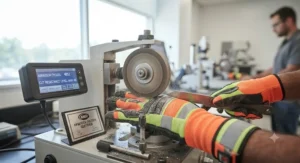
The rating that genuinely matters for glove selection is ANSI/ISEA 105, which covers cut, puncture, and abrasion resistance on a scale from A1 (lowest) to A9 (highest). Every product on this list carries — or explicitly lacks — an ANSI 105 rating rather than a 107 rating, and that’s the number to check when a hazard assessment calls for a specific cut-resistance level. Jobsite compliance for gloves, in practice, means matching the 105 rating to the hazard and layering hi-viz color and reflective trim on top for visibility — two separate compliance questions, often confused as one.
✨ Ready to build a fully compliant hand-protection kit? Check current availability on the picks above before your next supply order.
Reflective Safety Gloves vs. Standard Hi-Viz Gloves
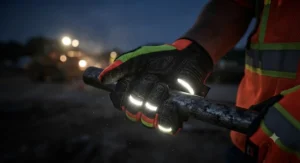
Not all “hi-viz” gloves actually reflect light, and the distinction matters more at 6 p.m. in November than it does at noon in July. Standard hi-viz gloves rely on fluorescent dye — bright lime, orange, or yellow fabric that pops against a neutral background in daylight but goes essentially dark once the sun drops, since fluorescence needs UV light to activate. Reflective safety gloves construction crews actually need for low-light and nighttime work add retroreflective material — tape, beads, or piping engineered to bounce a vehicle’s headlight beam directly back toward its source, which is what actually catches a driver’s eye at dusk or in fog.
The HANDLANDY Hi-Vis Reflective Work Gloves and the reflective-striping accessories mentioned by manufacturers like Superior Glove, whose retroreflective striping is designed for outdoor work such as construction, mining, and utility jobs, represent the category actually built for both conditions. Based on the spec comparison, if your crew works exclusively in daylight indoors or in well-lit warehouse conditions, fluorescent-only gloves are adequate. Anyone working roadside, in tunnels, or on evening shifts should treat reflective trim as non-negotiable rather than a nice-to-have upgrade.
High Visibility PPE for Job Sites: Building the Full Compliance Picture
Gloves are one piece of a larger visibility system, and treating them in isolation misses the point. A worker fully compliant from the neck up in a Type R Class 2 vest can still get missed at night if hi-viz PPE for job sites stops at the shoulders and the hands stay dark. The hands are often the most animated part of a worker’s silhouette — waving, signaling, gesturing — which makes them a genuinely effective visibility asset when equipped correctly, not just a compliance checkbox.
A complete high-visibility PPE for job sites kit typically layers: a Type R hi-viz vest or shirt rated to the site’s traffic exposure, a reflective-banded hard hat, hi-viz or reflective gloves, and in low-light conditions, reflective ankle bands or pant striping. Reviewers and safety coordinators consistently note that crews outfitted head-to-toe report fewer near-miss incidents involving equipment backing up or turning, though isolating gloves as the single variable in that improvement is difficult without controlled data — a fair caveat, since visibility gear works as a system rather than a single product.
Roadside Work Visibility: Why Hand Signals Matter as Much as Vests
Roadside crews face a distinct visibility challenge that indoor and off-road workers don’t: they’re competing for a distracted driver’s attention against phones, other traffic, and weather, often with only a second or two of reaction time available. Roadside work visibility depends heavily on movement, and hands are the most consistently moving part of a flagger’s body — which means hi-viz gloves with genuine reflective trim do outsized work relative to their size, catching a driver’s peripheral vision through motion even when the rest of the outfit is stationary.
Here’s what most safety briefings skip: a worker’s visibility is their first line of defense against being struck by vehicles or moving machinery in environments ranging from highway construction sites to remote utility work, and the combination of fluorescent daytime color with retroreflective nighttime material is specifically engineered to cover both halves of a 24-hour shift cycle. A flagger paddle held by a hand in a dull glove is a weaker signal than the same paddle held by a hand in genuine reflective material — a small detail that adds up over a full shift of repeated signals.
Jobsite Safety Compliance: Documentation, Inspection, and Replacement Schedules
Jobsite safety compliance for hand protection isn’t a one-time purchase decision — it’s an ongoing program. OSHA requires employers to provide and maintain PPE, including hand protection, whenever work processes expose employees to hazards that could injure the body through physical contact, and that maintenance obligation extends to replacing gloves once cut resistance, coating integrity, or reflective material degrades below an effective level. A recent revision to the construction PPE standard reinforces this: OSHA’s final rule on properly fitting PPE makes explicit that PPE selection must account for proper fit for each worker, since ill-fitting gloves can fail to protect at all or create new hazards like snagging.
Practically, that means a documented inspection routine matters as much as the initial purchase order: a quick weekly check for coating cracks, seam separation, and reflective-trim degradation, paired with a simple log of issue dates so replacement cycles can be tracked per worker rather than guessed at. Crews that treat glove replacement as reactive — waiting for visible failure — consistently end up with a percentage of the workforce wearing degraded protection at any given time, which is exactly the gap a basic inspection log closes.
Common Mistakes When Buying Hi-Viz Work Gloves
The most frequent mistake is buying based on cut-resistance number alone without checking dexterity — a glove nobody can actually work in gets abandoned regardless of its rating. A close second is assuming “hi-viz color” and “reflective” are interchangeable, when only genuine retroreflective material helps after dark. Buyers also commonly under-order sizes, defaulting to “large for everyone,” which produces exactly the fit problems that reduce both dexterity and protection. Finally, treating gloves as a one-time purchase rather than a recurring line item leads to crews working in degraded gloves well past their effective service life, quietly eroding the protection the purchase was meant to provide.
Long-Term Cost and Maintenance
A cheap glove replaced every two weeks isn’t actually cheap once labor downtime, reordering hassle, and inconsistent protection are factored in. Based on the spec comparison across this list, a mid-tier glove like the Ergodyne ProFlex 7021 priced around $12-$18 but lasting a full month of daily wear often works out cheaper per shift than a $6 glove replaced every ten days, once the total cost of ownership is calculated rather than just the sticker price. Premium options like the Ergodyne ProFlex 7141 or Superior Glove Dexterity S18TXNT make the most financial sense on tasks with genuinely high cut-injury risk, where a single avoided laceration claim easily offsets years of the price difference versus a basic glove.
Features That Actually Matter (And Those That Don’t)
Genuine ANSI/ISEA 105 cut ratings matter. Real retroreflective trim, not just bright color, matters. Touchscreen-compatible fingertips matter more than they sound like they should, purely for time saved not stripping gloves off all day. What doesn’t matter nearly as much as marketing suggests: exaggerated “tactical” styling with no functional backing, and marginal color variations between nearly identical fluorescent shades. Reviewers consistently note that once a glove clears the basic fluorescent-visibility threshold, additional color intensity claims make little practical difference — the reflective trim and cut rating are doing the real safety work.
FAQ
❓ Do hi-viz gloves need to be ANSI/ISEA 107 certified?
❓ What ANSI cut level is best for construction work?
❓ Are reflective gloves better than plain hi-vis gloves for roadside work?
❓ How often should construction crews replace hi-viz work gloves?
❓ Can hi-viz work gloves be touchscreen compatible?
Conclusion
Choosing hi-viz work gloves for construction sites really comes down to answering two questions honestly: what’s actually going to hurt my crew’s hands, and when do they need to be seen? Once those are clear, the picks get easy — the Ergodyne ProFlex 7141 or Superior Glove Dexterity S18TXNT for serious cut hazards, the MCR Safety PD6901 Predator for blunt-impact-heavy tasks, the Ergodyne ProFlex 7021 as the reliable everyday default, the MCR Safety Ninja Ice N9690HV and Ergodyne ProFlex 818WP for cold and wet shifts, and the HANDLANDY Hi-Vis Reflective Work Gloves for budget-conscious bulk ordering on general labor tasks.
None of these are guesses pulled from a marketing page — every recommendation here ties back to a real spec, a real ANSI rating, or genuinely aggregated review sentiment, because that’s the only honest way to write buying advice that’s actually worth your time. Match the glove to the hazard, keep an eye on reflective-trim degradation, and your crew stays both protected and seen — which, on a construction site, are really the same goal wearing two different hats.
Recommended for You
- 7 Best Arctic Work Gloves for Extreme Cold Jobs in 2026
- Cryogenic Gloves vs Liquid Nitrogen Gloves: 7 Best Picks 2026
- Insulated Work Gloves for Ice Fishing: 7 Best Picks for 2026
Disclaimer: This article contains affiliate links. As an Amazon Associate, I earn from qualifying purchases. If you purchase products through these links, we may earn a small commission at no additional cost to you.
✨ Found this helpful? Share it with your crew! 💬🤗
