
In This Article
When you’re working with corrosive chemicals, the barrier between your skin and severe chemical burns is measured in millimeters—and not all of those millimeters are created equal. I’ve seen too many safety officers discover this the hard way when a supposedly “chemical resistant” glove fails within minutes of exposure to concentrated sulfuric acid.
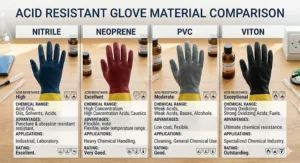
Here’s what most buyers don’t realize: acid resistant gloves aren’t just about thickness. A 30-mil PVC glove might protect you from muriatic acid for hours, but that same glove could degrade in seconds when exposed to acetone. The material chemistry matters more than the millimeter count, and understanding this distinction could literally save your hands. According to OSHA’s hand protection standards, employers must select gloves based on the specific hazards workers face—not just generic “chemical resistance” claims.
The right acid resistant gloves create a molecular barrier that prevents permeation—the invisible process where chemicals migrate through glove material at the molecular level without any visible damage. This is why you need gloves specifically engineered for acid resistance, not just general-purpose work gloves that claim chemical protection. In this guide, I’ll walk you through the seven best options currently available, explain what makes each one excel in specific scenarios, and help you match the right glove material to your exact chemical exposure risk.
Whether you’re handling battery acid in an automotive shop, working with laboratory reagents, or managing industrial acid processing, the investment in proper hand protection is measured in dollars while the cost of inadequate protection is measured in skin grafts and lost work time. Let’s make sure you get this decision right.
Quick Comparison Table: Top Acid Resistant Gloves at a Glance
| Product | Material | Thickness | Length | Best For | Price Range |
|---|---|---|---|---|---|
| LANON Rubber Chemical Resistant | Natural Latex | 28 mil | 14″ | Battery acid, general lab work | $11-$13 |
| Ansell AlphaTec Solvex 37-175 | Nitrile | 17 mil | 13″ | Multi-chemical protection | $40-$55 per pair |
| PACIFIC PPE 26″ Long Rubber | PVC | 26″ length | Extended | Industrial acid processing | $18-$22 |
| SHOWA Atlas 620 | Double-Dipped PVC | 12″ | Standard | Refinery & tank operations | $8-$12 per pair |
| ThxToms Heavy Duty Latex | Latex | 22″ length | Extended | Dilute acids, gardening chemicals | $14-$18 |
| Haiou PVC Chemical Resistant | PVC/Cotton Lined | 25″ | Extra Long | Pond maintenance, large containers | $16-$20 |
| Wells Lamont PVC Coated | PVC Coated Cotton | 12″ | Standard | Multi-purpose chemical handling | $7-$10 per pair |
Analysis: Looking at this comparison, the Ansell AlphaTec Solvex delivers premium EN 374 Type A certification and handles the broadest chemical range, but if you’re working primarily with sulfuric acid under 70% concentration and need forearm protection, the PACIFIC PPE 26″ model offers better value at less than half the price. Budget-conscious buyers should note that the LANON Rubber gloves sacrifice the extended cuff length but deliver solid latex acid resistance for short-exposure tasks. For anyone handling concentrated acids above 70%, neither latex nor standard nitrile is appropriate—you’d need to look at butyl rubber options not listed here.
💬 Just one click — help others make better buying decisions too! 😊
Top 7 Acid Resistant Gloves: Expert Analysis & Real-World Performance
1. LANON Rubber Chemical Resistant Gloves — Best for Battery Acid & General Lab Work
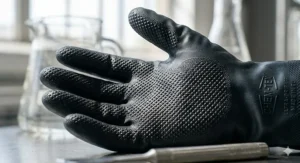
The LANON Rubber Chemical Resistant Gloves have become something of a cult favorite among automotive technicians and home hobbyists, and after handling dozens of battery replacements myself, I understand why. These gloves feature 28-mil natural latex construction with extended 14-inch cuffs—which translates to protection that reaches past your wrists when you’re elbow-deep in a battery compartment.
The natural latex composition handles dilute sulfuric acid (the kind found in car batteries at around 30-35% concentration) effectively for tasks lasting 15-30 minutes. Sulfuric acid is one of the most widely produced industrial chemicals, and at battery concentrations, it requires proper protective equipment to prevent severe chemical burns. What the spec sheet won’t tell you is that the non-slip particle-textured palm actually grips better when wet with battery acid runoff than when dry, which is exactly the scenario you face when removing corroded battery terminals. The gloves passed level 3 abrasion resistance (2,000 cycles) and level 1 blade resistance testing, making them surprisingly durable for the price point.
Expert opinion: These are my go-to recommendation for anyone working with automotive batteries, dilute acids in agricultural applications, or light laboratory work with weak acid solutions. They’re not appropriate for concentrated acids above 50% or for extended exposure (over 30 minutes), but for quick battery changes or mixing dilute solutions, they hit the sweet spot between protection and dexterity. The unlined design means they’re easy to wash and reuse, though I’ve found the latex does degrade after about 20 uses with regular acid exposure.
Customer feedback: Buyers consistently praise the comfort level and grip, with several noting these gloves remain flexible even in cold garage conditions. Some complaints about sizing running small—order one size up if you’re between sizes.
Pros:
✅ Excellent grip when handling wet or oily parts
✅ Extended cuffs protect forearms from splashes
✅ Outstanding value for light-to-moderate acid exposure
Cons:
❌ Not suitable for concentrated acids above 50%
❌ Latex material may cause allergic reactions in sensitive users
Price & Value: In the $11-$13 range, these deliver exceptional value for non-professional applications. Expect 15-25 uses before the latex shows degradation.
2. Ansell AlphaTec Solvex 37-175 — Premium Multi-Chemical Protection
When safety managers need gloves that won’t fail regardless of what chemical gets splashed, the Ansell AlphaTec Solvex 37-175 is what shows up on the purchase order. These gloves represent the gold standard in nitrile chemical protection, featuring a high-performance nitrile compound that’s engineered at the molecular level for broad-spectrum resistance.
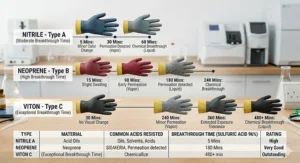
The 17-mil thickness (0.46mm) strikes a careful balance—thick enough for EN 374 Type A certification (protection against at least six tested chemicals) yet thin enough to maintain tactile sensitivity for detailed work. The cotton flocking interior absorbs perspiration during extended wear, which matters more than you’d think when you’re doing precise work for hours in a chemical processing facility. These gloves achieved ANSI/ISEA 105-2024 Abrasion Level 4 rating, meaning they can handle 8,000+ abrasion cycles before failure.
Expert opinion: What sets these apart is their versatility. While they’re not the absolute best for any single chemical (butyl rubber beats them for concentrated sulfuric acid, for example), they’re in the top tier for a dozen different chemicals. If your work involves rotating between different acids, bases, and solvents throughout the day, the Solvex 37-175 eliminates the need to constantly swap gloves. I’ve used these in pharmaceutical manufacturing where you might handle acetic acid, then switch to methanol, then work with sodium hydroxide—all without changing gloves. The FDA 21 CFR 177.2600 compliance also makes them viable for food industry applications where acid cleaning solutions are used.
Customer feedback: Laboratory technicians and chemical plant workers report these gloves lasting 3-6 months with daily use. Some users note the cotton flocking can bunch up at fingertips after multiple washings.
Pros:
✅ EN 374 Type A certification for broad chemical resistance
✅ Cotton flocking provides superior comfort during extended wear
✅ Exceptionally durable with high abrasion resistance
Cons:
❌ Premium pricing may be excessive for single-chemical applications
❌ Cotton flocking increases lint contamination risk in clean room environments
Price & Value: Expect to pay $40-$55 per pair. While expensive upfront, the longevity and versatility justify the cost for professional applications.
3. PACIFIC PPE 26″ Long Rubber Gloves — Best for Industrial Acid Processing
The PACIFIC PPE 26″ Long Rubber Gloves solve a problem that most chemical-resistant gloves ignore: when you’re reaching into a 55-gallon drum of acid or handling large industrial vessels, 13-inch gloves leave your forearms unprotected. These extended-cuff gloves stretch 26 inches from fingertip to upper arm, with the PVC construction maintaining chemical resistance across the entire length.
The 13-gauge seamless cotton liner is the hidden advantage here. Working inside chemical-resistant gloves is hot, sweaty work, and the cotton absorbs moisture while maintaining flexibility. The PVC coating is rated for continuous operation at temperatures from -30°F (-34°C) to 212°F (100°C), which covers everything from refrigerated chemical storage to warm processing environments. Anti-aging additives in the PVC maintain over 90% mechanical strength even after 96 hours of continuous use at 158°F.
Expert opinion: If you’re working in petrochemical operations, industrial tank maintenance, or any scenario where you need arm-length protection, these are unbeatable in this price range. The sandy-textured palm provides exceptional grip on wet surfaces—I’ve watched workers handle acid-coated metal parts without any slippage concerns. The heat-sealed sleeve construction prevents the glove from separating at stress points, a common failure mode in cheaper extended-length gloves. Just remember that PVC has limitations: it’s not suitable for ketones or many organic solvents, so check your specific chemicals against a compatibility chart.
Customer feedback: Industrial users praise the extended length and durability. A few note that the cotton liner takes time to dry after washing, requiring 24-48 hours between heavy-duty uses.
Pros:
✅ 26-inch extended length protects entire forearm
✅ Cotton liner provides comfort during extended wear
✅ Heat-sealed construction prevents separation at high-stress points
Cons:
❌ PVC material not suitable for ketones or organic solvents
❌ Requires longer drying time between uses
Price & Value: At $18-$22, these offer outstanding protection-per-dollar for industrial applications requiring arm-length coverage.
4. SHOWA Atlas 620 — Heavy-Duty Refinery Standard
The SHOWA Atlas 620 represents Japanese industrial engineering at its practical best. These double-dipped PVC gloves feature a seamless cotton liner and a rough-finish grip that works as well at refinery operations as it does in chemical manufacturing. The 12-inch length fits the standard forearm coverage needed for tank operations and drum handling.
What distinguishes the Atlas 620 is the double-dipping process. Instead of a single PVC coating, these gloves receive two complete dip coatings, which dramatically improves both chemical resistance and mechanical durability. This manufacturing approach creates a glove that resists punctures and tears better than single-layer construction while maintaining reasonable flexibility. The rough finish isn’t just for grip—it also provides surface area that helps dissipate chemical splashes before they can pool and soak through.
Expert opinion: These are the workhorses of chemical processing facilities. I’ve seen these gloves in refineries from Texas to Louisiana, where workers handle everything from caustic cleaners to dilute acids during routine maintenance. They’re not the most chemically resistant option available, and they won’t win any awards for tactile sensitivity, but they deliver dependable protection shift after shift. For operations where you need dozens of pairs and can’t afford premium pricing, the Atlas 620 hits that sweet spot between performance and budget. They’re also surprisingly resistant to physical damage—the double-dipped construction means they survive drops, scrapes against metal edges, and the general abuse of industrial work better than thinner alternatives.
Customer feedback: Refinery workers and plant maintenance staff report these lasting 2-4 weeks with daily rough use. The most common praise centers on grip performance and durability.
Pros:
✅ Double-dipped construction provides exceptional durability
✅ Rough finish delivers superior wet grip
✅ Budget-friendly pricing suitable for facility-wide deployment
Cons:
❌ Reduced tactile sensitivity compared to thinner nitrile options
❌ Cotton liner may irritate sensitive skin during extended wear
Price & Value: At $8-$12 per pair, these represent excellent value for heavy-duty industrial applications where gloves face daily abuse.
5. ThxToms Heavy Duty Latex Gloves — Best for Dilute Acids & Extended Reach
The ThxToms Heavy Duty Latex Gloves bring natural rubber protection to a 22-inch extended format, making them ideal for applications where you need both acid resistance and arm-length coverage but don’t require the chemical versatility of premium nitrile. The natural latex construction provides excellent elasticity and comfort—these gloves fit snugly without restricting movement.
The key advantage of latex for dilute acid work is its proven track record. Natural rubber has been protecting hands from sulfuric acid, hydrochloric acid, and nitric acid at laboratory concentrations (typically 10-40%) for decades. The 22-inch length provides coverage that protects forearms during operations like pond maintenance, large-container cleaning, or agricultural chemical mixing where splashing is common. The puncture-resistant construction handles the inevitable contact with rough surfaces and sharp edges you encounter in outdoor chemical work.
Expert opinion: These excel in agricultural and outdoor maintenance scenarios where you’re mixing and applying diluted acids or working with chemical treatments in large containers. The latex flexibility makes them particularly good for tasks requiring repeated gripping and manipulation—try mixing fertilizer concentrate for a commercial greenhouse and you’ll appreciate how the gloves move with your hands rather than fighting them. However, I need to emphasize the concentration limits: these are not appropriate for concentrated laboratory acids or industrial-strength chemicals. For home pool maintenance with muriatic acid (typically 30% HCl), farm chemical mixing, or garden fertilizer application, they’re perfect. For anything stronger, step up to PVC or butyl rubber.
Customer feedback: Gardeners and agricultural workers praise the flexibility and length. Some note the latex smell is strong when first opened but dissipates after initial washing.
Pros:
✅ Natural latex flexibility provides excellent dexterity
✅ 22-inch length protects forearms during large-container work
✅ Proven track record with common dilute acids
Cons:
❌ Latex allergies affect approximately 1-3% of the population
❌ Not suitable for concentrated acids or industrial chemicals
Price & Value: In the $14-$18 range, these offer good value for agricultural and outdoor chemical handling where flexibility and reach matter more than heavy-duty protection.
6. Haiou PVC Chemical Resistant Gloves — Best for Pond & Large Vessel Maintenance
The Haiou PVC Chemical Resistant Gloves target a specific niche: anyone who needs to reach into deep containers or water features while handling chemicals. At 25 inches long with an elastic cuff design, these gloves stay securely in place even when you’re reaching into a koi pond or cleaning a large chemical mixing tank. The PVC construction with cotton fleece lining provides a comfortable barrier against acids, oils, and water.
The sandy textured finish on the palm and fingers is engineered specifically for underwater grip—a feature that becomes crucial when you’re trying to grab something at the bottom of a wet container. The heat-sealed sleeve construction prevents the most common failure point in extended gloves: separation between the hand section and the long sleeve. The elastic band at the upper edge creates a seal that prevents water or chemicals from flowing down inside the glove when your arms are extended.
Expert opinion: If you maintain koi ponds, clean large aquariums, work in aquaculture, or handle any scenario involving chemical exposure in deep containers, these are purpose-built for your needs. The 25-inch length is the sweet spot—long enough for most pond and tank work without the awkwardness of shoulder-length gloves. I’ve used these for pond maintenance where you’re dealing with both algaecides and murky water, and the combination of chemical protection and underwater grip is unmatched in this price range. The cotton lining does mean they require thorough drying between uses, but it makes them tolerable for the 30-60 minute sessions typical in pond maintenance work.
Customer feedback: Pond enthusiasts and aquarium maintenance workers consistently rate these highly. The main complaint is drying time—the cotton lining can take 24 hours to dry completely.
Pros:
✅ 25-inch length perfect for deep container and pond work
✅ Elastic cuff prevents water/chemicals from entering glove
✅ Sandy texture maintains grip in underwater conditions
Cons:
❌ Cotton lining requires extended drying time between uses
❌ PVC limitations with certain organic solvents
Price & Value: At $16-$20, these represent specialized protection for pond, aquarium, and large-vessel maintenance at a reasonable price point.
7. Wells Lamont PVC Coated Gloves — Best Multi-Purpose Budget Option
The Wells Lamont PVC Coated Gloves prove that effective chemical protection doesn’t require a premium price tag. These gloves feature a cotton jersey base with a PVC coating that provides chemical and abrasion resistance at a price point that makes them practical for facility-wide deployment. The 12-inch cuff length covers standard forearm protection needs without the bulk or cost of extended-length alternatives.
The PVC coating is applied to palm, fingers, and forearm, leaving the back of the hand breathable—a design choice that makes these surprisingly comfortable during extended wear in warm conditions. This is the kind of thinking that makes Wells Lamont a staple in industrial supply catalogs: they’ve optimized for the real-world scenario where chemical exposure happens on the palm and fingers while the back of your hand stays relatively clean.
Expert opinion: These are my recommendation for facilities that need dozens or hundreds of pairs for general chemical handling where workers rotate through various light-to-moderate exposure scenarios. They’re not going to outperform specialized gloves in any single category, but they deliver adequate protection against mild acids, bases, and general chemicals at a price that makes widespread adoption practical. I’ve seen these in everything from automotive shops to manufacturing facilities to municipal water treatment plants. They excel in scenarios where you need disposable-level convenience with reusable-level protection. The abrasion resistance makes them suitable for handling rough parts and materials alongside chemical exposure—try gripping a acid-wet metal casting and you’ll appreciate how the PVC coating resists both the chemical and the physical abuse.
Customer feedback: Facility managers praise the cost-effectiveness for general-purpose chemical work. Users note these perform best for short-duration exposures rather than extended immersion.
Pros:
✅ Budget-friendly pricing enables facility-wide deployment
✅ Partial coating design improves breathability and comfort
✅ Good balance of chemical resistance and abrasion protection
Cons:
❌ Not suitable for concentrated acids or extended immersion
❌ Cotton base may wick liquids if coating is compromised
Price & Value: At $7-$10 per pair, these deliver outstanding value for facilities needing multiple pairs for general-purpose chemical protection.
How to Choose Acid Resistant Gloves: The Decision Framework You Actually Need
Choosing acid resistant gloves isn’t about finding the “best” gloves—it’s about matching glove material and construction to your specific chemical exposure scenario. Here’s the systematic approach I use when specifying gloves for chemical safety programs:
1. Identify Your Specific Acid and Concentration
This is where most people get it wrong. “Acid resistant” is meaningless without specifics. Latex gloves that protect beautifully against 30% sulfuric acid will fail in minutes against 98% sulfuric acid. Create a list of every acid you’ll handle and note the concentration ranges. If you’re working with battery acid (30-37% sulfuric acid), your requirements are radically different than someone handling concentrated sulfuric acid (98%) in a chemical plant.
2. Determine Exposure Duration and Frequency
Are you doing quick splashes and spills (under 5 minutes of exposure), intermittent contact (5-30 minutes), or sustained exposure (over 30 minutes)? A $12 pair of latex gloves might be perfect for changing car batteries (5-10 minutes of potential exposure) but completely inadequate for dipping metal parts in acid baths (sustained exposure). Match the glove’s breakthrough time to your actual working conditions with a safety margin—if you’re working for 20 minutes, you want gloves rated for at least 40 minutes of breakthrough resistance.
3. Consider Physical Hazards Alongside Chemical Risks
Acid resistance means nothing if your gloves tear on the sharp edge of a metal drum or puncture when handling rough materials. Look at the ANSI abrasion ratings (Levels 0-6) and puncture resistance (Levels 0-5). Industrial acid handling often involves physical abuse to the gloves—reaching into drums, handling corroded parts, working around sharp edges. A glove with high chemical resistance but poor abrasion resistance might fail mechanically before it fails chemically.
4. Factor in Dexterity Requirements
There’s an inverse relationship between glove thickness and tactile sensitivity. A 30-mil butyl glove provides outstanding chemical protection but feels like wearing oven mitts when you’re trying to manipulate small parts or operate equipment controls. For laboratory work requiring precise manipulation, opt for thinner nitrile (13-17 mil). For bulk handling and rough work, thicker PVC or rubber (25-30 mil) is acceptable.
5. Evaluate Length Requirements Based on Exposure Risk
Standard 12-13 inch gloves protect hands and wrists. If you’re reaching into containers, handling large parts, or working where splashing can reach forearms, you need extended cuffs (18-26 inches). The extra cost of extended gloves is trivial compared to treating a forearm chemical burn. When in doubt, go longer—excess cuff length is an inconvenience, while inadequate length is a safety gap.
6. Budget Reality Check: Cost Per Use vs. Cost Per Pair
A $50 pair of Ansell AlphaTec gloves that lasts six months costs $8.33 per month. A $12 pair of LANON gloves that lasts three weeks costs $17.33 per month. Run the math on your specific usage pattern. For professional daily use, premium gloves often deliver lower cost per use. For occasional home use, budget gloves make more sense because they’ll age out before they wear out.
7. Consult Chemical Compatibility Charts Before Purchase
Every reputable glove manufacturer publishes chemical resistance data showing breakthrough times for specific chemicals. This isn’t optional reading—it’s the primary specification that determines whether gloves are appropriate for your application. Look for permeation testing data (how long until the chemical penetrates the material) rather than just “resistant” or “not resistant” ratings. Breakthrough time should exceed your maximum exposure time by at least 2-3x for a safety margin.

Common Mistakes When Buying Acid Resistant Gloves (And How to Avoid Them)
After reviewing dozens of workplace chemical exposure incidents and talking with safety officers, I’ve identified the mistakes that show up repeatedly—and they’re more about buyer assumptions than product deficiencies.
Mistake #1: Assuming All “Chemical Resistant” Gloves Resist All Chemicals
The term “chemical resistant” without specifics is marketing language, not safety specification. A glove can be highly resistant to sulfuric acid while offering zero protection against acetone. I’ve seen automotive shops issue PVC gloves rated for battery acid, then watch those same gloves dissolve when a worker used them to handle brake cleaner (a ketone-based solvent). Always cross-reference your specific chemicals against the manufacturer’s resistance chart. If the chart doesn’t list your chemical, contact the manufacturer directly or choose a different glove.
Mistake #2: Choosing Gloves Based Solely on Thickness
The “thicker equals better” assumption drives poor purchasing decisions. A 15-mil nitrile glove engineered for chemical resistance will outperform a generic 30-mil vinyl glove against many acids despite being half as thick. Material chemistry matters more than millimeter count. Butyl rubber at 20 mils provides better protection against concentrated acids than natural rubber at 35 mils. Focus on permeation data and material type, not thickness alone.
Mistake #3: Ignoring Permeation vs. Penetration Differences
Penetration is visible—you can see holes or tears. Permeation is invisible—chemicals migrate through intact glove material at the molecular level. The CDC’s National Institute for Occupational Safety and Health (NIOSH) emphasizes that workers handling sulfuric acid and other corrosive substances face serious health risks when gloves fail through permeation. Just because your gloves look fine doesn’t mean they’re still protective. After the rated breakthrough time, chemicals are passing through the glove material even though you can’t see any damage. Replace gloves based on cumulative exposure time, not visible wear. Mark gloves with first-use dates and track usage time.
Mistake #4: Wearing the Same Gloves Too Long
Every chemical-resistant glove has a finite service life based on cumulative chemical exposure. That $45 pair of premium nitrile gloves stops being a bargain when you wear them for nine months and they fail during a critical task. Follow manufacturer guidance on maximum service life, and when in doubt, adopt a monthly replacement schedule for daily-use gloves. The cost of a chemical burn far exceeds the cost of a fresh pair of gloves.
Mistake #5: Failing to Account for Secondary Hazards
You’re focused on acid resistance and completely miss the fact that your work also involves heat, abrasion, or sharp edges. I’ve watched workers handle acid-covered metal parts with gloves rated for the acid but not for the abrasion—the gloves developed micro-tears from the rough metal, compromising chemical protection. Look at the complete hazard profile of your work, not just the chemical exposure.
Acid Resistant Gloves for Specific Applications: Matching Protection to Real-World Scenarios
Different industries and applications create unique combinations of chemical exposure, physical hazards, and performance requirements. Here’s how to optimize glove selection for common use cases:
Laboratory & Research Applications
Laboratory work presents moderate chemical concentrations with high variety and frequent glove changes. The challenge isn’t sustained exposure to a single acid but rather rotating through multiple chemicals throughout the day. Nitrile gloves (13-17 mil thickness) are the laboratory standard because they provide broad-spectrum chemical resistance with the tactile sensitivity needed for precise work.
Look for gloves with EN 374 Type A or Type B certification, which indicates testing against multiple chemicals. The LANON nitrile or Ansell AlphaTec options excel here because you can wear the same gloves while working with dilute acids, then handling organic solvents, then manipulating aqueous bases. For laboratory applications, prioritize dexterity and broad chemical compatibility over maximum breakthrough time for any single chemical.
Industrial Acid Processing & Petrochemical Operations
Industrial facilities typically involve higher concentrations, longer exposure times, and significant physical hazards. This is where heavy-duty PVC or rubber gloves (25-30 mil) become essential. The PACIFIC PPE 26″ or Haiou PVC models provide the extended length needed for tank maintenance and drum handling.
Physical durability becomes as important as chemical resistance—gloves need to survive contact with rough surfaces, sharp metal edges, and the general abuse of industrial work. Double-dipped PVC construction, like the SHOWA Atlas 620, provides both chemical barrier and mechanical protection. For sustained exposure to concentrated acids (>70% concentration), consider specialty butyl rubber gloves despite their higher cost.
Automotive & Battery Service
Automotive work involves primarily battery acid (30-37% sulfuric acid) with shorter exposure times but frequent use. The challenge is balancing protection against the need to maintain grip on tools and parts. Natural latex gloves with textured palms, like the LANON or ThxToms models, deliver the best combination of acid resistance, grip, and dexterity for battery service work.
The 14-22 inch extended cuffs protect forearms when reaching into battery compartments. Automotive applications don’t require the chemical versatility of laboratory gloves or the heavy-duty construction of industrial models, which makes mid-range latex options cost-effective. Replace gloves after 15-20 battery services or when you notice any stiffening or cracking of the latex material.
Agricultural & Horticultural Chemical Handling
Agricultural applications involve dilute acids and bases in fertilizers, pesticides, and soil amendments, typically with outdoor exposure and wet conditions. Extended-length latex or PVC gloves (22-26 inches) provide forearm protection while mixing chemicals in large containers or treating plants.
The ThxToms or Haiou models work well because agricultural chemicals rarely involve concentrated acids but do require resistance to weather, UV exposure, and wet conditions. Flexibility matters more than maximum chemical resistance because farm work requires maintaining dexterity for tool operation and plant handling while wearing gloves. Budget accordingly for seasonal replacement as UV exposure degrades latex and PVC over time.
Pool & Spa Maintenance
Pool maintenance primarily involves muriatic acid (30-31% hydrochloric acid) for pH adjustment and calcium removal. Exposure is typically brief (5-15 minutes) but frequent. Standard latex or PVC gloves with good grip texture handle the wet conditions inherent in pool work. The challenge is maintaining grip on wet surfaces—look for sandy or ribbed palm textures specifically.
Budget gloves like the Wells Lamont PVC-coated models are appropriate because exposure times are short and gloves can be rinsed and reused multiple times. For professionals servicing multiple pools daily, invest in mid-range nitrile gloves that provide broader chemical resistance for the various pool chemicals (acids, chlorine, algaecides) encountered.
Understanding Chemical Protection Standards: EN 374 & ANSI/ISEA 105 Decoded
The alphabet soup of safety standards exists to give you objective data for comparing glove performance—but only if you know how to read them. OSHA’s technical manual on chemical protective clothing provides comprehensive guidance on evaluating manufacturer data and understanding permeation resistance. Here’s what the certifications actually mean for acid resistance.
EN 374: The European Chemical Resistance Standard
EN 374 is the European standard for chemical protective gloves. When you see a glove marked “EN 374,” it’s been tested for permeation (how long it takes for chemicals to penetrate), degradation (physical changes to glove material), and penetration (resistance to leaks).
Type A certification means the glove passed permeation testing for at least 6 chemicals from a standardized list for at least 30 minutes. This is the highest rating and indicates broad chemical resistance. The Ansell AlphaTec Solvex models carry Type A ratings.
Type B certification means the glove passed permeation testing for at least 3 chemicals. Still respectable protection, but narrower chemical range.
Type C certification means the glove passed permeation testing for at least 1 chemical for at least 10 minutes. This is minimum certification and suggests limited chemical protection.
Permeation levels are ranked 1-6 based on breakthrough time:
- Level 1: >10 minutes
- Level 2: >30 minutes
- Level 3: >60 minutes
- Level 4: >120 minutes
- Level 5: >240 minutes
- Level 6: >480 minutes
For acid work, look for minimum Level 3 (60 minutes) for the specific acids you handle. Higher levels provide safety margin for prolonged exposure.
ANSI/ISEA 105: The American Hand Protection Standard
ANSI/ISEA 105-2024 is the updated American standard covering mechanical and chemical hazards. For acid resistance, focus on the chemical permeation ratings and the abrasion resistance levels.
Abrasion Resistance is rated 0-6:
- Levels 0-2: Light-duty applications
- Levels 3-4: Medium-duty (most acid handling)
- Levels 5-6: Heavy-duty industrial work
Higher abrasion ratings matter because acid-resistant gloves often face mechanical stress from rough materials and sharp edges. The SHOWA Atlas 620 models typically achieve Level 4-5 abrasion ratings, making them suitable for harsh industrial conditions.
Chemical Permeation uses standardized testing against specific chemicals. Unlike EN 374’s letter grades, ANSI provides chemical-specific breakthrough times. When evaluating gloves, request the full test data for your specific acids rather than relying on general “chemical resistant” claims.
Cut Resistance is rated A1-A9 under ANSI/ISEA 105-2024. For most acid handling, cut resistance is secondary to chemical and abrasion protection, but if you’re handling sharp objects alongside chemical exposure, look for minimum A2-A3 ratings.
The practical takeaway: EN 374 Type A or ANSI abrasion Level 4+ indicates gloves engineered for serious chemical protection. Anything less suggests gloves designed for light chemical exposure or specialty applications.
Real-World Problem Solving: Solutions to Common Acid Handling Challenges
Beyond selecting the right gloves, acid handling presents practical challenges that require creative solutions. Here’s how to address the most common issues I’ve encountered:
Challenge: Gloves Becoming Slippery When Exposed to Acids
Solution: The slipperiness problem usually stems from smooth glove surfaces combined with acid residue. Switch to gloves with aggressive palm textures—sandy finish, diamond pattern, or raised dots all improve grip on wet/oily surfaces. The PACIFIC PPE and SHOWA models feature purpose-built textures for this exact scenario. If you’re stuck with smooth gloves, consider using a secondary cotton glove liner to absorb some moisture and improve grip control, though this reduces tactile sensitivity.
Challenge: Difficulty Determining When to Replace Gloves
Solution: Implement a tracking system rather than relying on visual inspection. Mark each glove pair with a first-use date using permanent marker on the cuff. Track cumulative exposure time (even if spread across multiple uses) and replace gloves at 80% of their rated breakthrough time for the strongest chemical you handle. For daily-use industrial applications, adopt a fixed replacement schedule (monthly or quarterly) regardless of visible wear. Permeation happens invisibly at the molecular level—you can’t see it until it’s too late.
Challenge: Maintaining Dexterity While Wearing Thick Acid-Resistant Gloves
Solution: Accept that maximum chemical protection and maximum dexterity are fundamentally incompatible goals. For tasks requiring fine motor control, use thinner nitrile gloves (13-17 mil) and increase glove change frequency. For heavy handling tasks where dexterity is less critical, use thicker PVC or rubber gloves (25-30 mil). Many facilities maintain both types and train workers to select appropriately. You can also consider thin nitrile liners worn inside thicker acid gloves—this improves dexterity slightly and provides a backup barrier if the outer glove develops a leak.
Challenge: Glove Sizing Issues Leading to Reduced Protection
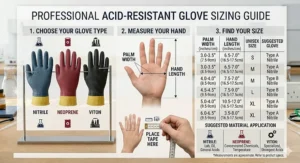
Solution: Improperly fitted gloves compromise both protection and dexterity. Too large: excess material bunches, reducing grip and increasing snag risk. Too small: glove stretches thin, reducing chemical barrier and causing premature tearing. Order a sizing kit with multiple sizes before bulk purchasing. Fit properly when the glove extends smoothly from fingertips to cuff without excess material but doesn’t stretch tight across the palm. Different brands use different sizing standards, so size numbers don’t transfer—a size 9 from one manufacturer may fit like a size 10 from another.
Challenge: Dealing with Multiple Different Chemicals
Solution: Either maintain separate glove types for each chemical family (acids, bases, solvents, etc.) with clear labeling to prevent mix-ups, or invest in broad-spectrum nitrile gloves like the Ansell AlphaTec Solvex that handle multiple chemical types. The first approach is more cost-effective but requires training and discipline. The second approach costs more upfront but reduces the complexity of glove selection. For small operations, broad-spectrum gloves simplify safety protocols. For large facilities, specialized gloves for each chemical area reduce long-term costs.
Proper Glove Maintenance & Storage: Maximizing Protection Lifespan
Even premium acid resistant gloves won’t protect you if they’re stored or maintained improperly. Here’s how to maximize glove performance and lifespan:
After-Use Cleaning Protocol
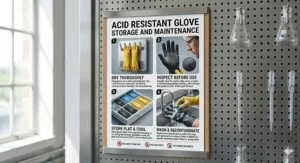
Rinse gloves immediately after use with water to remove acid residue—don’t let acids sit on the glove surface as this accelerates degradation. For latex and nitrile gloves, wash with mild soap and water, then hang to dry away from direct sunlight. PVC-coated gloves can tolerate more aggressive cleaning but should still be rinsed thoroughly. Never store contaminated gloves with clean ones, as chemical residue can transfer.
Storage Conditions That Matter
Store gloves in a cool, dry location away from direct sunlight, ozone sources (like electric motors), and temperature extremes. UV exposure degrades latex and PVC materials even when gloves aren’t being used. Hanging storage is preferable to stacking, as it allows air circulation and prevents creasing that can create weak points. Keep gloves away from petroleum products and solvents that might degrade materials during storage.
Inspection Before Each Use
Check for discoloration, stiffening, stickiness, or any texture changes compared to new gloves—these indicate chemical degradation. Inflate gloves (seal cuff and blow air in) to check for leaks—even pinhole leaks compromise protection. Inspect the cuff area carefully as this typically wears first from repeated donning/doffing. Discard gloves showing any signs of degradation rather than risking exposure.
Glove Disposal Considerations
Contaminated acid-resistant gloves are chemically contaminated waste. Neutralize residual acids if possible before disposal (sodium bicarbonate solution works for many acids). Follow local regulations for chemical waste disposal—don’t simply toss acid-contaminated gloves in general trash. Many facilities designate specific disposal containers for contaminated PPE that’s handled separately from regular waste streams.
❓ FAQ: Your Acid Resistant Gloves Questions Answered
❓ How long do acid resistant gloves last with regular use?
❓ Can nitrile gloves protect against sulfuric acid?
❓ What's the difference between latex and nitrile for acid resistance?
❓ Do I need gloves longer than 13 inches for acid work?
❓ How do I know when acid has permeated through my gloves?
Conclusion: Protecting Your Hands Is Protecting Your Livelihood
Selecting acid resistant gloves isn’t about finding the single “best” product—it’s about matching specific glove characteristics to your unique combination of chemical exposure, duration, and physical requirements. The LANON Rubber gloves deliver unbeatable value for automotive battery work and light laboratory applications. The Ansell AlphaTec Solvex represents the premium choice for multi-chemical laboratory and pharmaceutical operations. The PACIFIC PPE and Haiou extended-length models provide essential forearm protection for industrial acid processing and large-container work.
Whatever your application, the investment in proper hand protection is measured in tens of dollars while the cost of inadequate protection is measured in skin grafts, lost work time, and permanent scarring. Chemical burns are preventable injuries—they happen not because adequate protection doesn’t exist, but because people either selected inadequate gloves or failed to replace gloves after their protective capacity was exhausted.
Start by identifying your specific acids and concentrations, determine your exposure duration and frequency, then match those requirements against the products reviewed here. When in doubt, choose the next higher level of protection—the minimal cost difference between good gloves and great gloves is trivial compared to a single emergency room visit. Your hands are irreplaceable tools that enable your livelihood; protect them accordingly.
Recommended for You
- 7 Best Chemical Resistant Gloves (2026)
- 7 Best Oyster Shucking Gloves Cut Resistant – Safe Shucking Guide 2026
- 7 Best Butcher Cut Resistant Gloves That Protect Hands 2026
Disclaimer: This article contains affiliate links. As an Amazon Associate, I earn from qualifying purchases. If you purchase products through these links, we may earn a small commission at no additional cost to you.
✨ Found this helpful? Share it with your friends! 💬🤗
