
In This Article
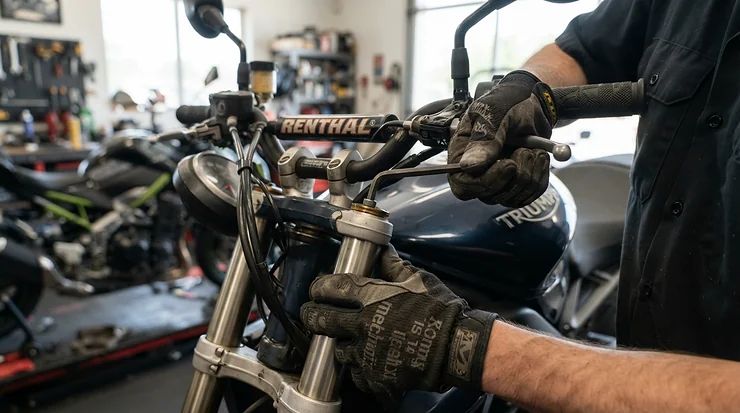
Every rider knows the moment. You’re deep under the fairing, the stubborn bolt finally lets go, and your hand skates across a sharp edge of the engine case. Skin loses. Aluminum wins. Ten minutes later you’re fishing brake-fluid grit out of a scrape and wondering why the gloves stayed on the workbench.
That’s the pitch for mechanic gloves for motorcycle maintenance, and it goes beyond comfort. A motorcycle is a tight, greasy puzzle full of fins, fasteners and pinch points. Used oil isn’t gentle either. The CDC’s toxicology fact sheet on used engine oil notes that mechanics handling it in volume have developed skin rashes, and that long-term skin exposure caused skin cancer in mice. A weekend oil change is a long way from a fleet shop, but less skin contact is still the smarter default.
Here’s the catch. Most generic work gloves are too bulky to count as proper motorcycle repair gloves. Try threading a small bolt while wearing oven mitts and you’ll see the problem. The sweet spot is a snug, flexible glove with a grippy palm and padding only where it earns its keep.
What Are Mechanic Gloves for Motorcycle Maintenance?
Mechanic gloves for motorcycle maintenance are thin, close-fitting work gloves built for wrenching rather than riding. They pair a grippy synthetic or coated palm with a stretchy back and, sometimes, knuckle or fingertip padding. They protect your hands from scrapes, grease and pinch points while keeping enough feel to start a small bolt.
Everything below comes from spec sheets, published glove tests and aggregated reviewer feedback, not from a lab of my own. I picked seven real options across budget, mid-range and premium. For each one I’ll say who it suits, where it falls short, and how it handles real garage motorcycle repair, from chain and sprocket work to cramped access behind the engine.
Quick Comparison: Mechanic Gloves for Motorcycle Maintenance at a Glance
| Glove | Style | Price Range | Best For |
|---|---|---|---|
| Mechanix Wear M-Pact | Padded, impact-guarded | $35-$45 range | Stuck fasteners, rough jobs |
| Mechanix Wear Specialty 0.5mm | Ultra-thin, high dexterity | Low-to-mid $30s | Small hardware, tight spots |
| Mechanix Wear Original | Classic all-rounder | Around $18-$25 | Everyday wrenching |
| CLC Handyman Flex Grip | Padded, touchscreen tips | Around $17-$22 | Phone-in-hand garage work |
| Ironclad General Utility | Feature-packed value glove | Roughly $13-$18 | Budget-minded riders |
| DEX FIT FN330 | Nitrile-coated, slip-on | Mid-teens per multipack | Chain cleaning, fluids |
| Muc-Off Mechanics Gloves | Lightweight polyurethane palm | Roughly $10-$25 | Light bike-specific work |
Looking at the table, the real divide isn’t price. It’s protection versus feel. The Mechanix Wear M-Pact sits at the armored end, while the Mechanix Wear Specialty 0.5mm and DEX FIT FN330 chase fingertip sensitivity. If you only want to buy one pair, the Mechanix Wear Original and Ironclad General Utility are the safe middle ground. Most serious home mechanics eventually end up with two pairs, one for brute force and one for finesse. Prices vary by seller and size, so check current pricing before you commit.
💬 Just one click — help others make better buying decisions too!😊
Top 7 Mechanic Gloves for Motorcycle Maintenance: Expert Analysis
1. Mechanix Wear M-Pact — best knuckle armor for stubborn fasteners
The Mechanix Wear M-Pact earns its place by shielding the part of your hand that meets the frame first: the knuckles.
Mechanix says the thermoplastic rubber knuckle guard meets the EN 13594 impact standard. That standard comes from the motorcycle glove world, but the claim covers the guard, not the whole glove as a certified riding glove. In practice it means a slipped wrench is more likely to give you a bruise than a split knuckle. Add the padded palm (listed as D3O or XRD depending on the version), TPR pinch-point fingertips, a hook-and-loop wrist closure and machine-washable fabric, and this is the most protection in the lineup. The trade-off, on paper, is bulk exactly where tight-space tool access gets fussy.
This glove suits riders who fight seized axle nuts, rusty exhaust studs and swingarm bolts, and who’d rather wear armor than bandages.
Reviewer feedback is positive on comfort and finger dexterity, but durability comments repeat. One outdoor-gear tester saw a hole wear through a pinky and the padding flatten after two seasons of heavy firewood work. A shopping-roundup summary also warns the fabric can show wear within a month of heavy use. They aren’t insulated or waterproof.
Pros:
- ✅ Impact-rated knuckle guard absorbs slipped-wrench hits
- ✅ Palm padding eases vibration and pressure points
- ✅ Surprisingly good finger dexterity for a padded glove
Cons:
- ❌ Fabric and padding wear faster than buyers expect
- ❌ Added bulk reduces feel in very tight spots
Expect to pay around $35-$45, so check current price. It’s the priciest pair here, but worth it if skinned knuckles are your recurring tax.
2. Mechanix Wear Specialty 0.5mm — thinnest feel for fiddly hardware
If the Mechanix Wear M-Pact is a catcher’s mitt, the Mechanix Wear Specialty 0.5mm is a second skin.
The palm uses 0.5mm AX-Suede, which Mechanix pitches as precision feel. The back is TrekDry fabric with flex inserts, and an hourglass finger design removes material overlap that bunches under your fingertips. Weighing roughly 55 grams per pair, it’s the closest thing to compact mechanic gloves in this roundup. That helps when you’re starting a small bolt blind or routing a connector behind the engine. Mechanix’s own listing shows a basic 1121X certification, which reads as a feel-first glove rather than an armor-first one.
The ideal owner does a lot of small-hardware work: carb jets, brake caliper bolts, sensor plugs, fairing fasteners. If you spend more time delicately than violently, this is your glove.
Retail reviewers keep praising the thin, light dexterity, with one noting reloading mid-task felt natural. The same thinness draws the caveat that it might not survive long-term abuse. Mechanix’s own page shows a middling customer rating near 3.9 out of 5, so sizing and durability expectations matter.
Pros:
- ✅ Exceptional dexterity for small fasteners and connectors
- ✅ Low-profile wrist strap stays out of the way
- ✅ Breathable back keeps hands cooler
Cons:
- ❌ Minimal impact or abrasion protection
- ❌ Thin palm may wear quickly under heavy use
Expect the low-to-mid $30s. It’s premium money for a specialist, so buy it as your second pair rather than your only one.
3. Mechanix Wear Original — best all-rounder for everyday wrenching
The Mechanix Wear Original is the glove you picture when someone says “mechanic gloves.”
It combines synthetic leather palms and fingers with a mesh top and a hook-and-loop closure. The mesh is the headline: it breathes, so your hands don’t boil in a closed garage in July, and the thin construction preserves good fingertip dexterity. Because nothing is padded, you won’t need a break-in period.
Who should buy it? Riders doing general garage motorcycle repair such as oil changes, chain adjustments, cable work and routine nuts-and-bolts jobs, where the real enemy is dirt and scrapes rather than impact. One roundup calls it a middle-of-the-road pick best for non-messy work, because the breathable fabric soaks up oil and coolant. That’s an honest limitation worth planning around.
Testers describe it as lightweight and comfortable. One reported fingertip holes appearing within a few weeks of daily shop use, though longevity was better outside the shop. For a weekend rider that wear pattern is far more forgiving than for a full-time technician. Little padding means slipped wrenches will hurt.
Pros:
- ✅ Lightweight, breathable mesh top for warm days
- ✅ Comfortable straight out of the package
- ✅ Good fingertip feel for general tasks
Cons:
- ❌ Absorbs oil and coolant like a sponge
- ❌ Fingertips wear out early under daily use
Around $18-$25 is the typical range, so check current price. At that level it’s a strong value for casual wrenching.
4. CLC Handyman Flex Grip — touchscreen-friendly garage workhorse
The CLC Handyman Flex Grip is for the rider who always has a repair video playing on a phone propped against the toolbox.
It uses a spandex back, elastic cuff, synthetic palm with padded palm pads and touchscreen-capable fingertips. That means you can scroll a service manual PDF without peeling the gloves off with greasy teeth. Padded palm pads dampen the buzz of a long session with an impact driver. The Drive picked it as its best overall mechanic glove for balancing protection and dexterity.
The same review flags a real weakness: mixed materials create stitching failure points, and the writer has seen seams blow out. It’s also not very breathable. So it fits hobbyists with semi-regular wrenching habits, not daily abuse.
Retail reviewers praise the flexibility and snug fit, and some report it works well with power tools thanks to vibration dampening. A recurring reservation is that touchscreen response isn’t always crisp and tactile feel is reduced compared with thinner gloves. Treat the touchscreen feature as a bonus, not a promise.
Pros:
- ✅ Padded palm dampens power-tool vibration
- ✅ Flexible, snug fit with stretch back
- ✅ Touchscreen fingertips handy for repair videos
Cons:
- ❌ Seams can fail after extended use
- ❌ Poor breathability in hot garages
Expect roughly $17-$22. For hobbyists it’s solid value, provided you accept the seam trade-off.
5. Ironclad General Utility — most features for the least money
The Ironclad General Utility looks plain until you count the features.
It uses a reinforced synthetic suede palm, breathable nylon back, TPR knuckle protection, a hybrid safety cuff, a terry-cloth thumb for wiping sweat, and touchscreen-compatible fingertips. Ironclad’s own grip ratings score it 4.5 out of 5 on oily surfaces and 3.5 on wet ones. That pattern suggests it’s built more for greasy parts than rainy driveways. Padded palms and armored knuckles at this price are unusual.
It suits riders who want protection and dexterity without paying M-Pact money. For cold or wet days, look elsewhere, since reviewers note it isn’t warm or waterproof.
Reviews skew positive. Roundup testers praise the padding and reinforcement, and one test site scored it 4.8 out of 5 for versatility. The Drive found it hard to use with a phone or to pick up tiny items, and some owners say larger sizes run slightly small. A retailer review also warns that Ironclad’s sizing doesn’t match Mechanix, so don’t assume your size transfers.
Pros:
- ✅ Padded palm and TPR knuckles at a low price
- ✅ Terry thumb wipes sweat mid-job
- ✅ Machine washable and fairly durable
Cons:
- ❌ Hard to pick up very small parts
- ❌ Sizing can feel inconsistent versus other brands
Roughly $13-$18 is the typical price range. It’s the best pure value in this list.
6. DEX FIT FN330 — nitrile-coated grip for fluids and cleaning
The DEX FIT FN330 is the glove you reach for when things get wet and slippery.
A nylon-spandex shell wears a nitrile coating, a material Wikipedia describes as resistant to oil, fuel and other chemicals. That’s exactly the profile you want for degreasers, brake fluid splashes and used oil. It’s slip-on with no closure, sized slightly small, and thin enough for blind reaching, which makes it a legitimate compact mechanic glove for cramped spots.
The ideal user does a lot of chain and sprocket work, fluid changes or parts washing, and wants grip over armor. One former aircraft mechanic who tested it valued the thin feel for reaching blind areas and handling hydraulic fluid and solvents. The same tester called it the least durable glove in the test, with little protection, and warned it won’t survive heavy work.
Another test site scored it highly for general tasks. So expect excellent grip and feel, plus a short lifespan if you abuse it. Because it’s cheap, many riders treat it as semi-disposable.
Pros:
- ✅ Oil- and water-resistant nitrile coating
- ✅ Excellent grip on slick parts
- ✅ Thin enough for tight-space tool access
Cons:
- ❌ Least durable gloves in at least one test
- ❌ Almost no impact or cut protection
It runs in the mid-teens for a multipack, so check current price. Per pair it’s the cheapest way into dedicated fluid-handling gloves.
7. Muc-Off Mechanics Gloves — bike-specific, lightweight second skin
The Muc-Off Mechanics Gloves come from a brand that lives in the bicycle and motorcycle cleaning aisle, and it shows.
The fabric blend is mostly polyamide and polyester with elastane, topped with a polyurethane palm coating. It’s latex-free, machine washable at low temperature, ultra-lightweight and offered in five sizes. There’s no padding, so it’s about dirt, scratches and grip rather than impact. That makes it useful bike maintenance hand protection for wheel swaps, cable adjustments and routine cleaning.
It suits riders who found disposable nitrile too flimsy but don’t want bulky padded gloves. One UK retail reviewer called it a much stronger and more convenient alternative to disposables.
Aggregated feedback is encouraging. A European retailer shows a 4.5 out of 5 average from 11 reviews, with comments praising grip and fit. Another buyer felt they were expensive for what they are, and one reviewer complained a decal peeled off quickly. Review counts are small, so treat the sentiment as a good sign rather than proof.
Pros:
- ✅ Latex-free polyurethane palm gives dependable grip
- ✅ Very light and easy to wash
- ✅ Good fit across five sizes
Cons:
- ❌ No knuckle or palm padding
- ❌ Some buyers find them pricey for the protection
Pricing varies widely by seller, roughly $10-$25, so check current price. A fair choice for light jobs.
Spec Comparison: How the Top 7 Stack Up
| Glove | Palm | Padding / Impact | Closure | Reviewer Sentiment |
|---|---|---|---|---|
| Mechanix Wear M-Pact | Synthetic leather | TPR knuckles, padded palm | Hook-and-loop | Comfortable; wears faster |
| Mechanix Wear Specialty 0.5mm | 0.5mm AX-Suede | Minimal | Low-profile TPR strap | Great dexterity; thin |
| Mechanix Wear Original | Synthetic leather | Minimal | Hook-and-loop | Comfortable; fingertips wear |
| CLC Handyman Flex Grip | Synthetic with pads | Padded palm | Elastic / wing strap | Flexible; seams a concern |
| Ironclad General Utility | Reinforced synthetic suede | TPR knuckles, padded palm | Hybrid cuff | Durable; sizing varies |
| DEX FIT FN330 | Nitrile-coated | None | Slip-on | Great grip; low durability |
| Muc-Off Mechanics Gloves | Polyurethane | None | Slip-on | Good fit; pricey for some |
The pattern is clear. Every glove with real padding (Mechanix Wear M-Pact, Ironclad General Utility, CLC Handyman Flex Grip) trades some finger feel for protection, while the thinnest options (Mechanix Wear Specialty 0.5mm, DEX FIT FN330, Muc-Off Mechanics Gloves) give almost nothing back when a wrench slips. For best “Best For” matching, use padded gloves for breaking fasteners loose and thin gloves for reassembly. A two-glove system costs less than one premium riding glove and covers nearly every job on a typical service schedule. Reviewer data is thin for newer models, so check a few recent reviews before ordering.
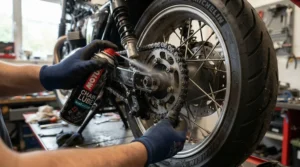
Chain and Sprocket Work: A Practical Glove Routine
Chain and sprocket work is where gloves can help or hurt, so a routine matters.
- Pick the right glove for the stage. For cleaning, grab oil-resistant nitrile gloves such as the DEX FIT FN330 because degreaser and chain gunk will soak breathable fabric. For measuring wear and fitting a new chain, switch to a snugger glove like the Mechanix Wear Specialty 0.5mm so you can feel the master link clip.
- Mind the cuff. Loose cuffs can snag. Choose a tight, closed cuff like the Ironclad General Utility‘s hybrid design, and never reach near a moving chain while the engine runs or the wheel spins.
- Wipe before you wrench. Greasy palms slip on fresh tools. Wipe gloves on a rag between steps.
- Wash on schedule. Machine washable gloves like the Muc-Off Mechanics Gloves can go in a cool cycle when they stiffen.
- Retire worn pairs. Once fingertips thin out, swap them. A hole is a free pass for degreaser.
A good routine turns chain and sprocket work from a mess into a ten-minute habit.
Real-World Scenarios: Matching Gloves to Your Garage
Specs only matter if they fit your life. Here are three profiles.
The weekday commuter. A rider who changes oil twice a year and adjusts the chain monthly doesn’t need armor. The Mechanix Wear Original or Ironclad General Utility covers it for modest money, and either survives occasional use for years.
The vintage restorer. Seized bolts, rusty exhaust studs and flaking paint mean more impact risk. The Mechanix Wear M-Pact takes the hits, and a Mechanix Wear Specialty 0.5mm handles delicate carburetor work afterward. Budget around $65-$80 for the pair. Considering the cost of a single urgent-care visit, that math is easy.
The weekend track-day rider. Paddock work is quick: tire swaps, brake pad checks, chain lube. Pack a spare DEX FIT FN330 multipack for fluids and a Muc-Off Mechanics Gloves pair for wheel work. Both are light enough to live in the toolbox.
Frequency, environment and budget decide everything, and no single glove wins all three.
✨ Ready to Protect Your Hands?
🔍 Take your garage motorcycle repair to the next level with these carefully selected gloves. Click on any highlighted item to check current pricing and availability, and give your knuckles the upgrade they deserve!
Garage Problems and Fixes
Problem: soaked, smelly gloves. Breathable fabric absorbs oil. Use a nitrile-coated option such as the DEX FIT FN330 for messy jobs, and save the Mechanix Wear Original for dry tasks.
Problem: seams splitting. Mixed-material gloves like the CLC Handyman Flex Grip can fail at stitches. Don’t over-stretch them when donning, and rotate pairs rather than wearing one until it dies.
Problem: can’t pick up tiny screws. Thick palms kill feel. Switch to the Mechanix Wear Specialty 0.5mm for reassembly, or pull one glove off for the smallest hardware.
Problem: sweaty hands in summer. Mesh backs (Mechanix Wear Original) and TrekDry fabric (Mechanix Wear Specialty 0.5mm) help. Avoid padded options on a 95-degree day.
Problem: wrong size. Mechanix and Ironclad sizing doesn’t match, so measure your hand and check each brand’s chart rather than assuming.
How to Choose Mechanic Gloves for Motorcycle Maintenance
OSHA’s hand protection standard says glove choice should rest on the task, the conditions, how long they’re worn and the hazards present. Home mechanics can borrow that logic:
- Identify your main hazard. Scrapes need abrasion resistance. Fluids need nitrile or coatings. Impact needs padding. Name the hazard first.
- Prioritize dexterity. If you can’t pick up a 6 mm bolt, the glove is wrong for fine work.
- Check fit. Fingers should have under a quarter inch of slack, because loose fingertips cause fumbling.
- Match the closure to the job. Hook-and-loop adjusts, slip-on stays slim, and tight cuffs reduce snag risk.
- Consider cleaning. Machine washable gloves last longer and cost less over time.
- Set a budget by frequency. Occasional wrenchers spend less. Frequent wrenchers justify spending more.
Compact Mechanic Gloves and Tight-Space Tool Access
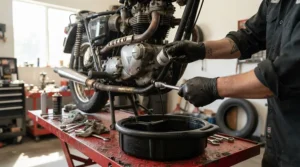
Motorcycle engines are architecture by committee, with fasteners tucked behind frames, exhausts and radiators. That’s where compact mechanic gloves earn their keep.
Bulk is the enemy of tight-space tool access. A knuckle guard that protects in the open can wedge between a frame tube and a cylinder. Thin palms like the 0.5mm AX-Suede on the Mechanix Wear Specialty 0.5mm let you thread a nut by feel. A testing aircraft mechanic liked the DEX FIT FN330 for the same reason: reaching blind areas without losing fingertip sensitivity.
The practical rule is simple. Wear thin gloves when your hand must travel somewhere narrow, and wear padded gloves when the danger is a slipped tool in the open. You can even swap mid-job. It’s a thirty-second change that can save a knuckle.
Features That Actually Matter (And Those That Don’t)
Matters: palm material and grip. A palm that grips oily steel beats any marketing slogan. Ironclad’s own oily-grip score of 4.5 out of 5 is a useful signal.
Matters: fit and closure. Loose fingertips ruin dexterity, and a loose cuff is a snag hazard.
Matters: washability. Every glove here except the thinnest coated options can go in a cool wash, which stretches lifespan.
Mostly marketing: touchscreen fingertips. They work, sometimes, but reviewers of the CLC Handyman Flex Grip note mixed feel. Don’t pay extra for them.
Mostly marketing: impact ratings. The Mechanix Wear M-Pact knuckle guard cites an impact standard, but that’s for the guard, not a riding-glove certification. Don’t wear these as riding gear.
Depends: padding. It helps with vibration and knocks, but hurts tight-space work.
Mechanic Gloves vs Alternatives: Which Protects Better?
| Option | Protection | Dexterity | Best For |
|---|---|---|---|
| Reusable mechanic gloves (e.g., Ironclad General Utility) | Moderate; abrasion and light impact | Good | General wrenching |
| Disposable nitrile | Chemical splash; almost no abrasion | Excellent | Quick oil or fluid jobs |
| Bare hands plus barrier cream | Very little | Best | Not recommended for dirty work |
| Riding gloves | Built for crashes, not grease | Poor | Riding only |
Looking at the table, reusable gloves hit the practical middle. They resist abrasion and scrapes, while disposables only block fluids and tear easily on sharp edges. Riding gloves are the wrong tool for the garage, since oil and solvents can ruin leather and armor. For fluid-heavy jobs, the DEX FIT FN330 splits the difference with nitrile protection and a reusable build.
If you can only afford one type, pick reusable mechanic gloves for motorcycle maintenance and keep a box of nitrile disposables for oil changes.
Bike Maintenance Hand Protection: Fit, Sizing and Washing
Good bike maintenance hand protection starts with fit. Measure around your palm below the knuckles and compare against each brand’s chart, because the Ironclad General Utility and the Mechanix family don’t match. If you’re between sizes, size down for thin gloves like the Muc-Off Mechanics Gloves since fabric stretches, and size up for padded gloves like the Mechanix Wear M-Pact so the padding isn’t crushed.
For washing, most gloves here are machine washable. Use a cool or low-temperature cycle as Muc-Off recommends, skip fabric softener, and air-dry flat. Heat shrinks synthetic leather and hardens coatings.
Finally, store gloves dry and away from solvents. A damp, oily glove left in a toolbox is a perfect incubator for odor and cracked coatings. Do this and each pair lasts noticeably longer.
Long-Term Cost & Maintenance
Cheap gloves aren’t always cheap. If the Mechanix Wear Original gets fingertip holes within weeks of daily shop use, as one tester reported, a pair around $20 can cost more per month than a pricier alternative. But for a rider doing a handful of jobs a year, a sub-$25 pair can last for ages.
The Mechanix Wear M-Pact may seem expensive, but a tester who accepted replacing theirs about every two years of heavy use was effectively paying a modest yearly fee for knuckle protection. A multipack like the DEX FIT FN330 works out cheaper per pair if you treat them as semi-disposable.
Don’t forget skin care. The UK Health and Safety Executive warns that frequent and prolonged contact with used engine oil may cause dermatitis and other skin disorders, and that barrier creams shouldn’t be relied on as a full barrier. Gloves plus washing up afterward is the cheapest long-term insurance.

FAQ
❓ How much do mechanic gloves for motorcycle maintenance cost?
❓ Can I machine wash my mechanic gloves?
❓ Do mechanic gloves work with a phone screen?
❓ What size mechanic gloves should I order?
❓ How often should I replace my mechanic gloves?
Conclusion
The best mechanic gloves for motorcycle maintenance aren’t the toughest or the thinnest. They’re the ones that match the job in front of you. If your hands regularly meet seized bolts and sharp edges, the Mechanix Wear M-Pact gives the strongest protection. If you’re constantly threading small hardware or working with compact mechanic gloves in tight spaces, the Mechanix Wear Specialty 0.5mm is the pick. For a balanced all-rounder, the Mechanix Wear Original and CLC Handyman Flex Grip cover everyday garage motorcycle repair, and the Ironclad General Utility is the best value of the seven.
For fluids and chain and sprocket work, the DEX FIT FN330 brings dependable oil resistance, and the Muc-Off Mechanics Gloves suit lighter, bike-specific jobs. Everyone benefits from a two-glove system: padded for breaking things loose, thin for putting them back.
Whichever you choose, wear them consistently. Your future self, free of oil rashes and scraped knuckles, will thank you.
Recommended for You
- Touchscreen Compatible Mechanic Gloves: 7 Best Picks For 2026
- Precision Mechanic Gloves: 7 Proven Picks For Fine Work (2026)
- Oil Resistant Mechanic Gloves: 7 Best Picks For 2026
Disclaimer: This article contains affiliate links. As an Amazon Associate, I earn from qualifying purchases. If you purchase products through these links, we may earn a small commission at no additional cost to you.
✨ Found this helpful? Share it with your friends! 💬🤗
