
In This Article
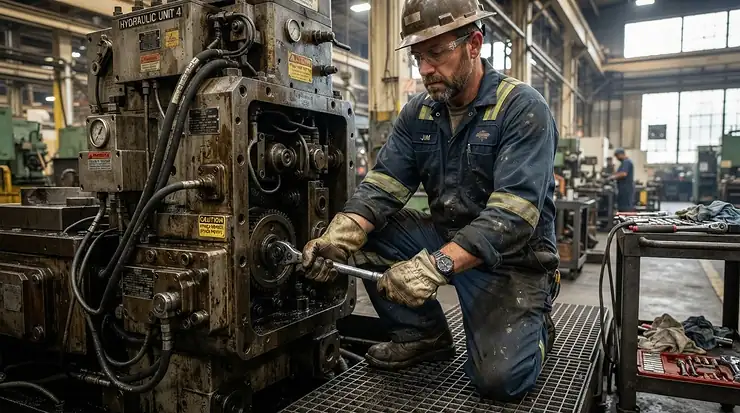
Anyone who’s ever slipped with a ratchet and cracked a knuckle on a strut tower knows the exact sound a bare hand makes against cast iron. It’s a dull, sickening thud, followed by a very specific vocabulary. TPR impact gloves for mechanics exist to turn that thud into a shrug, and honestly, that trade-off alone justifies the twenty-odd dollars most pairs cost.
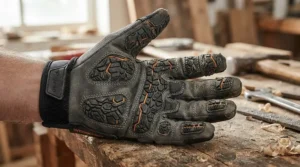
TPR — thermoplastic rubber — is the molded, semi-flexible material you see armoring the backs of modern work gloves. It’s not new science; it’s the same family of polymer used in phone cases and power-tool grips, just shaped into knuckle-sized shields and bonded onto a glove shell. What is new is how aggressively glove makers have refined it over the last few product cycles, layering it with foam padding, D3O inserts, and anti-vibration gel until a $25 mechanic glove offers protection that would have needed a $60 industrial glove a decade ago.
This guide breaks down seven real, currently sold options — from budget-friendly warehouse-style gloves to purpose-built mechanic gear from brands like Mechanix Wear and Ironclad — with honest analysis of specs, aggregated review sentiment, and where each one actually earns its keep. We’ll also cover how EN388 and ANSI ratings translate to real garage conditions, when TPR knuckle guard gloves make more sense than a plain leather driver glove, and how heavy equipment maintenance crews should be shopping differently than a weekend wrench-turner. Per OSHA’s hand protection standard (29 CFR 1910.138), employers are required to match glove selection to the actual hazards a task presents — which is exactly the mindset this guide is built around.
What Is TPR Impact Protection?
TPR impact protection is a molded thermoplastic rubber shield, usually placed over the knuckles and back of the hand, that absorbs and disperses blunt-force energy from tool slips, dropped parts, or contact with hard surfaces. Unlike leather or padded foam alone, TPR keeps its shape and flexes back after impact, which is why it’s become the default back-of-hand material across nearly every modern mechanic impact protection glove on the market…
Quick Comparison Table
| Glove | Best For | Cut Level | Price Range |
|---|---|---|---|
| Mechanix Wear M-Pact | All-around daily driver | EN388 2121XP | $25-$35 |
| Ironclad EXO Motor Impact Glove | Dedicated mechanic tasks | Not cut-rated | $20-$30 |
| HexArmor Helix Core 3012 | Sheet metal + impact combo | ANSI A5 | $25-$35 |
| Ergodyne ProFlex 9012 | Power-tool vibration control | ANSI/ISO 10819 | $50-$65 |
| MAGID T-REX TRX441 | Best value cut-and-impact hybrid | ANSI A5 | $28-$38 |
| KAYGO KG30NB | Tightest budget | ANSI A3 | under $10 |
| RIGWARL Impact Gloves | Lightweight entry-level pick | Not cut-rated | $15-$22 |
Looking at the lineup, the split between cut-rated and impact-only gloves matters more than most buyers realize. The HexArmor Helix Core 3012 and MAGID T-REX TRX441 are the only two here stacking a real ANSI cut rating on top of TPR impact protection, which is the combination heavy equipment maintenance crews handling sheet metal, wire, or cable typically need. If your work is closer to general wrenching — sockets, breaker bars, the occasional dropped bolt — the impact-only gloves like the Ironclad EXO Motor Impact Glove and RIGWARL Impact Gloves are lighter and more dexterous for the money.
💬 Just one click — help others make better buying decisions too!😊
Top 7 TPR Impact Gloves for Mechanics: Expert Analysis
1. Mechanix Wear M-Pact — best all-around TPR protection with D3O palm tech
The M-Pact opens the list because it’s arguably the glove that popularized the whole category — TPR knuckle guards on a mechanic glove used to be a niche feature, and Mechanix Wear made it standard. The welded TPR knuckle panel is rated to EN388 2121XP, and the palm pairs 2mm D3O impact-dissipating padding with a 0.8mm touchscreen-capable synthetic leather face. Based on the spec comparison with the rest of this list, the D3O layer is the real differentiator — it’s a shear-thickening material that stays soft during normal grip but firms up instantly on impact, which is a more sophisticated approach than the plain foam padding most competitors use. The reinforced index finger and thumb address the two wear points that fail first on cheaper gloves.
Who should care: shop mechanics and DIYers who want one glove that handles everything from oil changes to suspension work without swapping pairs. Reviewers consistently note the fit runs true to size and the Ripstop back-of-hand material resists snagging in tight engine bays, though a recurring theme in owner feedback is that the touchscreen palm loses sensitivity faster than the knuckle protection wears out.
Pros:
- ✅ EN388 2121XP-rated TPR knuckle protection
- ✅ D3O palm padding for genuine impact dissipation
- ✅ Touchscreen-capable, machine washable design
Cons:
- ❌ Touchscreen sensitivity fades before the glove does
- ❌ Snugger fit runs small for wide palms
Priced in the $25-$35 range depending on colorway and retailer, the M-Pact sits at a fair mid-tier value — you’re paying a small premium over generic TPR gloves for a genuinely tested impact system, and for daily shop use that premium holds up.

2. Ironclad EXO Motor Impact Glove — purpose-built for grease-monkey hands
Ironclad built the EXO Motor Impact specifically with mechanics in mind, and it shows in details competitors skip. The back-of-hand TPR panel covers the knuckles and metacarpals in full, while open-cell memory foam pads line the palm to absorb both impact and the low-grade vibration from impact wrenches and ratchets. What most buyers overlook about this model is the terry cloth sweat wipe stitched onto the back of the thumb — a small feature, but anyone who’s worked under a hood in July understands why it matters.
The TPR cuff puller is another practical touch: it lets you yank the glove into position one-handed, which sounds trivial until you’re doing it with a torque wrench in your other hand. Reviewers frequently mention the fit runs true and the hook-and-loop wrist closure holds up better than expected, though the lack of any ANSI cut rating means this glove is a poor choice if your work involves sharp sheet metal edges or wire harnesses.
Pros:
- ✅ Full back-of-hand TPR coverage across knuckles and metacarpals
- ✅ Anti-vibration memory foam palm pads
- ✅ Built-in sweat wipe and fast one-handed cuff puller
Cons:
- ❌ No ANSI/EN cut resistance rating
- ❌ Bulkier profile reduces fine-motor dexterity
At around $20-$30, this is the glove I’d point a full-time automotive tech toward if their day is 90% impact and vibration exposure and 10% handling sharp material — for that split, the value is hard to beat.
3. HexArmor Helix Core 3012 — best cut-plus-impact combo for sheet metal work
The Helix Core 3012 solves a problem the first two gloves on this list don’t even attempt: what happens when your hazard isn’t just blunt force but also a stamped-metal edge or a frayed brake line. Its 15-gauge HPPE/steel/fiberglass blend shell delivers ANSI cut level A5, while the sewn-on IR-X Impact Exoskeleton handles back-of-hand protection separately from the cut-resistant knit — a two-system approach rather than a single TPR overlay.
Here’s what to weigh: that dual-system design adds a small amount of bulk compared to a single-piece TPR panel, but it also means the cut protection doesn’t get compromised by the impact guard’s mounting points. The polyurethane palm coating is tuned for grip and abrasion resistance rather than oil-shedding, so it’s a slightly better match for dry-handling tasks like body panel work than it is for greasy engine teardown. Aggregated owner sentiment on HexArmor’s Helix line tends to praise the durability of the knit shell relative to price, with occasional notes that the touchscreen compatibility is inconsistent across finger types.
Pros:
- ✅ ANSI cut level A5 with separate impact exoskeleton
- ✅ Touchscreen-capable across working fingers
- ✅ Elastic knit wrist keeps debris out
Cons:
- ❌ Less oil-grip performance than sandy-nitrile competitors
- ❌ Two-system design adds slight bulk
In the $25-$35 range, this is the pick for anyone doing bodywork, HVAC line work, or general shop tasks where cuts are as real a hazard as impacts.
4. Ergodyne ProFlex 9012 — best for taming power-tool vibration
This is the specialist on the list, and it’s here because impact protection and vibration protection are related but not identical problems. The ProFlex 9012 carries ANSI/ASA S2.73-2014/ISO 10819:2013 certification for anti-vibration performance — a specific, third-party-tested standard most impact gloves never bother pursuing. Full-length AVC palm padding is the mechanism, backed by a built-in wrist support with an Open-Center Stay design meant to relieve repetitive-motion strain, and neoprene knuckle pads that meet EN388 2121X for basic impact resistance.
Based on the spec comparison, this glove trades some knuckle-guard bulk for palm-focused vibration damping, which makes sense given its target use case: riveting, grinding, deburring, and other tasks where the tool — not a wrench slip — is the primary hand hazard. The CDC’s National Institute for Occupational Safety and Health has documented hand-arm vibration syndrome as a genuine occupational risk among workers who use vibrating tools for extended daily periods, which is the exact population this glove is engineered for. Reviewers report the wrist support is noticeably firmer than typical work gloves, though a few note it takes a break-in period before it stops feeling restrictive.
Pros:
- ✅ Certified ANSI/ISO 10819 anti-vibration performance
- ✅ Built-in wrist support reduces repetitive-motion strain
- ✅ EN388 2121X knuckle protection included
Cons:
- ❌ Highest price point on this list
- ❌ Wrist support needs a break-in period
At roughly $50-$65, it’s the priciest glove here, but for someone running an impact wrench or grinder eight hours a day, the vibration certification alone can justify the gap.
5. MAGID T-REX TRX441 — best value cut-and-impact hybrid
The TRX441 is what I’d call the smart-shopper’s pick among cut-rated options. Its 13-gauge Hyperon (HPPE) shell earns ANSI cut level A5 — matching the pricier HexArmor above — while MAGID’s M-Force Defense System adds TPR back-of-hand protection rated ANSI/ISEA 138 Impact Level 2, extending coverage down to the fingertips and into the thumb-index web, an area a lot of competing gloves leave bare. The NitriX sandy-nitrile palm coating is specifically tuned for oily and wet grip, which lines up well with actual mechanic conditions.
What the spec sheet won’t tell you, but the design choices suggest, is that MAGID built this as a working-class alternative to premium industrial brands rather than a consumer-first mechanic glove — it comes in hi-vis colorways and is sold through industrial suppliers as much as Amazon. Reviewers note the lightweight 13-gauge knit keeps dexterity high for a cut-rated glove, and the reinforced thumb saddle holds up under repeated grip-and-release cycles common in bolt-turning work.
Pros:
- ✅ ANSI A5 cut resistance plus TPR impact level 2
- ✅ NitriX grip engineered for oily conditions
- ✅ Fingertip and web-of-thumb coverage most rivals skip
Cons:
- ❌ Hi-vis styling won’t suit everyone’s taste
- ❌ Slightly stiffer break-in than knit-only gloves
Typically priced in the $28-$38 range, this is the glove I’d recommend first to anyone asking “do I really need both cut and impact protection?” — because here, you get both without paying premium-brand prices.
6. KAYGO KG30NB — best budget pick under $10
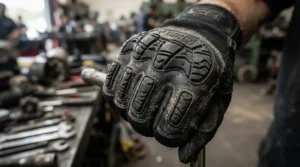
Sometimes the honest answer to “what glove should I buy” is “the cheapest one that still does the job,” and for a lot of light-duty and occasional mechanic work, the KAYGO KG30NB is that glove. It pairs an ANSI cut level A3 HPPE liner with EN388-certified TPR padding across the back of the hand, and a micro-foam nitrile palm coating built for light-oil grip. None of these specs are class-leading, but all of them are real, verified ratings rather than marketing language — which matters more than most budget gloves manage.
Here’s what to weigh honestly: at this price, you’re not getting D3O padding or vibration certification, and the TPR panel is thinner than what you’ll find on the Mechanix or Ironclad gloves above. For a shop that goes through gloves quickly — think tire shops, quick-lube bays, or a home garage where gloves grow legs and wander off — that’s an acceptable trade. Aggregated online sentiment on KAYGO’s TPR line tends to be positive relative to price point, with the most common critique being that sizing runs slightly large.
Pros:
- ✅ Real ANSI A3 cut rating at a budget price
- ✅ EN388-certified TPR back-of-hand impact protection
- ✅ Micro-foam nitrile palm handles light oil
Cons:
- ❌ TPR panel is noticeably thinner than premium gloves
- ❌ Sizing runs a half-size large
Often sold under $10 per pair (frequently in multi-pair packs that push the per-unit price even lower), this is the pragmatic pick for high-turnover environments.
7. RIGWARL Impact Gloves — lightest entry-level option for weekend wrenchers
Rounding out the list is a glove aimed squarely at the casual end of the market — gardening, general warehouse work, and yes, weekend automotive repair. The RIGWARL Impact Gloves use a 5mm TPR protector across the fingers and knuckles, which the manufacturer states dissipates roughly twice the impact energy of traditional EVA foam padding, paired with a 4mm XRD palm pad marketed as absorbing up to 90% of impact energy on contact. It’s worth noting these performance figures come from the manufacturer rather than independent third-party certification, so treat them as directional rather than lab-verified — a distinction that matters more here than with the ANSI/EN-rated gloves above.
Reviewers frequently describe the fit as comfortable for extended wear and note the tire-rubber reinforcement in high-wear zones holds up reasonably well for the price, though a common complaint is that the glove lacks the crisp, structured feel of brand-name TPR panels — the padding is softer and less precisely molded. For a DIYer changing their own oil and brakes a few times a year, that’s a fair trade for the price.
Pros:
- ✅ 5mm TPR knuckle protector at a low price point
- ✅ XRD palm padding aimed at shock absorption
- ✅ Comfortable for extended casual wear
Cons:
- ❌ Performance claims are manufacturer-stated, not independently certified
- ❌ Less structured TPR molding than name-brand gloves
At roughly $15-$22, this is a reasonable entry point for anyone who wants TPR protection without committing to a full-time mechanic’s budget.
Getting the Most from Your TPR Impact Gloves: A Practical Usage Guide
Buying the right glove is half the equation — how you break it in and maintain it determines whether it lasts six months or two years. Start with sizing: TPR knuckle guard gloves should fit snug enough that the guard sits directly over your knuckle joint, not floating an inch back on your hand, or the impact energy transfers past the padding on contact. Most brands, including Mechanix Wear and MAGID, publish hand-circumference size charts — measure before you buy rather than guessing from your regular glove size.
In the first 30 days, resist the urge to machine-dry a new pair on high heat even if the tag says machine washable; TPR can lose some flexibility under sustained heat exposure, and cold-air or line drying preserves the guard’s shape longer. A common early mistake is storing gloves crumpled in a tool drawer, which trains the TPR to hold a folded shape and reduces coverage over the knuckle’s natural range of motion — hang or lay them flat instead. For anti-vibration models like the Ergodyne ProFlex 9012, give the wrist support a week of regular wear before judging comfort; the Open-Center Stay design needs to conform to your wrist’s specific flex pattern. Rotate two pairs if your budget allows — letting foam and TPR padding fully decompress between shifts measurably extends the working life of the impact-dissipating layer.
Which Mechanic Are You? Real-World Glove Scenarios
If you’re a weekend DIYer changing your own oil, rotating tires, and doing the occasional brake job a few times a year, a lighter impact-only glove like the RIGWARL Impact Gloves or the Ironclad EXO Motor Impact Glove makes more sense than paying for cut-rating you’ll rarely need — your main risk is knuckle strikes against the undercarriage, not sharp-edge lacerations.
If you’re a full-time shop technician logging eight-hour days with impact wrenches, grinders, and cutoff tools, the calculus changes toward vibration control. The Ergodyne ProFlex 9012‘s ISO 10819 certification directly targets the cumulative strain that builds over months of daily tool use, and the wrist support addresses a fatigue point that TPR-only gloves don’t touch.
If you’re on a heavy equipment maintenance crew — handling stamped brackets, hydraulic lines, or wire harnesses on excavators and loaders — cut resistance stops being optional. The HexArmor Helix Core 3012 and MAGID T-REX TRX441 both combine ANSI A5 cut protection with TPR impact guards, which is the minimum spec profile for that kind of mixed-hazard environment.
Common Hand-Protection Problems Mechanics Face (And How to Solve Them)
Problem: knuckles taking repeated hits during suspension or undercarriage work. A dedicated TPR knuckle guard glove like the Mechanix Wear M-Pact solves this directly — the molded panel is specifically shaped to cover the knuckle’s strike zone during upward-reaching tasks.
Problem: hands going numb after extended impact-wrench use. This points toward hand-arm vibration exposure rather than a simple impact issue, and the fix is a certified anti-vibration glove such as the Ergodyne ProFlex 9012 rather than a thicker TPR panel, which does little to dampen tool vibration.
Problem: gloves losing grip the moment they contact engine oil. Sandy-nitrile or NitriX-style palm coatings, found on the MAGID T-REX TRX441 and KAYGO KG30NB, are formulated specifically for oily-surface grip, unlike smooth synthetic-leather palms that get slick fast.
Problem: cuts from sharp sheet-metal edges or wire harness clips. No amount of TPR back-of-hand protection helps here — you need an ANSI-rated cut-resistant shell like the HexArmor Helix Core 3012, since impact and cut protection are tested and rated as entirely separate hazards.
Problem: gloves wearing out at the thumb saddle within weeks. Look for a reinforced thumb crotch, a feature both the MAGID T-REX TRX441 and Mechanix Wear M-Pact build in specifically because that seam sees the most repeated flex-and-grip stress of any point on the glove.
How to Choose TPR Impact Gloves for Mechanics
- Identify your primary hazard first. Blunt impact, cuts, vibration, and oil exposure each call for different features — buying based on TPR alone without checking cut rating or grip coating can leave a real gap in protection.
- Check for an actual ANSI or EN388 rating, not just marketing language. “Impact resistant” printed on packaging means nothing without a certified level number behind it.
- Match palm coating to your typical mess. Sandy nitrile and NitriX-style coatings outperform smooth synthetic leather once oil or coolant gets involved.
- Size for knuckle alignment, not just glove length. A TPR guard that sits even slightly off-position stops protecting the joint it’s meant to cover.
- Consider vibration separately from impact. If your day involves hours of power-tool use, an ISO 10819-certified glove addresses a hazard TPR alone doesn’t.
- Factor in dexterity loss. Heavier cut-and-impact hybrids protect more but cost some fine-motor control — weigh that against how much precision work you actually do.
- Budget for glove turnover. Even premium TPR gloves degrade with heavy daily use; a mid-tier glove replaced twice a year often outperforms a premium pair worn until it fails.
Impact Rating EN388: What Those Numbers Actually Mean
EN388 is the European testing standard covering mechanical hazards for work gloves, and once you can read its rating string, glove shopping gets dramatically easier. A glove marked EN388 2121XP is scored across abrasion, cut, tear, and puncture resistance (the four digits), followed by a letter for straight-blade cut resistance and, where impact protection is tested and claimed, a “P” or “X” to indicate pass or not-tested status. According to SATRA’s technical breakdown of the standard, impact protection under EN388 is tested separately from the four core mechanical ratings, and manufacturers are only required to disclose it if they’re specifically claiming impact resistance — which is why some gloves list a full rating string while others simply state “TPR impact protection” without a formal number attached.
Here’s the practical takeaway: a higher first-digit abrasion score matters if you’re constantly dragging your hands across rough surfaces, while the cut-resistance digit matters far more for sheet-metal or wire work than for general bolt-turning. Don’t assume a higher overall rating always means a better glove for your task — the Ergodyne ProFlex 9012‘s comparatively modest EN388 2121X rating is intentional, since its engineering budget went toward ISO 10819 vibration certification instead of maximizing cut resistance it doesn’t particularly need.
✨ Don’t Miss These Exclusive Deals!
🔍 Take your hand protection to the next level with these carefully selected TPR impact gloves. Click on any highlighted product to check current pricing and availability, and find the pair that matches how you actually work.
TPR Knuckle Guard Gloves vs Traditional Leather Mechanic Gloves
| Factor | TPR Knuckle Guard Gloves | Traditional Leather Gloves |
|---|---|---|
| Impact protection | Molded, purpose-built shielding | Minimal to none |
| Cut resistance | Varies by model (often ANSI-rated) | Moderate, material-dependent |
| Dexterity | Good, slightly reduced by knuckle bulk | Generally higher, thinner material |
| Best For | Impact-heavy, high-hazard tasks | Fine detail work, low-impact handling |
The written comparison matters more than the table alone. Leather driver-style gloves still win on raw tactile feedback — there’s a reason detailers and upholstery techs often skip TPR gloves entirely — but they offer essentially no defense against a wrench slip or a dropped transmission pan corner. TPR knuckle guard gloves close that gap by design, at the cost of a small dexterity penalty that’s most noticeable during precision tasks like connector work or small-fastener handling. For the average mechanic whose day mixes both impact risk and moderate dexterity needs, the trade generally favors TPR; for someone doing almost exclusively fine assembly work, thin leather or synthetic-leather gloves remain the better fit.

Back-of-Hand Protection: Features That Actually Matter (And Those That Don’t)
Back-of-hand protection gets marketed with a lot of noise — “impact-reducing,” “shock-absorbing,” “military-grade” — and cutting through it comes down to a few concrete questions. Coverage area matters more than most buyers assume: a TPR panel that stops at the mid-knuckle leaves the finger joints exposed, which is exactly where the MAGID T-REX TRX441‘s extended fingertip coverage earns its keep over more basic designs. Segmentation is another underrated factor — a back-of-hand guard broken into multiple smaller TPR segments (rather than one rigid plate) flexes with the hand’s natural movement and reduces fatigue over a full shift, which is part of why the HexArmor Helix Core 3012‘s exoskeleton design holds up well on all-day wear.
What doesn’t matter nearly as much as marketing suggests: raw TPR thickness in isolation. A thicker panel isn’t automatically better protection if it’s poorly shaped to the knuckle’s actual strike zone, and it often just adds bulk that hurts dexterity without a proportional safety gain. Similarly, cosmetic detailing — molded logos, color-blocked panels, aggressive styling — has zero bearing on actual impact performance, even though it’s often the first thing buyers notice on a store shelf or product photo.
TPR Impact Gloves for Heavy Equipment Maintenance Crews
Heavy equipment maintenance work — excavators, loaders, agricultural machinery, over-the-road trucks — presents a different hazard mix than passenger-vehicle repair, and glove selection should follow accordingly. Components are larger and heavier, which raises the stakes of a slip: a wrench coming off a seized fastener on a piece of construction equipment carries more kinetic energy than the same slip on a sedan’s engine bay. That argues for prioritizing impact protection with genuine coverage depth, not just a token TPR strip, making gloves like the Mechanix Wear M-Pact and MAGID T-REX TRX441 stronger fits than ultra-lightweight options.
Cut exposure also rises with heavy equipment work — stamped metal brackets, hydraulic line fittings, and cable ends are common on this equipment class, which is where the HexArmor Helix Core 3012‘s ANSI A5 cut rating becomes less of a nice-to-have and more of a baseline requirement. Crews running impact wrenches and pneumatic tools for extended stretches on torque-heavy fasteners should also weigh the Ergodyne ProFlex 9012‘s vibration certification seriously, since cumulative tool exposure in this work category tends to run longer per shift than typical passenger-vehicle shops.
Common Mistakes When Buying Automotive Repair Hand Protection
The most frequent mistake is buying based on the word “impact” alone without checking whether a formal rating backs it up — plenty of budget listings use the term loosely, and the difference between a certified EN388 impact rating and an uncertified marketing claim is significant when it comes to actual protection. A second common error is ignoring palm coating entirely and focusing only on back-of-hand TPR; automotive repair hand protection needs to handle oil and coolant just as reliably as it handles impacts, and a slick palm coating undermines grip exactly when you need it most, mid-turn on a stuck bolt.
Buyers also frequently oversize for comfort, not realizing that a loose-fitting TPR knuckle guard glove shifts position during use and stops aligning with the actual knuckle joint. Finally, a subtler mistake is assuming one glove style covers every task in a shop — pairing a heavy cut-and-impact hybrid for general use and a lighter, more dexterous glove for detail or electrical work tends to serve most working mechanics better than a single do-everything pair.
Long-Term Cost & Maintenance: What TPR Gloves Really Cost Over a Year
Sticker price tells an incomplete story. A $9 pair like the KAYGO KG30NB replaced every six to eight weeks in a high-turnover shop can cost more annually than a single $30 pair like the Mechanix Wear M-Pact or MAGID T-REX TRX441 that holds up for six months to a year of regular use — the math depends heavily on wear rate, not just unit price. Washability also factors into total cost: gloves rated machine washable, which most of the models on this list are, extend usable life simply by staying cleaner and less oil-saturated, which slows material breakdown from solvent exposure over time.
Maintenance costs stay low across the board — none of these gloves require anything beyond occasional washing and letting TPR fully dry and decompress between uses — but replacement cadence varies more by task intensity than by brand. A shop tech doing eight impact-heavy hours daily should expect faster wear than a home mechanic doing occasional weekend work, regardless of which glove they choose, and budgeting two to three pairs per year per heavy user is a realistic baseline for planning purposes.
Frequently Asked Questions
❓ Do TPR impact gloves actually stop broken fingers?
❓ Can I wear TPR impact gloves for detail electrical work?
❓ How often should mechanic impact protection gloves be replaced?
❓ Are ANSI and EN388 cut ratings interchangeable?
❓ Do anti-vibration gloves also provide impact protection?
Conclusion
There’s no single best TPR impact glove for mechanics — there’s a best one for what your hands actually do all day. The Mechanix Wear M-Pact remains the safest all-around recommendation for anyone who wants one glove to handle most tasks, while the Ergodyne ProFlex 9012 earns its higher price for anyone logging serious hours behind an impact wrench. Crews facing real cut hazards alongside impact risk should lean toward the HexArmor Helix Core 3012 or the excellent value of the MAGID T-REX TRX441, and budget-conscious buyers or high-turnover shops can reasonably rely on the KAYGO KG30NB or RIGWARL Impact Gloves without feeling shortchanged.
Hand and finger injuries remain one of the most commonly reported workplace injury categories in BLS occupational injury data, which is a fair reminder that the few minutes spent picking the right glove is cheap insurance against a much worse afternoon. What matters most is matching the glove’s certified specs — not its marketing copy — to the actual hazards on your bench. Check current pricing on any of these before you buy, since availability and pricing shift regularly, and remember that even the best TPR panel is only doing its job if the glove fits snugly enough to keep that panel exactly where your knuckle needs it.
Recommended for You
- 7 Best Anti-Vibration Gloves for Construction Workers (2026)
- Moisture Wicking Work Gloves Under $20: 7 Best Picks (2026)
- Hi-Viz Work Gloves for Construction Sites: 7 Best ANSI Picks (2026)
Disclaimer: This article contains affiliate links. As an Amazon Associate, I earn from qualifying purchases. If you purchase products through these links, we may earn a small commission at no additional cost to you.
✨ Found this helpful? Share it with your friends! 💬🤗
