
In This Article
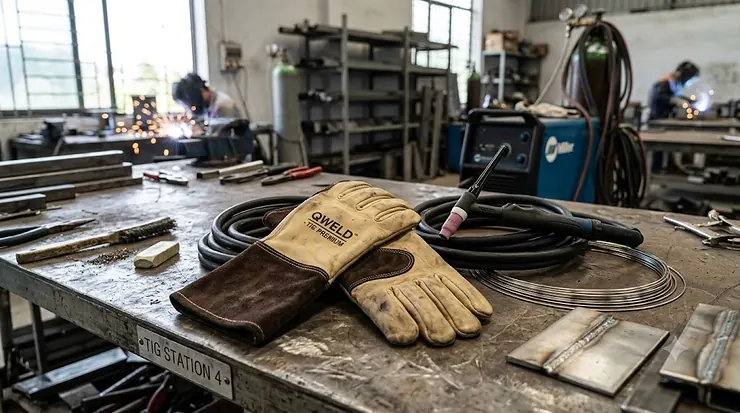
A TIG welding glove is a thin, low-profile leather glove — usually goatskin, kidskin, or pigskin — designed to protect a welder’s hand from arc heat and sparks while preserving enough tactile feedback to feed filler rod and steer a torch with precision. Unlike a bulky stick-welding gauntlet built to survive a hailstorm of spatter, a TIG glove is built around one core tension: how thin can it get before it stops protecting you?
That tension is the whole story of this guide. TIG welding doesn’t throw much spatter, but it throws a lot of radiant heat into a very confined, fussy hand movement — feeding 0.030″ filler wire, dabbing a tungsten cup a hair’s width off the puddle, holding a steady drag along a seam in stainless that’s thinner than a soda can. Ask any welder who’s burned through a cheap pair mid-bead, and you’ll hear the same complaint: the glove either felt like a oven mitt or it felt like nothing at all. Good TIG welding gloves split that difference. They’re the reason a clean, narrow bead on thin-wall tubing is even possible without your hand shaking from heat creep three minutes in.
Below, I’ve pulled together seven real, currently available options — spanning bargain-bin goatskin to Kevlar-lined specialty leather — and broken down exactly who each one is built for, where it earns its price tag, and where it falls short.
Quick Comparison Table
| Category | Glove | Leather | Price Range | Best For |
|---|---|---|---|---|
| Best Overall | Lincoln Electric K2983 | Top-grain goatskin | $25–$35 | All-around precision TIG gloves |
| Best Budget | Tillman 1338 | Pearl goatskin (unlined) | $15–$25 | Hobbyists & beginners |
| Best Dexterity | IRONCAT 6141 | Kidskin | $20–$30 | Fine detail welding dexterity |
| Best Heavy-Duty | Miller 263353 | Goatskin | $30–$40 | Switching between TIG and shop work |
A few things jump out fast here. The price spread is narrower than you’d expect — even the priciest pair on this shortlist sits under $40 — which tells you that in TIG gloves, you’re rarely paying for “more material.” You’re paying for stitching quality, leather grading, and small ergonomic tricks like a curved thumb or a reinforced drag patch. Notice, too, that the cheapest glove on the list (Tillman) and the priciest (Miller) actually serve different missions entirely: one is built to disappear on your hand, the other is built to survive a full shop day of mixed tasks.
💬 Just one click — help others make better buying decisions too!😊
✨ Don’t Miss These Exclusive Deals!
💬 Take your TIG setup to the next level — click any glove below to check current pricing and availability before you commit to a pair. 😊
Top 7 TIG Welding Gloves: Expert Analysis
Here’s the detailed lineup, with specs translated into what they actually mean once you’re holding a torch.
| Glove | Leather | Cuff | Standout Feature | Price Range |
|---|---|---|---|---|
| Tillman 1338 | Pearl goatskin, unlined | 4″ | Glide patch | $15–$25 |
| Lincoln Electric K2983 | Top-grain leather | 4″ | Keystone thumb | $25–$35 |
| Black Stallion TIGster T50 | Goatskin + FR cotton | Short | DragPatch®, seamless index | $20–$30 |
| IRONCAT 6141 | Kidskin | 4″, gold | Kevlar thread | $20–$30 |
| Caiman 1871-6 | Boarhide palm, goat grain | Scalloped, 4″ | Wool-insulated back, Kontour design | $30–$45 |
| Miller 263353 | Goatskin | Standard | TIG/multi-task crossover build | $30–$40 |
| Superior Endura 370GFKL | Goatskin + Kevlar liner | Gauntlet | Cut-resistant liner | $30–$45 |
The takeaway from this table is less about specs and more about tradeoffs: every row that adds protection (Kevlar liners, boarhide palms, longer cuffs) costs you a little raw fingertip feel, and every row optimized purely for feel (unlined goatskin, kidskin) gives up some margin against heat soak. None of these gloves “win” outright — they win for a specific welder, in a specific shop, doing a specific kind of work. That’s exactly why there are seven of them on this list instead of one.
1. Tillman 1338 Top Grain Pearl Goatskin TIG Welding Gloves
The Tillman 1338 has been the default “cheap pair that’s actually good” recommendation in welding shops for years, and the reasons are concrete. These gloves are made from top-grain pearl goatskin, which stays flexible and gives a good feel and dexterity, and the lack of any liner enhances that feel — which in practice means you can feel the resistance of your filler rod the moment it touches the puddle, not half a second later. A glide patch on the side of the hand lets you rest, drag, or slide your hand along the workpiece to follow the weld’s progress, which matters more than people expect; dragging your hand on bare leather wears a hole fast, and the Tillman 1338‘s patch is built specifically to take that abuse instead.
Owner feedback tends to praise the fit and comfort, though the cuffs use cowhide that some users find too stiff out of the box, and going unlined means you’ll feel heat soak sooner during long, hot passes than you would in a lined glove. For a hobbyist building a first home shop, or a student welder who doesn’t yet need a $40 pair, this is the sensible starting point — buy two, since at this price you can afford to keep a backup.
✅ Unlined goatskin maximizes torch feel
✅ Glide patch resists drag-wear
✅ Kevlar-stitched seams won’t melt through
❌ No liner means less heat buffer on long passes
❌ Stiff cowhide cuff needs breaking in
Price & Verdict: Around $15–$25. For the money, this is still the easiest “yes” on the list — buy it, weld in it, don’t think twice.
2. Lincoln Electric K2983 Premium TIG Welding Gloves
If the Tillman is the reliable economy car, the Lincoln Electric K2983 is the one with better ergonomics under the hood. Lincoln shaped and positioned the seams specifically to improve hand movement in different directions, including a “keystone” thumb shape that lets the thumb move in a full circle and reach every angle. That sounds like marketing copy until you’ve actually rotated a torch through an odd vertical-up pass and realized your thumb isn’t fighting the seam anymore.
A cotton liner on the upper half of the glove protects the back of the hand from excess heat, which is a smart, targeted compromise — you keep the unlined palm feel where it matters, while shielding the part of your hand that radiant heat actually cooks. The 4-inch cuff and Medium, Large, and Extra-Large sizing round it out as a genuinely well-thought-through precision TIG glove rather than a generic goatskin pair with a logo slapped on.
✅ Keystone thumb tracks natural hand rotation
✅ Targeted cotton lining shields hand-back heat
✅ Strong fit range across hand sizes
❌ Slightly thicker than ultra-thin goatskin alternatives
❌ Costs more than bargain pairs for similar leather grade
Price & Verdict: Around $25–$35. This is the one I’d point most welders toward as a daily driver — it earns the “Best Overall” badge by being good at almost everything instead of great at one thing.
3. The Black Stallion TIGster T50 built its reputation on one specific, smart idea:
st TIG glove wear happens on one side of one hand, from constantly dragging across the workpiece. The DragPatch side reinforcement offers better heat shielding and extra abrasion resistance, extending the life of the glove, while a seamless index finger improves tactile sensitivity for precise TIG work, paired with an unlined palm to maximize feel and control. Kevlar stitching throughout means the wearer doesn’t have to worry about seams melting, dripping, or igniting under sustained heat.
Real owner feedback backs up the dexterity claim — customers find these excellent for TIG work, citing good fit, durability, and comfort that lets them feel the filler rod, with positive marks for dexterity and value, though heat resistance gets mixed reviews. One detail worth flagging from actual buyers: the wrist can run a little loose at first, though most report it settling in fine after a break-in period. This is the TIGster T50‘s sweet spot — hobbyists and weekend fabricators welding thin aluminum who want their hand to basically disappear into the work.
✅ DragPatch dramatically extends drag-side life
✅ Seamless index finger boosts trigger feel
✅ Kevlar stitching resists burn-through at seams
❌ Wrist fit reportedly loose until broken in
❌ Better suited to hobby use than nonstop daily pro shifts
Price & Verdict: Around $20–$30. A genuinely clever design choice (the DragPatch) sold at a fair price — this earns its loyal following honestly.
4. IRONCAT 6141 Kidskin TIG Welding Gloves
Kidskin is the leather most welders haven’t tried and most welders should. It’s thinner and more supple than goatskin, which is exactly why the IRONCAT 6141 shows up on lists built around fine detail welding dexterity. The leather molds to your hand within a few uses rather than weeks, and that immediacy is the entire selling point — you’re not waiting out a break-in period to get good torch control precision.
What most buyers overlook here is that kidskin’s biggest advantage is also its limiting factor: it’s thin enough to feel a tungsten taper through the glove, but that same thinness means it has less margin against sustained radiant heat than a goatskin pair of equal price. The 4-inch gold cuff and straight thumb design, finished with Kevlar thread stitching, add a reasonable amount of cuff coverage to offset that tradeoff. This is the pick for thin-gauge stainless and aluminum work — exhaust systems, sheet metal, motorsport fabrication — where feel beats brute heat resistance.
✅ Kidskin offers best-in-class fine-motor feel
✅ Kevlar thread stitching holds up at seams
✅ Long gold cuff adds welcome coverage
❌ Thin leather trades some heat margin for feel
❌ Less ideal for grinding or heavy shop tasks between welds
Price & Verdict: Around $20–$30. If your work is mostly thin material welding safety and precision rather than raw heat exposure, this is the glove built for your exact problem.
5. Caiman 1871-6 White/Gold Goat Grain TIG/MIG Welding Gloves
The Caiman 1871-6 reads almost like a checklist of “comfort features nobody else bothered with.” It pairs a boarhide palm with a wool-insulated back, a scalloped cuff, an unlined goat-grain build, a reinforced thumb, Kevlar stitching, and Caiman’s Kontour ergonomic design. In practice, the boarhide palm is the standout: it’s naturally oily and resists hardening from grease and shop grime far better than plain goatskin, while the wool backing keeps your hand comfortable through a cold-shop winter shift in ways unlined gloves simply can’t.
This isn’t the glove for someone chasing maximum thinness — it’s the glove for a welder who’s done enough 10-hour days to know that comfort over time beats raw feel in the first five minutes. The Kontour shaping reduces the micro-fatigue of holding a torch position for long stretches, which matters more than spec sheets ever capture.
✅ Boarhide palm resists oil and abrasion exceptionally well
✅ Wool-insulated back adds genuine cold-weather comfort
✅ Kontour ergonomic cut reduces long-shift hand fatigue
❌ Bulkier feel than pure goatskin TIG-specific gloves
❌ Sits at the higher end of this lineup’s price range
Price & Verdict: Around $30–$45. Built for the pro who weld all day, not the hobbyist welding all weekend — and priced accordingly
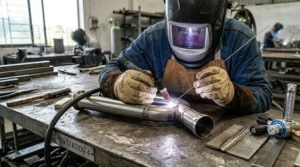
Not every welder gets to specialize. The Miller 263353 is built for the realistic shop scenario where you’re TIG welding stainless one
6. Miller Electric 263353 TIG/Multi-Task Welding Gloves
hour and grinding, fitting, or MIG tacking the next — and you don’t want to swap gloves five times a shift. Real buyer feedback backs this dual-purpose pitch directly: customers report the gloves are excellent and perfect for TIG welding, describing them as nice and soft with good dexterity, while others find them reliable and practical, noting they fit well and last a long time, with one welder calling them worth the money after extended use.
It’s worth noting a few buyers did report seam separation after light use, and at least one comparison against the Tillman 1488M and a longer-cuff Black Stallion T50 found the Miller’s added protection came at some cost to dexterity. That’s a fair tradeoff assessment: this glove sacrifices a notch of fine feel for genuine multi-task durability — exactly what a one-person shop or mobile welder needs more than a dedicated TIG specialist does.
✅ Holds up well across mixed TIG/MIG/fab tasks
✅ Strong owner-reported comfort and longevity
✅ Reliable fit across a range of hand sizes
❌ Some users report seam separation after light wear
❌ Dexterity trails dedicated thin-leather TIG gloves
Price & Verdict: Around $30–$40. The right call if your shop doesn’t let you specialize — wrong call if pure TIG feel is your only priority.
7. Superior Glove Endura 370GFKL Goatskin TIG Welder Gloves
This is the lesser-known pick on the list, and it earns its spot for one reason: cut resistance most TIG gloves never address. The Superior Endura 370GFKL features a Kevlar liner designed to give a cut-resistant, durable TIG welding glove intended for all-day work, with the thin Kevlar liner yielding superior dexterity and a great feel, suitable for either TIG or MIG work thanks to a high level of sensitivity, and usable for stick welding and general shop work too. Wide cowhide gauntlet cuffs add extra protection from burns and abrasion.
The honest caveat: there have been reports of quality control issues, including unevenly sized fingers and occasionally poor seam stitching. That’s a real consideration on a glove in this price bracket — worth a careful fit-check on arrival rather than assuming consistency pair to pair. For welders who also handle sheet metal edges, wire mesh, or anything with a bite to it between welds, the built-in cut layer is hard to find elsewhere without sacrificing torch feel.
✅ Kevlar liner adds cut resistance most TIG gloves skip
✅ Versatile across TIG, MIG, and stick processes
✅ Wide gauntlet cuff adds burn protection
❌ Reported QC inconsistencies in finger sizing/stitching
❌ Less consistently available than major-brand alternatives
Price & Verdict: Around $30–$45. Worth the gamble if cut protection solves a real problem in your shop — check the fit the day it arrives.
✨ Found a Favorite Yet?
🔍Click through on any pick above to compare current availability and lock in the pair that matches your welding style.
Practical Usage Guide: Breaking In & Maintaining TIG Gloves
A new pair of TIG welding gloves rarely feels right on day one, and that’s normal — leather needs to relax into the shape of your hand. Here’s how to shorten that adjustment window and stretch the glove’s working life:
- Flex before you weld. Spend a few minutes opening and closing your fist, rolling the thumb through its full range, before your first real pass. Stiff leather that hasn’t moved yet is exactly when seam stress and tearing happen.
- Keep them dry, not soaked. Sweat breaks down leather fibers faster than heat does. If you weld long shifts, rotate two pairs rather than running one pair into the ground daily.
- Watch the drag-side seam. Whichever hand you rest or slide along the workpiece will wear out first — this is precisely the failure point that features like the Black Stallion’s DragPatch are designed to delay.
- Avoid storing them folded in a tight roll. Creased leather cracks at the fold line over time; hang gloves loosely or lay them flat.
- Re-evaluate fit at the three-month mark. Unlined goatskin and kidskin stretch with wear. A glove that felt snug on day one may need a size swap if it’s gone loose — loose gloves lose the precision they were bought for in the first place.
The biggest first-30-day mistake is judging a glove too early. Give a new pair two or three real welding sessions before deciding it’s “wrong” — most of the stiffness complaints in reviews resolve with simple use.
Real-World Scenarios: Matching Gloves to Your Welding Life
The weekend hobbyist welding a motorcycle frame in the garage: Budget and feel matter more than industrial-grade durability here. The Tillman 1338 or the IRONCAT 6141 both make sense — neither will bankrupt a hobby budget, and both deliver the dexterity needed for thin tubing without asking you to baby an expensive glove.
The mobile welder bouncing between repair jobs: You need one glove that survives TIG, MIG, and the occasional grinder pass without a wardrobe change. The Miller 263353 is built exactly for this — slightly less feel than a dedicated TIG glove, but far less hassle than swapping pairs mid-job.
The pro running 8-to-10-hour shop shifts on stainless and aluminum: Comfort over time beats raw thinness. The Caiman 1871-6’s wool backing and Kontour shaping, or the Lincoln K2983’s targeted heat shielding, both reduce the cumulative fatigue that a thinner, unlined glove can’t manage by hour six.
How to Choose TIG Welding Gloves
- Start with your dominant material thickness. Thin sheet and tubing reward thin, supple leather (kidskin, unlined goatskin); thicker stock and mixed-process shops can absorb a slightly heavier glove.
- Match the leather to your tolerance for break-in time. Kidskin softens almost immediately; goatskin takes a few sessions; boarhide and cowhide take longest but reward you with durability later.
- Check cuff length against your typical hand position. Vertical-up or overhead welding throws sparks down your wrist — a longer cuff earns its keep here.
- Decide if you need crossover capability. If TIG is one of three processes you run weekly, prioritize gloves explicitly rated for TIG/MIG/multi-task use.
- Read for recurring complaints, not single reviews. A handful of “seam separated” or “ran small” comments across hundreds of reviews is normal; a pattern across most reviews is your real signal.
- Buy a size you can confirm, not guess. Hand circumference varies more between brands than people expect — check the manufacturer’s size chart rather than assuming your usual glove size carries over.
- Budget for two pairs if you weld daily. Rotating gloves extends life far more than babying a single pair ever will.
TIG Welding Gloves vs. MIG Welding Gloves
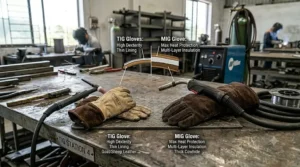
It’s tempting to treat “welding glove” as one category, but TIG and MIG gloves solve genuinely different problems. MIG and stick gloves are built around spatter and bulk heat — thicker leather, heavier linings, longer gauntlet cuffs, because MIG throws far more molten spatter than TIG does. TIG gloves go the opposite direction: thinner leather, often no lining at all, because the entire job is fine motor control of a torch and filler rod a few inches from your fingertips.
You technically can weld TIG in a MIG glove, but most welders who try it report the same thing — you lose the rod-feed feel almost entirely, and your hand fatigues faster fighting bulky leather through small, repeated movements. Going the other direction is worse: a TIG glove in a MIG bay is genuinely under-protected against spatter. If your shop runs both processes regularly, the better fix isn’t picking one glove for everything — it’s keeping a crossover pair like the Miller 263353 specifically for the in-between days.
What to Expect: Real-World Performance
Spec sheets describe leather thickness and cuff length; they don’t describe what a four-hour TIG session on stainless actually feels like in a given glove. In practice, the unlined goatskin and kidskin gloves on this list (Tillman, IRONCAT, TIGster T50) deliver noticeably better torch control precision in the first hour, but heat soak becomes the deciding factor by hour three — your palm will feel warmer sooner in an unlined glove than in the Lincoln K2983’s targeted-lining design or the Caiman’s wool-backed build.
For thin material welding safety specifically — exhaust tubing, sheet panels, anything under 16-gauge — the thinner gloves earn their reputation. You genuinely need to feel the puddle’s behavior through your fingertips to avoid blowing through thin stock, and thicker gloves take that feedback away exactly when you need it most.
Features That Actually Matter (And Those That Don’t)
Matters: leather type. Goatskin offers high tensile strength while staying thin and pliable, giving maximum freedom of movement, which is why it shows up so often in TIG applications where touch is essential, while elkskin handles high heat well and resists hardening after repeated heat exposure better than cowhide does. This single material choice affects feel more than almost any other spec.
Matters: seam construction. Kevlar-stitched seams across nearly every glove on this list aren’t a gimmick — thread that melts or burns through is a real failure mode under sustained arc exposure.
Doesn’t matter much: color or cosmetic branding. White/gold versus black versus tan changes nothing about protection or feel; pick whatever you’ll actually want to wear.
Doesn’t matter much: glove “weight” claims on the box. Two gloves both marketed as “lightweight” can feel completely different once leather grade and lining placement are accounted for — read the construction details, not the marketing adjective.
Long-Term Cost & Maintenance
Budget TIG gloves like the Tillman 1338 cost less upfront but typically need replacing every few months of regular use, especially the drag-side seam. Mid-range options with reinforcement features — the DragPatch on the TIGster T50, the boarhide palm on the Caiman — cost more initially but often extend usable life by a meaningful margin before the glove needs retiring. Run the simple math for your situation: if you weld a few times a month, a $20 pair replaced occasionally is the more economical path; if you’re welding daily, paying $10–$15 more for a reinforced pair upfront usually works out cheaper per year than burning through bargain pairs every six to eight weeks.
Safety, Regulations & Compliance Guide
Glove choice isn’t purely a comfort decision — it’s a regulatory one in any professional setting. OSHA’s welding, cutting, and brazing standard requires that employees exposed to the hazards created by welding, cutting, or brazing operations be protected by personal protective equipment in accordance with the general PPE standard, and that general standard specifically covers hand protection. Employers must select and require appropriate hand protection whenever employees’ hands are exposed to hazards including severe cuts, abrasions, punctures, and thermal burns, basing that selection on the actual task, conditions, and duration of exposure — not on whichever glove happens to be cheapest in the supply closet. You can read OSHA’s full hand-protection standard directly on osha.gov if you’re setting policy for a shop rather than just outfitting yourself.
For background on the welding process itself, including why TIG specifically demands this glove/dexterity tradeoff in the first place, Wikipedia’s entry on gas tungsten arc welding is a solid plain-language starting point — it’s an arc welding process using a non-consumable tungsten electrode, with the weld area and electrode protected from atmospheric contamination by an inert shielding gas such as argon or helium, giving the operator notably more control over the weld than competing processes, though at the cost of speed and ease of mastery. For glove fit and sizing guidance straight from a major manufacturer, MillerWelds’ glove resource page is worth a look before you order. And if you want a deeper breakdown of leather grades beyond what’s covered here, Black Stallion’s leather education resource walks through the differences in detail.
Common Mistakes When Buying TIG Welding Gloves
- Buying based on price alone. The cheapest pair often costs more over a year once you account for replacement frequency.
- Ignoring cuff length for your welding position. Overhead and vertical-up work need more wrist coverage than flat-position welding does.
- Skipping the fit chart. Glove sizing varies meaningfully between brands — a “Large” in one brand can run snug or loose compared to another.
- Assuming one glove covers every process. A dedicated TIG glove in a MIG-heavy week, or vice versa, sets you up for either lost dexterity or lost protection.
- Not inspecting on arrival. Given the QC variance reported on a few models in this category, checking stitching and finger sizing the day a glove arrives saves a return hassle later.
Benefits vs. Traditional Alternatives
| Factor | Dedicated TIG Glove | General MIG/Stick Glove | No Glove / Improvised |
|---|---|---|---|
| Torch & rod feel | Excellent | Poor to fair | N/A (unsafe) |
| Heat protection | Good (purpose-built) | Very good | None |
| Thin-material control | Excellent | Poor | N/A (unsafe) |
| Long-shift comfort | Good to excellent | Fair (bulkier) | N/A (unsafe) |
The pattern here is straightforward: a dedicated TIG glove is the only option that doesn’t force a tradeoff between protection and the fine control TIG welding actually requires. A heavier MIG/stick glove technically protects you, but at a dexterity cost that makes thin-material TIG work genuinely harder, not just less comfortable. Skipping gloves entirely isn’t a real alternative — it’s simply outside the bounds of safe practice, and isn’t a comparison worth treating as a viable option.
FAQ
❓ What's the best leather for TIG welding gloves?
❓ Can you use MIG welding gloves for TIG welding?
❓ How long do TIG welding gloves typically last?
❓ What size TIG welding glove should I buy?
❓ Are kidskin TIG gloves better than goatskin for beginners?
Conclusion
There’s no single “best” TIG welding glove on this list — there’s a best one for what you’re actually doing on a Tuesday afternoon in your shop. If you’re starting out or welding occasionally, the Tillman 1338 won’t let you down for the price. If you want one glove that handles your whole week without complaint, the Lincoln K2983 or Miller 263353 both earn their keep. And if you’re chasing the absolute thinnest, most responsive feel for delicate thin-gauge work, the IRONCAT 6141’s kidskin construction is hard to beat.
What matters most is matching the glove to the work, not the work to whatever glove happened to be cheapest at checkout. Spend the extra ten minutes reading a size chart and thinking honestly about how many hours a week you’re actually welding — it’ll save you a return shipment and a frustrating first session.
Recommended for You
- 7 Best Stick Welding Gloves in 2026: Tested for Heat & Grip
- 7 Best Heat Resistant Gloves in 2026 (BBQ to Industrial)
- 7 Best Supported Chemical Resistant Gloves in 2026
Disclaimer: This article contains affiliate links. As an Amazon Associate, I earn from qualifying purchases. If you purchase products through these links, we may earn a small commission at no additional cost to you.
✨ Found this helpful? Share it with your friends! 💬🤗
