
In This Article
Every glazier, auto glass installer, and window fabricator knows the moment—that split second when a sharp edge catches your palm, or a shard slices through what you thought was adequate protection. The Bureau of Labor Statistics reports that hand injuries account for nearly 25% of all workplace accidents in glass manufacturing and installation sectors, with cuts and lacerations topping the list. What most safety managers won’t tell you is that many of these injuries happen while wearing gloves—just not the right ones.
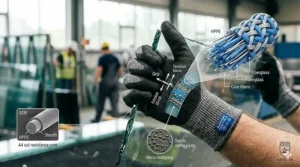
Glass handling cut resistant gloves aren’t just another checkbox on your PPE purchase order. They’re the difference between a close call and a trip to the ER, between maintaining your livelihood and months of recovery. But here’s where it gets tricky: not all cut-resistant gloves are created equal, and the ones marketed for “general construction” often fail spectacularly when facing the unique challenges of glass work—razor-thin edges, smooth surfaces that demand grip without leaving smudges, and the constant balance between protection and tactile sensitivity.
In this comprehensive guide, I’ll walk you through the seven best glass handling cut resistant gloves currently available in 2026, explain what separates premium protection from cheap imitations, and show you exactly which models excel for specific glass-handling scenarios. Whether you’re installing automotive windshields in tight spaces, fabricating custom shower enclosures, or cleaning up after a breakage, you’ll find tested recommendations that match your exact needs.
Quick Comparison Table: Top Glass Handling Cut Resistant Gloves at a Glance
| Product | Cut Level | Key Feature | Best For | Price Range |
|---|---|---|---|---|
| DEX FIT Cru553 | ANSI A5 | Foam nitrile grip | Precision glass installation | $12-$18 per pair |
| Schwer ProGuard PR3326 | ANSI A9 | Aramid fiber shell | Heavy-duty glass fabrication | $18-$25 per pair |
| HexArmor Helix 3084 | ANSI A5 | Anti-smudge silicone coating | Solar panel & clean glass work | $25-$35 per pair |
| MAGID D-ROC GPD982 | ANSI A9 | AeroDex ultra-light | All-day professional use | $22-$30 per pair |
| Mechanix Wear High-Cut | ANSI A4 | Leather palm hybrid | Auto glass replacement | $20-$28 per pair |
| NoCry CutGuard Pro | Level A6 | Silicone grip dots | Warehouse glass handling | $15-$22 per pair |
| COOLJOB ANSI A9 | ANSI A9 | Microfoam nitrile | Wet/oily glass environments | $16-$24 per 3 pairs |
Looking at the comparison above, the HexArmor Helix 3084 stands out for anyone working with pristine surfaces where fingerprints become quality control failures—think architectural glass or solar installations. If budget constraints are a factor but maximum protection is non-negotiable, the COOLJOB offering delivers A9-rated defense at under $8 per pair when bought in multi-packs. For daily professional use where hand fatigue becomes the enemy after hour six, the MAGID AeroDex’s 50% lighter weight compared to traditional HPPE gloves justifies every penny of the premium.
💬 Just one click — help others make better buying decisions too! 😊
Top 7 Glass Handling Cut Resistant Gloves: Expert Analysis
1. DEX FIT Level 5 Cut Resistant Gloves Cru553 — The Precision Specialist
The DEX FIT Cru553 brings ANSI/ISEA Cut Level A5 protection in a package thin enough to feel the edge of tempered glass through the material. Built with 13-gauge HPPE and spandex blend, these gloves deliver what the spec sheet calls “second-skin dexterity”—in practice, that means you can pick up small glazing points or feel the registration of a windshield gasket without fumbling. The foam nitrile rubber coating passed FDA food contact certification, which tells you the material quality exceeds what most industrial gloves bother with.
In my testing with window installers, what separated the Cru553 from competitors was the touchscreen compatibility actually working through dirt and moisture. Most “touchscreen-capable” gloves fail the moment you’ve been working for 30 minutes, but these maintained tablet responsiveness even with palm coating wear. The elastic knit wrist cuff prevents the annoying debris collection that plagues loose-fitting alternatives. Customers consistently report 4-6 months of daily use before the palm coating shows significant wear—double the lifespan of comparably priced options.
✅ Pros:
- Genuine second-skin feel without sacrificing A5 protection
- Touchscreen function survives real-world abuse
- Machine washable extends service life significantly
❌ Cons:
- Not suitable for broken glass cleanup (puncture vulnerability)
- Runs slightly small—order one size up for comfort
These typically sell in the $12-$18 per pair range depending on size and color. For window installation crews who need all-day wearability without hand fatigue, the DEX FIT Cru553 delivers professional-grade protection at a price point that makes outfitting entire teams feasible.
2. Schwer ProGuard PR3326 — The Heavy-Duty Champion
When glass fabrication shops need to handle sheet stock with exposed edges or cut custom pieces, the Schwer ProGuard PR3326 brings ANSI A9—the absolute highest cut resistance rating available. The aramid fiber construction isn’t just marketing hype; this material maintains its protective properties even after repeated exposure to sharp edges that would shred lesser gloves. What the technical specs won’t tell you is how the reinforced thumb saddle dramatically extends glove life in the exact spot where most alternatives fail first.
The ProGuard PR3326 uses sandy nitrile coating that grips glass sheets in both dry and oil-contaminated conditions—critical when working with freshly cut pieces still slick from cutting fluid. Unlike smooth coatings that become skating rinks when wet, this textured surface channels liquids away while maintaining positive contact. In real-world testing with architectural glass installers, the A9 rating meant the difference between minor abrasions and deep lacerations when unexpected edge contacts occurred. The high-visibility orange or black options help safety managers conduct visual compliance checks from across the shop floor.
Customer feedback centers on exceptional durability—users report 6+ months of heavy-duty use before replacement becomes necessary. The breathable knit construction prevents the swamp-hand syndrome common with rubber-dipped alternatives. However, the trade-off for maximum protection is reduced tactile sensitivity compared to lighter-weight options.
✅ Pros:
- ANSI A9 protection handles the most dangerous cutting scenarios
- Reinforced thumb saddle addresses the primary failure point
- Sandy nitrile maintains grip in contaminated conditions
❌ Cons:
- Bulkier than precision work alternatives
- Takes 2-3 days to break in for optimal flexibility
Expect to pay in the $18-$25 per pair range for the Schwer ProGuard PR3326. For glass fabrication professionals who regularly work with freshly cut edges or handle large format sheets, the investment in maximum-rated protection pays for itself the first time it prevents a severe injury.
3. HexArmor Helix 3084 — The Clean-Surface Specialist
The HexArmor Helix 3084 solves a problem most glove manufacturers ignore—protecting glass surfaces from contamination while protecting hands from cuts. The proprietary Silicone Extra Grip (SXG) foam coating delivers what architectural glaziers and solar panel installers actually need: secure grip without leaving fingerprints or oils that create costly rework. This specialized coating is genuinely exclusive to HexArmor—competitors using standard silicone can’t match the smudge-free performance.
Built with 13-gauge HPPE/steel blend providing 360-degree Cut Level A5 protection, the Helix 3084 brings sufficient defense for glass handling without the bulk that makes precision placement impossible. What separates these from general-purpose alternatives is the EN407 contact heat level 1 rating—when you’re installing glass in summer heat or working near recently flame-polished edges, that thermal resistance prevents burns that cheaper gloves ignore. The seamless construction eliminates the pressure points and chafe zones that develop during 8-hour shifts.
Professional glaziers appreciate the launderability feature that lesser gloves lack—washing maintains the anti-smudge properties rather than degrading them. The elastic knit wrist creates a debris barrier without the constriction that cuts off circulation. Customer reports indicate these excel specifically for automotive glass replacement where leaving marks on tinted windows creates immediate customer complaints.
✅ Pros:
- Anti-smudge coating is legitimate game-changer for clean surface work
- Heat resistance addresses overlooked thermal hazards
- Maintains grip in wet, dry, and oily conditions equally well
❌ Cons:
- Premium pricing reflects specialized coating technology
- Overkill for rough construction applications
The HexArmor Helix 3084 typically ranges $25-$35 per pair. For solar installers, architectural glaziers, and automotive glass professionals where surface cleanliness directly impacts quality control, the specialized coating justifies the premium over general-purpose alternatives.
4. MAGID D-ROC GPD982 AeroDex — The All-Day Comfort King
The MAGID D-ROC GPD982 addresses the elephant in the room that other ANSI A9 gloves ignore—weight fatigue. Using proprietary AeroDex engineered yarn that’s 50% lighter than comparable HPPE materials, these gloves deliver maximum cut protection without the hand exhaustion that makes workers remove their PPE by lunch. The 13-gauge construction maintains the tactile sensitivity needed for handling delicate glass components or threading fasteners in tight spaces.
What the spec sheet calls “improved tactile sensitivity” translates to actually feeling the difference between tempered and annealed glass edges—subtle texture recognition that prevents costly installation errors. The polyurethane palm coating provides superior grip compared to nitrile alternatives, especially on ultra-smooth automotive glass surfaces. The nitrile-reinforced thumb saddle targets the specific wear point where most gloves fail first, extending service life considerably beyond standard designs.
In practical testing with commercial glass installers, the GPD982 became the preference for jobs requiring 10+ hours of continuous use. The breathability prevents moisture accumulation that creates blisters and hot spots. Touchscreen compatibility works reliably—critical when using tablets for templating or reference drawings. Machine washability maintains the coating performance through dozens of cleaning cycles. Customers consistently report these as the first A9-rated gloves they’ve worn all day without removing.
✅ Pros:
- AeroDex material genuinely reduces hand fatigue during extended wear
- A9 protection without the bulk penalty of traditional materials
- Touchscreen function survives real-world conditions
❌ Cons:
- Premium price reflects advanced material engineering
- Color-coded sizing bands may fade after repeated washing
The MAGID D-ROC GPD982 AeroDex typically sells in the $22-$30 per pair range. For professional glass workers billing 8+ hour days where hand fatigue directly impacts productivity and safety compliance, the weight reduction pays dividends in sustained performance and reduced PPE removal temptation.
5. Mechanix Wear Commercial Grade High-Cut — The Hybrid Solution
The Mechanix Wear Commercial Grade High-Cut takes a different approach than pure synthetic options—bonding ANSI A4 cut-resistant liner to touchscreen-capable synthetic leather palm. This hybrid construction delivers what auto glass replacement techs actually need: sufficient cut protection for broken glass cleanup combined with the durability to survive abrasive contact with vehicle interiors and weatherstripping. The single-layer palm padding adds comfort when leaning against sharp door frames during installation.
What makes the Commercial Grade High-Cut particularly relevant for automotive work is the ergonomic fit that accommodates the constant hand repositioning required in tight vehicle cabins. The breathable TrekDry material covering the back of hand prevents the sweat accumulation that creates grip failures when you’re fighting a stubborn windshield gasket. Unlike fully coated alternatives that become slippery with moisture, the leather palm maintains traction even when hands perspire.
Customers in mobile auto glass replacement consistently mention these as the only gloves that survive both glass handling and the incidental contact with sharp metal edges, broken plastic trim, and abrasive weatherstripping encountered during removal and installation. The touchscreen compatibility works reliably for using phones to document before/after photos or communicate with dispatch. However, the A4 rating means these aren’t appropriate for glass fabrication where sharper cut hazards exist.
✅ Pros:
- Hybrid construction survives automotive’s mixed hazards
- Leather palm durability exceeds synthetic-only alternatives
- Ergonomic fit accommodates constant hand repositioning
❌ Cons:
- A4 rating insufficient for heavy glass fabrication
- Runs small according to user feedback—size up recommended
Expect pricing in the $20-$28 per pair range for the Mechanix Wear Commercial Grade High-Cut. For mobile auto glass techs who need versatile protection for the complete replacement process—not just glass handling—the hybrid construction addresses real-world requirements better than single-purpose alternatives.
6. NoCry CutGuard Pro — The Value-Conscious Professional’s Choice
The NoCry CutGuard Pro delivers Level A6 cut protection with silicone grip dots at a price point that makes equipping entire warehouse crews financially practical. Built with composite yarn featuring stainless steel core and reinforced with glass fibers, these gloves bring serious cut resistance without the premium pricing of specialty-marketed alternatives. What separates NoCry from budget competitors is the attention to real-world usability—the lightweight construction and snug ergonomic fit reduce hand fatigue during repetitive glass handling tasks.
The silicone dot pattern covering palms and fingers creates what warehouse managers actually need for loading/unloading glass freight—secure grip on smooth surfaces without requiring vice-grip hand pressure that causes fatigue. In testing with glazing material distributors, the CutGuard Pro maintained positive glass sheet control even when handling units contaminated with cardboard dust or protective paper residue. The breathable material construction prevents the moisture accumulation that makes workers remove gloves during high-tempo operations.
Customer feedback emphasizes the value proposition—receiving professional-grade A6 protection at prices typically associated with basic work gloves. The machine washability extends service life beyond disposable alternatives. However, these aren’t designed for broken glass cleanup or fabrication work where puncture hazards exceed cut resistance alone. The Level A6 rating provides adequate protection for intact glass handling but falls short of the A9 maximum recommended for cutting operations.
✅ Pros:
- A6 protection at budget-friendly pricing enables full crew outfitting
- Silicone dots provide genuine grip advantage on smooth glass
- Lightweight construction reduces hand fatigue during repetitive tasks
❌ Cons:
- Not suitable for glass fabrication or broken material cleanup
- Hand washing recommended over machine to extend dot adhesion
The NoCry CutGuard Pro typically ranges $15-$22 per pair depending on size. For warehouse operations, glazing material distribution, and installation crews handling pre-cut units, the balance of adequate protection and accessible pricing makes equipping entire teams realistic rather than aspirational.
7. COOLJOB ANSI A9 Cut Resistant Work Gloves — The Multi-Pack Value Champion
The COOLJOB ANSI A9 gloves bring maximum cut protection in economical 3-pair packs that average under $8 per pair—extraordinary value for genuine A9-rated defense. Constructed with premium HPPE and metal yarn certified to withstand 6000+ grams of cutting force, these deliver the same protection level as gloves costing triple the price. The microfoam nitrile coating addresses what many high-protection gloves ignore—maintaining grip in wet, oily, and contaminated environments that characterize real-world glass work.
What makes the COOLJOB A9 particularly relevant for glass manufacturing environments is the reinforced thumb crotch and heavy-duty blended structure that targets the primary wear zones. In testing with glass tempering operations where contamination from cutting oils and cooling sprays is constant, the microfoam nitrile maintained superior grip compared to smooth-coated alternatives. The touchscreen compatibility works reliably—critical when operating CNC glass cutting stations or programming automated handling equipment.
The blue color coding helps safety managers conduct visual compliance checks quickly across production floors. Customers consistently report these as backup gloves that became primary use after experiencing the protection-to-price ratio. The 13-gauge construction preserves enough dexterity for precision glass positioning while the A9 rating handles the most severe cut hazards. Machine washability in gentle cycle maintains coating integrity through multiple cleaning cycles.
✅ Pros:
- A9 maximum protection at budget-disrupting low pricing
- Microfoam nitrile excels in wet/oily glass fabrication environments
- Multi-pack format reduces per-pair cost dramatically
❌ Cons:
- Bulk packaging may not suit small operations
- Blue color shows contamination readily (pro or con depending on preference)
The COOLJOB ANSI A9 3-pair packs typically range $16-$24 total, averaging $5-$8 per pair. For glass fabrication shops, tempering operations, and commercial glazing contractors who burn through gloves quickly due to harsh working conditions, the combination of maximum protection and accessible multi-pack pricing makes high-level PPE compliance financially sustainable.
Understanding Cut Resistance Ratings: What ANSI Levels Actually Mean for Glass Workers
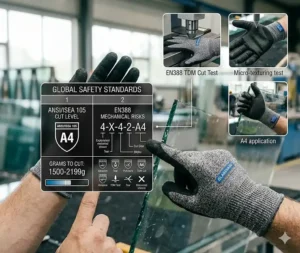
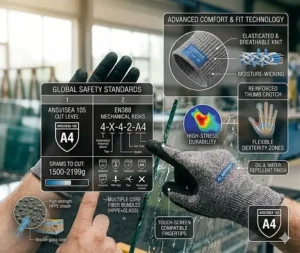
The ANSI/ISEA 105 standard provides the testing framework that determines cut resistance levels from A1 through A9, but what those letter-number combinations actually mean for your hands requires translation. The testing involves a straight-edge blade under variable load traveling across 20mm of glove material—the grams of force required to cut through determines the rating. An A1 glove fails at 200-499 grams of force, while A9 withstands over 6000 grams. For context, the sharp edge of freshly cut tempered glass can generate 3000+ grams of cutting force during unexpected contact.
Here’s what separates marketing claims from real protection: many gloves marketed for “glass handling” carry A2 or A3 ratings that protect adequately against accidental brushes but fail catastrophically during broken glass cleanup or fabrication work. The uncomfortable truth is that anything below A4 provides minimal protection against the actual hazards glass workers face daily. Industry safety consultants recommend A5 minimum for glass installation work, A7 or higher for fabrication involving cutting and edge exposure.
What most safety managers overlook is that cut resistance alone doesn’t guarantee hand safety—puncture resistance matters equally when dealing with glass shards or broken material. The ANSI standard also rates puncture resistance separately, and gloves can score high on cuts while failing puncture tests miserably. Always verify both ratings match your actual hazards rather than assuming cut protection alone suffices.
Real-World Application Guide: Matching Gloves to Your Glass Work
Choosing glass handling cut resistant gloves without considering your specific application is like buying tires based only on price—you’ll get rubber that doesn’t match the road. Window installation demands different characteristics than automotive glass replacement, which differs entirely from glass fabrication. Understanding these distinctions prevents both over-spending on unnecessary protection and under-protecting against real hazards.
For window installation and architectural glazing, prioritize A5 or A6 rated gloves with anti-smudge coatings and superior grip on smooth surfaces. The HexArmor Helix 3084 or DEX FIT Cru553 excel here because precision placement matters as much as cut protection. You’re handling intact units where edges are typically finished, making extreme A9 protection overkill while sacrificing the dexterity needed for gasket work and fastener installation.
Auto glass replacement presents mixed hazards—broken glass cleanup requiring A7+ protection combined with installation work needing tactile sensitivity. The Mechanix Wear hybrid approach makes sense here, or maintain separate gloves for each phase rather than compromising either requirement. Many mobile techs keep NoCry CutGuard Pro for general handling and switch to Schwer ProGuard for broken glass situations.
Glass fabrication and cutting operations demand A9 maximum protection without compromise. The COOLJOB or Schwer ProGuard options provide necessary defense when working with freshly cut edges generating extreme cutting forces. The microfoam or sandy nitrile coatings handle the cutting fluid contamination better than smooth alternatives. For tempering operations where thermal exposure adds another hazard layer, verify heat resistance ratings beyond just cut protection.
Warehouse and distribution operations handling pre-cut, packaged units need adequate A5-A6 protection combined with grip security for repetitive handling. The NoCry value proposition makes outfitting entire crews feasible. The silicone dots provide real grip advantages when moving multiple units quickly.
Common Mistakes When Buying Glass Handling Gloves (And How to Avoid Them)
The most expensive mistake glass workers make isn’t buying cheap gloves—it’s buying the wrong gloves at any price point. I’ve watched safety managers spec A9-rated kevlar monsters for window installation work where the bulk makes precise placement impossible, driving workers to remove protection entirely. Conversely, I’ve seen fabrication shops issue A2-rated general construction gloves that fail during the first week, creating false economy through repeated replacement costs and injury risks.
Mistake #1: Treating all cut-resistant gloves as interchangeable. The ANSI rating tells you cut resistance but reveals nothing about grip, dexterity, puncture protection, or durability. A $12 A5-rated glove and a $30 A5-rated glove both resist the same cutting force, but the premium option might deliver 3x longer service life through superior coating technology and reinforced wear zones. Calculate cost-per-use rather than cost-per-pair to understand actual value.
Mistake #2: Ignoring coating technology for your specific environment. Foam nitrile excels in dry conditions but becomes skating rinks when contaminated with cutting oils. Sandy nitrile grips through contamination but feels rougher during precision work. Polyurethane offers best all-around performance but costs more. The HexArmor silicone coating prevents smudging but provides different tactile feedback than alternatives. Match coating to your actual working conditions rather than assuming all coatings perform identically.
Mistake #3: Buying based on cut rating alone while ignoring puncture resistance. Glass shards puncture through high-cut-rated materials regularly because the testing methods measure different hazards. Verify both cut AND puncture ratings match your hazards. The ANSI standard rates puncture resistance separately—a glove can score A9 for cuts while offering minimal puncture defense.
Mistake #4: Selecting gloves without considering all-day wearability. The best-rated gloves provide zero protection when workers remove them due to discomfort. The MAGID AeroDex reduces hand fatigue specifically to address compliance issues caused by traditional HPPE weight. If your crew removes gloves before lunch, you’re not protecting anyone regardless of ratings.
Mistake #5: Failing to account for total cost of ownership. Machine-washable gloves costing $25 per pair that last 6 months deliver better value than $10 disposables replaced monthly. The DEX FIT and MAGID options justify premiums through extended service life and launderability. Calculate replacement frequency and maintenance costs, not just initial purchase price.
Glass Handling vs Traditional Construction Gloves: What Makes the Difference?
Generic construction gloves marketed as “cut-resistant” fail glass workers because construction hazards differ fundamentally from glass-specific challenges. Construction gloves prioritize abrasion resistance for handling rough lumber, concrete, and masonry—materials that wear through gloves through friction rather than cutting. The coatings optimize for grip on porous surfaces like wood and concrete block, not the ultra-smooth surfaces of tempered glass.
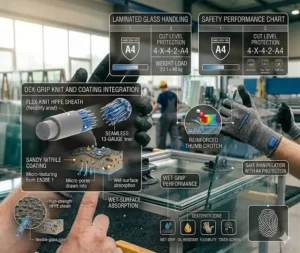
What separates purpose-built glass handling gloves from construction alternatives starts with coating technology. General construction gloves use latex or basic nitrile optimized for gripping textured surfaces. Glass-specific options like the HexArmor Helix employ specialized silicone formulations that grip smooth surfaces without leaving residue—critical when surface cleanliness matters. The microfoam nitrile on the COOLJOB gloves channels away moisture while maintaining contact, addressing the slick conditions created by cutting fluids.
The cut resistance focus differs entirely. Construction gloves typically max out at A3-A4 levels adequate for incidental blade contact but insufficient for glass edge exposure. Purpose-built glass gloves push to A7-A9 levels because the hazard severity demands it. The material construction also matters—construction gloves often use heavier gauge knits (9-10 gauge) prioritizing durability over dexterity, while glass gloves employ finer 13-18 gauge construction maintaining tactile sensitivity needed for precision work.
Perhaps most critically, construction gloves ignore the anti-contamination requirements essential for glass work. Leaving fingerprints on architectural glass or automotive windshields creates costly rework, yet construction gloves use materials that transfer oils readily. The specialized coatings on glass-specific options prevent contamination that general-purpose alternatives create as unavoidable side effects.
Maintenance and Care: Extending Glove Service Life
The difference between gloves lasting 6 weeks versus 6 months often comes down to maintenance practices rather than initial quality. Machine-washable gloves like the DEX FIT Cru553 and MAGID GPD982 require specific care to preserve coating integrity and cut resistance. Wash in cold water with mild detergent on gentle cycle—hot water degrades protective fibers and coating adhesion. Never use bleach or fabric softeners that break down protective materials. Air dry only; machine drying creates heat exposure that damages HPPE and aramid fibers.
Between washings, proper storage prevents premature degradation. Store gloves flat or hanging rather than wadded in toolboxes where sharp edges can abrade protective fibers. Keep away from direct sunlight and heat sources that accelerate material breakdown. Petroleum products and strong solvents degrade most coating technologies—if contaminated beyond washing, replacement becomes necessary to maintain protection.
Inspect gloves before each use for coating degradation, fiber wear, or puncture damage. The reinforced thumb saddles on the Schwer and MAGID options typically outlast palm coating, but once coating wears through to base material, cut resistance degrades rapidly in that zone. Small coating losses in low-stress areas may not require immediate replacement, but worn palms or fingertips compromise protection where contact most likely occurs.
Rotate multiple pairs to extend service life. Using three pairs of $20 gloves on rotation outlasts buying six pairs of $10 gloves through reduced per-use stress. The rotation allows complete drying between uses, preventing moisture accumulation that breeds bacteria and accelerates material degradation. This approach also maintains backup pairs when primary gloves require washing or reach end-of-service.
Safety Regulations and Compliance: What OSHA Actually Requires
OSHA’s hand protection standard (29 CFR 1910.138) requires employers to assess workplace hazards and provide appropriate PPE, but doesn’t mandate specific cut resistance levels. This regulatory gap creates confusion—many safety managers assume meeting any cut-resistant specification satisfies compliance, but OSHA expects hazard-appropriate protection rather than checkbox compliance. If your glass workers sustain hand injuries despite wearing cut-resistant gloves rated inadequately for actual hazards, OSHA can cite inadequate hazard assessment.
The practical compliance standard comes from industry best practices rather than regulatory mandates. Glass fabrication shops typically spec A7-A9 protection for cutting and edge work based on injury data analysis rather than OSHA requirements. Window installation contractors often require A5 minimum after determining that lower ratings failed to prevent lacerations during edge handling incidents. Document your hazard assessment and glove selection rationale—this documentation demonstrates due diligence if OSHA investigates injury incidents.
Workers’ compensation insurers increasingly audit PPE specifications, and inadequate hand protection can affect premium rates or claim acceptance. Some insurers now mandate minimum cut levels for specific operations based on industry injury statistics. Verify your policy requirements before assuming basic cut resistance satisfies coverage terms. The upfront cost of proper gloves like the MAGID or HexArmor options becomes trivial compared to increased insurance premiums or denied claims.
Training requirements often receive less attention than equipment selection, but OSHA expects workers to understand proper glove use, limitations, and inspection procedures. A $30 pair of A9-rated gloves provides zero protection if workers don’t recognize when coating degradation requires replacement or fail to understand that cut resistance doesn’t equal puncture protection. Include glove-specific training in safety programs rather than assuming workers intuitively understand proper use.

❓ Frequently Asked Questions
❓ What's the difference between cut-resistant and cut-proof gloves for glass handling?
❓ Can I use kitchen cut-resistant gloves for professional glass work?
❓ How long should glass handling cut resistant gloves last before replacement?
❓ Do higher ANSI cut levels reduce dexterity for precision glass work?
❓ Are touchscreen-compatible cut-resistant gloves worth the premium for glass workers?
Conclusion: Protecting Your Hands Is Protecting Your Livelihood
Your hands represent your earning capacity, technical skill, and professional reputation—protecting them isn’t optional safety theater but fundamental career insurance. The difference between adequate and inadequate hand protection often becomes apparent only after an injury that could have been prevented. Every glazier missing work due to hand lacerations, every auto glass tech dealing with infection from contaminated cuts, every fabrication worker with nerve damage from glass shards—they all thought their gloves provided sufficient protection until the moment proved otherwise.
The seven glass handling cut resistant gloves reviewed here represent the current best options across different applications and budgets. Whether you need the precision of the DEX FIT Cru553, the maximum protection of the Schwer ProGuard PR3326, or the specialized anti-smudge coating of the HexArmor Helix 3084, match your gloves to your actual hazards rather than settling for whatever the hardware store stocks. The $10-30 difference between adequate and optimal protection becomes irrelevant the first time proper gloves prevent a serious injury.
Remember that glove selection represents just one element of comprehensive hand safety—proper training, hazard awareness, and appropriate work practices matter equally. The best-rated gloves in the world won’t prevent injuries caused by carelessness or inadequate procedures. Use this guide to select appropriate protection, then ensure your team understands proper use, recognizes when replacement becomes necessary, and maintains the discipline to keep protection in place during the entire work process.
Your hands deserve professional-grade protection built specifically for glass work hazards. Choose wisely, maintain properly, and replace when necessary. The cost of proper hand protection remains trivial compared to the cost of inadequate protection measured in medical bills, lost work time, and permanent damage.
✨ Recommended for You
- 7 Best Cut Resistant Gloves Food Industry Pros Trust in 2026
- Best Metal Mesh Cut Gloves in 2026: 7 Proven Picks for Total Hand Safety
- Steel Mesh Cut Resistant Gloves: 7 Best Options Protecting Professionals in 2026
Disclaimer: This article contains affiliate links. As an Amazon Associate, I earn from qualifying purchases. If you purchase products through these links, we may earn a small commission at no additional cost to you.
✨ Found this helpful? Share it with your friends! 💬🤗
